

Living in Chiang Mai: Long-Term Rentals, Gyms, Healthcare & Insurance
 Wat Chiang Man is one of my favorite temples in the old city that sees fewer crowds.
Chiang Mai is a very easy place to live for a few months or longterm. I’ve been living in Chiang Mai every winter since 2018 and now have a five-year DTV (Destination Thailand Visa for remote workers) that makes it easy to come and go.
In this post, I’ve answered the most common questions I get asked about living in Chiang Mai, including long-term rentals, travel medical insurance, eSIM cards and gyms. Keep reading so you can spend less time worrying about logistics and more time enjoying Chiang Mai.
Need more help planning a Thailand trip? Check out my Thailand travel guide. I’ve also made in-depth posts on the best things to do in Bangkok and Chiang Mai.
Affiliate links are used in this post. If you make a purchase, I earn a small commission at no cost to you, which goes toward the cost of maintaining this blog.
Weekly & Monthly Room Rentals in Chiang Mai
There’s no shortage of monthly rentals in town. The best ones book out in advance. I’ve included several locations to show the wide variety of options. I prefer to pay $300-400/month personally depending on if I get a studio or a one-bedroom. Electric and water is usually not included. (I pay around $50USD/month for utilities.) A one-month deposit is also required.
Mirror Chiang Mai – These apartments are family-owned with both one- and two-bedroom units ranging from $540-840 USD/month. The same company owns PT Residences next door, which offers clean but dated apartments starting at $300/month. Weekly cleanings are included.
Huay Kaew Residence – This is the most budget friendly and centrally located spot in town for both the old city and Nimman. The good news: there’s a pool and the complex is huge so there’s always availability. The bad news: the beds are literally like sleeping on a wooden board. Studios start around 3,500 baht/$117 USD per month for 24 square meters.
Liv@Nimman – This modern condo building is swanky and includes a stunning pool. It’s located in the heart of Nimman near Maya Mall. One bedroom apartments start at $672/month.
Green Hill Place – This modern apartment building has two NICE pools and a gym. It’s located by Maya Mall. One bedroom units start at 10,000 baht/$336 USD.
Plan Your Trip
Currency: Thai Baht (THB)
When to Go: October to January for best weather. Avoid the smokey season from February to April.
Travel Medical Insurance: Get covered with SafetyWing.
Mobile eSIM Card: Stay connected with Airalo. (Save 10% with code AIRALOESIM10!)
The Best Coworking Spaces in Chiang Mai
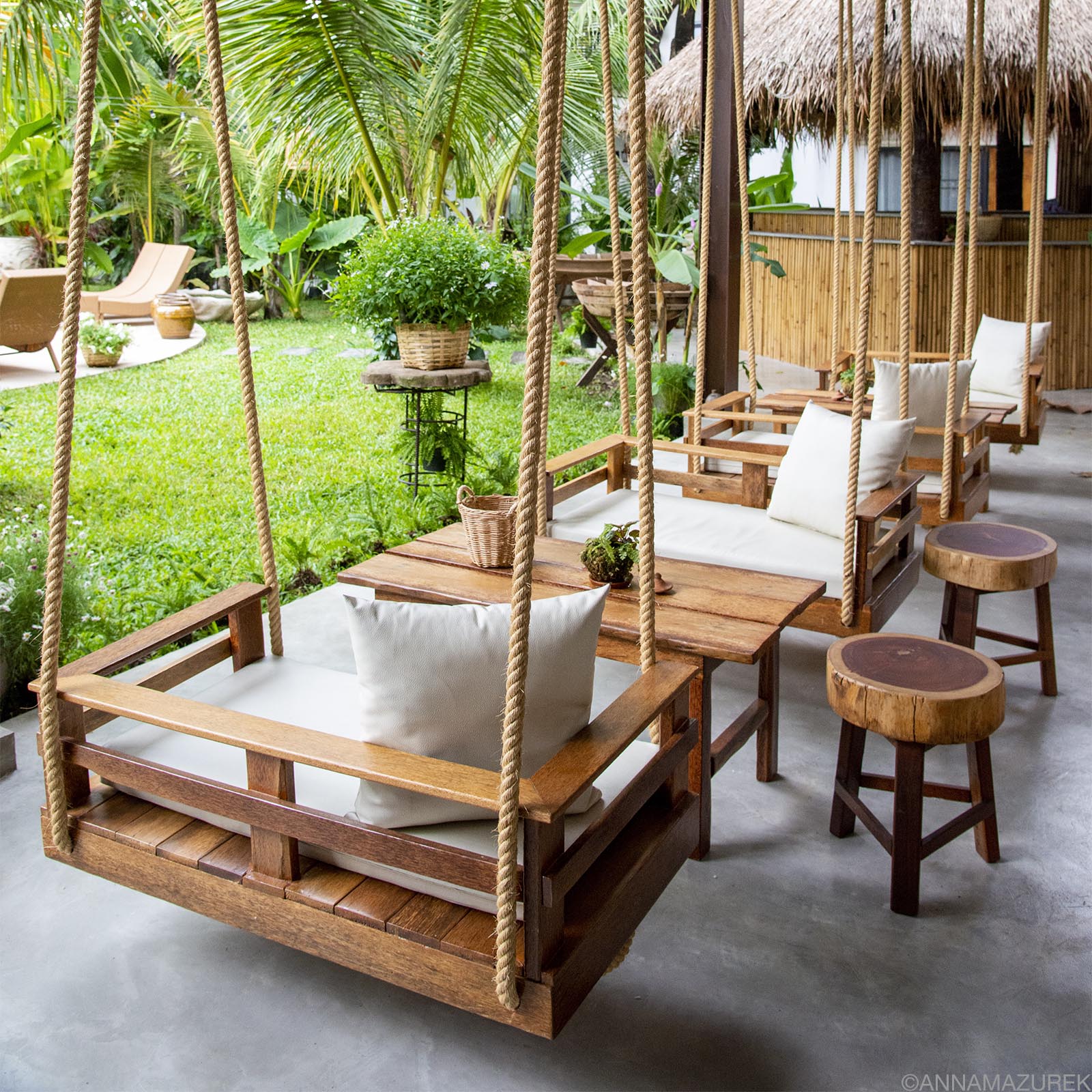 The Coco Club cowrking in Chiang Mai, Thailand.
There’s new coworking spaces opening all the time, and it’s best to choose a place based on where you live. Cafes are always a great backup option. I’ve always gone to Punspace, which has only two locations in old town because their Nimman branch closed during the pandemic. (Wiang Kaew is the most social of the two branches.)
In Nimman, there is Yellow, a large space that’s always packed, and the newest addition is OpenHub near Maya Mall is great for coworking and private offices. Another popular workspace is CAMP, a cafe in Maya Mall, that’s open 8 a.m. to midnight.
Other options include Hub53 (offers unlimited and hourly plans) and the Bali-style luxury of The Coco Club offering day passes and a swanky pool!
Car & Motorbike Rentals in Chiang Mai
Motorbikes can be rented just about anywhere in town for roughly 200 baht/day ($6.60 USD). There’s several places along Huay Kaew Road.
SAFETY ALERT: If you don’t have a Thai license or an international motorcycle license, most travel insurance companies will NOT cover you if there’s an accident. The police also set up regular check points around the city and fines are 500 baht ($16.50 USD) if you don’t have a proper license.
I’ve rented a car from Budgetcatcher Car and Scooter Rental in Nimman and had a great experience. It was roughly $30/day for a car.
Where’s the best place to buy an eSIM card
in Chiang Mai?
The easiest thing to do is buy a Thailand specific eSIM card from Airalo that will work instantly when you arrive. If you are traveling to multiple countries in Southeast Asia on a short trip, then consider one of their Asia Regional eSIM cards. (Both the country-specific and regional eSIMs have worked wonderfully for me and even have a mobile hotspot option that’s critical for me because I’m always working remotely.) Keep in mind it’s always cheaper to buy a country specific eSIM than a regional one. For more details, read my Airalo review for Southeast Asia.
Be sure to join the free Airalo Loyalty Program to earn 5% cash back for every purchase, which can be redeemed on future purchases. For more about eSIM cards, check out this post!! Airalo Promo Codes: New customers save 15% off with NEWTOAIRALO15 and existing users save 10% with AIRALOESIM10.
If you’re going to be traveling in Thailand for while, then buying a local SIM or eSIM when you arrive will offer the best value and maximum data. The main carriers are AIS, DTAC and TrueMove. I’ve always used AIS so that’s my preference since coverage is good everywhere I’ve been in the country. You have to show your passport to get a SIM card, which is pretty common in most countries. It’s always more expensive to buy it at the airport.
When I arrived in Thailand, I bought a 30-day plan with 6 GB from AIS in airport for $19 USD. When I topped it up at the AIS in Maya Mall, they offered me a new sim card with a better plan with unlimited data for $8.28 USD. You can top up at machines at 7Elevens or at the retail stores for all the main carriers.
The Best Gyms in Chiang Mai
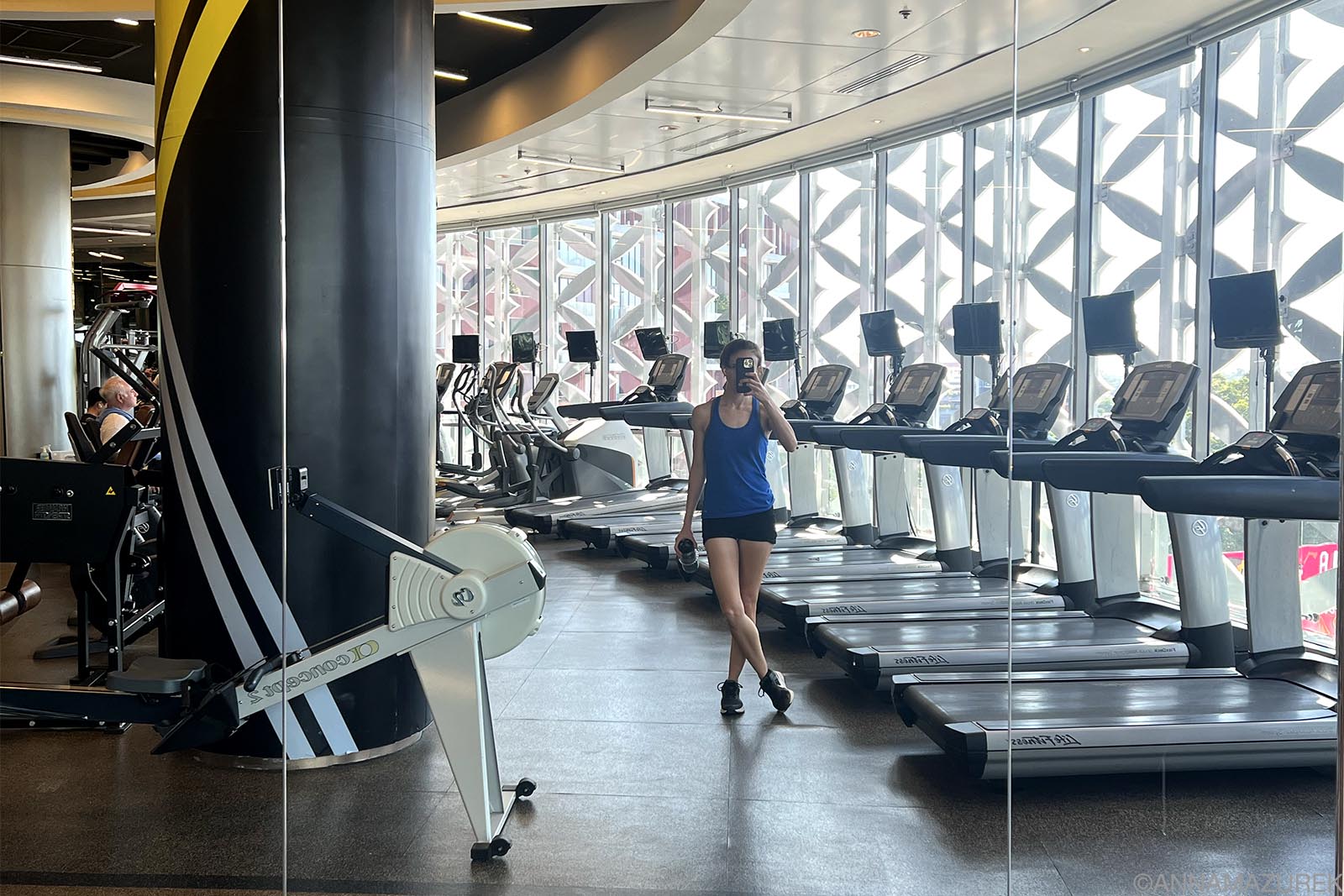 Maxx Fitness at Maya Mall
These gyms are located around the Nimman area and I’ve tried them all! (I am picky about gyms when it comes to equipment and air conditioning.) Prices can change frequently so be sure to check with the gyms directly!
Maxx Fitness – This is the nicest gym in the Nimman area and the priciest. It’s located in the Maya Mall and has excellent air circulation and climate control. The equipment is all new and classes are offered. The monthly membership fee is 1,699 baht ($50 USD).
Jett Fitness – This chain gym is located in the One Nimman shopping complex. It’s actually a fairly small and awkward space, so I decided to stick to Maxx Fitness instead. They have a good amount of equipment, but Maxx is still best in my opinion.
Playground Fitness Chiang Mai – When this gym opened, I initially didn’t like it because it was a small space, and the main floor area was used for classes in the mornings and evenings. It’s moved to a new space, so perhaps things are better. Monthly memberships start at 2,000 baht/ $64 USD. Sai 26 Road Suthep.
Harris Fitness Center – This is one of the most budget options in town located in the Lotus Hotel. It’s a cramped space with older equipment but lots of options. Classes are also included for free. The staff is really friendly. It doesn’t have great airflow or a/c. Rates are 1,250 baht/month ($42 USD) and 600 baht weekly ($20). 21 Huaykaew Rd.
Gold Hillside Gym & Fitness – (1,100 baht/$37 USD month) This gym is located in the bottom of Hillside Condo 3. It’s a nice-sized space but a bit dated. It’s got good airflow but just didn’t have the equipment I wanted. 50 Huaykaew Rd.
The Wall Fitness & Studio – (1,000 baht/$30 USD month or 100 baht/$3 USD day) This new modern gym is located behind the Maya Mall. It’s a large space filled with lots of equipment. Daily and monthly passes are available. (This is the only one I haven’t tried yet because I just love Maxx so much.) 49/22 Huay Kaew Rd.
Vira Yoga Studio – My friend Wee has a great yoga studio that I recommend. Class schedules can be found online. He also teaches the 8:30 a.m. class Maxx Fitness on Wednesdays, too.
Best Muay Thai Gyms in Chiang Mai

There is a Muay Thai gym in every corner of the city, but I love Heavy Hit Boxing Gym located southeast of the city. This gym is only pad work and by appointment only (1.5 hours, 350 baht), so it feels like more one-on-one training. There’s never more than a handful of people here. I feel like there’s more individual instruction here to help me improve my form. I’d recommend Heavy Hit first if you’re new to Muay Thai. Book via Facebook or Line.
Bear Fight Club Chiang Mai is another spot I frequent because I like the trainers. (They just moved to a bigger location south of town.) Classes are roughly 2.5 hours and 400 baht. It’s the most intense and also the most crowded, which is intimidating if you’re new. It can get too crowded for me, so I will only go early on weekdays. If you want to train to fight, this is the spot. (I haven’t tried the new location yet but I bet it’s bigger!)
The other option I’ve tired is Chiang Mai Muay Thai, which has the most frequent class times. Classes are shorter (1.5 hours) for 390 baht. It’s located in the old city and can also get slammed with people.
Chiang Mai Medical Care & Insurance
 SafetyWing travel medical insurance covers Thailand and over 180 countries
Do you need travel medical insurance for Chiang Mai?
Yes, travel medical insurance is one of the most important things to purchase for any trip abroad, especially to Thailand. It covers everything that could go wrong, from injuries to travel delays, so that you don’t have to worry and can focus on traveling!
When I’m in Chiang Mai, I always buy SafetyWing’s Nomad Essential Insurance policy. It offers $0 deductible travel medical insurance coverage for only a few dollars a day! If you get sick or injured abroad, you can visit any hospital or doctor.
In addition to SafetyWing, I have a global health insurance policy through Cigna Global using Chiang Mai as my base. The policy covers my routine care for an annual physical but has a high deductible for anything else, which is why I also buy a SafetyWing policy in addition to it. I dig into the details in my Why I Go Abroad for Health Care post.
Other benefits of SafetyWing Nomad Insurance include coverage for lost checked luggage, travel delays over 12 hours, motor accidents (if properly licensed, wearing all safety equipment and not intoxicated) and injuries from sports or leisure activities. You can even add adventure sports, electronics theft and U.S. coverage (for non-residents) to your policy. I love that their customer support lets you talk with a REAL human 24/7.
For more details, read my review of my experience with SafetyWing’s medical coverage and travel delay benefits.
Where to get Medical Care in Chiang Mai
The medical care in Thailand’s private hospitals is FANTASTIC, efficient and affordable. In Chiang Mai, Chiang Mai RAM near the old city and Bangkok Hospital Chiang Mai near Central Festival mall are the two main hospitals.
I’ve been to Bangkok Hospital many times and the facilities are really nice. (I get all of my routine annual health checks done in Thailand every year, which I’ve written about in this blog post with a full cost breakdown. I even get travel vaccines in Thailand because it’s easier and cheaper than the U.S.)
For medicine, Dara Pharmacy near Central Festival Mall will have any medication you need and it will be at least half the price of Bangkok Hospital. The British drugstore chains of Watson’s and Boots are also great but don’t always have every medicine.
Where to get a haircut in Chiang Mai
While there’s plenty of places around to get a haircut, I like New York New York in Nimman. It’s an Aveda salon, and they do a good job. (I’ve had so many terrible haircuts abroad that I’m really picky about places since I have short hair!) Prices range from 550-850 baht ($18-28 USD) for a wash and cut.
Pros & Cons of eSIM Cards for Travel
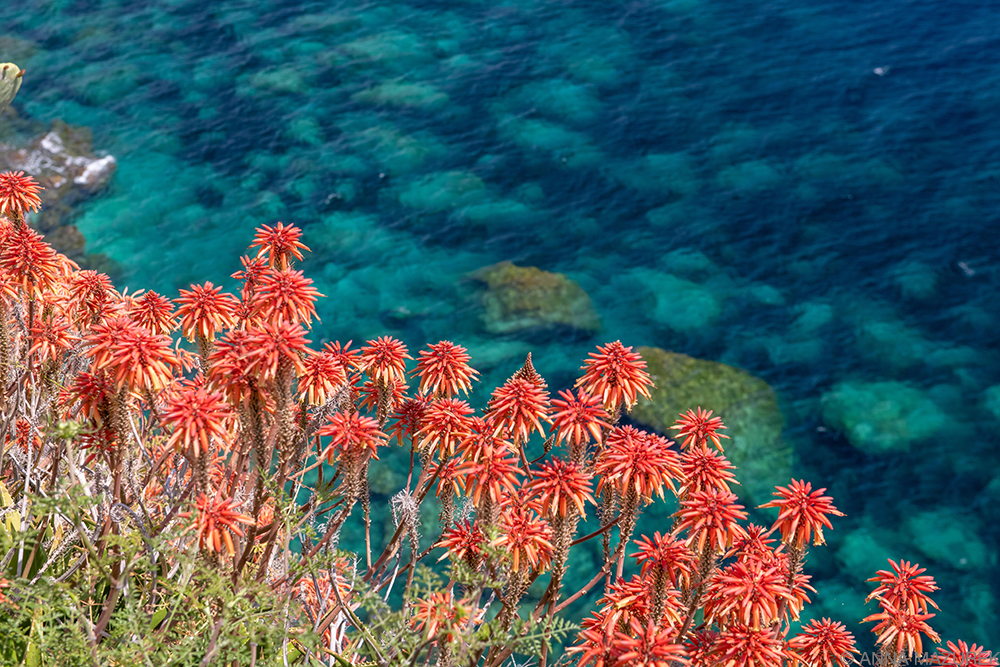
Bonifacio, Corsica // I used an EU SIM card I bought in Italy for a trip to three different countries in the Mediterranean with success.
This post was originally published in May 2023 and is updated frequently. Last update October 22, 2026.
Since I travel full-time, my biggest travel pet peeve is finding affordable cellular data plans abroad. Historically, I’ve always bought local SIM cards because they are significantly cheaper than paying $12/day for my U.S. plan with Verizon to work abroad.
When Apple removed SIM card slots from the iPhone, I had no choice but to reluctantly switch to eSIM cards. For a while, I traveled with my old iPhone 13 as a backup in case I had to buy a physical SIM card. Now, eSIMs have become my lifeline.
I’ve spent the last three years researching and testing eSIM cards across the globe, from Southeast Asia to Southern Africa. Keep reading for more details about eSIM cards for international travel, along with eSIM discount codes to cut costs!
Affiliate links are used in this post. If you make a purchase, I earn a small commission at no cost to you, which goes toward blog maintenance costs. I only recommend products and companies I truly love and use.
In this Post
What are the cons of an eSIM card for travel?
How much mobile data do you need for travel?
Do eSIMs offer unlimited data?
Are eSIMs cheaper than SIM cards for travel?
Do eSIMs work in the U.S. for travel?
Do eSIMs support personal hotspots?
Are eSIMs safe? Are there privacy concerns with eSIMs?
What is the best eSIM card for international travel?
How much does an eSIM card cost for iPhone?
How to check which network your eSIM uses
Do eSIM brands have loyalty or cash-back programs?
What is an eSim card?
An eSIM card is essentially a digital SIM card included in many newer phones. (Apple nixed the SIM card tray on U.S. models with the iPhone 14, so eSIMs are the only option for those models and newer ones going forward.) It makes things more convenient since people no longer have to go to a store to get a physical SIM card and find a tool or paper clip to open the SIM tray! The main benefit of an eSIM card is that it can work in multiple countries, so it eliminates the hassle of buying multiple SIM cards. Plus, it’s much cheaper than paying for an international plan through a U.S. carrier.
Apple made the iPhone 17 eSIM-only in 12 countries, including the U.S., Canada and Japan. In parts of Asia, iPhones with physical SIM trays are still available, but AppleCare doesn’t cover theft on models bought abroad
What are the cons of an eSIM card for travel?
The cons of eSIM cards are that they can be tricker to activate and aren’t compatible with all phones or phone plans. I initially had issues with my previous iPhone 13 Pro (locked by Verizon) but never had problems with the iPhone 15 or 17 Pro models. Now, most eSIM apps will tell you if your phone is compatible before purchasing.
The biggest problem with eSIM cards is that they don’t have coverage in remote parts of the world. Options are either limited or very expensive. I struggled to find an affordable eSIM card for a trip to Laos in Southeast Asia last year but was able to buy a cheap one from a local provider at the airport with no issues. I had similar issues in Namibia and Zimbabwe.
Also, learn from my mistakes: If you’re buying a regional or global eSIM card, be sure to check that every country on your trip is covered by your plan.
Honest eSIM Reviews for Travel
Since I travel fulltime, I constantly test eSIMs across the globe. Here are my reviews:
- Airalo eSIM Reviews for Southeast Asia, Europe and Africa.
- Saily eSIM Review for Southeast Asia and Europe.
- Truely eSIM Review for Southeast Asia.
- GigSky eSIM Review for Southeast Asia.
- Holafly eSIM Review for the United States.
How do I get an eSIM card?
To set up an eSIM card on your phone:
1. Download the app on your phone from any of the eSIM card brands, including Airalo, Saily, Nomad eSIM, GigSky, or Truely. (I have successfully tested each of these brands.)
2. Choose and purchase a global, regional or local eSIM card, depending on your needs. (The apps will even tell you right away if your phone is compatible before purchasing!)
3. Follow the on-screen instructions to install, which I recommend doing before leaving for your trip.
4. In the cellular settings on your phone, make sure the eSIM card is selected for cellular data.
Important Note: The plan will not activate until you arrive in the destination. If it doesn’t connect automatically, toggle Airplane mode on and off.
 Sarandë, Albania // A Europe regional eSIM made it easy to hop between the E.U. countries of Greece and Croatia and the non-E.U. nations of Albania and Montenegro. Previously, physical SIM cards would not work in the non-E.U. countries. For more details, read my Airalo Europe eSIM review.
How much mobile data do you need for travel?
For a one- or two-week trip, I usually start with a five or 10 GB plan. For a long weekend, I’ll buy the cheapest but prefer to have at least three gigs.
To make the most of your data, turn off cellular data for social media apps like Instagram and watch your hotspot usage. There are times when 10 GB lasts me an entire month and others where my hotspot usage drains it in a week. I always use Wi-Fi for downloading offline maps and large files to save my data for when I’m out exploring.
Most eSIM brands will let you buy top-ups in advance, which I do for safety. If I don’t use it, I simply ask for a refund. Lately, I’ve been using unlimited data plans.
Do eSIMs offer unlimited data?
Yes, there are several eSIM companies that offer an unlimited data option, but read the fine print. The word “unlimited” is deceptive because there’s always a “fair use” data limit, where you get a set amount of high-speed data (usually 3-5GB) per day. After that, data speeds are throttled, which makes sense. This also really affects hotspot users. I’ve seen brands that cap hotspot data at only half a gig a day, which is insane.
Most unlimited plans are more customizable allowing you to pick exactly the number of days you need but are always more expensive that plans with set data limits. While these are more expensive, unlimited plans remove the stress of worrying about data.
Currently, Airalo, Saily, Nomad eSIM, GigSky, and Truely offer unlimited data plans in certain parts of the world, while Holafly specializes solely in unlimited plans worldwide.
Are eSIMs cheaper than physical SIM cards for travel?
It depends. While eSIMs for travel are cheaper than paying for a U.S. international plan, they are not cheaper than buying a local physical SIM card in most places.
For most eSIM brands, it costs $16-20 USD for 5GB in various regions of the world, which is a good deal and more convenient if you’re country-hopping. If you’re staying in one place long-term, it’s still cheaper to buy a local SIM card. In Thailand, I pay roughly $10/month for an unlimited plan and in Laos, I paid $4 for 30 GB a few months ago buying directly from a local network because I’ve yet to find an eSIM with strong service there.
Always avoid buying SIMs or eSIMs in an airport—everything is usually half-price outside the airport! I’ve found physical SIM cards to be slightly less expensive than an eSIM, but most phones don’t have this option anymore, so eSIMs are often the only option.
The Best eSIM Discount Codes
- Airalo: New customers get 15% off with NEWTOAIRALO15. Existing users save 10% with AIRALOESIM10.
- Saily: Use code ANNA10 for a 10% discount.
- GigSky: Free 15-day plans and up to 30% off all plans for select Visa card holders in the U.S., Canada & Latin America.
- Truely: Use ANNA15 for 15% off all plans, including unlimited data.
- Holafly: Use TravelLikeAnna to save 5% on an eSIM or 10% on a subscription.
Do eSIMs work in the U.S. for travel?
Yes, eSIM cards work in the U.S. for travel. Nearly, every major eSIM card company has plans in the U.S., which are great for people traveling in the U.S. or expats returning for a short stint.
I occasionally run out of data on my pay-as-you-go Verizon plan right before a trip abroad, so I’ll use an eSIM for a few days to get by. This summer, I tested Holafly for 45 days in eight states. In order to use my Verizon number for calls and simultaneously use the eSIM data, I had to turn on cellular data switching.
Do eSIMs support personal hotspots?
The short answer is yes, eSIMs support personal hotspots but not all do! This is a dealbreaker for me because I work while I’m traveling and most of the time, I find that WiFi networks are terrible. I rely heavily on my personal hotspot for WiFi on my computer for Zoom calls.
I’ve had great success using my personal hotspot with both country-specific and regional Airalo eSIMs in Asia recently in Japan, Korea and Southeast Asia. As long as the local carrier supports using a hotspot, then it should work. (I still travel with my old iPhone 13 Pro in remote areas as a backup in case I need to buy a physical SIM to hotspot but haven’t needed to use it.)
I’ve successfully been able to hotspot to my computer using plans from Airalo, Saily, Nomad eSIM, GigSky, and Truely
Are eSIMs safe? Are there privacy concerns with eSIMs?
eSIM are as safe any doing anything on the internet. eSIM providers require you to use their app to activate and use the service, which means you can be tracked. Apple users should turn on the “ask app not to track” setting to avoid this. I’m sure Android devices have a similar setting. In some ways, eSIMs are safer.
If your phone is stolen, you can easily switch the service off your phone to prevent your number from being stolen. If you’re really concerned, you can also use a VPN for added security. (Saily eSIM cards actually include a virtual location feature.) I personally use NordVPN, which is the company that owns Saily, as my VPN for my phone and Mac for traveling. For more about VPNs, check out my post about two-step verification and traveling.
 On a two-month trip to Africa, I used Airalo’s plans in South Africa and Botswana seamlessly, which I wrote about in this detailed review.
What is the best eSIM card for international travel?
All eSIM brands have a similar pricing structure, but eSIM cards are only as good as the local partner network. And, networks on regional packages might differ from those used by local country-specific packages.
Research which brand partners with the strongest network in the location you are visiting. (For remote locations like Laos and Namibia, you’re better off going with a local company from my experience. Buy one when you arrive.)
Airalo is the world’s oldest eSIM store with one of the widest variety of plan options, while Saily adds built-in security features including virtual location. I’ve had great experiences with both. Gigsky offers great discounts with select VISA cards, while Truely offers seamless connectivity and the option to pause plans. If you decide to purchase these brands, use the discount codes in the next section.
Other brands include Holafly, Flexiroam and Nomad eSIM. Apple also has a comprehensive webpage with a list of wireless carriers worldwide that offer eSIM services.
How much does an eSIM card cost for iPhone?
eSIM card plans start as low as $4 USD. While pricing is often consistent between brands, certain companies will have a larger variety of plan options than others. Europe or Southeast Asia will always be cheaper than Africa.
Seven-day plans start around $4 USD for Europe, the U.S. and Asia, while five-day unlimited data plans start around $18.99 USD. Pricing varies based on duration (usually three to 60 days) and data limits (1GB to unlimited).
Save money with these eSIM discount codes:
- Airalo: New customers get 15% off with NEWTOAIRALO15. Existing users save 10% with AIRALOESIM10.
- Saily: Use code ANNA10 for a 10% discount.
- GigSky: Free 15-day plans and up to 30% off all plans for select Visa card holders in the U.S., Canada & Latin America.
- Truely: Use ANNA15 for 15% off all plans, including unlimited data.
- Holafly: Use TravelLikeAnna to save 5% on an eSIM or 10% on a subscription
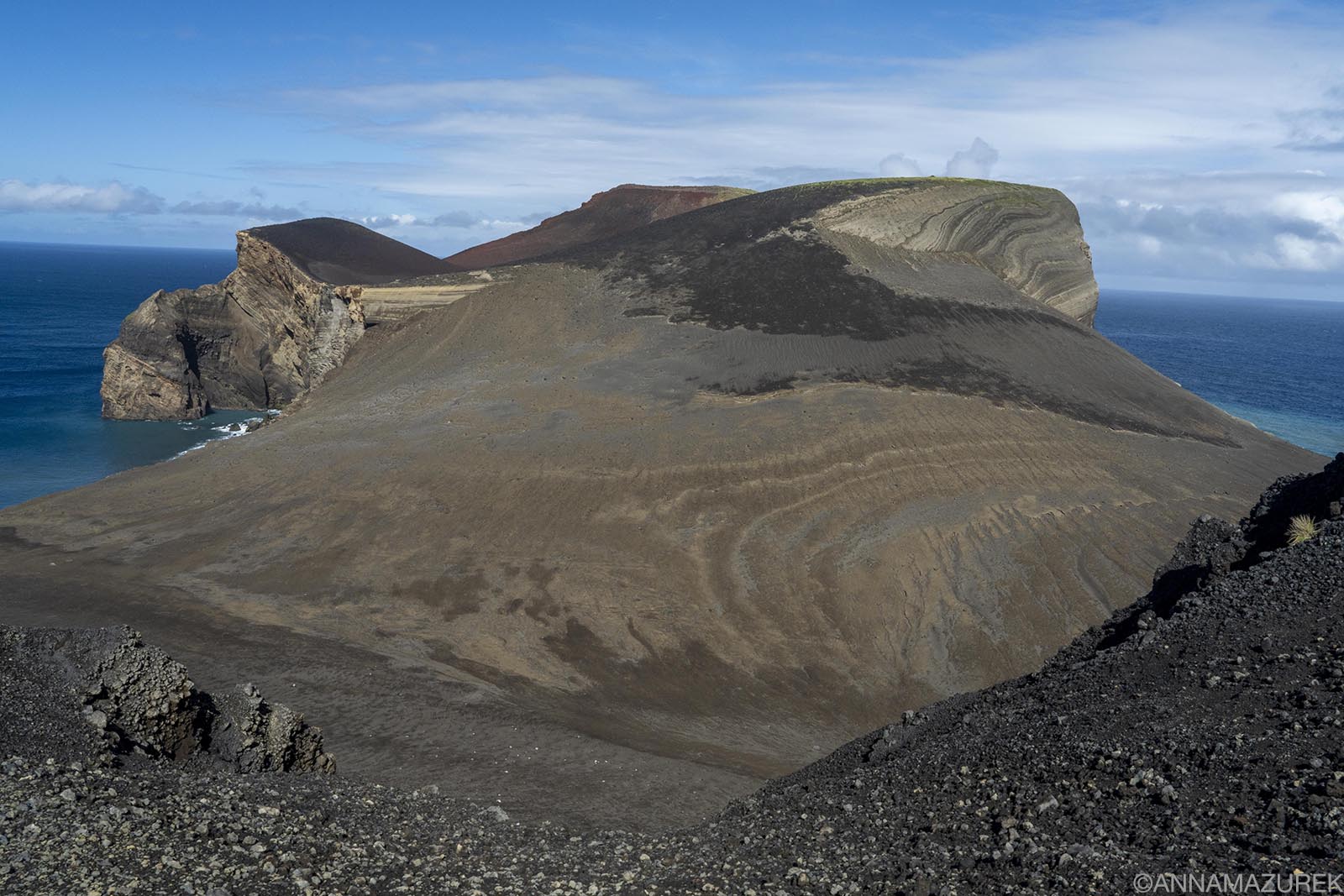 Faial Island, Azores. I’ve tested both Saily and Airalo in the Azores with great success on the NOS network, which is a strong network in the region. Both worked well on Faial island above.
How to check which network your eSIM uses
The key to eSIM card performance is the strength of the local mobile network. If you want to know the best network for a country, ask a local or email your accommodation to ask what they recommend. (If you are traveling to Vietnam, Viettel is the best network, so don’t waste your time on anything else.)
Most brands list the network online (Airalo is good at this), so you can usually check before buying. Lately, I’m seeing brands skip the network name because the eSIM switches between multiple based on signal strength. If it’s not listed, I always contact the eSIM’s support team to find out. Once your eSIM card connects, the network name appears in the top left corner of your screen. Some brands mask this to only show their own name, which is annoying.
If you are traveling in a developed area or honestly anywhere in Europe, most networks should provide good coverage. Network choice matters the most in remote areas, like my Namibia road trip last year, or when you are going off the grid like I often do.
Do eSIM brands have loyalty programs or cash-back rewards?
Nearly, every eSIM brand has a loyalty program as an incentive. Most are cash-back systems but some offer points that are redeemable for discounts. There are also discounts for referring friends.
The only negative side to loyalty programs is that you usually can’t pair discount codes with loyalty programs. I find it’s a better deal to use the 10% discount codes for every purchase than earning a lesser amount on the loyalty programs. (I use my own discount codes for purchases and don’t bother with loyalty programs.)
Which eSIM brands offer student discounts?
Several eSIM brands offer student discounts through third-party verification platforms, such as StudentBeans and MyUnidays. Discounts range from 15% for new customers for Airalo and Saily to 25% of Nomad eSIM for the first 10 purchases.
You don’t have to be a student to use my discount codes to save 10-15% with no limit on the number of purchases. From my experience, using these discount codes upfront is a better value than paying full price to earn rewards for future savings.
What I do for phone data when I travel long-term
Since Verizon’s international plan is outrageously expensive ($12/day!) and never worked for me, I use travel eSIM cards for the region I’m traveling. The only exception is in Thailand, where I spend a few months every winter, when I buy an eSIM directly from the local AIS network.
Final eSIM Takeaways
Overall, eSIMs are the future—ready or not. They are very convenient and cheaper than paying for an international plan for an American phone plan unless you have T-Mobile. Regional eSIM plans are excellent for short trips to multiple countries.
If you’re going to be traveling long-term in a country or region, I still think getting an eSIM or regular SIM card from a local cellular provider is a better deal, especially in places like Southeast Asia. After two months in Africa last year, I feel more confident about the availability of eSIMs for travel in remote locations.
Happy travels!
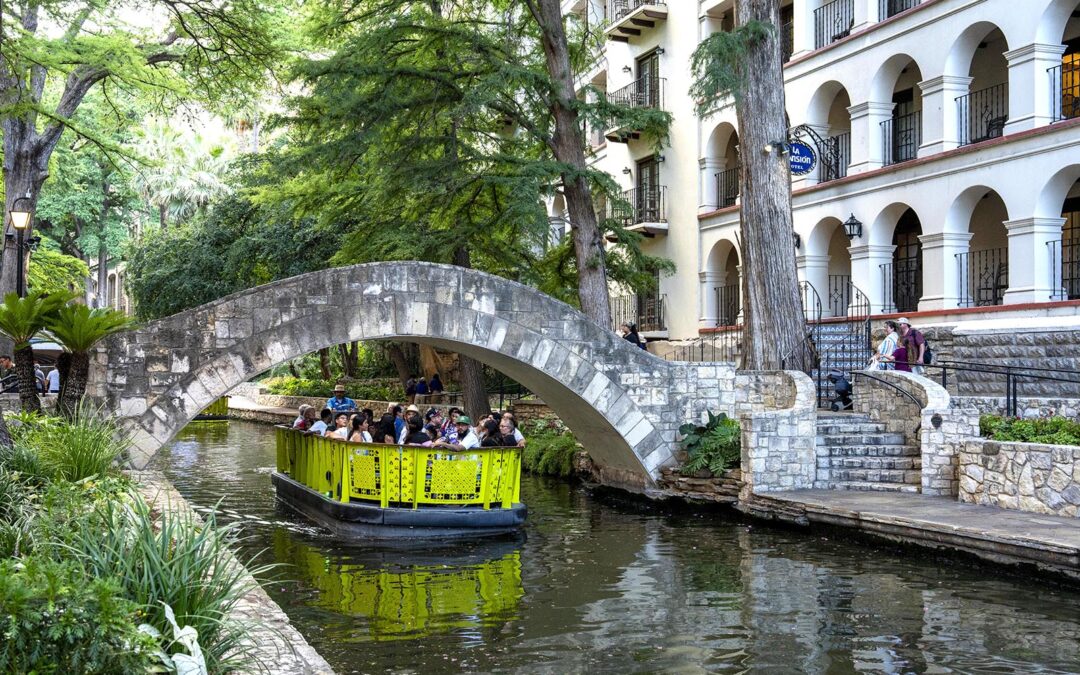
17 Best Things to Do in San Antonio, Texas, From a Local Travel Writer
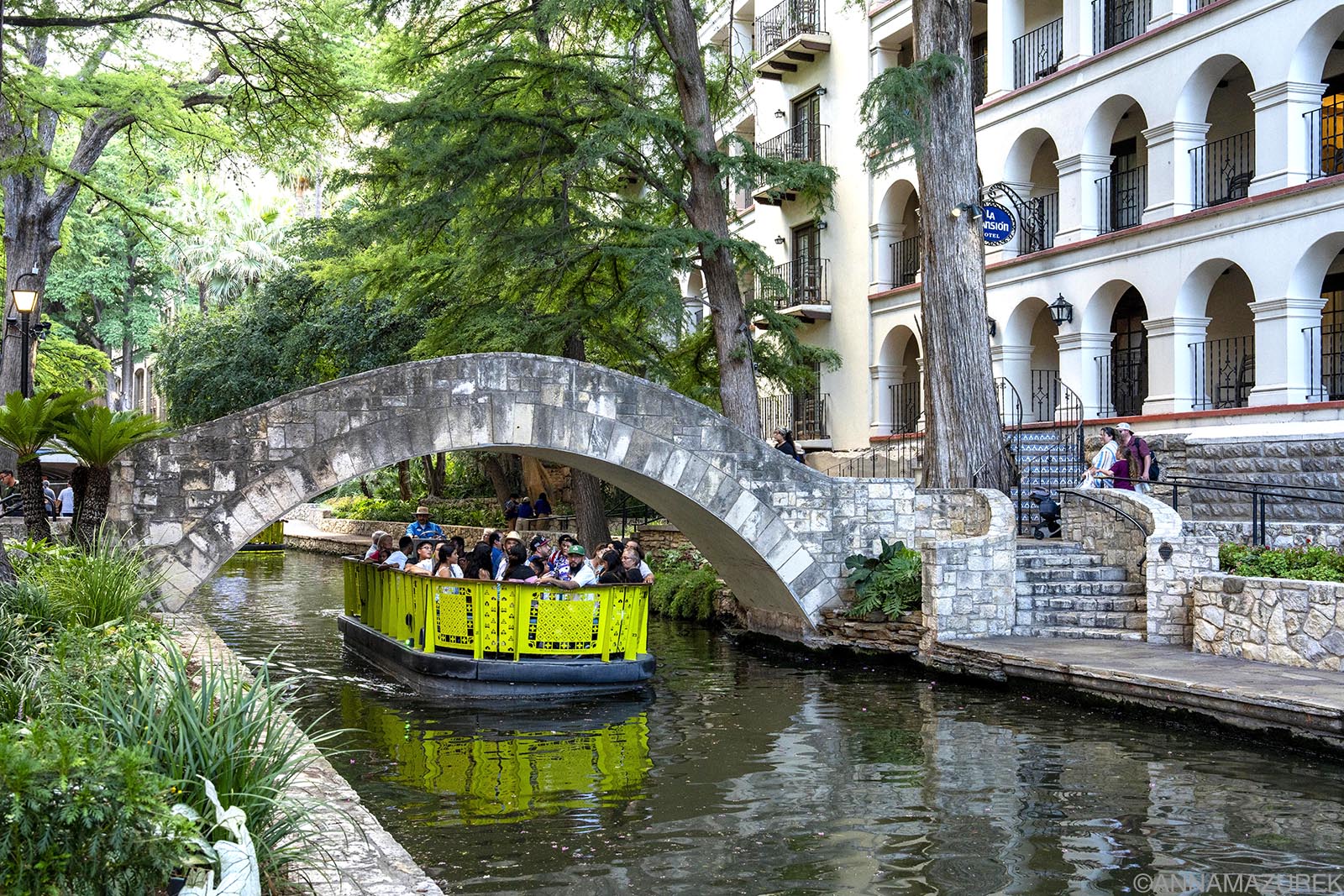 The best way to experience the San Antonio River Walk is a boat trip.
San Antonio, Texas is famous for two things: the Alamo and the scenic River Walk, but there’s much more to Texas’ second largest city. The culinary scene is top notch with three Michelin-rated restaurants and the largest food market in the Southwest.
As a Texas-based travel writer, it’s literally my job to write and photograph the coolest spots in the great state of Texas. I was never a fan of San Antonio for years until recently when I started seeking out lesser-visited spots with better parking. It’s easy to escape the crowds by biking or kayaking along the woodlands of the Mission Reach section of the River Walk or soak in natural thermal pools.
San Antonio’s proximity to Texas Hill Country makes it tempting to add a few days to your trip to sip wine or treat yourself to a spa day. For another day trip, check out my guide to Austin. If you’re heading to San Antonio for fun or work, keep reading for my list of all the best things to do in San Antonio, Texas.
Affiliate links are used in this post. If you make a purchase, I earn a small commission at no cost to you, which goes toward the cost of maintaining this blog.
1. The Alamo
 Each year 1.6 million people visit the Alamo in San Antonio.
Location: 300 Alamo Plaza, San Antonio, TX 78205 | Google Maps
Hours: 9 a.m. to 5:30 p.m.
Admission: Free with timed entry ticket
The Alamo is one of the top attractions in San Antonio and Texas. While it’s touristy and crowded, it is worth visiting due to the history. Original established as Mission San Antonio de Valero in 1718, the flags of five different nations have flown overhead. The Alamo was the site of the infamous and deadly battle in the fight for Texas’ independence in 1836.
Entry to the church is free with a timed-entry ticket. Both guided and self-guided audio tours are available for a fee. Parking near the Alamo and the River Walk is outrageous. The best flat-rate garages ($10!) I’ve found near the Alamo are the Houston Street Garage (5 minute walk) and the Convention Center Garage (10 minute walk). Pricing may change, so check before parking!
2. San Antonio Missions National Historic Park
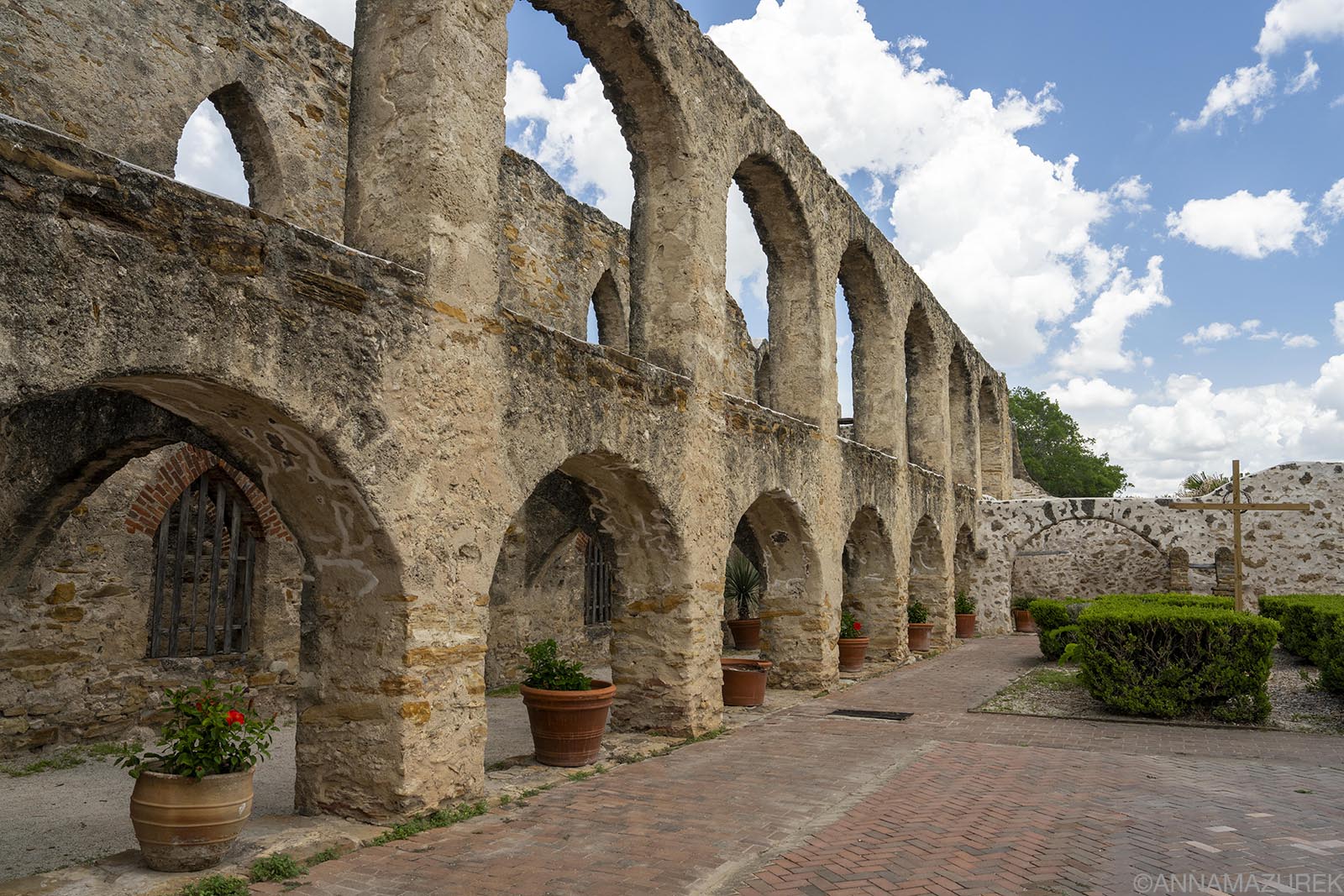 Mission San José is the most photogenic of San Antonio’s missions.
Location: 6701 San José Drive, San Antonio, Texas, 78214 | Google Maps (Mission San José & Park Visitor Center) |
Hours: 9 a.m. to 5 p.m. daily
Admission: Free
The San Antonio Missions National Historic Park is only UNESCO site in Texas, comprised of four Spanish Colonial missions built in the 1700s: Mission Concepcion, Mission San José, Mission San Juan, and Mission Espada. The expansive Mission San José (“Queen of the Missions” is my favorite to photograph. Visit on a Sunday for the 12 p.m. Mariachi Choir mass. (My first visit was on a Sunday, and it was one of the coolest experiences I’ve had in Texas.)
Four of the five missions are located on the lesser-visited southern portion of the River Walk, an eight-mile stretch known as Mission Reach. A hike-and-bike trail connects the Alamo and these four missions, which are each roughly 2.25 miles apart.
3. The San Antonio River Walk
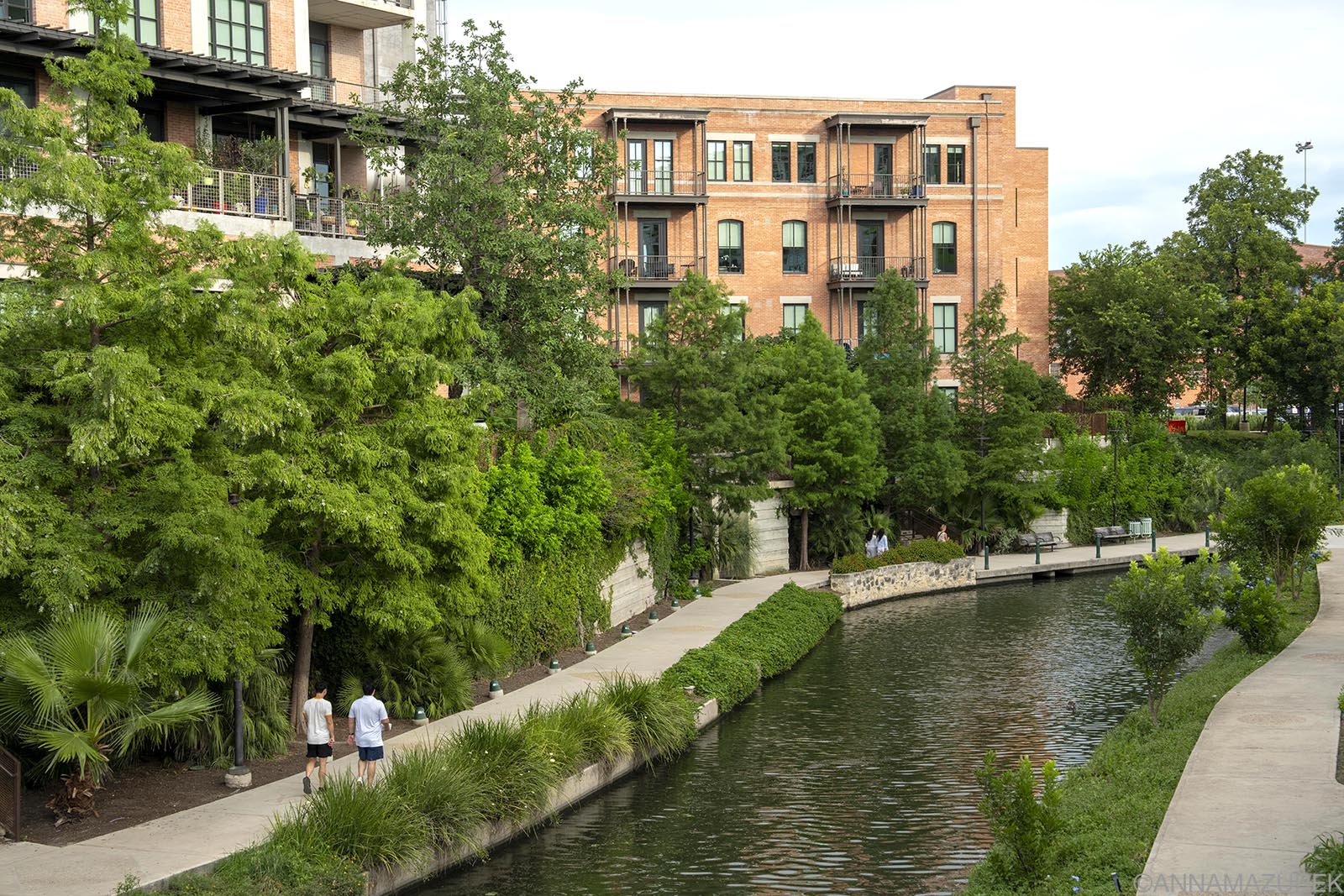 Museum Reach section of the River Walk at The Pearl District.
After the Alamo, the River Walk is one of San Antonio’s most known attractions. The paved pathway lines 15 miles of the San Antonio River and is divided into three sections from north to south: Museum Reach, Downtown Reach and Mission Reach.
The northern most section of the River Walk is Museum Reach, home to four museums in walking distance of the river. The San Antonio Museum of Art, a vast art collection housed in a historic brewery; The McNay Art Museum, a modern art museum set in a Spanish Colonial-Revival mansion; The Witte Museum, a science, natural history and culture institution; and The DoSeum, an interactive children’s museum. Museum Reach is the only section of the River Walk accessible by water taxi from downtown. It’s also home to The Pearl District and the 343-acre Brackenridge Park.
Downtown Reach, the loop around Market and Commerce Streets, is the oldest section of the River Walk and sees the most traffic. Hop on a colorful electric boat for a 35-minute narrated tour. The main attractions in this section are the Alamo, La Villita Historic Arts Village, HopScotch (20,000-square-foot interactive art gallery) and the “Selena” bridge that was featured in a movie about famed Tejano singer. The crowds thin once you wander north or south of this section.
Mission Reach encompasses the eight-mile section of a riparian woodland ecosystem that connects four of the Spanish missions. The lush landscape is ideal for walking, biking or kayaking. The Hot Wells of Bexar County, Ruby City and Villa Finale house museum are also located in this section.
4. Hot Wells of Bexar County
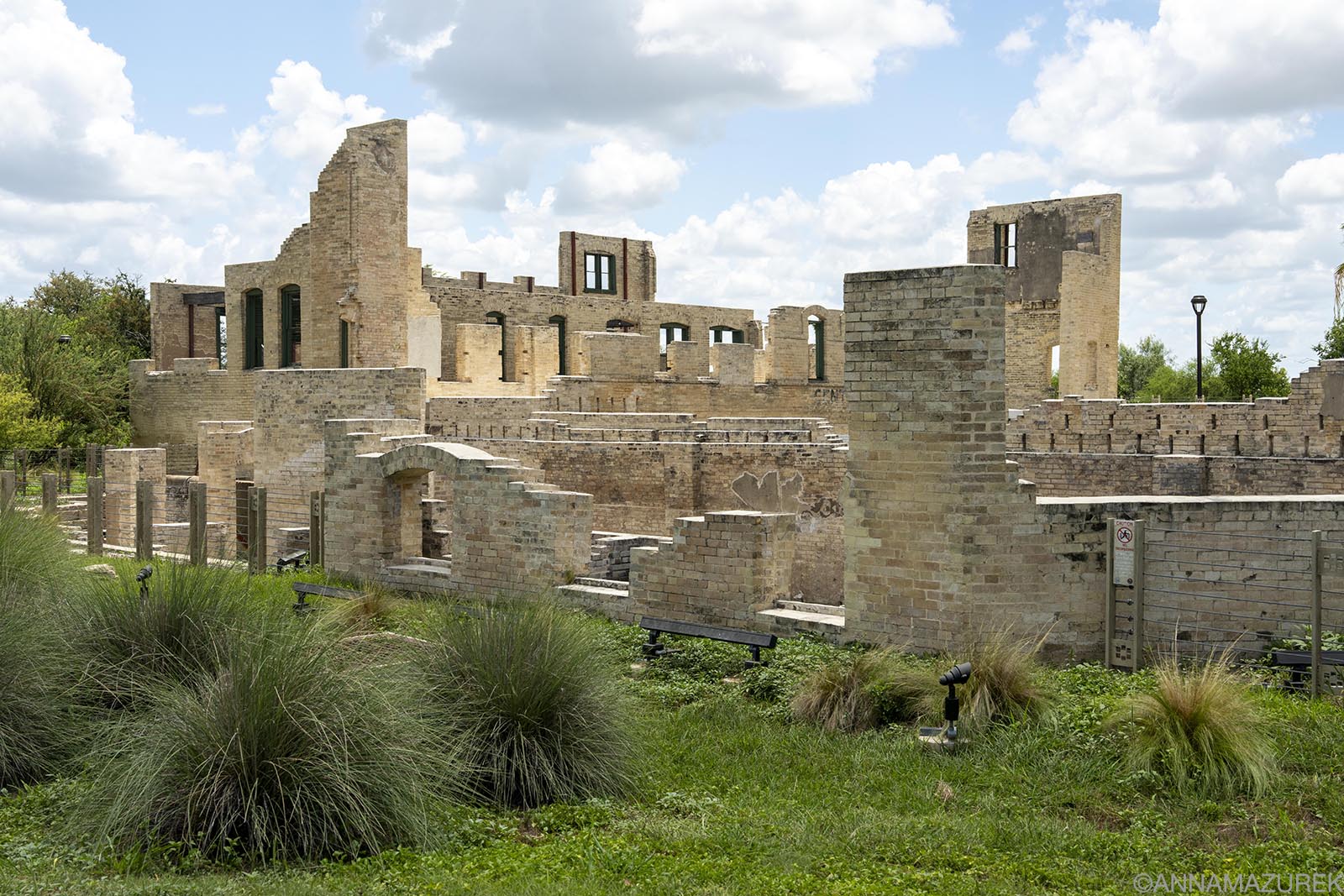 The Hot Wells of Bexar County are the ruins of an early 1900’s spa hotel.
Location: 5503 S. Presa St., San Antonio, TX 78223 | Google Maps
Hours: Summer 9 a.m. to 9 p.m.; Winter 9 am. to 6 pm.
Admission: Free
One of the most unique attractions along the southeastern portion of the River Walk are the ruins of the 1902 Hot Wells Hotel and Spa. Charlie Chaplin and Theodore Roosevelt are a just a few of celebrities who indulged in the resorts three swimming pools and 45-room bathhouse with solid porcelain tubs for relaxing in the thermal waters.
The hotel was abandoned after a series of fires and turned into the Hot Wells of Bexar County public park in 2019. While the ruins are fenced off and the well is plugged, a local non-profit, the Hot Wells Conservancy, and the county run events at the site. There is a public toilet on site at the adjacent Hot Wells Interpretive Center.
Book a soak next door at Camp Hot Wells, which offers two private open-air suites for soaking in thermal waters along with public hot foot soaks. Snacks and an extensive list of local craft beers are available.
5. BBQ Day Trip to Burnt Bean Co.
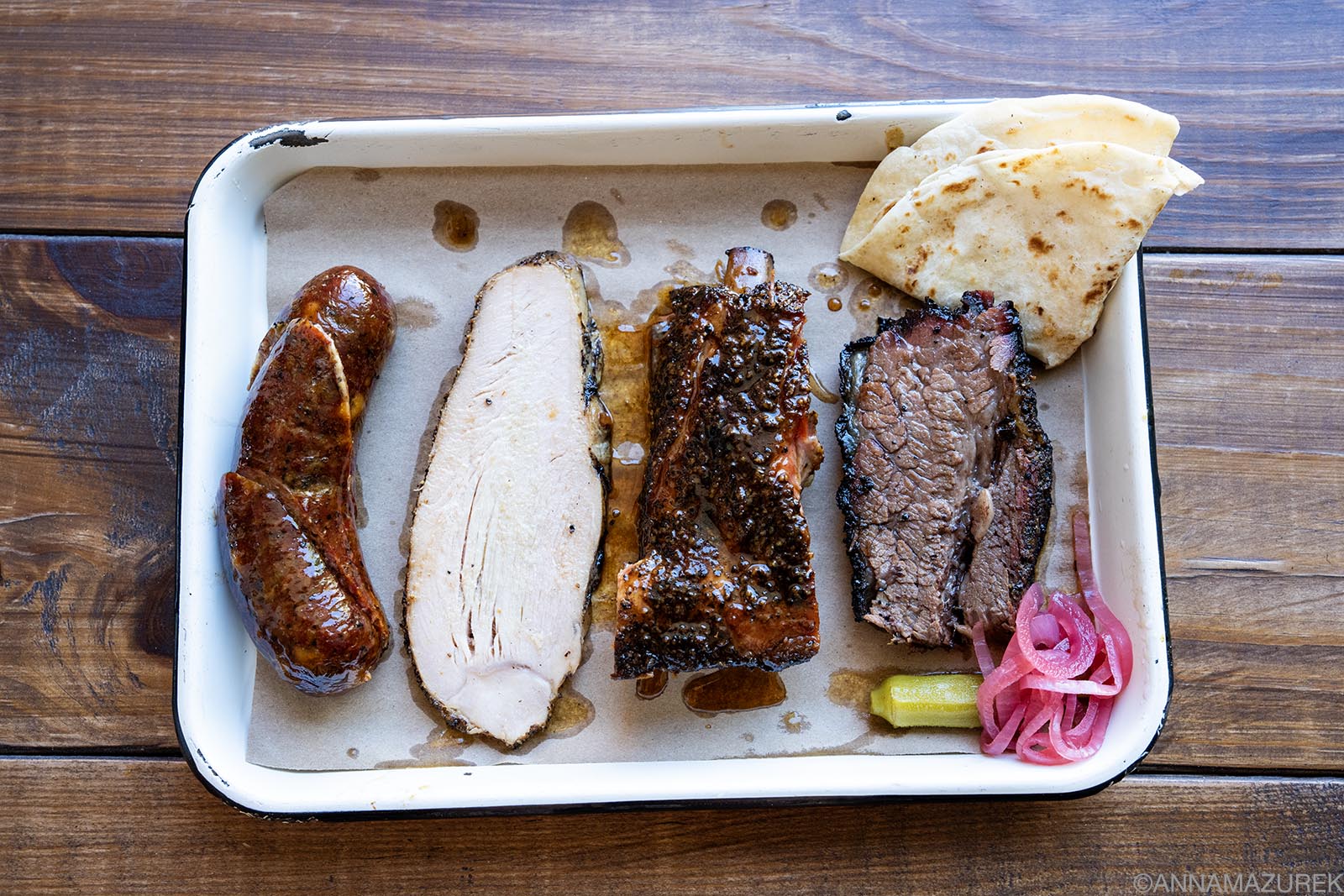 Burnt Bean Co. was rated the top barbecue joint in Texas in 2025 and is worth the drive.
Location: Seguin, Texas | Google Maps
Hours: Thursday to Saturday: 11 a.m. until 3 p.m.; Sunday 8 a.m. – 3 p.m. (or until they sell out!)
While San Antonio has great barbecue, it’s still worth a 45-minute morning trip to Seguin to sample the top rated barbecue joint in Texas: Burnt Bean Co. Pitmasters Ernest Servantes & David Kirkland cook up the Texas Trinity (brisket, sausage & pork ribs). The turkey is another highlight for me.
Don’t Miss the bourbon peach taco dessert, but save room for the banana pudding, too. It’s topped with a buñuelo (mini sopapilla) plunged into the whip cream with a layer of pecan sandies on the bottom! (I have high banana pudding standards, so this is saying a lot!) Arrive early, expect a queue and excellent service. Be sure to wander around the block to snap a photo of the world’s largest pecan.
6. Japanese Tea Garden
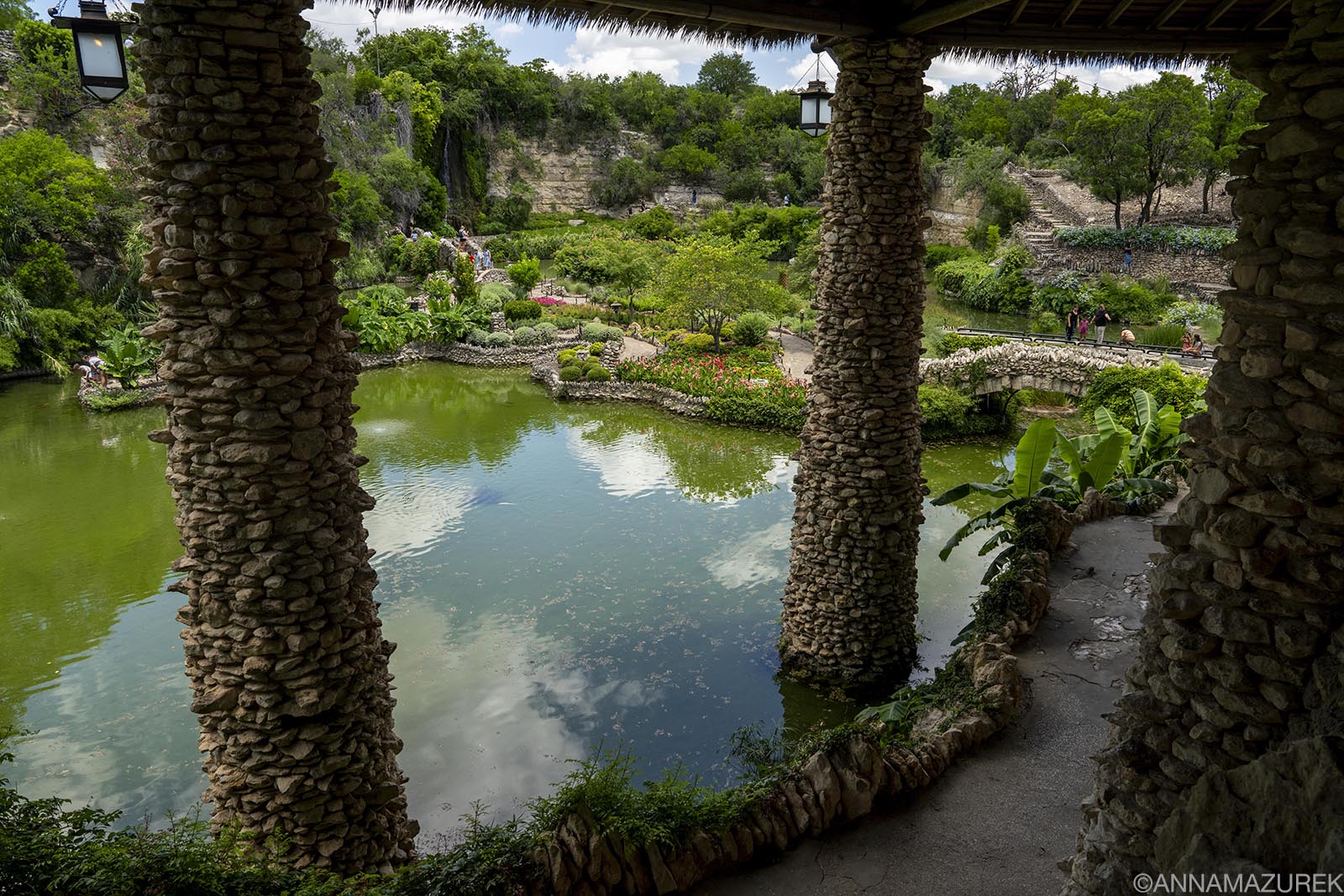 The Japanese Tea Garden at Brackenridge Park in San Antonio.
Location: 3853 N. St. Mary’s St., San Antonio, TX 78212 | Google Maps
Hours: 7 a.m. to 5 p.m. daily
Admission: Free
One of the best free things do to in San Antonio is the Japanese Tea Garden tucked into the western corner Brackenridge Park. The garden’s origins date back to the 1917 when an 11-acre lot next to an abandoned rock quarry was transformed into a lush oasis.
Residents donated the lily blubs for the pond while the lighting was provided by the City of San Antonio. Stroll down the shaded walkways along koi-filled ponds and a 60-foot waterfall or relax in the Japanese pavilion.
7. Buckhorn Saloon & The Texas Ranger Museum
Location: 318 E. Houston St., San Antonio TX 78205 | Google Maps
Hours: Museum (10 a.m. – 5 p.m.); Saloon (10 a.m. to 6 p.m.)
Entry: $22.99 for entry to both museums.
The antler-clad walls of the Buckhorn Saloon are a must-visit for a history lesson. In 1881, the saloon was opened by 17-year-old Albert Friedrich who started accepting horns and antlers as a payment for drinks, amassing an impressive trophy collection. The saloon later became the recruiting grounds for Teddy Roosevelt’s Rough Riders.
While the bar changed locations, the collection remains intact, and in 2006, The Texas Rangers Museum was added. The $22.99 entry fee includes access to the Buckhorn Museum and Texas Rangers Museum. Visitors can also pull up a chair, order a Prickly Pear Margarita and have a bite to eat in the saloon.
8. The Pearl District on the River Walk
 The Pearl is a dining, shopping and entertainment district in a former brewery complex along the River Walk.
Location: 303 Pearl Pkwy, San Antonio, TX 78215 | Google Maps
Hours: 5 a.m. to 12 a.m. daily; hours differ for shops and dining.
Admission: Free
The Pearl is a historic district built on the grounds of a 19-centry brewery compound along the Museum Reach section of the River Walk. The 23-acre outdoor complex includes a slew of shops, restaurants, a new 18-hole putt-putt course and a lively event calendar.
While there’s over 30 restaurants and bars in the 23-acre space, I’ve always enjoyed Freight Friend Chicken, Bakery Lorraine and the upscale dinner menu at the Michelin-listed Isidore, tucked inside Pullman Market. The Pearl’s newest dining edition is Santonia Cantina, a husband and wife team serving up blend of North Mexican and South Texas flavors, opening in November.
Want to stay the night? Snag one of the 146-rooms in the riverfront Hotel Emma. There’s a market every Saturday (local produce) and Sunday (crafts) from 9 a.m. to 1 p.m. and a seasonal Wednesday night market. Parking is free in surface lots Monday to Friday 8 a.m. to 3 p.m.
9. Pullman Market
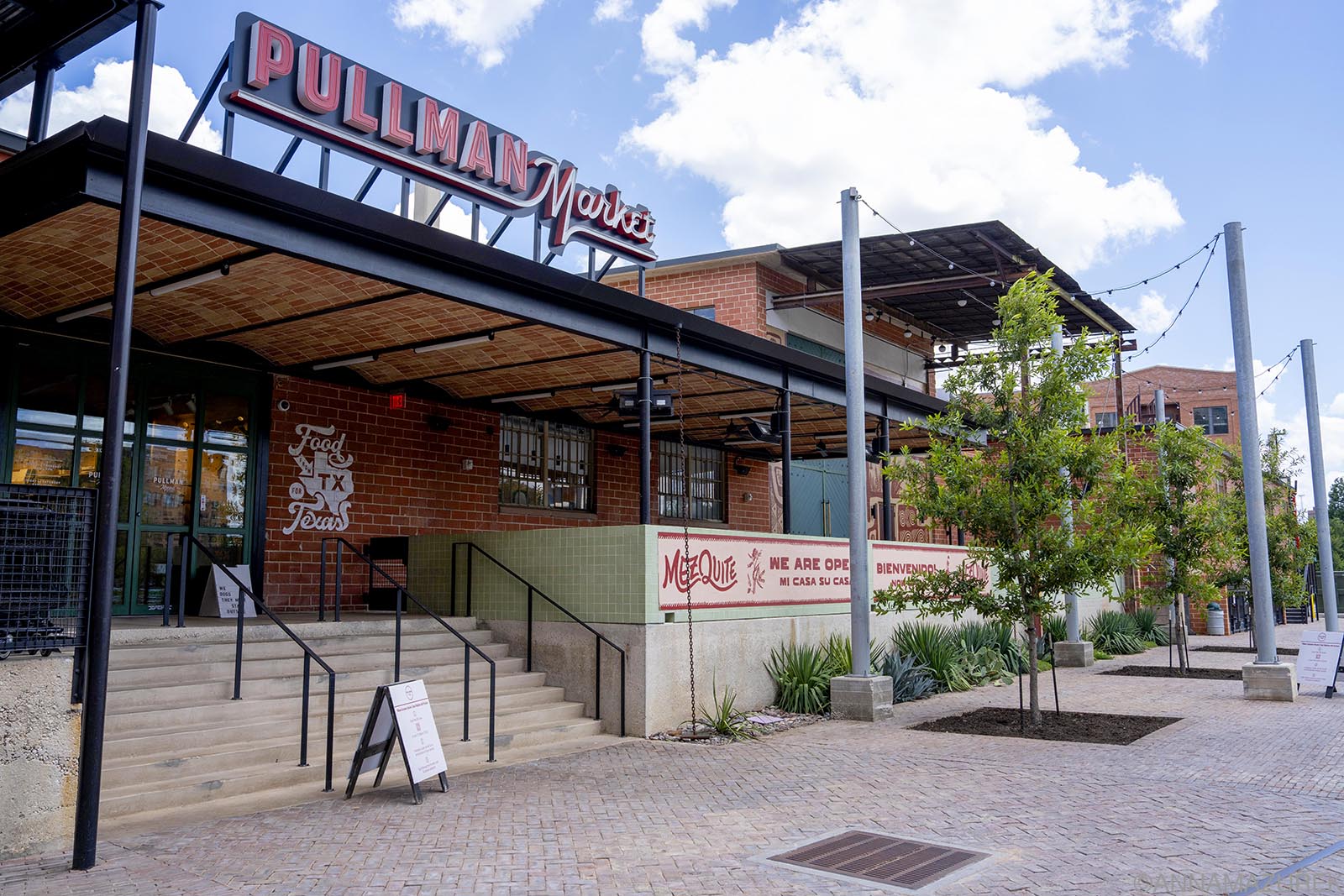 Pullman Market is one of the newest editions to The Pearl and the largest culinary market in the Southwest.
Location: 221 Newell Ave, San Antonio, TX 78215 | Google Maps
Hours: 8 a.m. to 9 p.m. daily
Admission: Free
Pullman Market has been a star attraction in The Pearl District since the food market opened in 2024. It is the largest culinary market in the Southwest and houses a specialty grocer along with quick eats and sit-down restaurants. ( Don’t miss the homemade tortilla stall!)
I personally loved the handmade pastas at Fife and Farro and seasonal Texas-sourced dinner menu at Isidore. Other highlights include Sonoran grilled meats from Mezquite and liberations from the agave-centered Mezcaleria. Save room for treats from the 20-seat desert bar, Nicosi. (Both Isidore and Nicosi are Michelin Guide listed!)
For free parking, use the lot on Newell Avenue and ask for parking validation.
10. San Antonio Museum of Art
 One of the highlights of the Asian art collection is the rare Medicine Buddha Sand Mandala on display at the San Antonio Art Museum.
Location: 200 West Jones Avenue, San Antonio, TX 78215 | Google Maps
Hours: Tuesday & Friday 10 a.m. to 7 p.m.; Wednesday, Saturday, Sunday 10 a.m. to 5 p.m.
Admission: Adults $24, Military/Seniors $19, Students $14
The former castle-like complex of the former Lone Star Brewery, originally built from 1895 to 1904, is home to the San Antonio Museum of Art. The museum opened in 1977 and houses a permanent collection of 300,000 items, including the eight-gallery Nelson A. Rockefeller Center for Latin American Art to an impressive Roman sculpture collection.
I really enjoyed the Asian art collection, which is largely comprised of Chinese ceramics. My favorite is the rare Medicine Buddha Sand Mandala that was made in San Antonio by Tibetan monks. Usually, sand mandala is meant to only last a few days but the His Holiness, the 14th Dalai Lama to preserve this piece.
11. Hill Country Spa Day at Loma de Vida
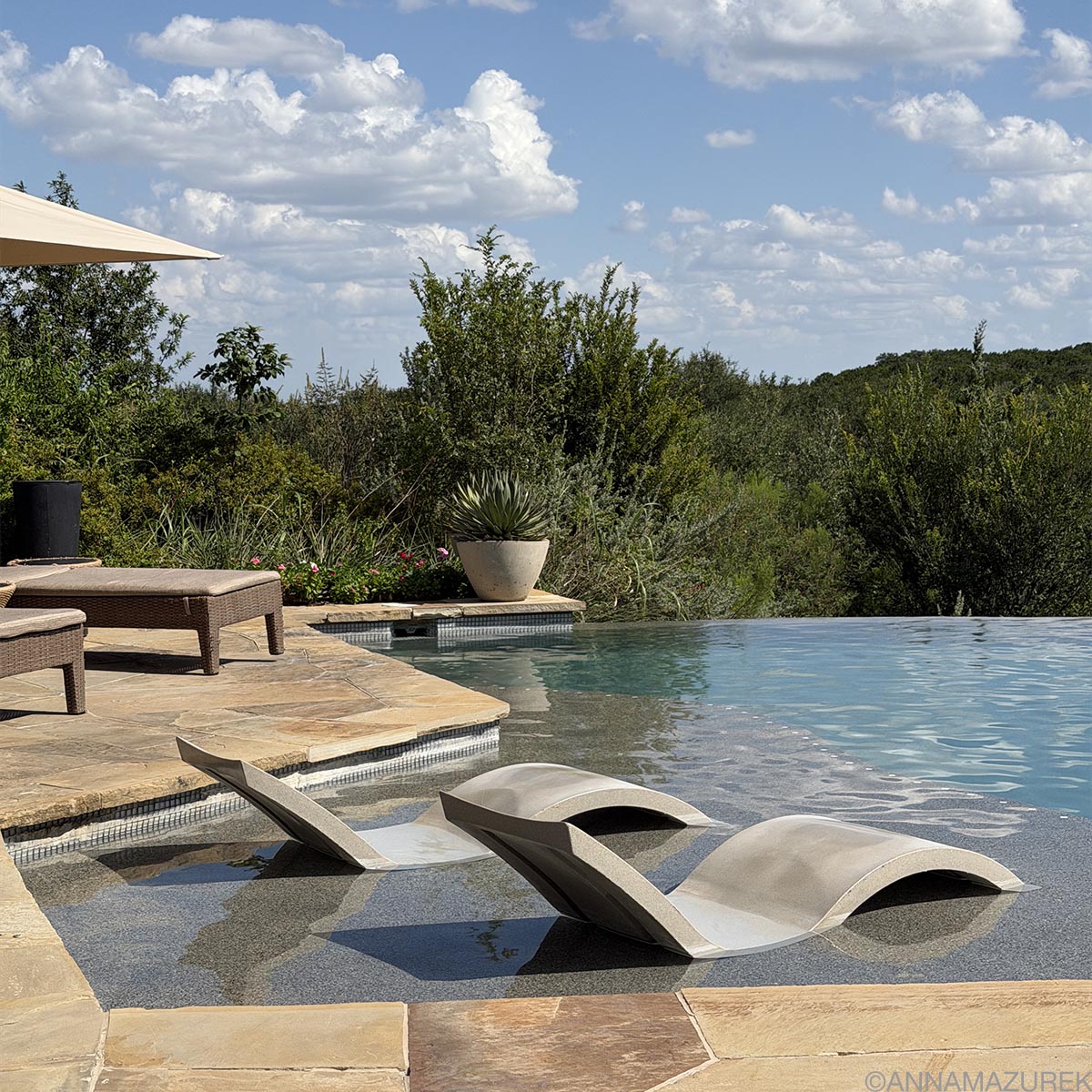 The private spa pool at the Loma de Vida Spa at La Cantera Resort & Spa in Texas Hill Country on the western edge of San Antonio.
Location: 16641 La Cantera Pkwy, San Antonio, TX 78256 | Google Maps
Texas Hill Country starts at the western edge of San Antonio with the hub of Fredericksburg just over an hour away.
If you don’t have time for a day trip, there’s a closer alternative for scenic views and relaxing getaway. Right on the edge of town just off the 1640 loop is the La Cantera Resort & Spa. It is home to one the best spas in the state (day passes available) and one of the best meals I’ve had in Texas.
The Signature Restaurant is Michelin-guide listed for a reason. My favorite dishes include the buttermilk fried quail with cornbread topped with habanero honey, short rib with sweet potato and panna cotta.
12. Natural Bridge Caverns
Location: 26495 Natural Bridge Caverns Road, San Antonio, TX 78266 | Google Maps
Hours: 9:30 a.m. to 5:30 p.m.
Admission: Tours start at $32. Parking is $10.
In the 1960s, college students discovered this limestone cave system, known as Natural Bridge Caverns. The property is family-owned and offers a series of tours, from the Discovery Tour (half-mile trek 180 feet below the surface) to the adrenaline-pumping Hidden Wonders Tour that ventures into newly opened sections of the cave.
13. Bat Emergence at Bracken Cave
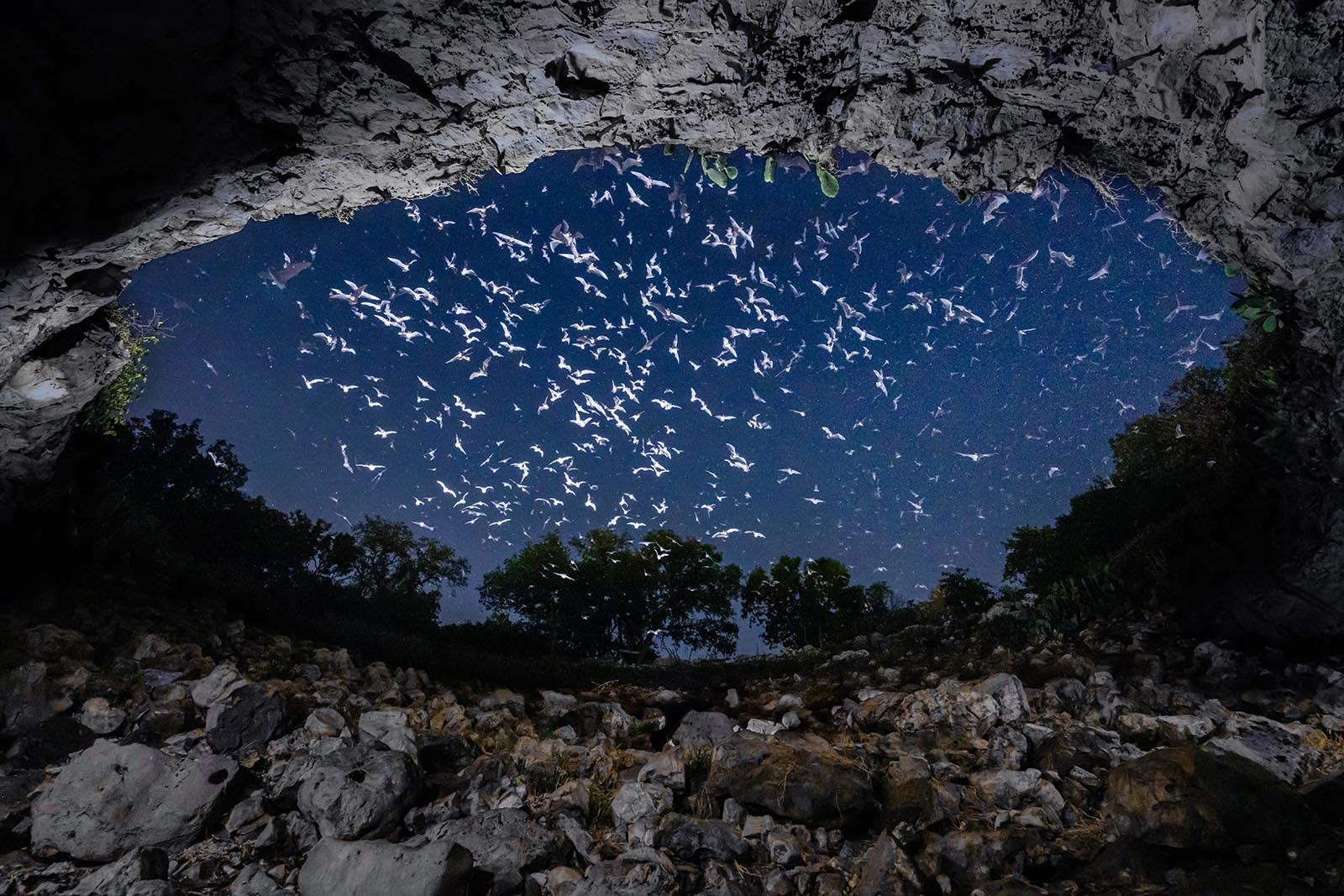 At sunset in summer, over 20 million bats swarm into the night sky at Bracken Cave. Photo courtesy of Visit San Antonio.
Location: 7515 Bracken Cave Rd, San Antonio, TX 78266 | Google Maps
Hours: Summer only. Reservations Required.
During the summer, plan a visit to see the nightly bat emergences at Bracken Cave, home to the largest colony of bats in the world. Every evening at dusk 20 million free-tailed bats spiral into the sky. Advanced reservations are required.
The 1,458-acre property is located 20 miles east of San Antonio and co-managed by The Nature Conservancy and Bat Conservation International.
14. Villa Finale
 Villa Finale offers a sneak peak into the lavish historic homes of the King William neighborhood. Photo courtesy of Visit San Antonio.
Location: 401 King William, San Antonio, TX 787204 | Google Maps
Hours: Tuesday to Saturday 10 a.m. to 4 p.m.
Admission: Gardens are free; Interior entry is $12 for adults and $10 for military/students/seniors.
The 12,000-item art collection of local preservationist Walter Mathis is on display in his 1876 Italianate home and gardens on the Mission Reach section of the River Walk in the historic King William neighborhood. Mathis purchased the home, Villa Finale, in 1976 and spent two years restoring it before focusing his efforts to restore14 properties in the neighborhood. The building and gardens were donated to The National Trust for Historic Preservation and opened to the public for tours.
15. Tower of the Americas
 The Tower of the Americas and the Alamodome photographed at night from the Tenfold Rooftop bar at the Kimpton Santo San Antonio on the River Walk.
Location: 739 E César E. Chávez Blvd, San Antonio, TX 78205 | Google Maps
Hours: Sunday to Thursday 10 a.m. to 10 p.m.; Friday and Saturday 10 a.m. to 11 p.m.
Admission: $19.59 for adults, $16 for military/seniors
For a sky-high view of the Alamo City, travel to the top of the 750-foot-tall Tower of the Americas. The iconic structure was built for the 1968 Hemisfair World’s Fair that coincided with the San Antonio’s 250th anniversary.
Take the elevator up to the observation deck to a photo stop or consider having dinner in the Chart House, a revolving restaurant. If you are just looking for a skyline photo of the iconic structure, the Tenfold Rooftop bar at the Kimpton Santo San Antoino on the River Walk is the best spot. (The first photo of this blog post was shot from the bar!)
16. Ruby City
 Ruby City is a free contemporary art museum located on the Mission Reach section of the River Walk.
Location: 150 Camp St, San Antonio, TX 78204 | Google Maps
Hours: Tuesday to Sunday, 10 a.m. to 6 p.m.
Admission: Free
This crimson-hued building along the River Walk is a two-story contemporary art museum featuring rotating exhibits from local and international artists. Philanthropist Linda Pace founded Ruby City in 2007, which includes 1,400 works from her collection. The main 14,000-square-foot building is part of a larger campus that includes a one-acre green space and an auxiliary exhibition space called Studio. Admission is always free.
17. Maverick Carter House
 The Maverick Carter House is located in San Antonio’s central business district across from the Tobin Center for Performing Arts. Photo courtesy of Visit San Antonio.
Location: 119 Taylor St., San Antonio, TX 78205 | Google Maps
Hours: The first and third Sunday of the month from 12 p.m. to 3 p.m.
Admission: Free
The Richardsonian Romanesque façade of the 1893 Maverick Carter House is one of the most unique house museums in San Antonio. The 23-room home was built for William Harvey Maverick, the son of Samuel Augustus Maverick, one of the signers of the Texas Declaration of Independence.
The second owners were H.C. Carter and his wife, Aline Badger Carter, the Texas poet laureate from 1947 to 1949 . In 1925, Aline converted the first-floor library into a chapel and later added an observatory to the roof. Her additions are some of the most unique features of the house.
The 10 Best Hotels in Austin: Where to Stay by Neighborhood in 2026
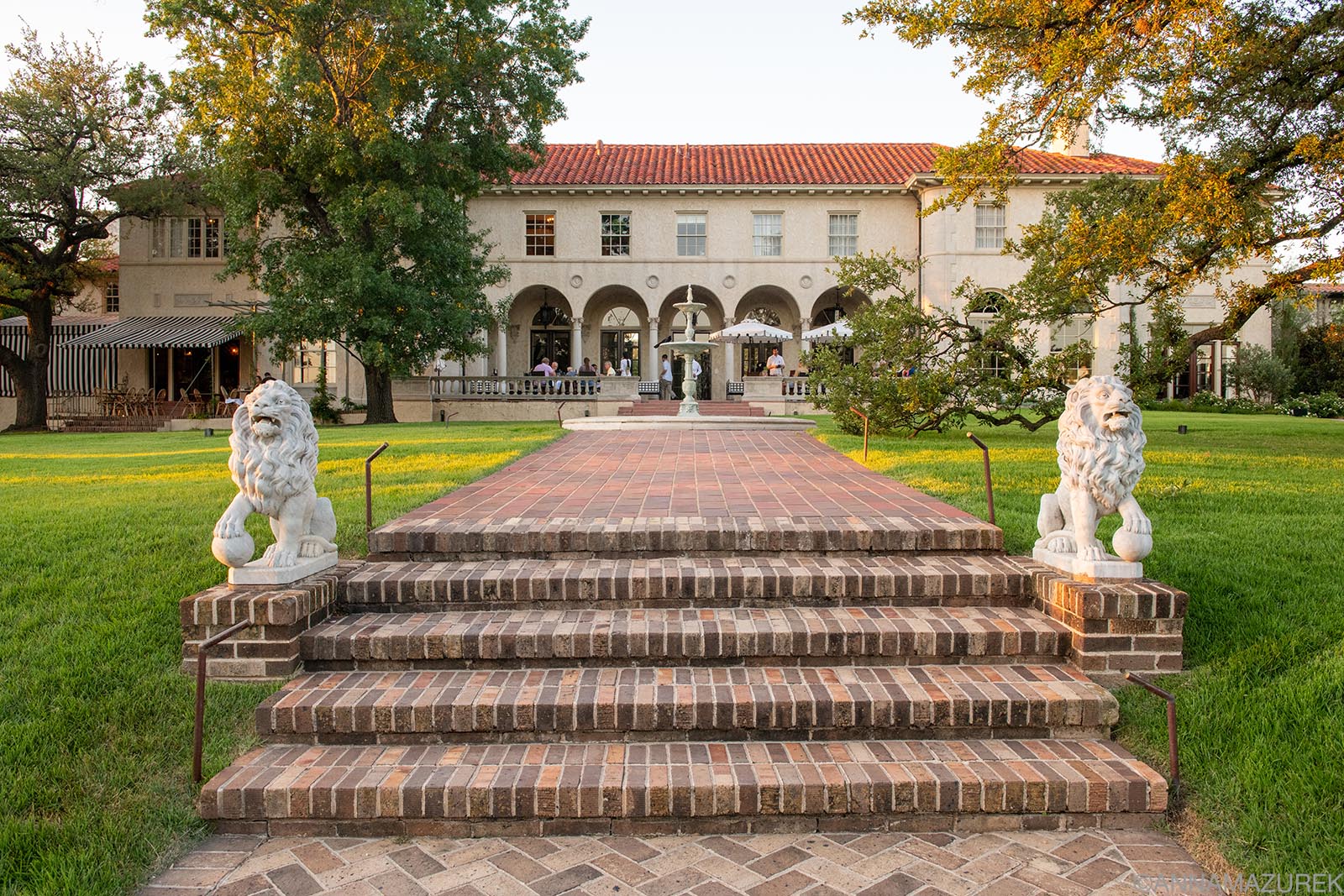 The Commodore Perry Estate is a 1928 mansion that was transformed into a luxury hotel.
Austin is booming—the culinary landscape now boasts seven one-star Michelin restaurants, and the live music scene is unmatched. Now, the hotel sector is buzzing with six properties making Travel + Leisure’s World’s Best List. Despite Austin’s rapid growth (the population hovers just under a million), it’s maintained the same small-town vibe that made me move here in 2013. With 30 million tourists visiting the Texas Capital every year, the hotel market is constantly expanding with options for every budget.
To avoid sitting in the notorious I-35 traffic jams that rival L.A., stay in the area you’ll be hanging out in the most. (Austin’s public transit consists mostly of buses and one train line that’s built only for commuters, so ride shares are the easiest way to get around.)
From South Congress to Barton Creek, keep reading for the best hotels in Austin, organized by neighborhood, from bougie to budget friendly. If you’re looking for things to do in Austin or where to eat in Austin, I’ve also written posts about both.
Affiliate links are used in this post. If you make a purchase, I earn a small commission at no cost to you, which goes toward the cost of maintaining this blog.
Hotel List
Just want the list? Here’s a quick round down of the best hotels in Austin.
Four Seasons Austin: Booking.com// Expedia // website
Driskill Hotel: Booking.com // Expedia // website
Austin Proper Hotel: Booking.com // Expedia // website
Austin Motel: Booking.com // Expedia // website
Inn at Green Pastures: Booking.com// Expedia // website
Frances Modern Inn: Booking.com // Expedia // website
bohéme: website
Commodore Perry Estate: Booking.com // Expedia // website
Archer Hotel Austin: Booking.com // Expedia // website
Lone Star Court: Booking.com // Expedia // website
Omni Barton Creek: Booking.com // Expedia // website
The Best Neighborhoods to Stay in Austin
Not sure where to stay? Here’s a quick breakdown of the Austin’s main neighborhoods.
-
Downtown: Urban skyline, walkable, nightlife hubs
-
South Congress: Hip boutiques, live music, eclectic restaurants
-
East Austin: Artsy and laidback, food trucks, breweries and dive bars
-
Domain: Modern shopping, tech, upscale suburban feel
-
Hyde Park: Historic homes, tree-lined streets, quiet charm
-
Barton Creek: Hill Country views, golf, luxury resorts, nature trails
Best Hotels in Downtown Austin
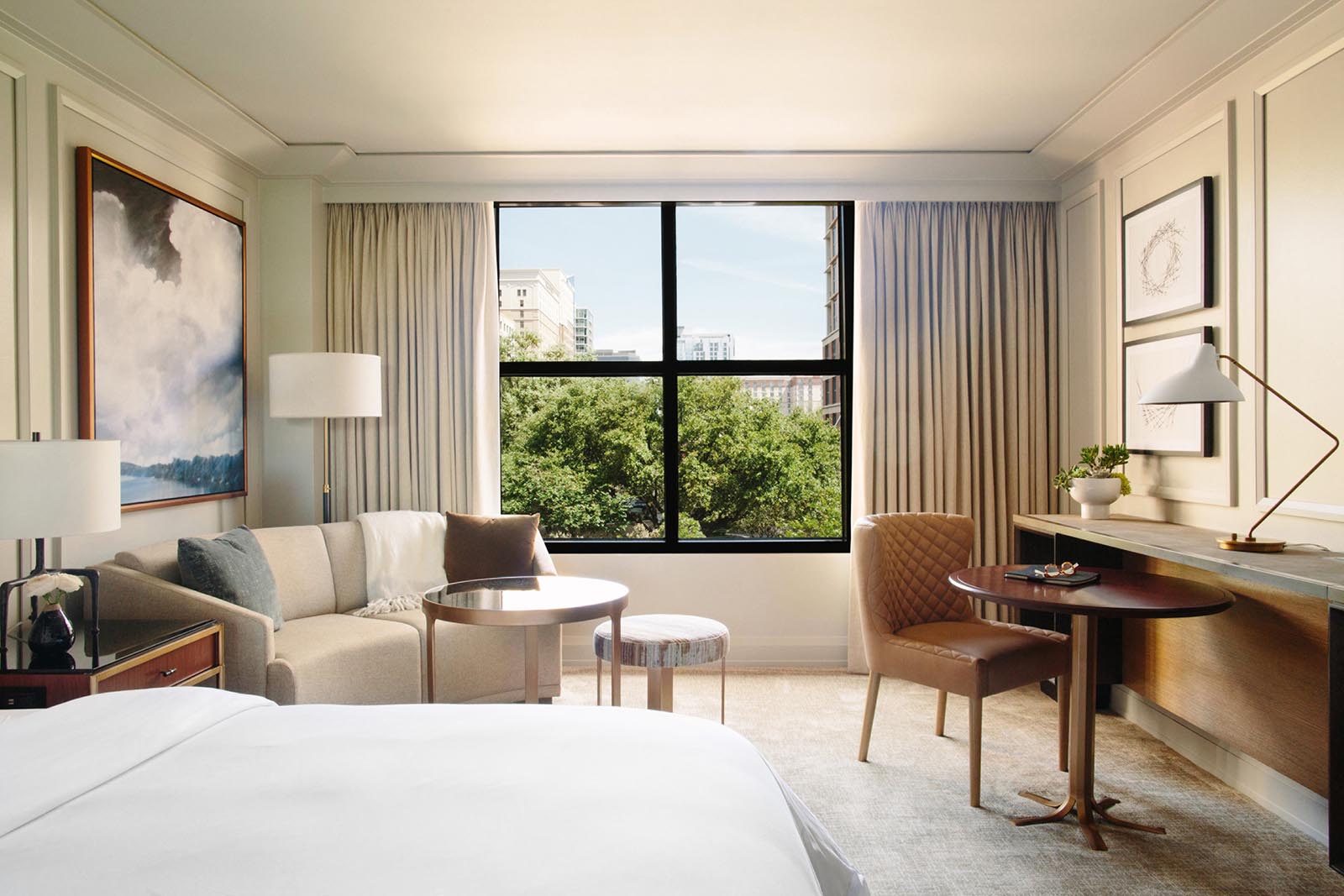 The Four Seasons Hotel Austin offers great views of the skyline and Lady Bird Lake. Photo courtesy of the Four Seasons.
Four Seasons Hotel Austin
Typical starting/peak prices: $650/$1300
Best for: Luxury Travelers, Couples, Business Travelers, Events, Families
On-site amenities: Saltwater outdoor pool, spa, fitness center, multiple restaurants & bar, paid valet parking, event space, lake access, kids’ programs
Pet Friendly: Yes, pets are free.
Book Now: Booking.com// Expedia // website
Unparalleled, direct access to Lake Bird Lake and the shoreside trails is the big draw for the Four Season’s Austin, a hidden refuge in the heart of the city. While the comfortable rooms and lavish amenities will make it hard to leave the property, the location is unbeatable for exploring downtown.
Take advantage of the hotel’s seasonal events and programming, ranging from an annual summer speakeasy pop-up to a winter ice rodeo. These events are open to non-guests making them a big draw for locals.
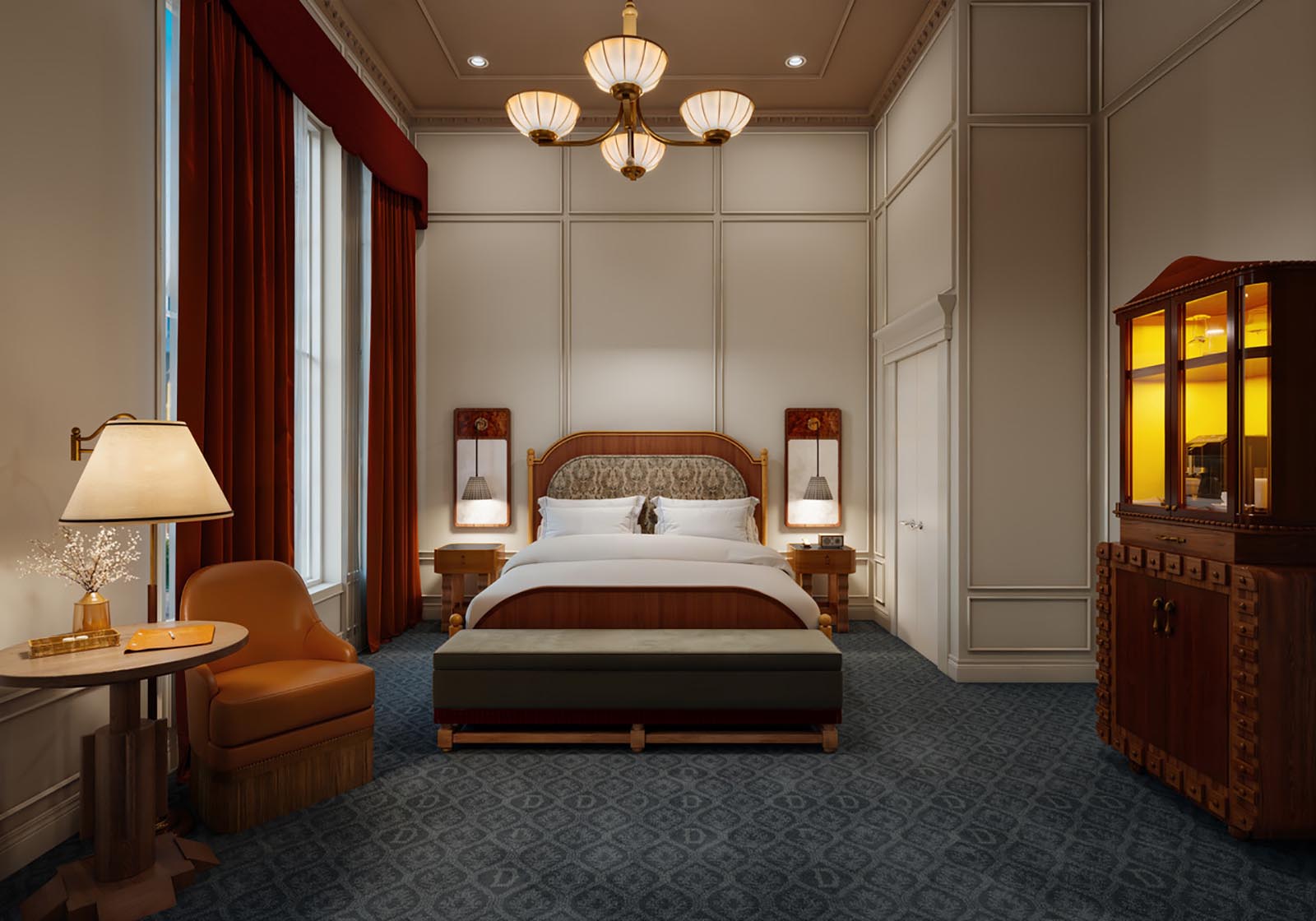 The Driskill Hotel is listed on the National Register of Historic Places. Rendering courtesy of Driskill Hotel.
The Driskill Hotel
Typical starting/peak prices: $299/$648
Best for: History Buffs, Couples, Business Travelers, Events
On-site amenities: Historic property, restaurant, bar, fitness center, paid valet parking, event/ballroom spaces, pet amenities, concierge
Pet Friendly: Yes, pet fee $100 per stay.
Book Now: Booking.com // Expedia // website
Built in 1886, this 18,000-square-foot historic property was the state’s first luxury hotel—President Lyndon B. Johnson and Lady Bird Johnson had their first date in the dining room. (The Governor’s Suite was perpetually reserved for Johnson.) Located on Sixth St., the hotel is only blocks from the Capitol Building.
The property will celebrate its 140th anniversary in December 2026 and completed a full renovation in mid-2026. The hotel debuted a new ballroom, fitness center and three dining concepts, including a cocktail lounge named The Victorian.
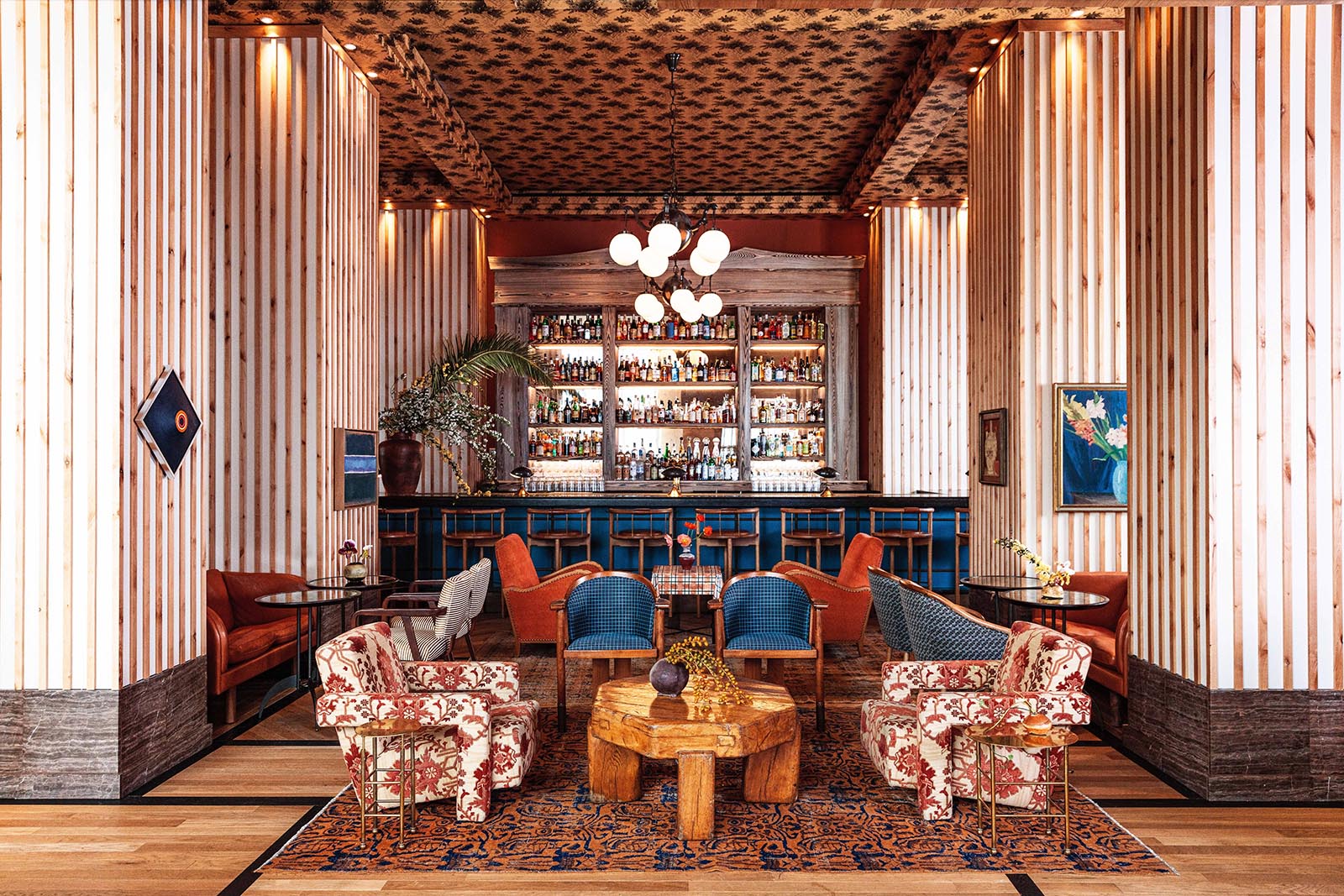 The Peacock Mediterranean Grill at the Austin Proper Hotel. Photo courtesy of Austin Proper Hotel.
Austin Proper Hotel
Typical starting/peak prices: $360/$900
Best for: Luxury Travelers, Couples, Solo Travelers, Business Travelers
On-site amenities: Rooftop pool and bar, multiple restaurants, paid valet parking, fitness center, spa, event space, concierge
Pet Friendly: Yes, pet fee $100 per stay.
Book Now: Booking.com // Expedia // website
This luxury hotel is nestled on the western side of downtown in the Seaholm district with great skyline views and a stunning rooftop pool. Each of the modern 238 rooms features floor-to-ceiling windows (with blackout drapes) and interiors selected by Kelly Wearstler to reflect the city’s Craftsman style, featuring local art and barefoot-friendly rugs. Fitness buffs will love the 2,000-square-foot gym, cold plunge and sauna. Four dining and bar options will keep you well-fed, from poolside breakfast tacos to Texas Wagyu beef tartare.
Best Hotels in South Congress
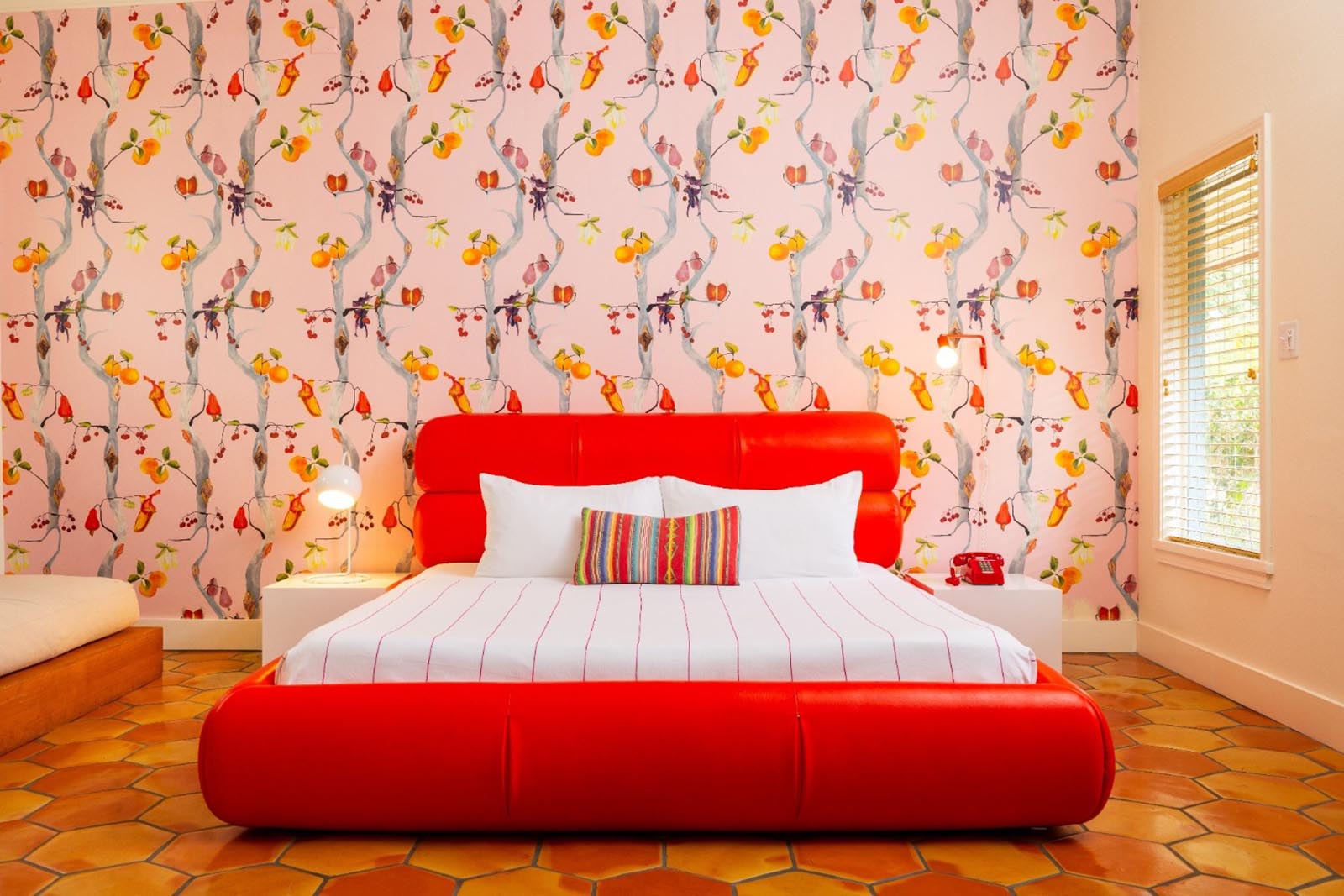 One of Austin Motel’s funky rooms. Photo by Grant Pifer.
Austin Motel
Typical starting/peak prices: $193/$329
Best for: Couples, Solo Travelers, Budget Travelers, Pet Owners
On-site amenities: Outdoor pool, free parking, bar/lounge, bodega, complimentary coffee, lobby shop
Pet Friendly: Yes, pets are free.
Book Now: Booking.com // Expedia // website
The property’s 1938 neon sign with ever-changing quirky messages is an Austin icon, like the hotel itself—a retro motor court continuously operated since the sign was put up. The unique 1,100-square-foot kidney-shaped pool is a draw for locals who often take advantage of the daily pool passes. The funky rooms have big pops of color with midcentury-modern inspired furnishings and brightly patterned walls. Texans get a preferred rate when booking directly.
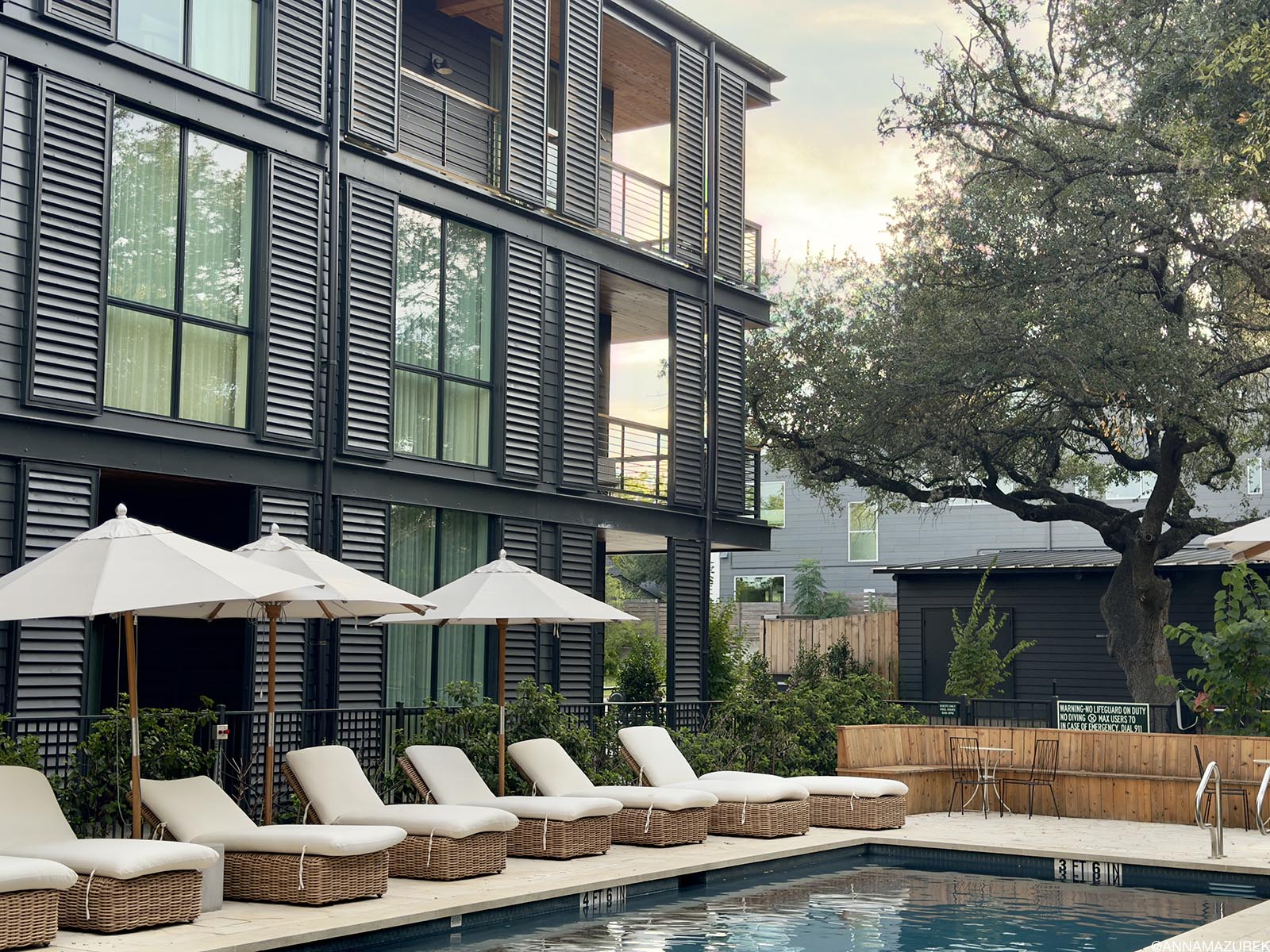 The photogenic outdoor pool and shaded grounds make the Inn at Green Pastures a great escape in Austin.
Inn at Green Pastures
Typical starting/peak prices: $315/$495
Best for: Couples, Solo Travelers, Business Travelers, Pet Owners
On-site amenities: Outdoor pool, free parking, bar/lounge, restaurant, complimentary coffee, lobby shop, 24-hour gym
Pet Friendly: Yes, $100 fee with a portion donated to Austin Pets Alive.
Book Now: Booking.com// Expedia // website
The resident peacocks are one of the unique features of this seven-acre, oak-shaded reprieve just a 15-minute walk from South Congress in the Bouldin Creek neighborhood. The modern 63-room inn opened in December 2025 next to Mattie’s restaurant, a local favorite dating back to 1946 serving up delicious biscuits (some of the best in town!) and other tasty Southern fare in a two-story farmhouse. Other amenities include the outdoor pool, 24-hour gym, Herny’s Nite & Day (all-day eatery and bar) and a lobby shop from Noah Marion, a local design studio.
Best Hotels in East Austin
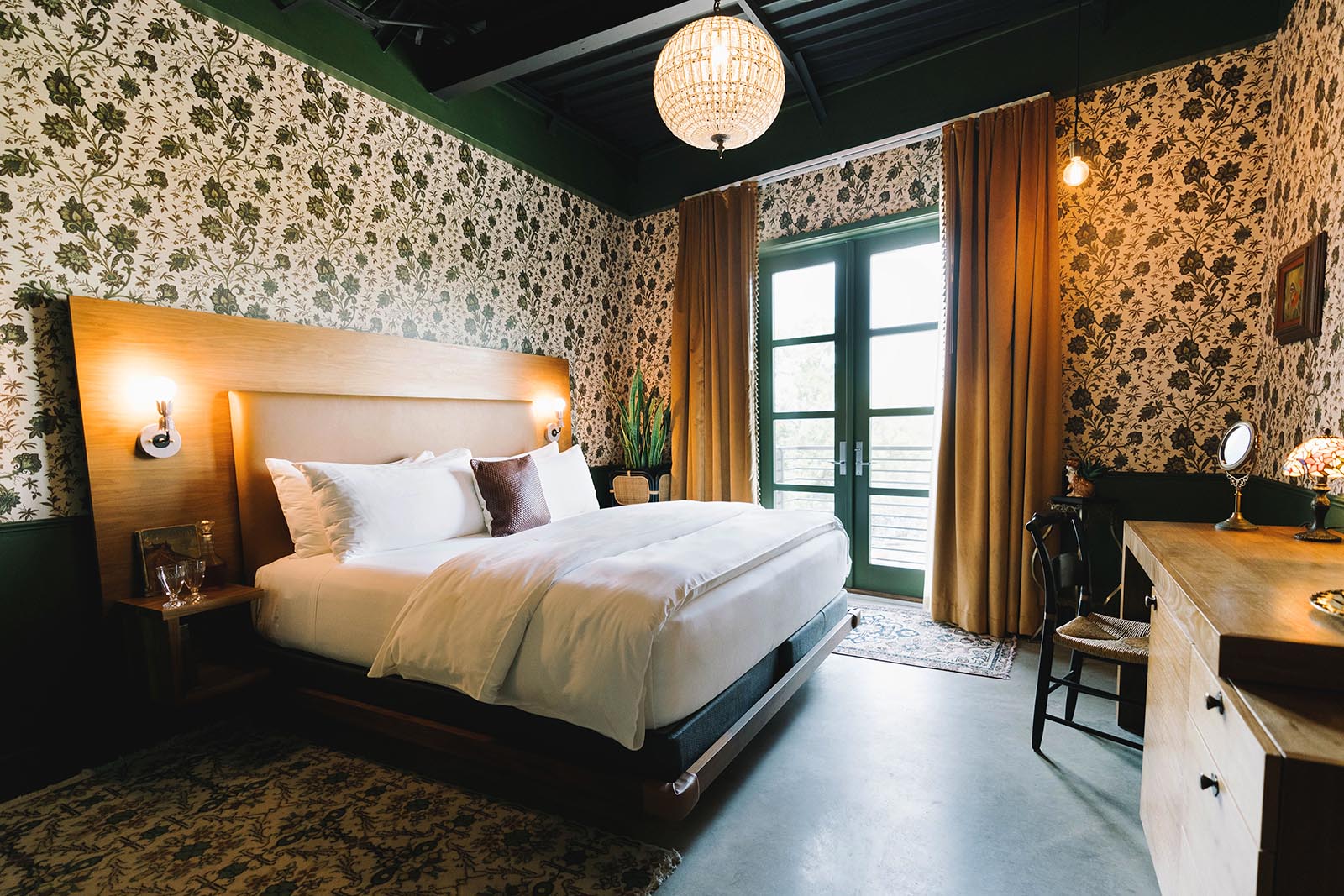 Frances Modern Inn’s medium rooms come with a Juliet balcony. Photo courtesy of France Modern Inn.
Frances Modern Inn
Typical starting/peak prices: $174/$454
Best for: Solo Travelers, Couples, Urban Explorers, Business Travelers
On-site amenities: Rooftop terrace, restaurant, free parking, lounge, concierge, complimentary coffee/tea in lobby, individually decorated rooms
Pet Friendly: No
Book Now: Booking.com // Expedia // website
This 15-room boutique hotel is just steps from famed Franklin’s Barbecue. Named after the owner’s grandmother, the space features one-of-a-kind rooms with unique color palettes reminiscent of your grandmother’s house, including whimsical door knockers ranging from a pineapple to a blinking cat. The medium rooms feature Juliet-style balconies while the extra-large room is a two-story space with private entry and a clawfoot tub. Soak in the skyline views while sipping a cocktail on the rooftop.
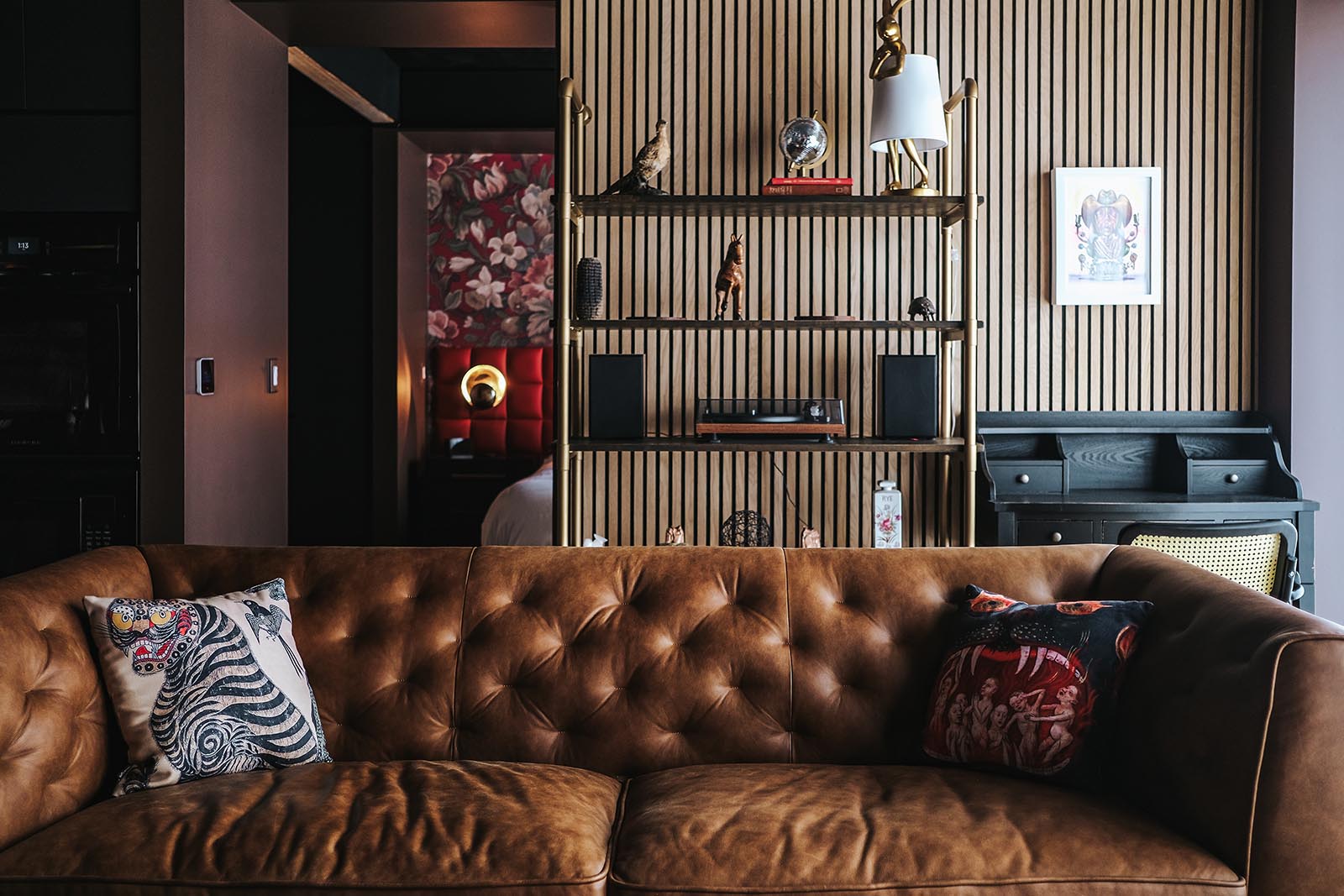 Each of the 20 guest rooms and suites at bohéme were individually designed. Photo by Collin Findlay.
bohéme
Typical starting/peak prices: $213/$444
Best for: Couples, Solo Travelers, Friends, Business Travelers, Pet Owners
On-site amenities: Lobby cocktail bar, rooftop lounge,
Pet Friendly: Yes, $100 per dog/night with two-dog maximum. Breed restrictions.
Book: website
The newest addition to East Austin is a 20-room boutique hotel, bohème, opening on October 1, 2026 on Comal Street. Originally a sustainable apartment building, the hotel will feature two bars: Sacred Souls, a cocktail lounge, and Higher Spirits, a rooftop retreat with East Austin’s only unobstructed view of the downtown skyline.
The most unique aspect of the property is that each of the 20 guest rooms and suites was individually designed and each include fully equipped kitchens and generously stocked mini bars and snack stations. The six suites were inspired by the city’s culture, including The Pearl, a Janis-Joplin inspired bohemian enclave, and The Start-Up, a sleek, tech-forward designed space. And, of course, the location is perfect for exploring the neighborhood’s restaurants, bars and nightlife by foot.
Best Hotels in Hyde Park (Hancock)
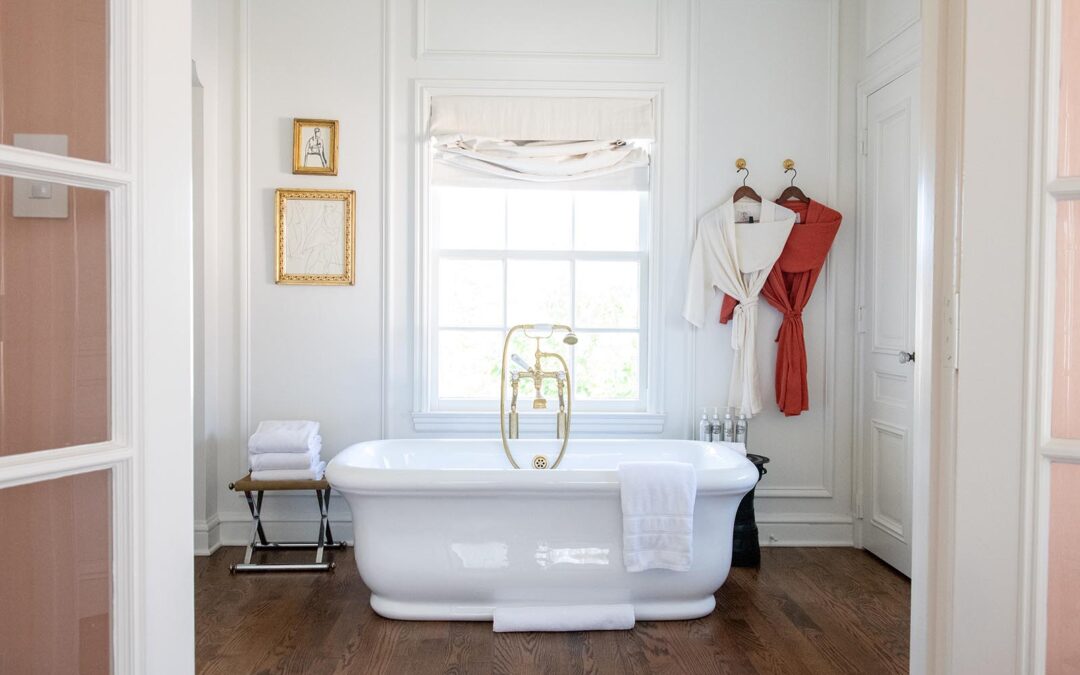
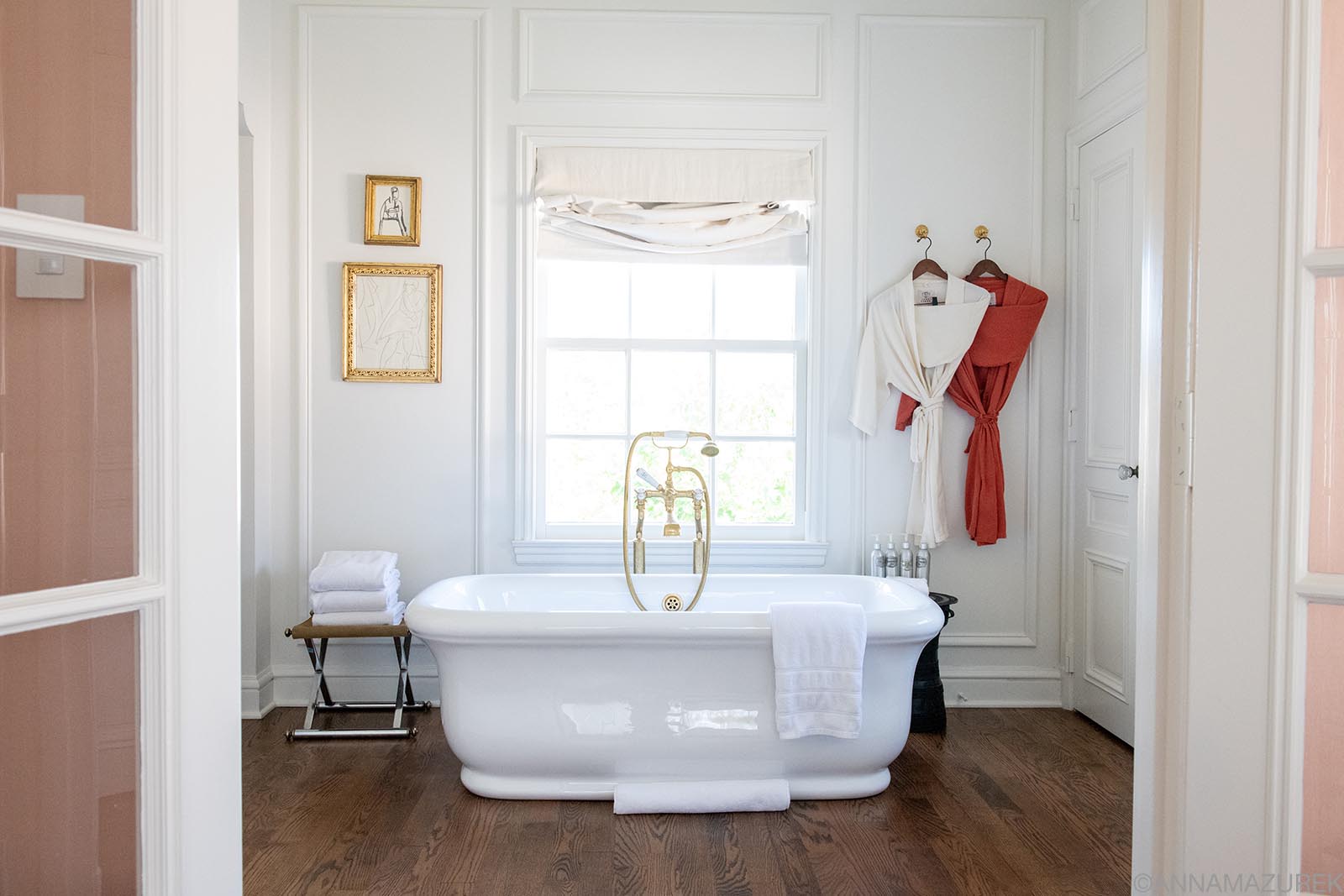 The bathroom in the Mr. & Mrs. Perry Suite at the Commodore Perry Hotel.
Commodore Perry Estate
Typical starting/peak prices: Starting at $496 but vary greatly by room type.
Best for: Luxury travelers, couples, wellness seekers
On-site amenities: Pool, 24-hour fitness center, wellness classes, ten acres of private gardens, historic chapel, complimentary guest bikes, valet parking, weekly live music
Pet Friendly: Yes, up to two pets under 60 lbs., $90 per night; includes amenities.
Book Now: Booking.com // Expedia // website
A 1928 mansion is the centerpiece of the 10-acre estate featuring a newly built three-story inn, giant oak trees and sculptured English gardens. Named after the original owner, businessman Edgar “Commodore” Perry, the estate has 54 rooms and 11 suites that make you feel as if you’ve traveled to Europe minus the jetlag.
Each of the mansion’s five original rooms was designed by Ken Fulk. (Pink Floral patterns cover the walls and ceiling of my favorite room, the LaVerne Suite.) Fulk also designed the garden-themed interior of Lutie’s, the on-site dinner and weekend brunch restaurant. (I still dream of the estate bread with layered butter and pastry dishes.)
Best Hotels in The Domain (North Austin)
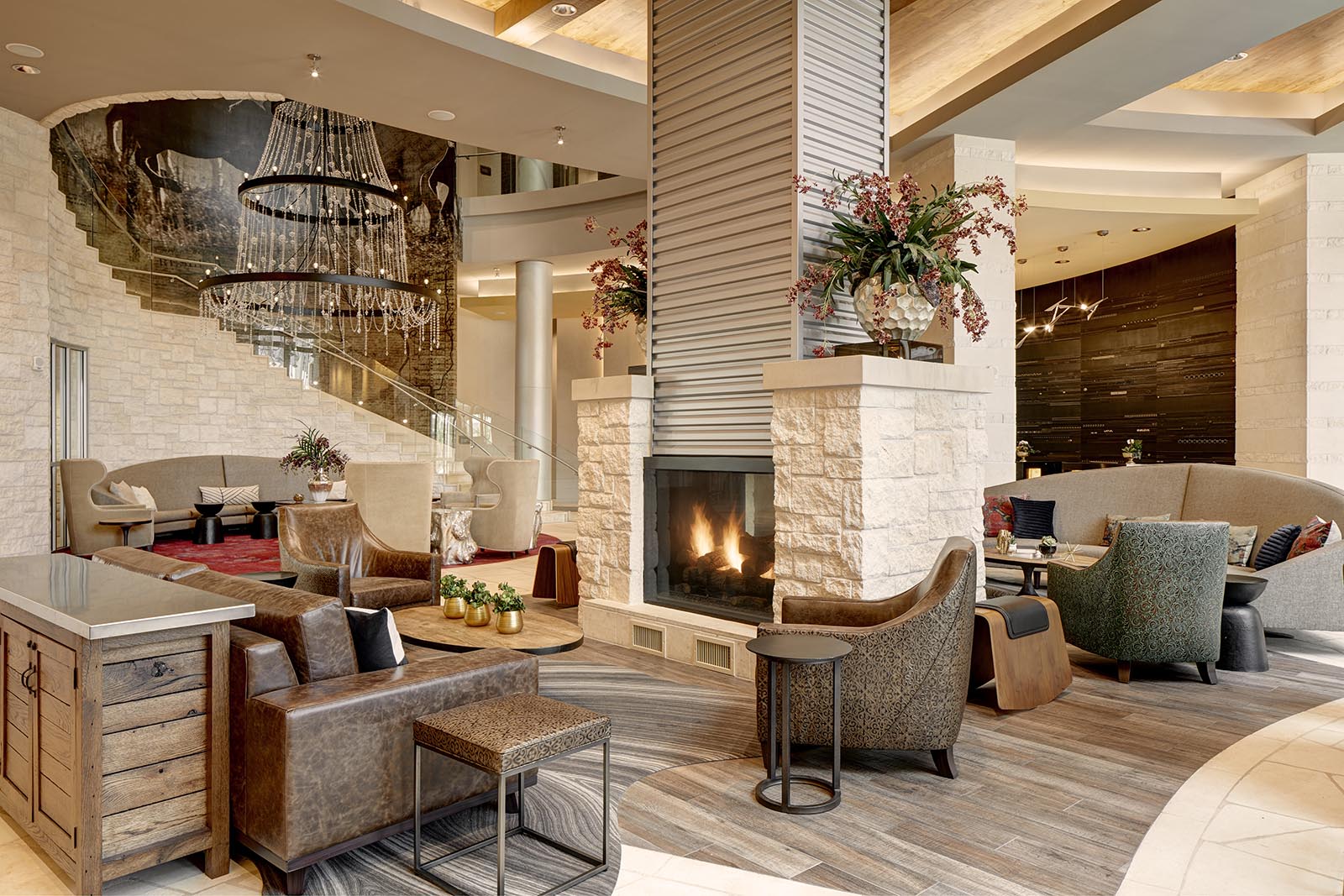 The photogenic lobby at Archer Hotel Austin. Photo courtesy of Archer Hotel Austin.
Archer Hotel Austin
Typical starting/peak prices: $188/$425
Best for: Couples, Business Travelers, Shoppers, Families
On-site amenities: Pool with free cabanas, paid parking, 24-hour fitness and business center
Pet Friendly: Yes, pet fee $75 per stay.
Book Now: Booking.com // Expedia // website
With a chandelier-clad lobby and poolside fire pit, it’s no wonder this Domain hotel landed on the Travel + Leisure World’s Best List for the top five hotels in Austin. The “Texas chic” rooms feature floor-to-ceiling photo murals of iconic Texas scenes and five-star bedding with a mix of down pillows. Watch the UT game from the 14-foot TV while lounging in the Lone Star-inspired splash pool, while nibbling on a pizza. Or grab a cocktail during the “sunset hour” happy hour from the on-site AKB bar.
Lone Star Court
Typical starting/peak prices: $133/$409
Best for: Couples, Families, Business Travelers, Music Lovers
On-site amenities: Outdoor pool, live music, bar/restaurant, free parking, fire pit, deluxe rooms, SMEG refrigerators, wrap-around porches
Pet Friendly: Yes, pet fee $50 per stay.
Book Now: Booking.com // Expedia // website
Tucked on four acres of North Austin, The Lone Star Court Hotel is nestled in the quieter side of the ever-expanding Domain, a shopping, entertainment and residential complex. The property resembles a modern retro-motor court with resort amenities, including fire pits, lawn games, a pool and complimentary bicycles.
The 123 rooms include classic Texas elements, such as sliding barn-style bathroom doors and cowhide director’s chairs and are situated on ranch-house-style breezeways lined with rocking chairs.
Best Hotels in Barton Creek (Hill Country)
 The Omni Barton Creek offers Hill Country views only 10 miles from downtown. Photo courtesy of Omni Barton Creek.
Omni Barton Creek
Typical starting/peak prices: $273/$709
Best for: Families, Golfers, Spa Enthusiasts, Couples, Business Travelers
On-site amenities: Four golf courses, multiple pools (including adults-only), nine dining outlets, paid valet & free self-parking, spa, tennis courts, large fitness center, kid’s programs
Pet Friendly: Yes, pet fee $125 per stay.
Book Now: Booking.com // Expedia // website
This 4,000-acre Hill Country refuge always ranks as one of the best resorts in Texas because of the wide range of lavish amenities from four 18-hole golf courses to the Mokara Spa, a 13,000-square-foot sanctuary featuring a private heated infinity pool. There are four pools—including an adults-only infinity pool. For children, there are nature hiking trails, movie nights, splash pads family-friendly pools and programming.
Rooms range in size from 425 square feet to the 1,800-square-foot suites with a private oversized terrace. Located only 10 miles from downtown Austin, it’s easy to explore the city or visit from the city for a spa day. (Day passes are available for spa guests.) Members of Texas Exes, the UT alumni association, receive 20% off rooms, a $75 resort credit and a complimentary room upgrade based on availability.
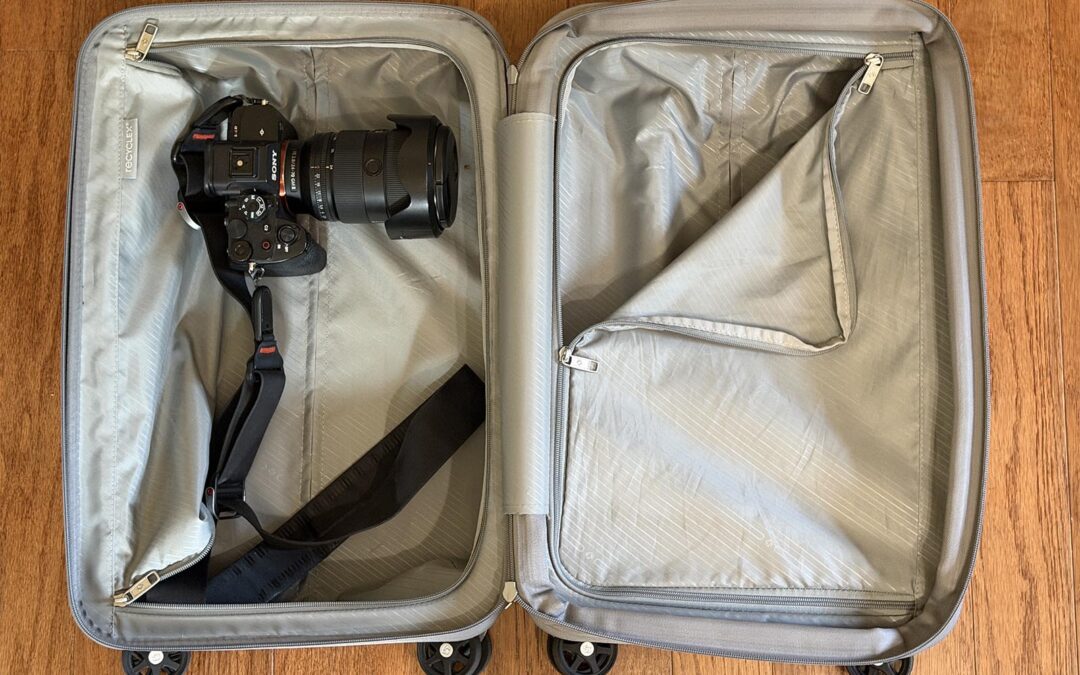
Are suitcase warranties actually worth it?
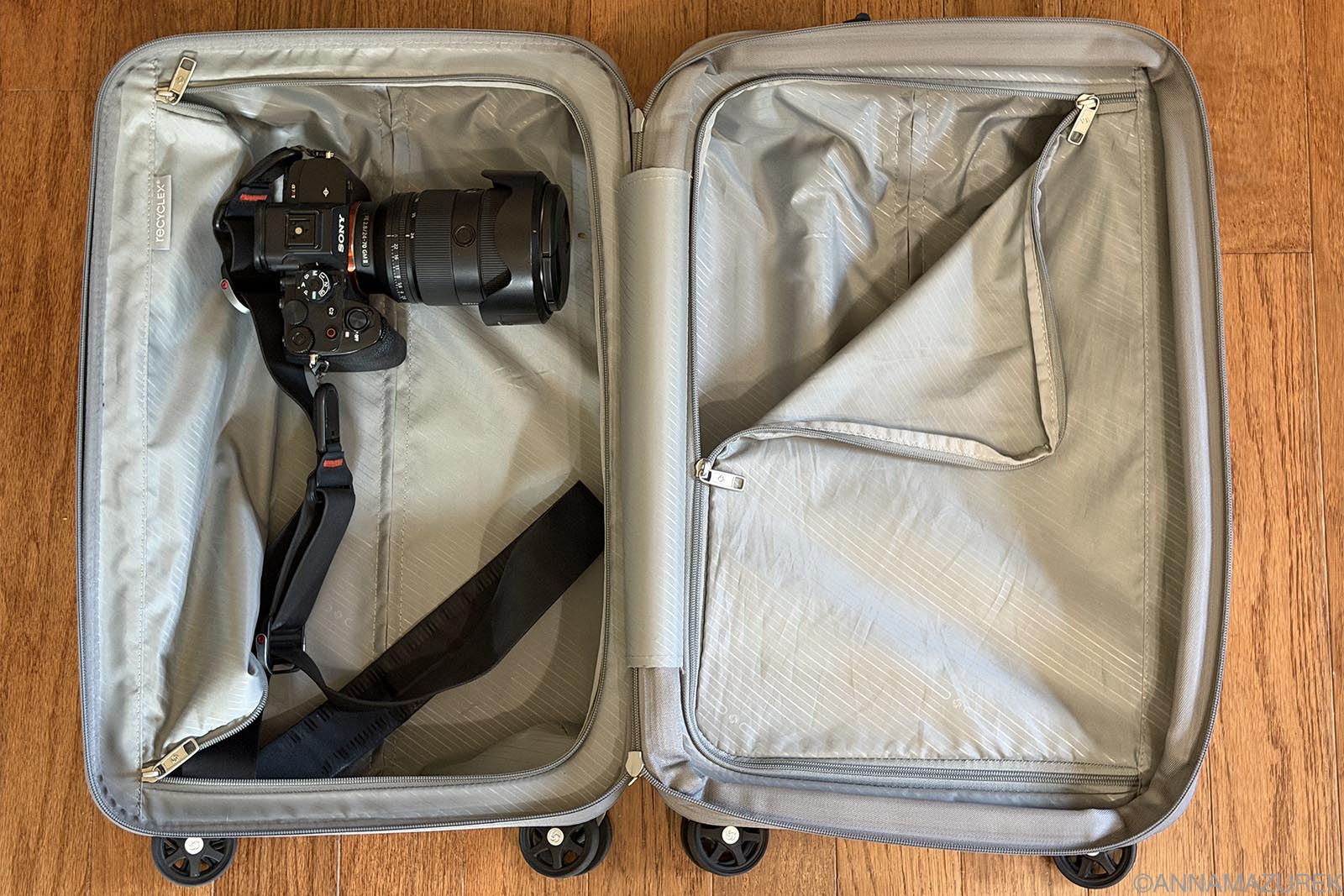 I discovered my new favorite carry-on (Samsonite Uplift Hardside Carry-on Spinner ($159)) while investigating suitcase warranties.
As suitcases get fancier and pricier, most brands, from Samsonite to Away, are hyping warranties as a major selling point. As a full-time traveler frequently cursed with luggage woes, I’ve always been skeptical after negative experiences with warranty claims. Of course, people always ask me which luggage brand is best, but I’ve hesitated to recommend anything due to warranty issues.
I had a change of heart recently after some surprisingly positive experiences with a Samsonite warranty claim and repair. In this post, I dig into what suitcase warranties actually cover, my recent experience with a Samsonite warranty repair and my favorite suitcases.
Affiliate links are used in this post. If you make a purchase, I earn affiliate revenue at no cost to you, which goes toward blog maintenance costs. This is NOT sponsored by Samsonite; I purchased all luggage mentioned myself.
Are suitcase warranties actually worth it?
Suitcase warranties are only worth it under two conditions:
- You are willing & able to drag around a broken suitcase if it breaks mid-trip.
- You can wait up to six weeks for the repair.
If you are frequently traveling (like me!), it’s hard to find six weeks (usually shorter) to send it off. There’s also nothing more miserable than being burdened by toting around a broken suitcase, which is why I’ve ditched so many broken ones instead of waiting to do a warranty claim.
Also, how far away is your suitcase brand’s store or repair facility? This is a key factor to consider based on transit costs for driving or shipping.
What do suitcase warranties actually cover?
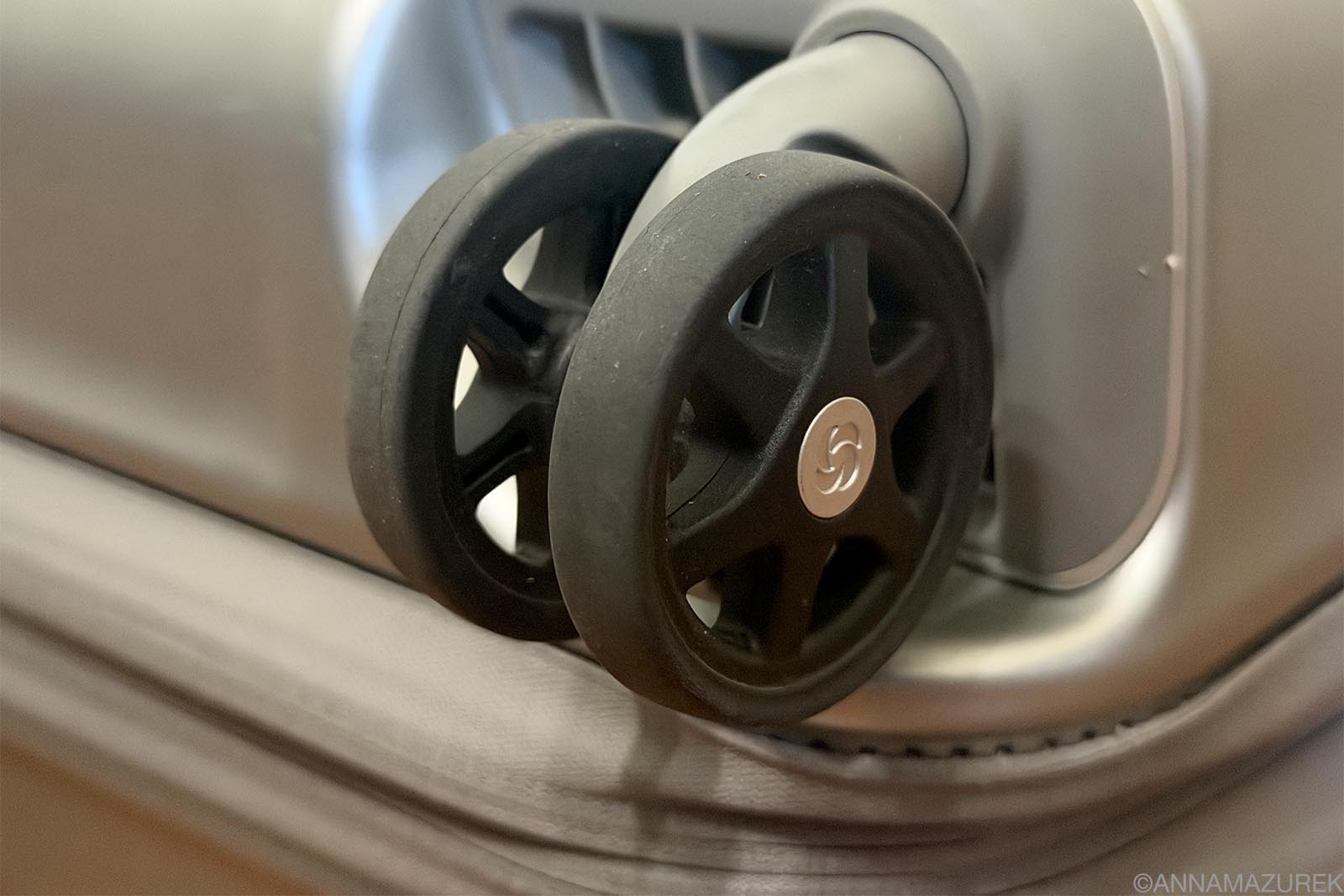 Suitcases with dual wheels are sturdier and last longer.
Functional manufacturing defects are always covered. Airline and transit damage are a grey area and often excluded by most brands. The brands that do cover it, like Away and Briggs and Riley, will only cover functional damage. (Away made this handy chart of suitcase warranties, which is likely skewed in their favor.) Warranties are often void if you send your suitcase to a non-authorized repair center.
The length of suitcase warranties varies by brand and ranges from five years to limited lifetime repairs.
What’s the Samsonite Warranty Process?
If your Samsonite luggage was purchased in the last ten years, you can take it to a Samsonite store, and they’ll send it off to a repair center. The store prefers that you fill out the repair request form online first, but they can also do it in the store for you.
While warranty repairs are free, shipping is $15 for pieces under 22 inches and $20 for pieces over 23 inches. Various stores will quote you different time frames from two to five weeks. For me, it came back in a week.
My Samsonite Warranty Experience (2026)
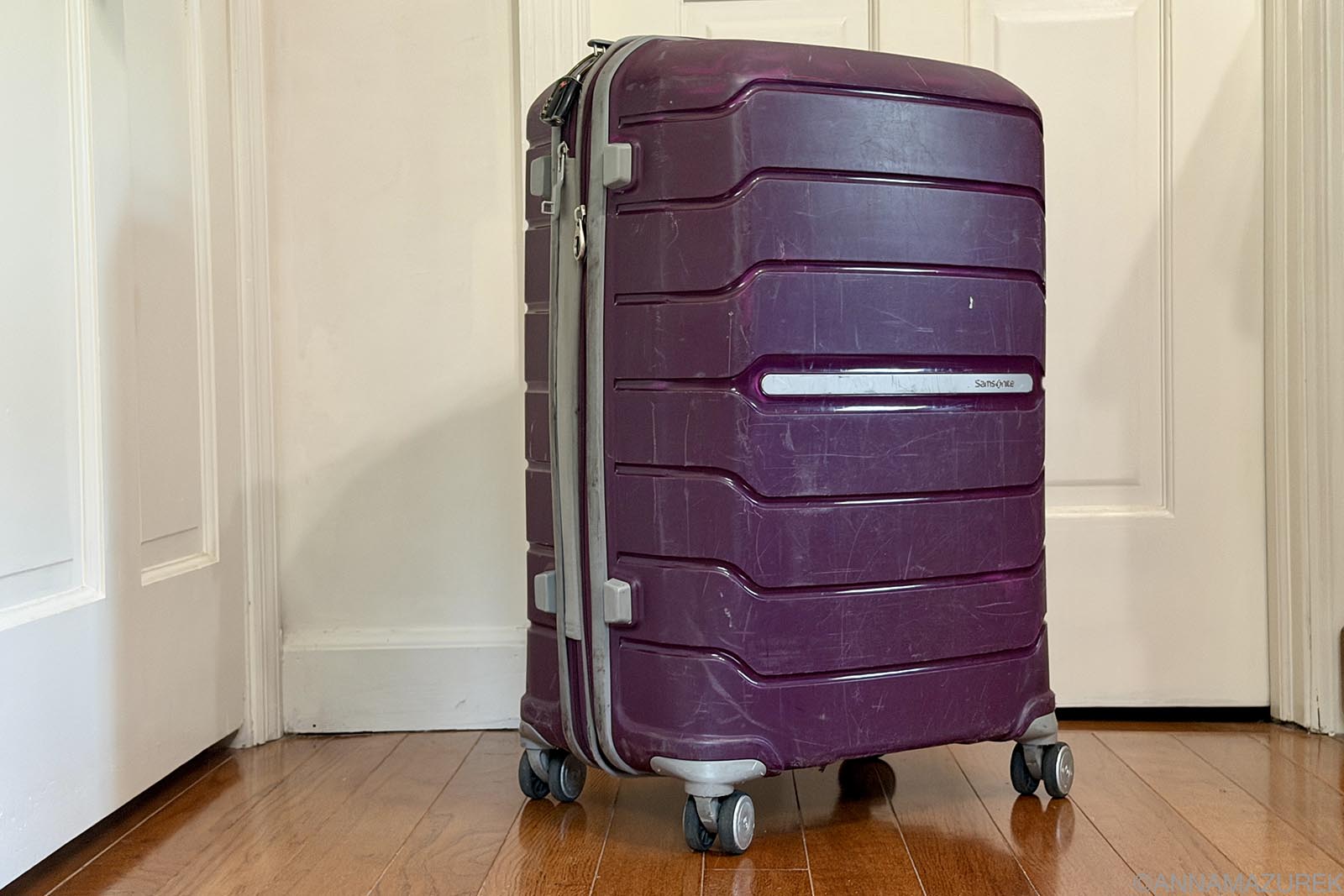 My well-loved Samsonite Freeform Medium Spinner post-zipper repair.
In 2023, I bought a Freeform Medium Spinner (27 in. x 18.5 in. x 12 in.; 8.5 lbs.) from the Samsonite Outlet in San Marcos, Texas, which comes with a 10-year limited warranty. I left for a three-month work trip to Europe, and after my second flight, the suitcase was missing a wheel when it got to baggage claim. I went to a Samsonite store in Europe, but none of their replacement wheels worked since it was an American suitcase.
I emailed the Samsonite repair center in San Antonio, who mailed replacement wheels for free to a friend who was meeting me in the Azores halfway through my trip. I was able to replace the broken wheel easily myself. On the same trip, the zipper pull-tab and crown (part the pull tab connects to) for the expansion zipper was broken by the airline. Basically, the zipper was still functioned but was very hard to operate since the crown just had a sharp edge that kept cutting my fingers. I assumed this wouldn’t be covered, so I never pursued a warranty claim.
Fast forward to March 2026, I just returned from an epic seven-month trip in Africa, Europe and Southeast Asia. The retractable handle was broken in transit. I tried to pull it up, and it got stuck and would not retract, making it almost impossible to travel with. Since I only had three weeks in the U.S., I emailed the same San Antonio repair facility, who said they couldn’t do much to repair the retractable handles except try to bend them back into place.
On a whim, I called the San Marcos outlet where I bought it, and they happened to have a spare replacement handle. I picked it up and replaced it myself easily.
After talking with the staff about the warranty, I sent off my suitcase when I returned from my trip in late June to have the expansion zipper replaced. I dropped it off at the Charlotte Samsonite store on a Friday and paid $20 for the shipping. By Wednesday, the suitcase was back repaired!
I’m actually shocked they replaced the zipper when technically it was from airline damage.The typical turnaround time for the Charlotte store is two to three weeks, but I had it back in less than a week. (The San Marcos store said they quote three to five weeks, but it’s usually much faster.)
Please note that it’s a good idea to keep your receipt because the ten-year warranty starts from the purchase date. Otherwise, they go off the manufacturing date on the tag.
Previously, I never considered suitcase warranties to be useful because I rarely have a month between trips. In 2018, I bought a Samsonite hard shell suitcase in Thailand, which cracked horizontally after my first flight, which wasn’t covered by the warranty. One of the wheels fell apart a couple of months later, so I tossed the suitcase. I emailed Samsonite to complain, and they did refund my purchase ($60). This set the tone for my distrust of suitcase warranties.
This recent experience completely changed my mindset! I have always found the Samsonite repair center (San Antonio Shoe and Luggage Repair ) in San Antonio to be helpful (Ask for Dustin if you call or email!), but this recent experience was a game-changer.
To find a repair center near you, visit the Samsonite repair center locator website .
What’s the best suitcase for travel?
 It takes a quality suitcase to survive cobbled streets in European cities like Conwy, Wales.
The best suitcase for traveling is the one that fits your lifestyle. It all comes down to your personal preferences for size, compartments (this is huge for me) and weight. The best quality suitcases have double spinner wheels, which last longer. Broken suitcase wheels were my biggest travel nightmare for years. The minute I started buying ones with the double spinner wheels, I had fewer issues.
Personally, I only like hard shell suitcases for stability. For years, I’ve loved the basic hardside carry-on spinner (7.3 pounds) from Target that lasted for years. (The checked bag sizes of this style were either too big or small for my needs.)
Since airlines in Asia and Europe are cracking down on carry-on weight, I’ve been really focused on lightweight luggage. (It’s hard to find a rolling carry-on that weighs less than 7.5 pounds empty!) I was considering splurging on one of the Away models because I thought they would be lighter weight than a cheaper suitcase from Target, but nope, still over 7 pounds!
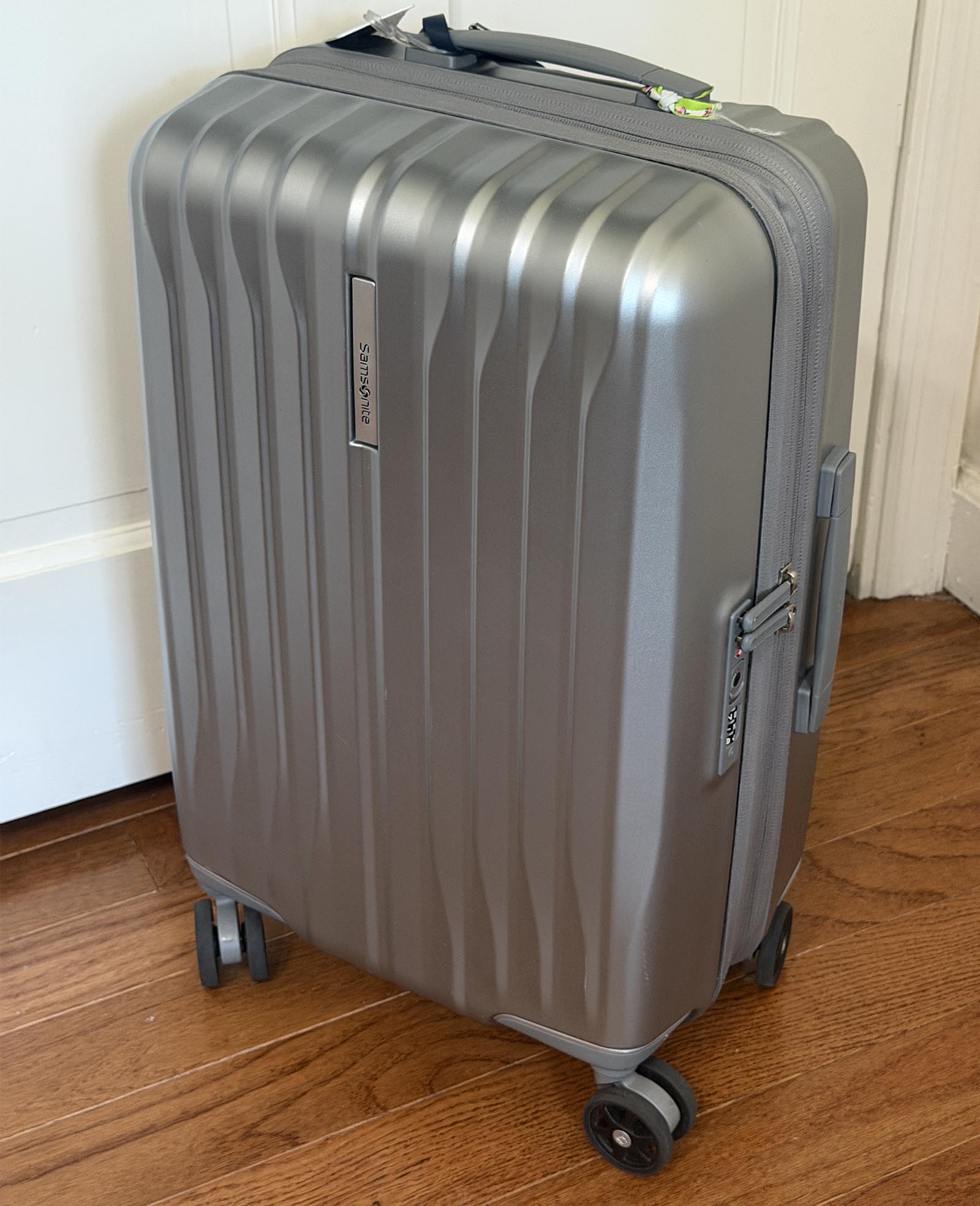 My Samsonite Uplift Hardside Carry-on Spinner ($159) was a lifesaver this summer traveling around Europe.
While I was investigating the Samsonite warranty process, I checked out the lightweight options and decided to test out the 5.07-pound Uplift Hardside Carry-on Spinner ($159). It’s a smaller European-sized carry-on (22″H x 14″L x 9″H) and was perfect for my trip because many European airlines have smaller overhead bins. To reduce weight, there are no proper inside pockets, just dual liner zipper dividers. (I’d rather just have one zipper divider with a mesh pocket personally, so I’m not a fan on the interior design.) I use this for my camera gear, and it rolls perfectly smooth.
Samsonite sells an even lighter model, the 4.7-pound Proxis Global Carry-on Spinner, with durable wheels to withstand cobblestone streets for a hefty $500 price tag. I just can’t justify paying that much for a carry-on!
Are luxury suitcase brands like Away worth it?
I haven’t tested AWAY myself (because I can’t justify the cost), so I can’t speak directly to them. I do have friends who rave about them, but they don’t travel as much as I do. Away’s limited lifetime warranty is a major selling point if you have the time to wait for a repair before your next trip. And, of course, don’t mind dragging around a broken suitcase if something happens during a trip. One of the perks of AWAY’s warranty terms is that damage from airlines is covered along with shipping.
Honestly, I do think they could have a lighter-weight carry-on that’s less than 7.5 pounds!
SafetyWing Review: What Happened When My Flight Was Delayed 24 Hours
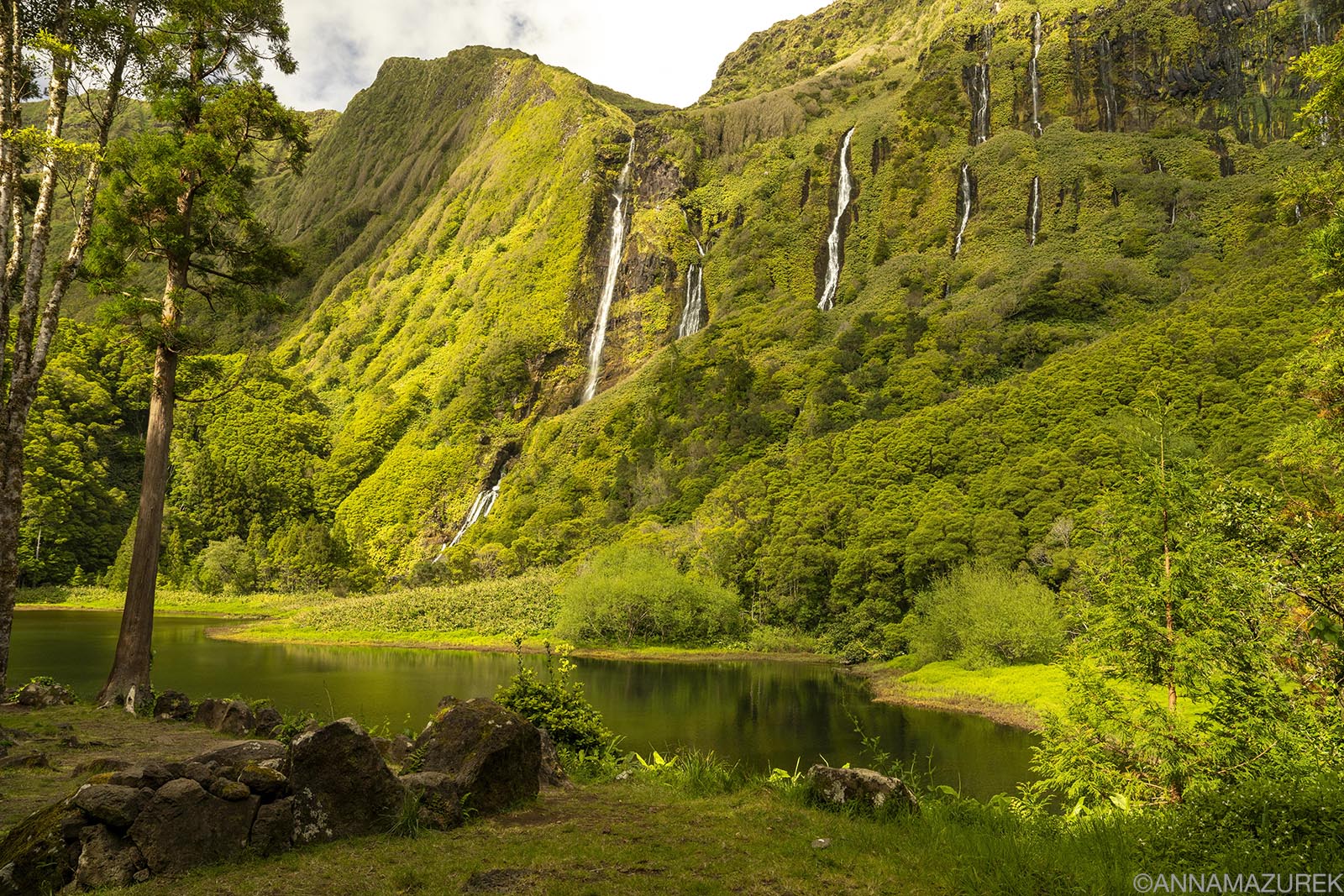 The cascading waterfalls of Ribeira Flores on the Azorean island of Flores is worth the flight delay to visit.
Since I travel full-time, one of the most important things I buy is travel medical insurance that includes travel delay coverage. I’ve been using SafetyWing for years and have previously written a review of my experience with medical claims. During a three-month Europe trip this spring, I used the travel benefit coverage for my SafetyWing Nomad Insurance plan when my flight to the Azores was canceled in May. In this post, I share my experience about filing a travel benefit claim with SafetyWing.
Affiliate links are used in this post. If you make a purchase, I earn affiliate revenue at no cost to you, which goes toward blog maintenance costs.
Who is SafetyWing?
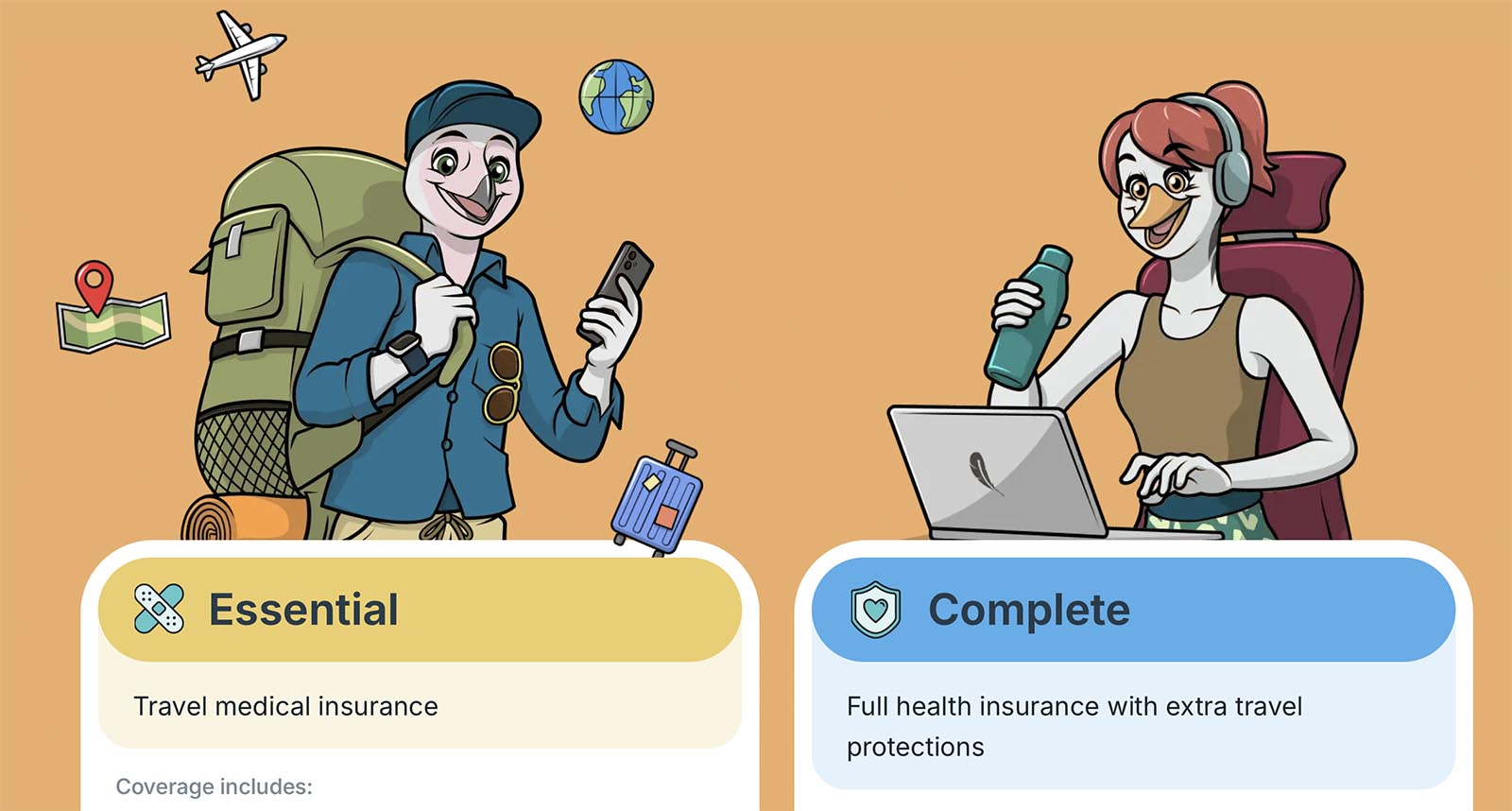 SafetyWing offers two types of travel medicial insurance polices, Essential and Complete.
SafetyWing is a fully remote startup founded in 2018 by expats and nomads providing travel medical insurance. The company provides two types of policies: Nomad Insurance Essential , flexible coverage from 5 to 364 days, and Nomad Insurance Complete, long-term full health insurance with additional travel protections. U.S. residents are not eligible for the latter. Neither policy covers preexisting conditions. For a full breakdown of each policy, SafetyWing has a nice visual chart of coverage options.
What are SafetyWing’s Travel Benefit Coverage?
SafetyWing covers delayed transportation more than three hours for flights, boats, trains and buses. A delay over three hours qualifies for a $60 reimbursement, while an eight-hour delay is $150 per night and up to $450 USD per trip and $900 per active insurance period.
The travel benefits also include inaccessible or canceled accommodation, lost checked luggage, stolen passport/travel visa, theft of wallet, along with trip interruption coverage. Visit the SafetyWing website for a full list of travel benefits.
If you decide to use SafetyWing, use code TravelAnna for 8 weeks of free electronic theft coverage on new 28-day subscription or annual Nomad Essential plans. New members only.
My Review of SafetyWing’s Travel Delay Benefit
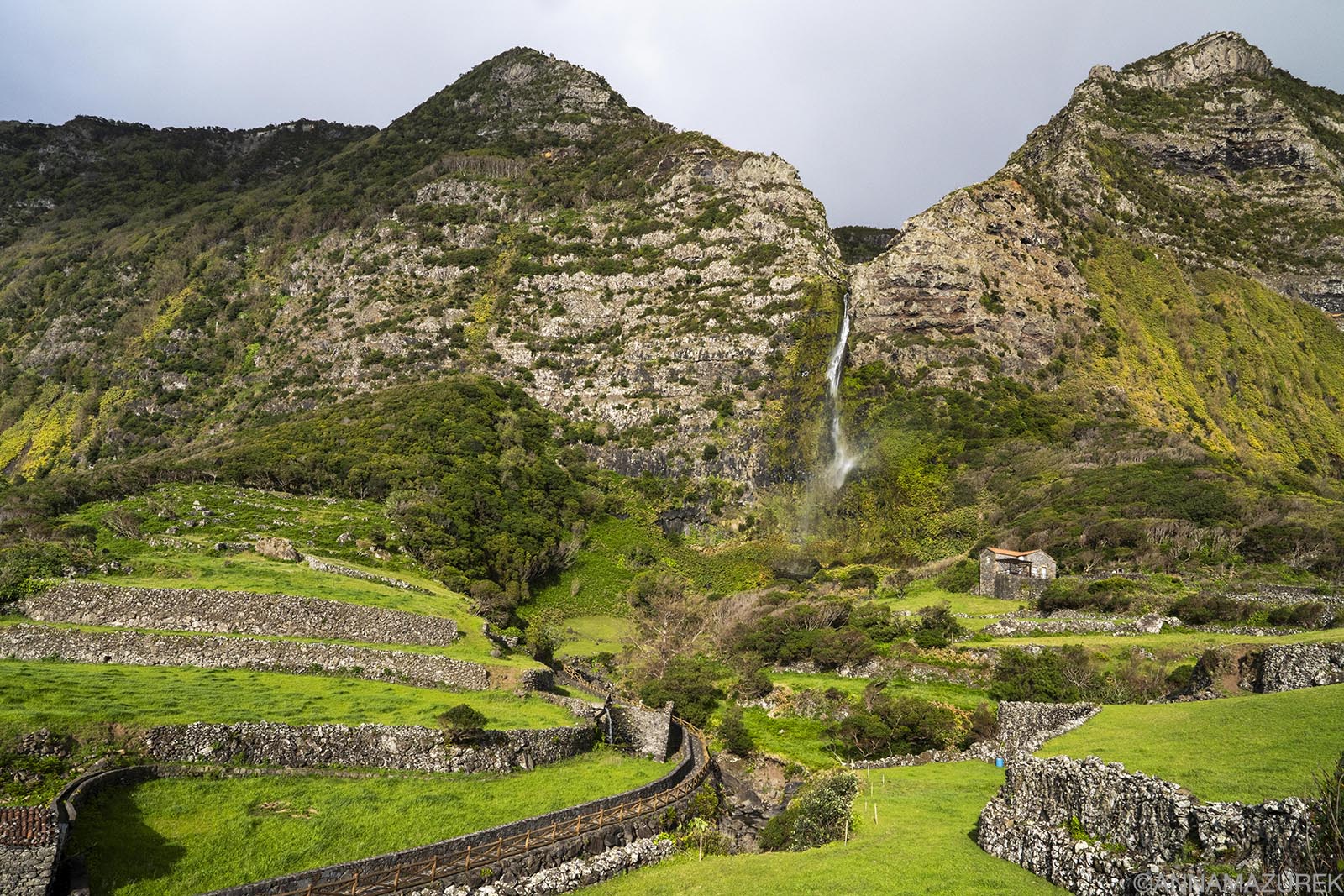 Poço do Bacalha waterfall near Fajã Grande on Flores island, Azores.
In early May, I visited Flores and Corvo, the two most remote islands in the Azores, which are not easy to reach and often involve multiple flight connections on tiny propeller planes. On our way to Flores, we flew from Lisbon to Terceira for a six-hour layover (ugh!) on SATA Airlines, the only airline that serves the remote islands.
Roughly an hour before our flight, the airport made a cancellation announcement because the incoming flight was canceled due to mechanical problems. My friend and I lined up at the airline service desk and were given tickets to the same flight the next day, a 24-hour delay.
After getting our new boarding passes, my friend said we should get a proof of delay letter from the airline, which is something I would not have thought to do. It’s very important to gather all the required documents and proof of delay before leaving the airport. Double check the airline fills out the form correctly.
SATA included the wrong flight number (the canceled incoming flight that in turn canceled our flight) on the form and listed an “irregularity” as the reason for the delay. (The form was in both English and Portuguese.) I didn’t catch the flight number issue because the numbers were so similar, and I was exhausted from being up at 5 a.m.
While the airline did offer some compensation, including a round-trip taxi to the main town, SafetyWing’s travel benefit was a huge help . The airline offered a hotel, which we declined due to the inconvenient location, and chose our own.
Since the delay was over eight hours, I was entitled to a $150 benefit from SafetyWing, which covered our hotel (with free breakfast) and my dinner and lunch exactly. The airline was only offering vouchers for airport cafe meals (ham and cheese sandwiches), which we declined.
SafetyWing Discount Codes
Use code TravelAnna for 8 weeks of free electronic theft coverage on new 28-day subscription or annual Nomad Essential plans. New members only.
 Due to our flight delay, we got to spend a night in the UNESCO town of Angra do Heroísmo on Terceria.
The delay happened on May 2nd, and I filed the claim on May 5th. The form was very simple and provided a place to explain the situation, so I typed a short paragraph. I submitted my receipt for purchasing the flight, the airline proof of delay letter, along with the boarding pass for the canceled flight and the new flight. I also uploaded receipts for the hotel and meals, totaling $150.86. It only took a few minutes to fill out the claim form because I had the documents organized in advance.
I got an email from a real human the following day requesting proof of the transportation delay, which was likely due to the error on the form. Since Flores was small, I stopped by the airport to correct the issue. The staff corrected the flight number but could not change the “irregularity” line to canceled. I submitted the new form and got a similar email the next day. I explained the issue with the form and attached a screenshot of a text from the airline saying the flight was canceled. The claim was approved the next day (May 8th), and the payment was direct deposited on May 19th. The entire process was completed in less than two weeks and would have been expedited if the airline hadn’t made a mistake on the form.
Under the new EU flight delay rules, SATA Airlines also owes us additional compensation, which we applied for the same day as the SafetyWing claim but have heard no response from the airline in over two months!
Overall, the process for filing a claim for SafetyWing’s travel delay benefit was fast and easy , and the 24/7 customer service always responded promptly. It was a much more pleasant experience than dealing with the airline support.
2-Week Eurail Itinerary: How to Travel Europe by Train (Budapest, Bratislava, Lake Bled & More)
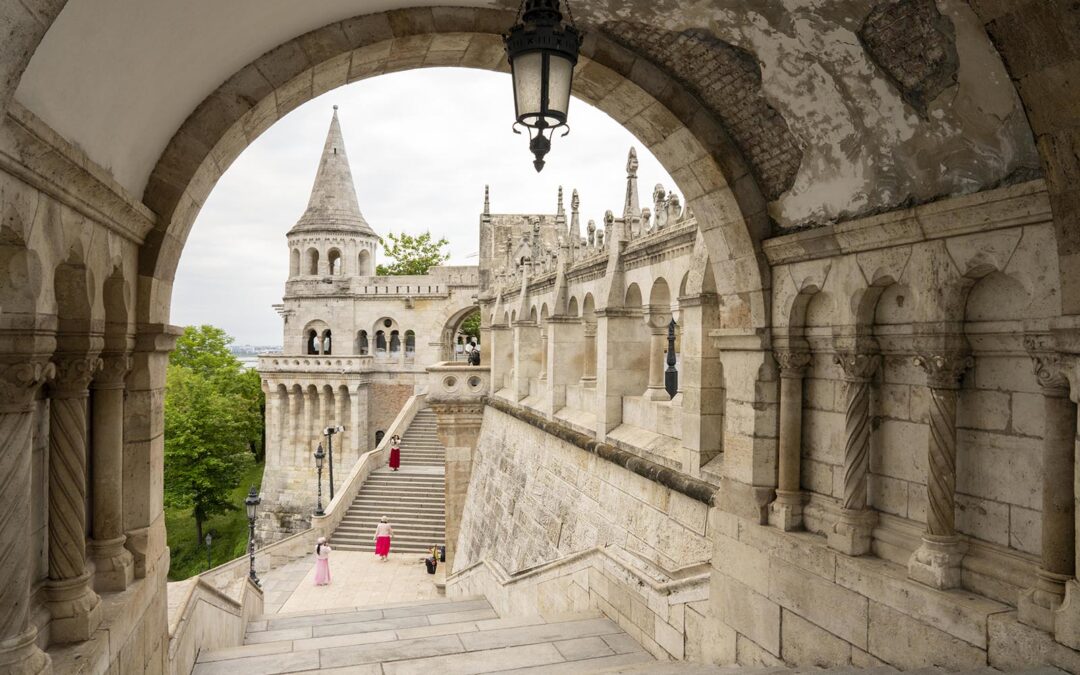
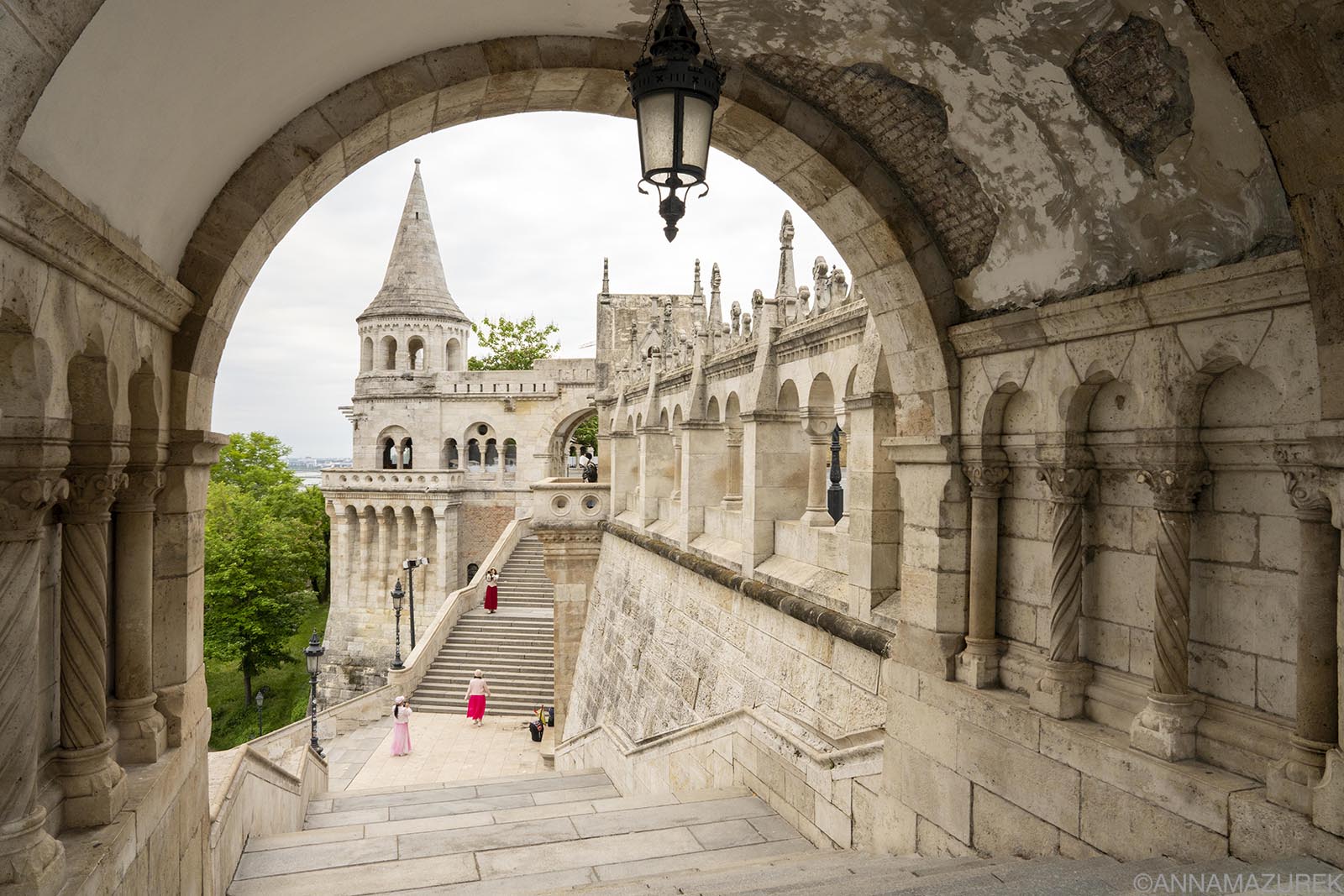 Sunrise at Fisherman’s Bastion, a fairytale-like UNESCO World Heritage Site in Budapest, Hungary, one of the highlights of my Eurail trip.
The best way to explore Europe is by train. Eurail makes it easy and affordable to travel seamlessly between countries in Europe without the hassle of airports. This spring, I spent three months in Europe with a long stint in the Azores for work. I was on a mission to explore some new parts of Central Europe and decided on a roughly two-week train trip to Wales and a Budapest-to-Zagreb journey with stops in Budapest, Bratislava (my new favorite city!), Vienna, Lake Bled (Slovenia) and Zagreb.
To help you plan your own European rail adventure, I wanted to break down my trip by location to share the best things to do, where to stay and eat, along with helpful tips on how to make the most of your Eurail pass.
Locations Visited: London, Conwy (Wales), Budapest, Bratislava, Vienna, Lake Bled, Zagreb
Duration of Trip: 16 Days
Type of Eurail Pass: Eurail Global First Class 15-Day Continuous Pass ($717 USD)
Disclosure : Eurail provided a free rail pass for this trip. All opinions are my own. The Eurail links are not affiliate links, but other affiliate links are included. If you make a purchase, I earn affiliate revenue at no cost to you.
Types of Eurail Passes
Eurail sells one country passes and global passes valid for two or more countries. Global passes include 33 countries and have two types: continuous or flexi, a set number of days within a month. All passes include unlimited travel .
Calculate how many days you will need to be traveling by train on your trip. If you are going to spend a few days in each city in between trains, then the cheaper flexible (flexi) passes are often your best bet. Since my trip was only 16 days, including four in Zagreb at the end, the 15-day continuous pass was perfect for me.
How to Use Your Eurail Pass
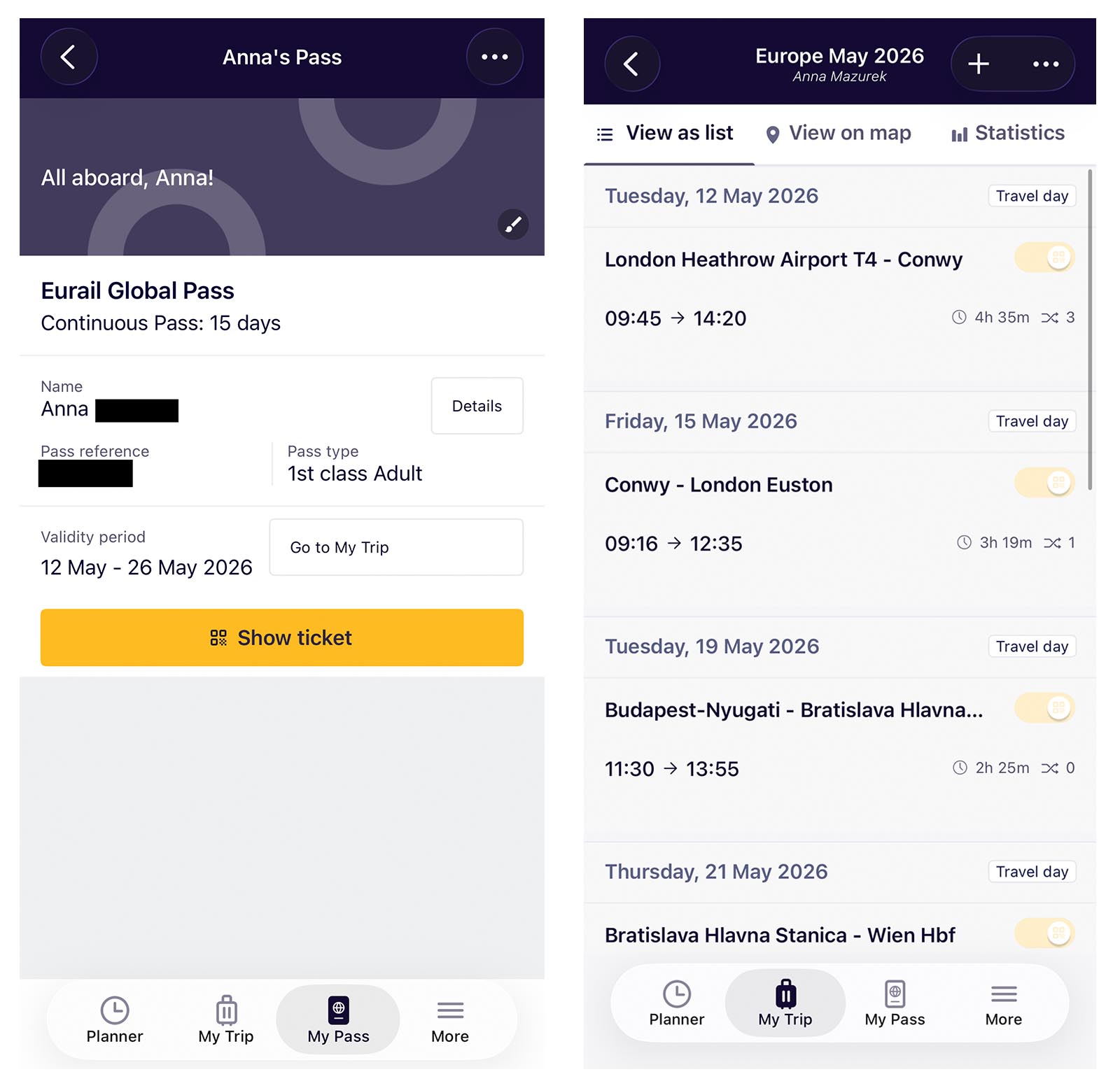 First, add and activate your Eurail Pass to your app (left), then start adding trains to your journey (right).
Activating your Eurail Pass and planning your trip is a breeze. First, purchase the pass that best suits your trip duration and type. Be sure to save and screenshot your confirmation email.
Next, download the Eurail Rail Planner App. To load your pass, simply go to the My Pass section on the bottom of the app, hit the plus button in the top right corner and follow the prompts to add your pass using your last name and pass number from your email confirmation.
Create a new trip under the My Trip section and name it accordingly. (I named mine Europe May 2026.) Then, use the planner tool to search for trains and add them to your trip, which automatically adds them to your pass. This feature easily organizes trains chronologically.
When you board the train, simply tap on My Pass, your trip name and show ticket to display a barcode railway staff scanned easily.
Conwy, Wales
 An aerial view from one of the eight towers at the 13th-century ruins of Conwy Castle in Wales.
Why Go: Conwy Castle is one of the most intact medieval castles in Europe.
Where to Stay: I loved this centrally located Airbnb .
How to get there: Express train from London Euston to Chester and Express from Chester to Conwy (3.5 hours)
How Long: Two nights
Despite having lived in England, I had never been to Wales, so I Googled “ best castle town in Wales, ” and Conwy was the perfect match. (I started my trip in the UK because I needed to make sure, I didn’t go over my 90 days in the Schengen.)
Conwy Castle, a behemoth ruin on the banks of the River Conwy, is the main attraction for good reason. I highly recommend climbing all eight towers for the views. For the best photos of the castle, take a stroll on the walking paths on both sides of the river.
For tasty meat pies, try the spicy dragon rolls or the turkey/cranberry ones at Edwards of Conwy. The soup and homemade scones at 2 The Square (right below my Airbnb !) were lovely. The Albion, a co-op between local craft breweries, is a good spot for a drink.
Benefits of Eurail Pass in U.K.
First-class trains in the U.K. are like business class on a plane —food and drinks (including craft beer and alcohol) are free. Of course, I didn’t know this and was sitting there with my Marks & Spencer’s sandwich like a peasant. No other train on my trip provided free food. The value for the money for the first-class Eurail Pass in the UK is unmatched in the rest of Europe. This short journey alone paid for my pass! (I break down the pricing in this section.) This was the nicest train of my entire trip.
I started my journey at London Heathrow and Eurail covers the Elizabeth Line train, so it was easy to get around in London, but I had to pay for a short Tube ride to connect to Euston station. My Eurail pass wouldn’t scan, so I always had to show it to an attendant for the Elizabeth Line. (FYI: The line connects directly to Paddington Station.)
Seat reservations are free on trains in the UK, so I made sure to reserve my seats at advance in the station. (You can do this in the Eurail app, but it’s paid. The app said reservations were required for my train, but this was not true.) Due to time and the fact that my job was paying for the flight, I flew from London to Budapest instead of taking the train, which would have been covered by my pass.
Budapest, Hungary
 A sunset view of Budapest’s parliament building from across the Danube River.
Why Go: Thermal baths, architecture (Parliament Building, Fisherman’s Bastion) and eclectic dive bars
Where to Stay: I loved this beautiful apartment on Airbnb.
How to get to Budapest: I flew from London to start my trip.
How Long: Three nights
Budapest did not disappoint. I purposely chose an Airbnb away from one of the city’s most famous and largest ruin bars (dive bars housed in abandoned buildings ), Szimpla Kert. One of my favorite photos spots was the fairytale-esque Fisherman’s Bastion that provides excellent views of the Parliament building. (I went at sunrise (5:30 a.m.!), and it was packed with Instagrammers who disappeared after an hour, so I finally had it to myself.)
It was cold and rainy, so I decided to visit the indoor circa 1571 Rudas Thermal Baths. The historic rooms were cool, but I was bored after an hour and left. One of the highlights was the Robert Capa Contemporary Photography Center, a gallery with rotating exhibits and a permanent exhibition about the famed Hungarian-born war photographer who assumed an American identity to command higher wages.
The Metropolitan Ervin Szabó Library is worth a visit. It costs $6 (for non-members) to explore the portion of the library housed in an ornate 19th-century palace.
Budapest Eurail Transit Tips
Since I had a lot of luggage, I ended up taking a taxi to the train station because the metro has the steepest escalators I’ve ever seen! The Eurail app said that a seat reservation was required for my train, which was true. I stopped by the train station the day before to book a seat. It was three Euros in person and six through the app. (It’s always cheaper to book seats in person at the station.) It was always very easy to book seat reservations in advance in person. I just showed my app with my pass and never had an issue.
Bratislava, Slovakia
 A view of Bratislava Castle from the top of St. Michael’s Tower.
Why Go: Laid-back European capital with cobbled streets and castles minus the crowds
Where to Stay: LOFT Hotel Bratislava
How to get there from Budapest: RJ276 Railjet Train from Budapest-Nyugati to Bratislava Hlavna Stanica (2.5 hours)
How Long: Two nights
Bratislava (Slovakia’s capital) was the most surprising part of the trip. I absolutely loved it—such a fun, livable city with large public parks and tons of people walking dogs. Plus, the craft beer and food were top-notch.
During its golden age, the city was the coronation capital of the Kingdom of Hungary from 1536-1783 at St. Martin’s Cathedral. The city is famous for its preserved cobbled old town, gorgeous palaces, quirky street statues (like Napoleon leaning on a bench) and the UFO bridge .
Buying the 24-hour (30 Euros) Bratislava Card was the most affordable way to see all the sights, but it was a struggle to see them all in one day! Public transport is also included. (Most European cities have this pass, but I didn’t find it to be a good value in Budapest for my interests.)
The best view in town is from the St. Michael’s Gate tower in the morning, and the interior of the pink-hued Primates Palace was very photogenic. Devin Castle, perched at the confluence of the Danube and Morava Rivers, is one of the country’s most important landmarks and worth the 30-minute bus ride.
Bratislava Eurail Travel Tips
The aging Bratislava train station wasn’t my favorite station of the trip, but it was very walkable from the old town (35 minutes). I chose a hotel ( LOFT Hotel Bratislava ) halfway between the two. The train to Vienna was a short 56-minute journey on an older commuter train with compartments of seat benches that face each other like they do in movies. Seat reservations weren’t possible. Even on the smaller trains like this, my Eurail pass worked easily with no issues.
Vienna, Austria
Why Go: Imperial history, classical music and coffeehouse culture
Where to Stay: DoubleTree
How to get there from Bratislava: ER 2515 Euregio from Bratislava Hlavna Stancia to Wien Hbf (56 minutes)
How Long: One night
Vienna was just a practical stop to break up the trip for the long journey to Lake Bled the next day. I’d been here before, and it’s not really my favorite. (Vienna does parks well, I will say.) I did walk around to a few locations from Before Sunrise, one of my favorite travel movies. The lounge for first-class was nice in Vienna and included a few snacks. It was mostly nice to have a quiet place to relax before the train.
Lake Bled, Slovenia
 The view of Bled Island in Lake Bled from the Ojstrica viewpoint.
Why Go: Emerald-green lake with a cliffside castle and a 17th-century church perched on an island
Where to Stay: Centrally-located Airbnb just steps from bus station
How to get there from Vienna: RJX 52 Railjet Express to Villach Hbf connecting to EC 115 EuroCity train to Lesce Bled (5 hours if trains are on time)
How Long: Two nights
The beauty of Lake Bled is undeniable, but beauty often equals crowds. Even on a weekend visit, I found ways to escape the hordes (go out before 10 a.m. and after 6 p.m.) to hike and paddleboard in relative solitude. It was a perfect weekend. (I did a morning run around the lake at 8 a.m. on a Sunday morning, and it was nearly deserted!)
I used the eastern edge of the lake in Bled, the largest village on the lake, as my base, which I would recommend. The first thing I did was walk the 3.7-mile loop (1.5 to 2 hours) around the lake at sunset to scout for photo locations.
For 20 Euro roundtrip, I took a traditional wooden pletna boat (rowed by a local oarsman) with other travelers to Bled Island to visit the 17th century Church of Assumption to ring the famous wishing bell. The island is worth visiting, and you can also rent a smaller rowboat to go on your own.
I’m a hiker, so I scouted the best time to trek to viewpoints for the best light for photos, which is 4 p.m. in late May. I did the Ojstrica Loop, going to the Mala Osojnia viewpoint first (highest view to separate the island from the mountains), then to the famous (and more crowded) Instagram spot of Ojstrica (island is centered in the lake with a rock people can stand on for photos).
I rented a paddleboard for 15 Euros/hour and had a magical Sunday morning. (You can’t land on the island in a paddleboard.) I recommend renting boats and paddleboards on the western side of the lake at this spot because it’s closer to the island. On my walk back to Bled on the southern side of the lake, I met an old man named Bobi selling paintings for 4 Euros who literally made my trip. When you buy a painting, he paints a portrait of you and him on the back!
For food, I loved the peach burrata salad and local wines at Beestro Bled, ice cream from Jodlar, baked goods and affordable sandwiches from Pekarna Planika (affordable) and pricey but delicious sandwiches for the train from the Market by the Lake.
Parking is terrible, so I’d avoid having a car unless you have parking at your accommodation. It’s easy to walk everywhere.
Lake Bled Eurail Travel Tips
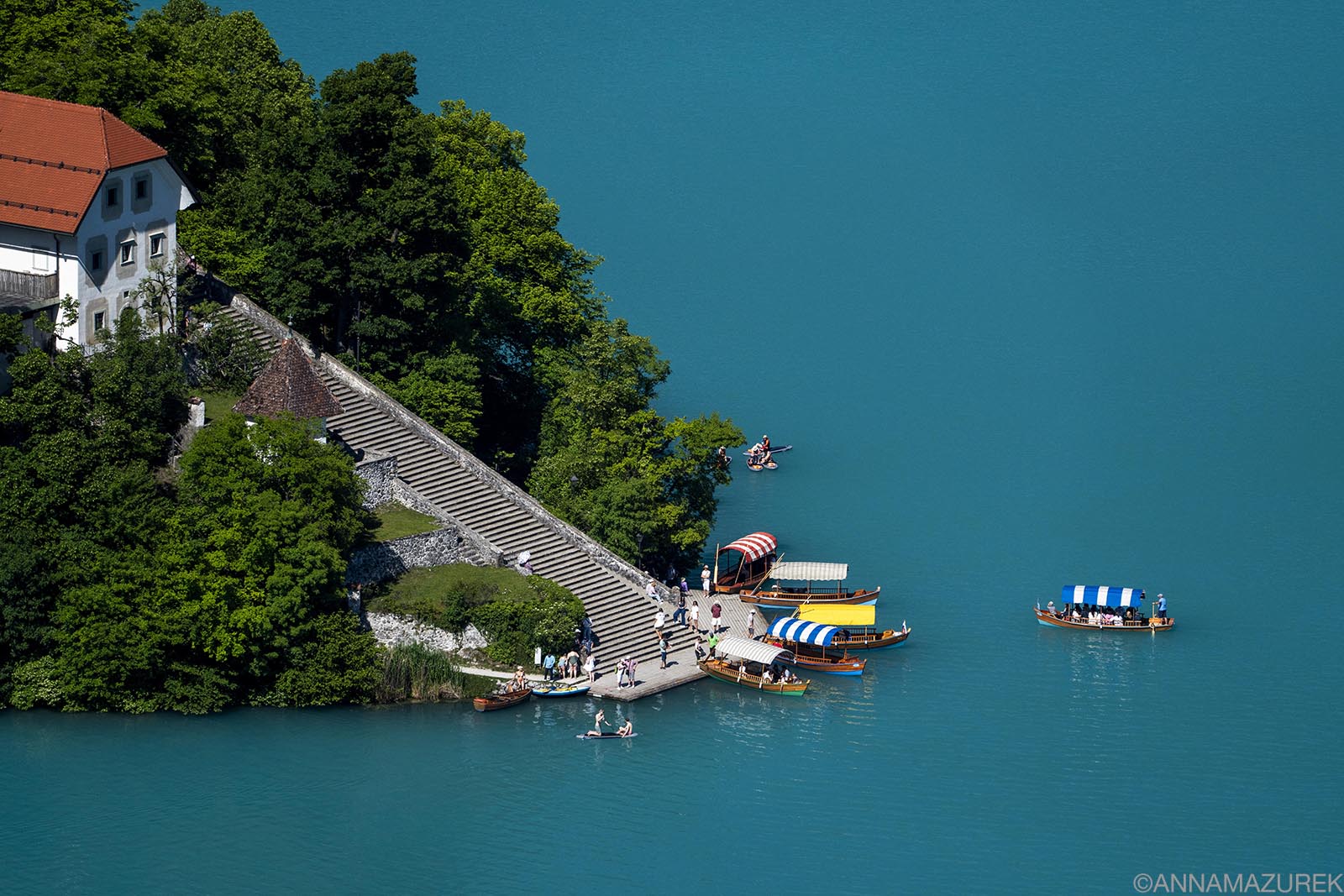 Traditional wooden pletna boats, rowed by an oarsman, drop off people at Bled Island for 20 Euros round-trip.
The town of Bled is about a six-minute drive from Lesce Bled train station. A taxi is 15 Euros, so I took the bus for 1.50 Euros. Check the bus schedule on the tourism website.
Arriving in Lake Bled by Train
The best thing about the Eurail pass is the ability to hop on almost any train (that doesn’t require reservations) instantly. If you miss a train, you just catch the next one with no drama. This was a huge benefit on my way to Bled because my initial train from Vienna was late, so I missed my connecting train and had to wait two hours for the next one. I didn’t have to stand in line to change my ticket. The first-class car on the smaller train was only half a carriage and not really the best.
Departing Lake Bled by Train
Since there were only two direct trains from Lesce Bled to Zagreb (an early and later afternoon one), I stored my luggage at Funturist Bled, a rafting, biking and outdoor company at the bus station for 5 Euros a bag. I highly recommend this spot because the owner was so nice and helpful with travel details. This train was packed, and the first-class car was overly crowded, so book ahead for seats if you can. (The Lesce station is staffed infrequently, so seat reservations were impossible in person, and it wasn’t an option in the app.)
Zagreb, Croatia
 The colorful tiled roof of St. Mark’s Church in Zagreb, built in 1880, features the medieval coat of arms of Croatia, Dalmatia and Slavonia on the left and the emblem of Zagreb on the right.
Why Go: Crowd-free capital with an excellent food scene
How to get there from Lake Bled: EC 115 EuroCity from Lesce Bled to Zagreb (3.5 hours)
How Long: Four Nights
Zagreb was a charming, livable city with a great food scene. It’s a refreshing break from the crowded hotspots of Spilt and Dubrovnik. It’s famous for the world’s shortest funicular ride (217 feet!) and the intricate, colorful tiled roof of St. Mark’s Church and the Grič Tunnel, an underground walkway through a former bomb shelter during World War II.
While those are all cool, the best thing in Zagreb is the Museum of Broken Relationships, a crowd-funded art project sharing objects and stories from broken relationships of all types (romantic, work, family and friendship). It’s hilarious, heartbreaking and above all, real. It’s worth going to Zagreb just for this award-winning museum!
The culinary scene is fabulous. Stop by Bastion No. 19 for some unique wines —one of the Croatian co-owners is the beverage manager for Gaggan in Bangkok. The Garden Brewery is an easy train ride from the city center and has one of the best taprooms in Europe. La Štruk serves up traditional Croatian štrukli, a baked dish of dough and fillings.
Eurail FAQ: Is a Eurail pass worth it?
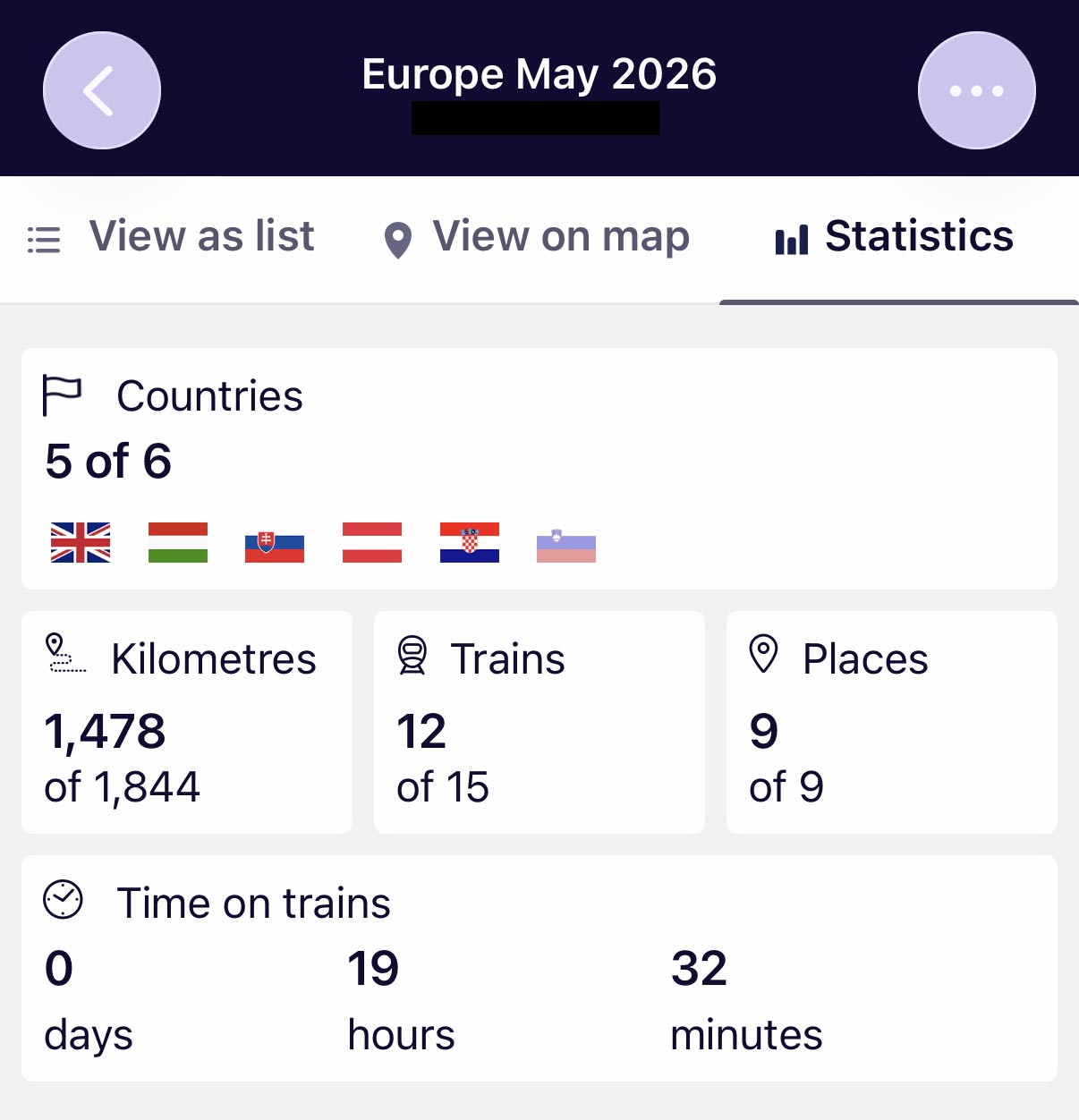 The Eurail Rail Planner app keeps track of your journey.
Yes, my Eurail pass saved me almost $300! An adult Eurail First Class 15-day consecutive pass is 618 EUR/$717 USD, while the total cost of individual tickets would have been $1,011.92. The pass saved me 27% of the total cost.
Prices below are all one-way for the trains I took on my trip.
London Heathrow to Conwy Wales (I did this round trip. One-way prices listed below.)
First Class: 281 GBP/$378 USD
Standard: 85 GBP/$114 USD
Budapest to Bratislava, Slovenia
First Class: 79.99 EUR/ $91.50 USD
Standard: 42 EUR/48.60 USD
Bratislava to Vienna
Standard: 18.50 EUR/21.16 USD
No first-class option.
Vienna to Lake Bled, Slovenia
First Class: 69.90 EUR/79.96 USD (nonflexible)
Standard: 49.50 EUR/56.62 USD (nonflexible)
Lake Bled to Zagreb
First Class: 54 EUR/62.30 USD
Standard: 36.25 EUR/41.47 USD
How to Use Make Seat Reservations with a Eurail Pass
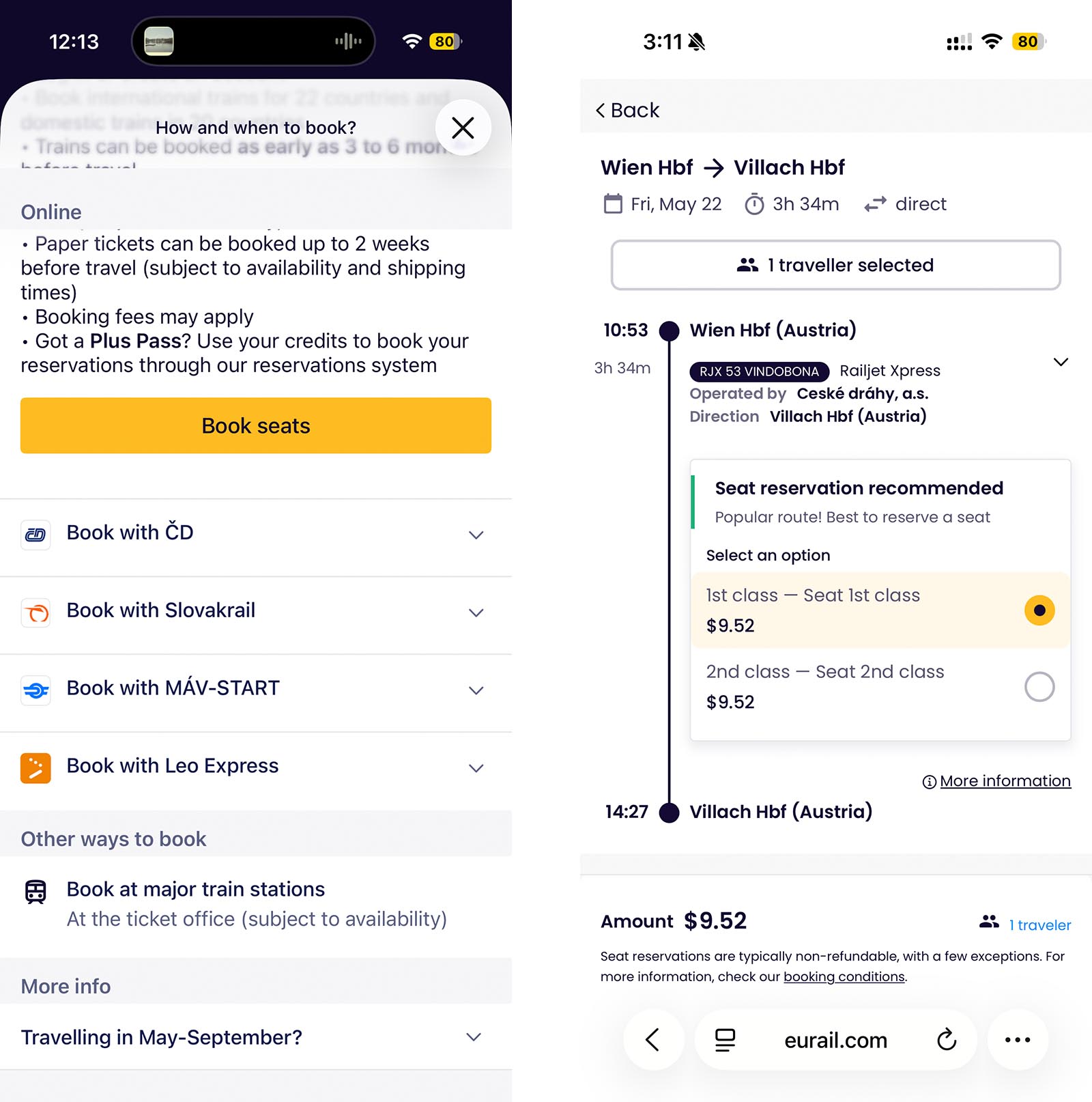 The Eurail app gives you the option to book and reserve seats on select trains in the app directly through Eurail or the trainline. Seats can also be reserved in person for a cheaper fee.
The Rail Planner app lets you make seat reservations for most trains for a fee (usually around 6 Euros). You can also reserve directly through the train line in person and online. I found it to be much cheaper to reserve seats directly at the station, instead of using the app. Keep in mind that seat reservations aren’t an option on many smaller trains. For peak travel times like holidays and summer months, reserve seats well in advance.
Is a first-class Eurail pass worth it?
A first-class Eurail pass is worth it if you are taking long-haul services, especially in the UK where food and alcohol are included for free. The shorter trains usually have very tiny first-class compartments that don’t add as much value as the long-haul ones. The standard price for my round trip trains to Wales alone was more than the cost of the pass. In big transit hubs, a first-class ticket and Eurail pass includes lounge access with snacks and WIFI.
Overall, my Eurail pass made this trip seamless, even with train delays. The pass is worth the money, but I’d just book seats in person at the station or directly through the train line to save money.
How much does a Eurail Trip Cost?
Excluding the rail pass, I spent $2,103 USD in 16 days, which is $131/day for my 16/day trip. My largest expense was accommodation. I spent about $150-120/USD night for hotels and Airbnbs because I needed a quiet place to work, so I was picky about where I stayed. (I mostly did Airbnbs because they were cheaper.) I did spent four nights in Zagreb at a friend’s place for free. I bought groceries for breakfast but ate out for most other meals. I was traveling solo, so this would have been a lot cheaper with a friend.
The U.S. dollar is pretty weak compared to the last few years, which made the trip much more expensive than I had originally planned. (The dollar was a lot stronger when I booked the trip!) Wales was the most expensive by far followed by Budapest and Vienna. Bratislava and Zagreb were surprisingly affordable with great quality food.
If you’d like to do this trip, I’d recommend sharing accommodation to cut costs along with eating out less.
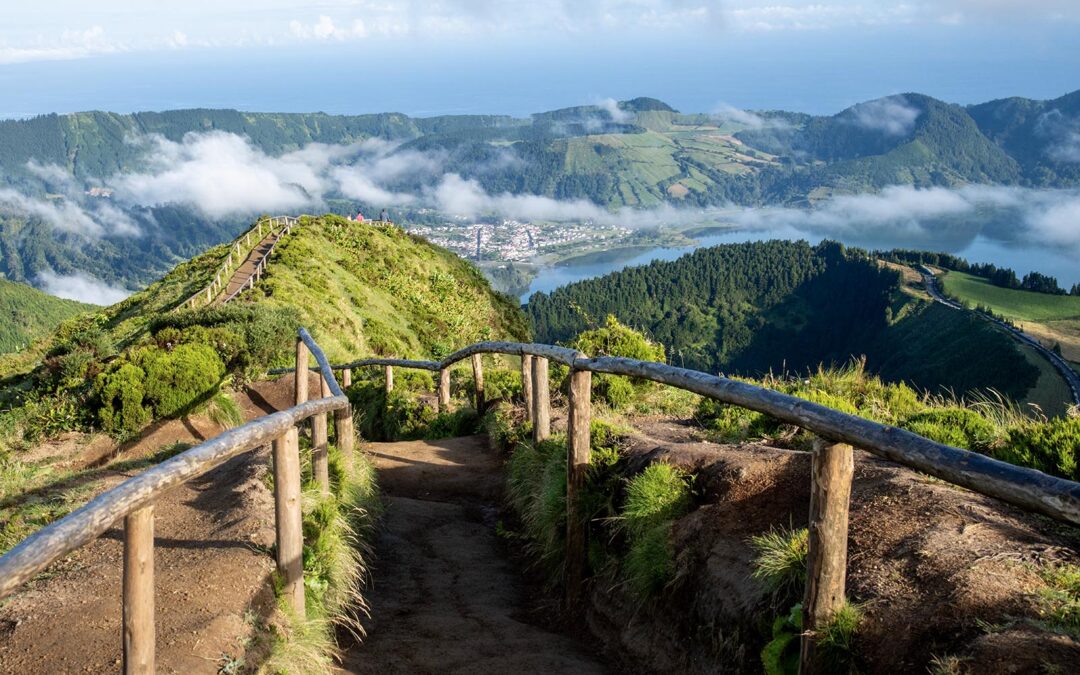
Best Places to Visit in Azores: I Visited All 9 Islands, Here’s Where to Go
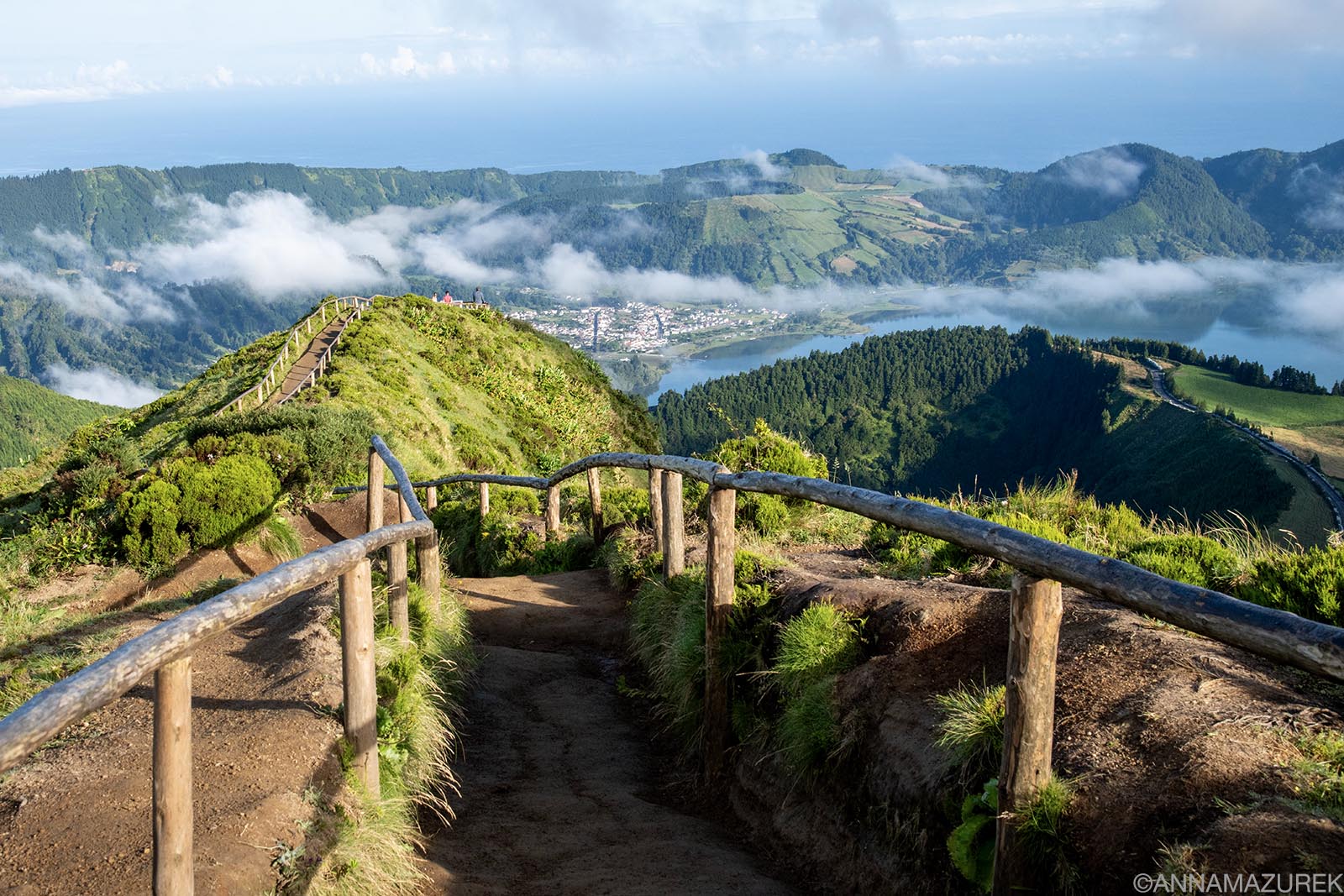 The short walk to Miradouro da Grota do Inferno is São Miguel’s most scenic viewpoint.
The Azores is a nine-island Portuguese archipelago located in the middle of the Atlantic Ocean between Europe and North America, known as Europe’s Hawaii for its mild climate and lush volcanic landscape. From epic hikes with jaw-dropping waterfalls to whale watching and soaking in thermal springs, these volcanic islands are worth a visit.
Half of Portugal’s cheese comes from the happy Azorean cows who live in a patchwork of endless green fields lined with volcanic rock fences. Each island has its own cheese and queijadas, dense egg tarts with varied fillings, which I highly recommend tasting.
Over the past three years, I’ve done an extensive amount of travel in the Azores and have visited (and hiked!) all nine islands. For hikers, the Azores provides excellent online trail maps and clearly marked trails. I’ve linked to the official trail maps for all hikes mentioned below.
The hardest part of planning is deciding the best places to visit in the Azores. Keep reading to decide which islands to visit, how far in advance to book and the best things to do in the Azores.
Affiliate links are used in this post. If you make a purchase, I earn a small commission at no cost to you, which goes toward the cost of maintaining this blog.
São Miguel
Best for hot springs, lakes & widest activity range
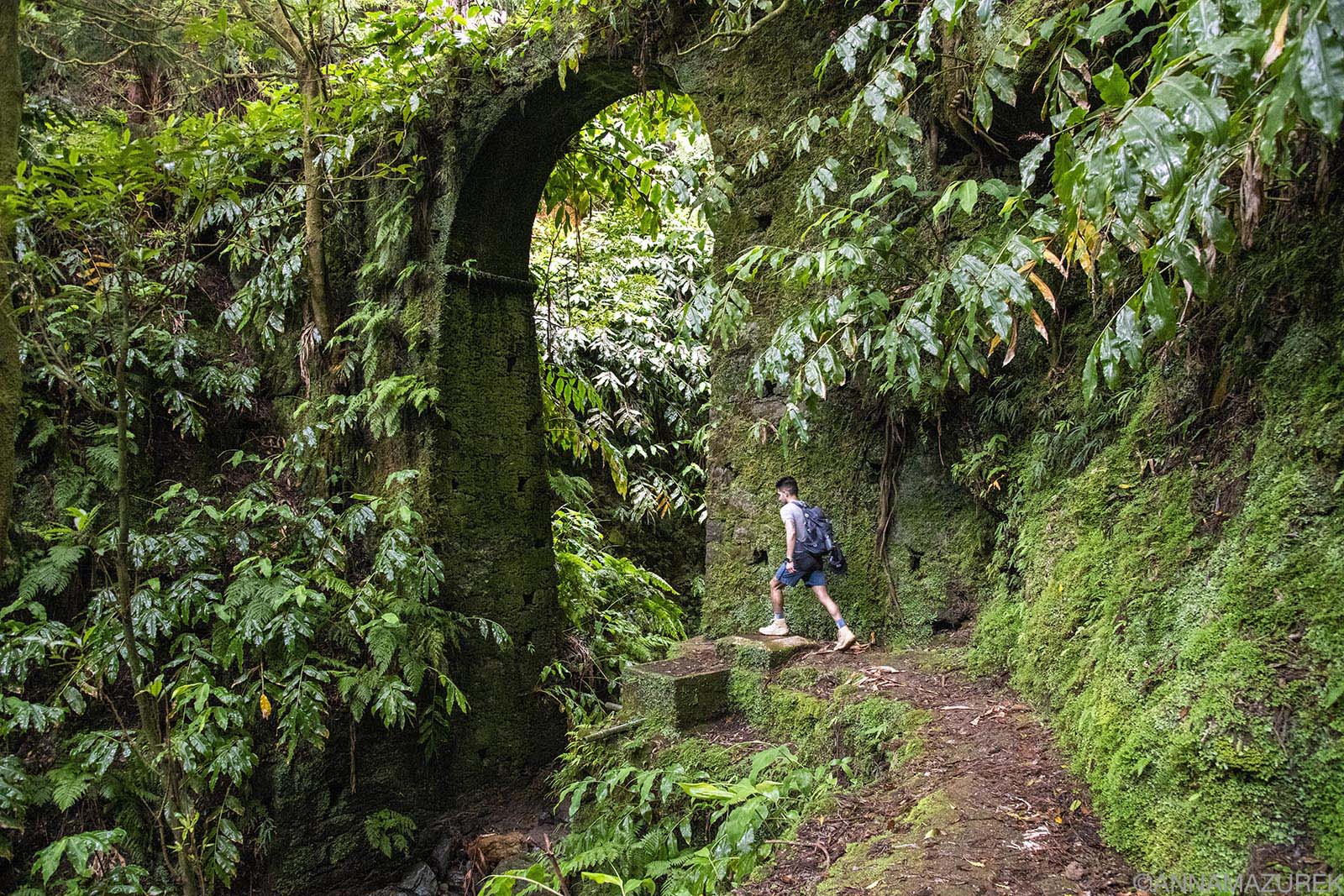 The Janela do Inferno hike is a photogenic series of stairs and tunnels.
Why Go: Easy-to-reach from Lisbon with whale watching, scenic lakes, lava tubes and hot springs
Where to Stay: Hotel Marina Atlântico in Ponta Delgada
How Long: 3-7 days
São Miguel is the largest island and the easiest to reach from Lisbon—a one-stop shop for the most impactful landscapes, ranging from lava tubes to scenic lakes and hot springs. One of my local guide friends calls the island a “volcano Disney park.” You can easily spend a week or 10 days here and never run out of things to do. It’s the best Azorean island (after Pico) for whale watching outings.
Sete Cidades, contrasting blue/green twin lakes in a dormant volcano, is one of the main draws. While you can hike the crater rim, the most scenic viewpoint is Miradouro da Grota do Inferno, a short walk best visited early before the crowds arrive.
There are over 30 official hiking trails, but my favorite São Miguel hikes are the Janela do Inferno, an easy scenic 4.7-mile trail with a series of tunnels, and Fogo Lake, a 6.8-mile hike along stone levadas to the island’s highest lake. Don’t miss Gruta do Carvão, lava tubes near Ponta Delgada.
 Cozido is a traditional Azorean dish of meat and vegetables cooked underground in pots with geothermal steam at Furnas Lake.
No trip to São Miguel is complete without a soak in the volcanic hot springs at Furnas. While I recommend visiting Parque Terra Nostra, a sprawling 30-acre botanical garden with a geothermal pool, I find the pools and modern facilities at Poça da Dona Beija to be more relaxing and less crowded. (Tip: Wear a dark bathing suit because the water will stain light colors.)
The Furnas Lake is a nice stroll, but be sure to arrive at the Caldeiras da Lagoa das Furnas around 11:30 a.m. to see people digging up traditional cozido pots, a signature Azorean dish with meat and vegetables cooked with geothermal steam underground. To sample it yourself, make a reservation at Resturante Tony’s or visit as part of a Furnas day tour. (To be honest, I don’t care for the dish, but some people love it.)
But, I do love the traditional queijadas from Queijadas do Morgado and the gelato from La Gelateria in Ponta Delgada.
Terceira
Best for history, lava tubes & natural swimming pools
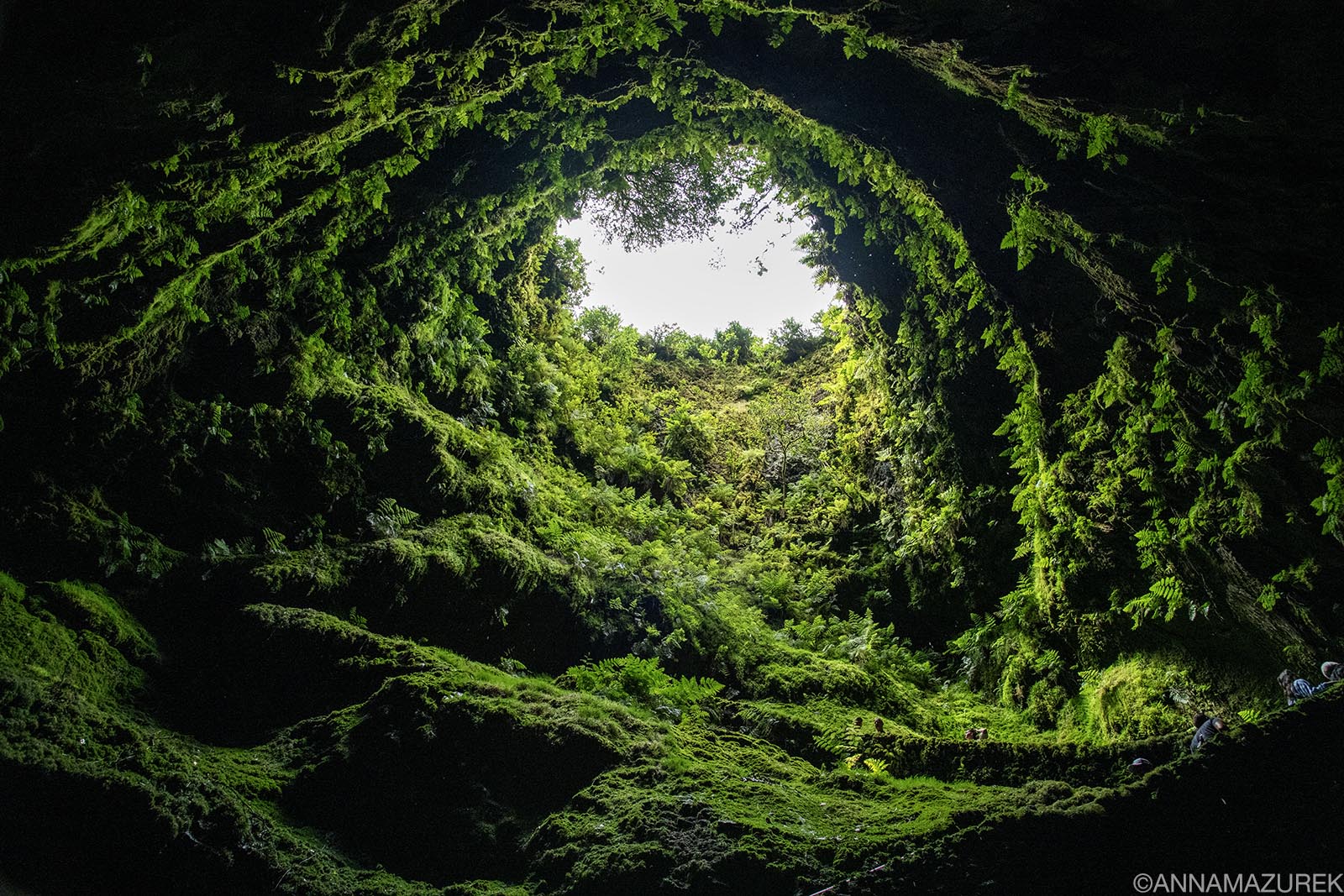 The vertical lava tube of Algar do Carvão on Terceira island is the most awe-inspiring.
Why Go: Portugal’s first UNESCO site, bullfighting, vertical lava tube and natural ocean swimming pools
Where to Stay: Hotel Cruzeiro in Angra do Heroísmo
How Long: 3 to 5 days
Terceira, the third-largest Azorean Island, is home to Portugal’s first UNESCO site, the town of Angra do Heroísmo, an obligatory port of call for ships from the 15th to 19th centuries protected by two 400-year-old fortresses. The city is the best hub for exploring the island.
Algar do Carvão, a vertical lava tube, is the archipelago’s most impressive. The best hikes in Terceira are Mistérios Negros, a hard 3.2-mile circular route; the hydrangea-lined cliffs of Rocha da Chambreand, and the ocean views from the easy Baías da Agualva.
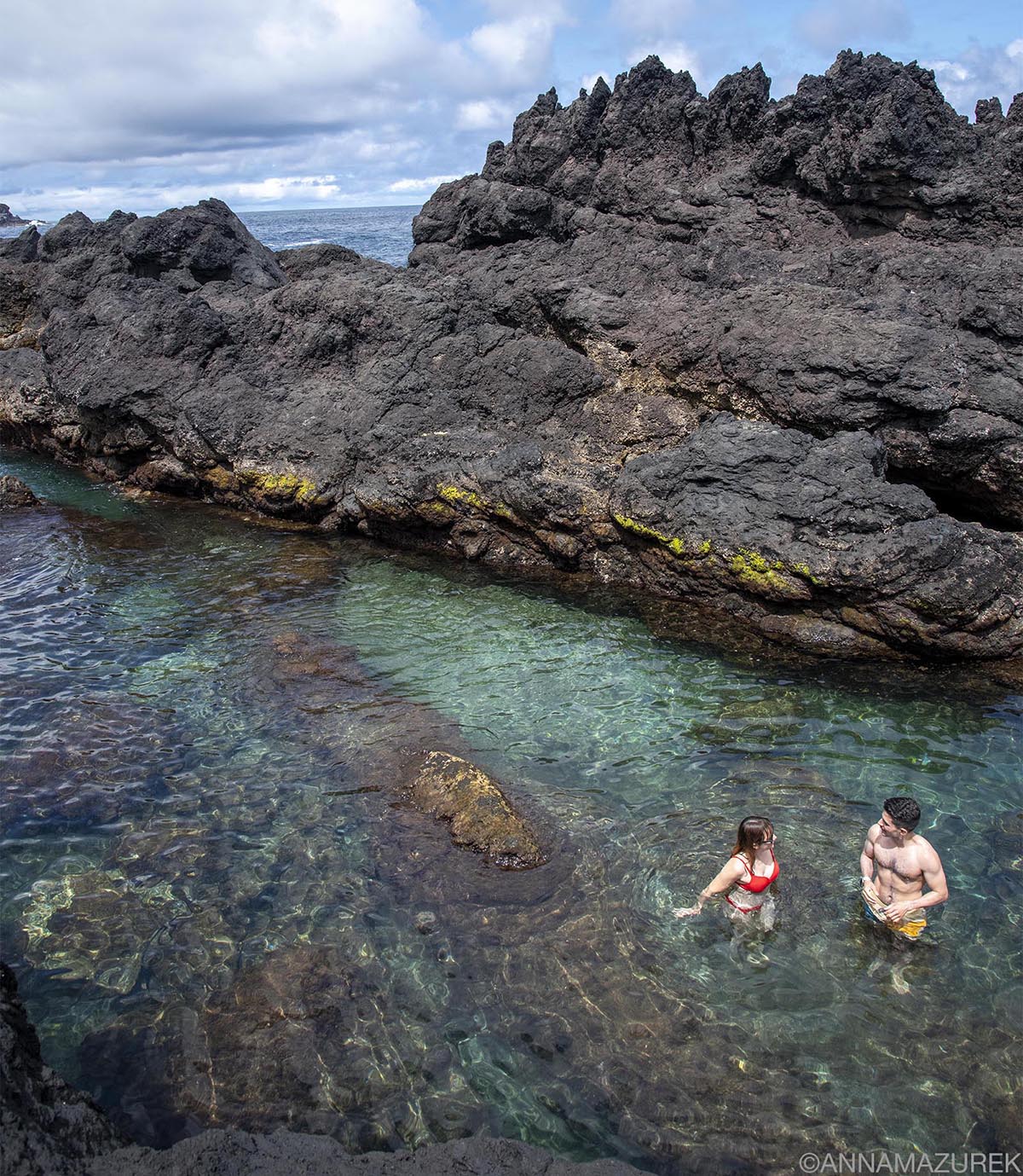 Piscinas Naturais Biscoitos is one of Terceira’s refreshing ocean swimming holes.
I highly recommend going for a post-hike dip in the Piscinas Naturais Biscoitos, natural rock ocean swimming holes. Visit the island in summer to witness the ancestral bullfighting. Bulls actually run through the streets!
The island is one of the easiest to reach (after São Miguel) from Lisbon and has a plethora of accommodation options. The craft beer scene is also solid.
Pico
Best for whale watching & wine
 Pico Mountain (7,713 feet) is the tallest peak in Portugal and a popular hike (permits required!) on Pico Island.
Why Go: Hike Portugal’s tallest peak, whale watching and sipping wine grown in lava rock vineyards
Where to Stay: Whale’come AO Pico or Casa do Brasão in Lajes do Pico
How Long: 3 days
Pico is one of the three triangular islands, including Faial and São Jorge, which are connected by frequent short ferries on the Atlantico line. The island’s namesake and biggest attraction is the 7,713-foot Pico Mountain, Portugal’s tallest peak. The hike is a challenging climb, taking roughly 6-to-8-hours roundtrip. Only 320 people are allowed each day and advance permits are required.
Pico’s vineyards literally grow out of lava rock, making it one of the world’s most unique landscapes and a UNESCO World Heritage Site. I’m a big fan of the white and rosé from Azores Wine Company. Book ahead for tastings.
A whale watching tour is a must for anyone visiting Pico. For a deep dive into the history of the local whaling industry, visit The Whaling Industry Museum, housed in a former whaling factory in Lajes do Pico. The factory was the largest sperm whale processing facility in the Azores and operated from 1946 to 1981.
Faial
Best for sailing culture
 Horta is the capital of the sailing culture with “sea art” along the marina and gin and tonics from a historical Peter Café Sport.
Why Go: Sailing culture and otherworldly landscapes
Where to Stay: Casa da Baía in Horta
How Long: 2-3 days
Faial is the sailor’s island—it is either the first or last stop for boats crossing the Atlantic—and has the strongest presence of sailors and maritime culture in the archipelago. The marina at Horta is an open-air museum of “sea art” painted by sailors for safe passage or to come their journey before having one of the famous gin and tonics at Peter Café Sport, a local watering hole that’s been welcoming seafarers since 1918. (The upstairs has an impressive scrimshaw (carved whale teeth/bones) museum.)
For food and drinks, I like Oceanic Cafe (great bar, too) or Restaurant Atlético. The homemade ice cream at Gelados do Atlântico is another favorite.
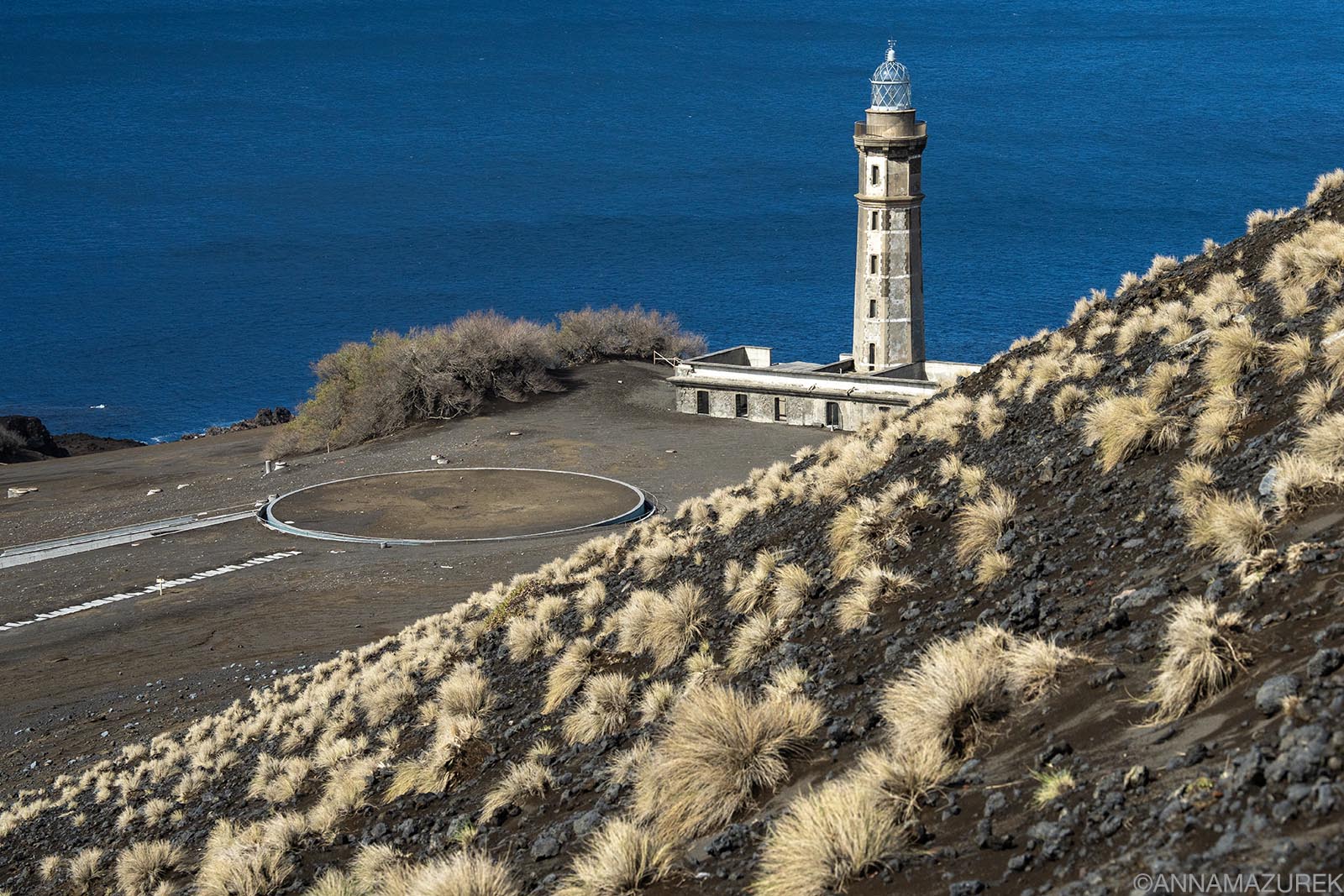 My favorite place in the Azores is hiking to the ruins of the Capelinhos lighthouse, a result of a 13-month eruption in the late 1950s.
If you’re up for a challenge, the 12- mile Dez Vulcões (10 Volcanoes trail) hike is a must. (Shorter variations are an option, too.) The trail ends at the ruins of the lighthouse of Capelinhos, which was destroyed during the 13-month eruption in 1957-8 that added roughly 617 acres of land to the island. The otherworldly landscape is one of my favorite places in the Azores. Be sure to climb the lighthouse, and visit the fantastic interpretation center.
São Jorge
Best for extreme hikes & cheese
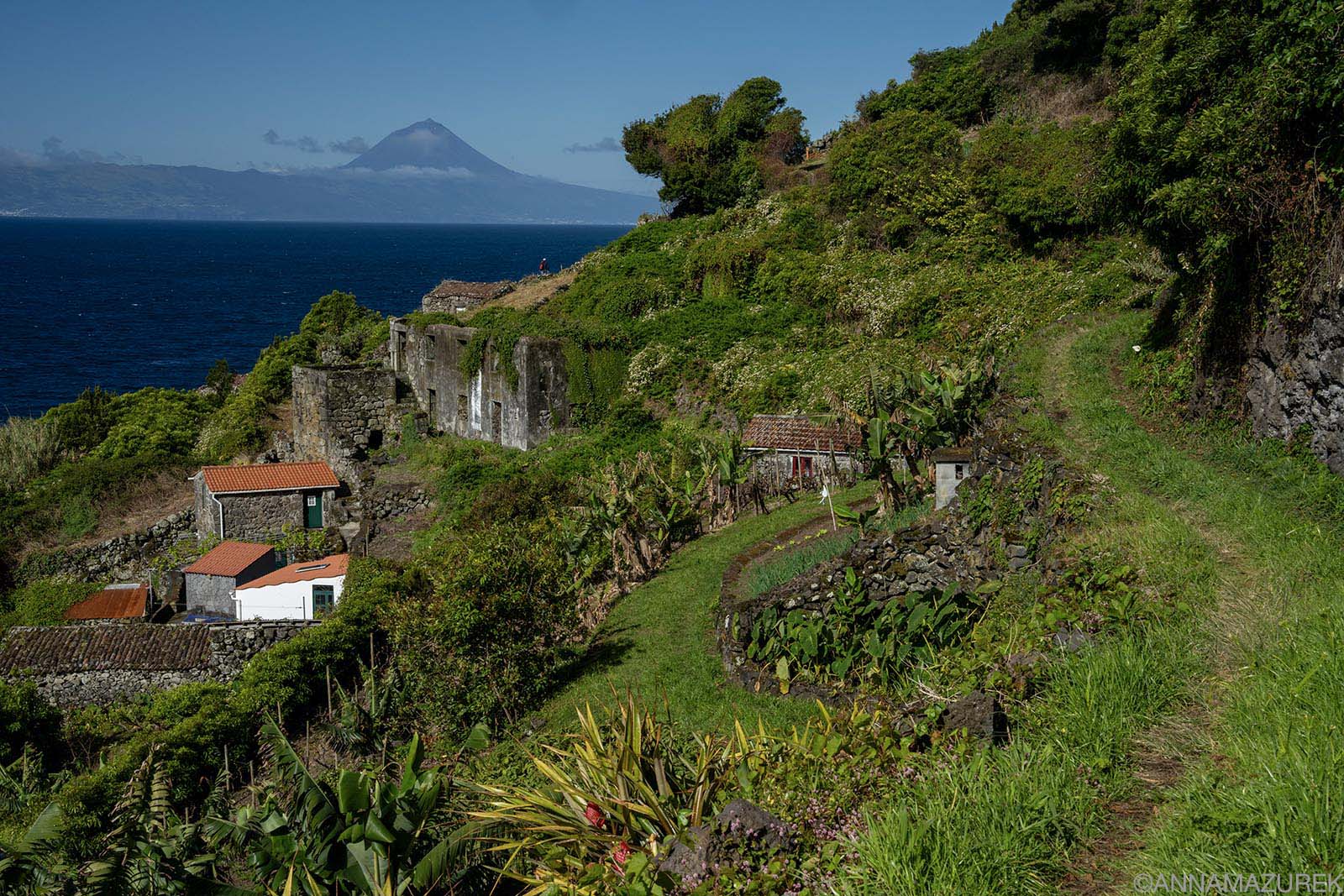 The steep cliffs of São Jorge with Pico Mountain in the background.
Why Go: Extreme hikes & cheese tastings
Where to Stay: Hotel Sao Jorge Garden in Velas
How Long: 2-3 days
São Jorge, famous for cheese, is often called the dragon island for its narrow shape and jagged, steep cliffs. All the hikes are extreme—straight up or down. You can even hike the 34.7-mile-long island end-to-end on the Grand Route (trails GR01SJO and GR02SJO). Portuguese surfers flock to Santa Cristo, accessible only by foot or quad bike.
The sleepy town of Velas is the ferry port from Faial and Pico, and the best hub for accommodation. For a good meal and cheese, I like Alcatra Rustica Sao Jorge (located in center of island off main road). Coffee-lovers shouldn’t miss the house-grown espresso at Café Nunes.
No visit to São Jorge is complete without tasting the cheese, originally made famous by sailors for its longevity and taste (mild yet buttery). Tour one of the three active cheese manufacturers on the island: Uniqueijo, Finisterra and Lourais.
Graciosa
Best for solitude & epic lava cave
 The lava cave of Furna do Enxofre on Graciosa island.
Why Go: Least crowded island with largest volcanic dome in Europe
Where to Stay: Praia or Santa Cruz da Graciosa
How Long: 2 Days
Graciosa is the second smallest and the least visited Azorean island, making it the best place to escape crowds. School buses double as tourist transport around the school schedule!
While the entire island is a UNESCO Biosphere Reserve, the highlight is Furna do Enxofre, a lava cave housing the largest volcanic dome in Europe. It’s worth the 183-steps to walk down (and back up!) to see the lake inside the cave.
While the island has mild slopes, it’s still fun to hike or bike the 405-meter-high Caldeira da Graciosa. The famous red-roof, Dutch-style windmills, many of which are rental accommodation, are another highlight. The queijadas from the nearby Queijadas da Graciosa Factory are tasty. Locals call Graciosa “the 15-minute island” because everything is 15 minutes away from everything else, from hot springs to surf spots.
Flores
Best for waterfalls & wild nature
 Flores is home to the most stunning landscapes in the Azores, including Cascata da Ribeira do Ferreiro, a series of waterfalls cascading into a lake.
Why Go: Untouched Nature & Waterfalls
Where to Stay: Villas do Mar in Fajã Grande
How Long: 5 Days, including day trip to Corvo
Flores is the magical wild island and yet another UNESCO Biosphere Reserve. (It’s the furthest western island in the Western Group that includes Corvo.) If I had to pick a favorite Azorean island, it would be Flores.
The landscape on the west coast is the most beautiful in the Azores, thanks to Cascata da Ribeira do Ferreiro, a series of a dozen waterfalls cascading into a natural amphitheater. It’s a 20-minute uphill hike from the road but best seen as part of the longer eight-mile Lajedo to Fajã Grande hike that meanders through a ghost town and epic viewpoints.
Other highlights include Baía da Alagoa, a photogenic bay with rocky outcrops accessible via a short trail, and Rocha dos Bordões, a vertical set of basalt columns. Book ahead for the duck at Maresia Restaurant in Fajã Grande. It was so delicious we went twice!
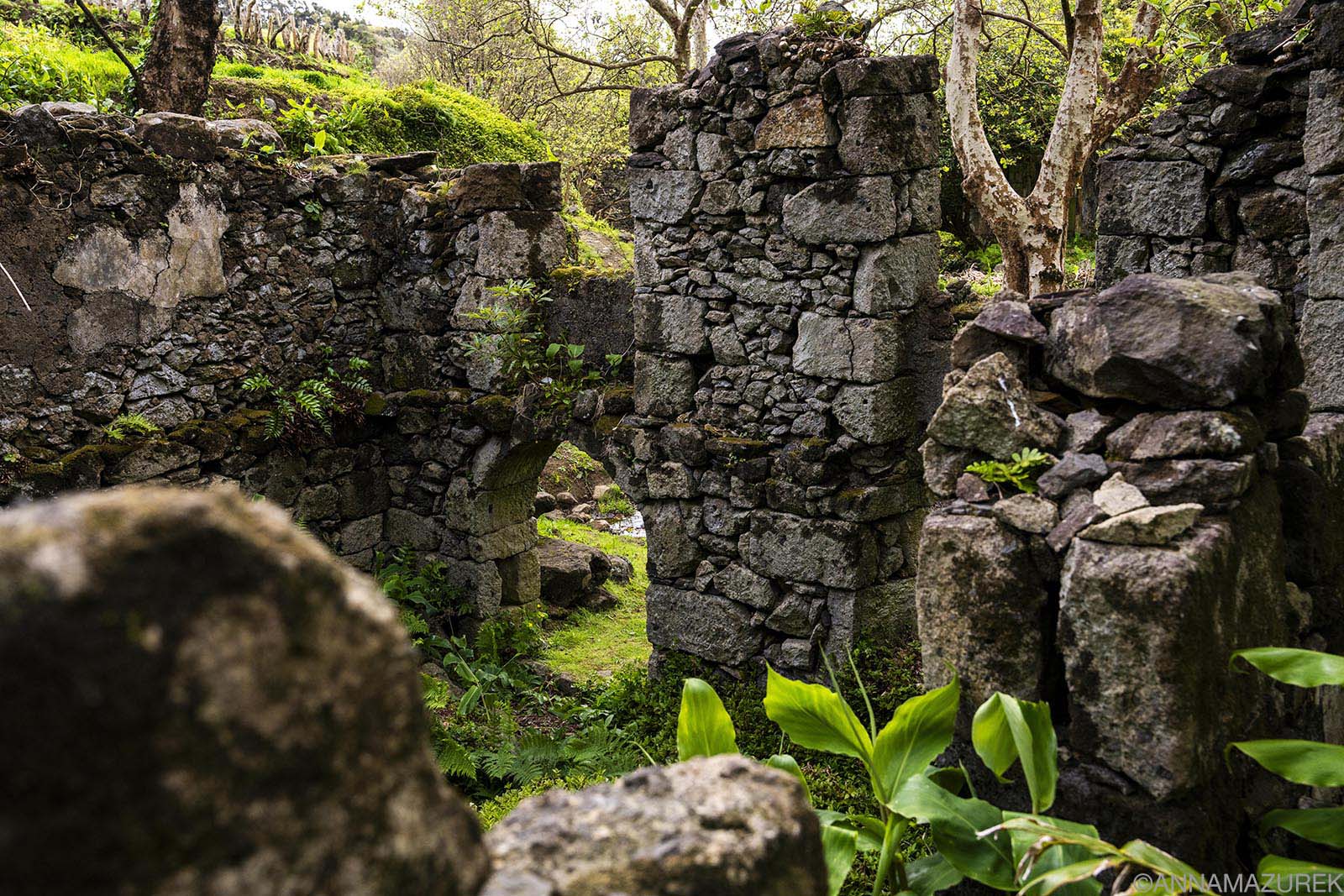 The ghost town of Caldeira do Mosteiro is on the Lajedo to Fajã Grande hike but can also be visited by car.
I found the seven volcanic crater lakes to be underwhelming, but the final view of Fajã Grande at the end of the Miradouro das Lagoas to Poco do Bacalhau trek was worth the effort. Please note that stage 2 of the Grand Route trail closed in July 2024 due to fallen rocks and trail disintegration. It was still closed in May 2026 and unlikely to reopen anytime soon.
The two museums in Santa Cruz, Fábrica da Baleia do Boqueirão, a former whaling-factory, and the Flores Museum housed in a 17th century church, were fantastic. All public museums in the Azores are free on Sundays.
Flight cancellations and delays are common when visiting Flores and/or Corvo, so plan a night or two in Lisbon as a buffer between any international flights. We got stuck in Terceira for a night due to a flight cancellation. I highly recommend travel insurance.
Corvo
Best for staying off-the-grid
 The Corvo Caldera is 1.42 miles in diameter and 1,000 feet wide. It’s a popular hiking spot shared with grazing sheep and cows.
Why Go: Most impressive volcanic crater in Azores
Where to Stay: Joe & Vera’s Villa in Vila do Corvo
How Long: 1 or 2 days
The entirety of Corvo, the smallest Azorean Island, is a UNESCO Biosphere Reserve and home to the archipelago’s most beautiful volcanic crater. While it can be visited easily on a day trip (weather permitting!) from Flores, it’s worth staying longer.
Hiking the caldera (trail PRC02COR) is the main attraction. While you can hike to the caldera (all uphill!) from town, it’s best to take a taxi (20 Euro RT for two people) to the trailhead then hike back. When you get to the trailhead, walk up to the radio tower for an aerial view, then walk back down to take the official trail down into the crater. The island’s second trail is the 6.4-mile trek, Cara do Índo, from the caldera (mostly downhill) back to Vila do Corvo.
The island only has one village, Vila do Corvo (population 430), with two restaurants and limited accommodation, so book ahead for meals and rooms. There is free camping park near Praia da Areia beach.
 Famed Portuguese street artist Bordalo II has three sculptures on Corvo.
Bordalo II, a famous Portuguese street artist known for creating large installations out of trash, has three sculptures on Corvo: Mero, a grouper fish on the side of an old boat; Cagarro, a Cory’s Shearwater (migratory seabird) on a building; and a cow (my favorite) on the side of an old car in a junkyard.
There’s an airport with limited flight connections to Flores, Faial and São Miguel. We took the Atlântico Line ferry from Flores but left a night early due to incoming bad weather on a private open-air zodiac-style boat booked through our helpful taxi driver, Lourenço, who runs a tour agency called Paralelo 39. I highly recommend booking through him. (I recommend using the free Windy app to track sea and wind conditions.)
Santa Maria
Best for diving & summer festivals
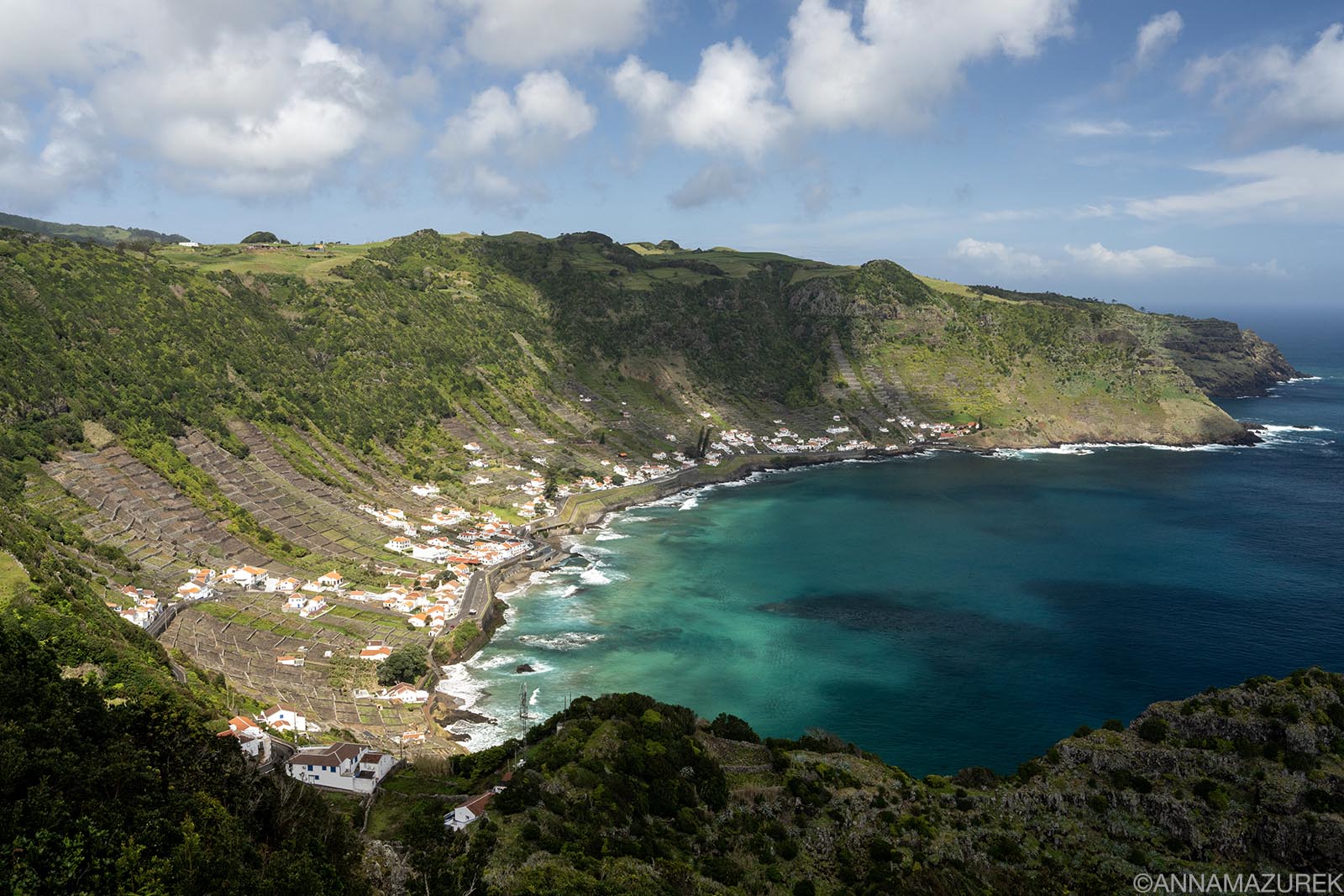 The vineyard-clad slopes of São Lourenço Bay on Santa Maria in the Azores.
Why Go: Swim with manta rays and whale sharks, summer festivals, then hike the island end-to-end on the 78.6 km Grand Route.
Where to Stay: Vila do Porto
How Long: 2-3 days
Santa Maria, the southernmost island, is famous for being the sunniest Azorean Island with a bit of a Caribbean vibe (in my opinion) and white sandy beaches. Manta rays and whale sharks frequent the island in summer (June to October), including the marine protected area of Baixa do Ambrósio, one of the Azores’ best dive sites. July and August are best for free diving sightings, but scuba divers can see them starting in June, according to local guides.
Hike the island end-to-end on the 78.6 km Grand Route (2.5-3 days) or opt for a shorter trek like Areia Branca (PR06SMA) through São Lourenço Bay, a natural terraced amphitheater lined with vineyards. Don’t miss the summer music festivals—Santa Maria Blues (July) and Maré de Agosto (August).
Azores Travel FAQ
 The most photogenic time to visit the Azores is when the invasive hydrangeas bloom from late June to August.
When is the best time to go to the Azores?
The summer months of June through September have the best weather for hiking, sunshine and blooming hydrangeas. While it can be crowded, it will likely be less crowded now that Ryanair suspended all flights to the Azores in March 2026.
For peak summer season, book accommodation a year in advance for all islands except São Miguel and Terceira. I tried to book in April for a July trip to Pico and Flores once, but everything (cars and hotels) was sold out. We had to change the islands we visited.
The shoulder months of April and May have fewer crowds but a higher chance of rain and rough seas, which can affect flights and ferries. I’d still book at least six months out if not more for accommodation and cars in shoulder season. For my May trip to Flores and Corvo, I booked accommodation in October, flights in January and rental cars in December.
What is the best way to get around the Azores?
Renting a car is the best way to explore the islands. All the islands, excluding Corvo, have public buses, but planning hikes around infrequent bus schedules on islands like Flores is complicated. (Sometimes, there’s a 7:45 a.m. school bus, and nothing until 3 p.m.!) Taxis are an alternative but can be a bit pricey.
There are two main local rental car companies on each island, Ilha Verde and Autoatlantis. I used both on Flores, and they were fine. Ilha Verde had nicer cars, but Autoatlantis seemed a bit cheaper. I found the rates on Booking.com and DiscoverCars.com to be the cheapest. There are a few bigger rental brands on the bigger islands, but I recommend supporting the local companies.
On the smaller islands, it’s best to book months in advance for the best prices and options. In Corvo, you can only rent small electric cars that don’t have enough range to make it to the caldera, so you’ll need to take a taxi or hike.
In May, we returned to Flores a day early from Corvo due to weather. Thankfully, I got a last-minute car rental through Ilha Verde on DiscoverCars.com because Autoatlantis was fully booked. For a six-month advance booking, I got a car for $56 USD/day with Booking.com but a last-minute booking on DiscoverCars.com for $114 USD/day, which was cheapest option last minute.
 There are more cows than people in the Azores. Every island has its own cheese.
Is it easy to get between islands in the Azores?
Atlântico Line ferries are the easiest way to travel between Flores and Corvo (40 minutes, pedestrian only), the two most Western Islands, and the Triangle Islands of Faial, Pico and São Jorge. There is a seasonal summer ferry between Terceira and Graciosa that runs roughly once a week. There are private boats that also connect the islands.
Otherwise, a series of inter-island flights on SATA Azores Airlines are your best options. These are usually smaller propeller planes, so carry-on luggage space can be limited.
From Lisbon, you can fly directly to São Miguel, Pico, Terceira and Faial on Azores Airlines and/or TAP Air Portugal. Ryanair stopped flying to the Azores in March 2026.
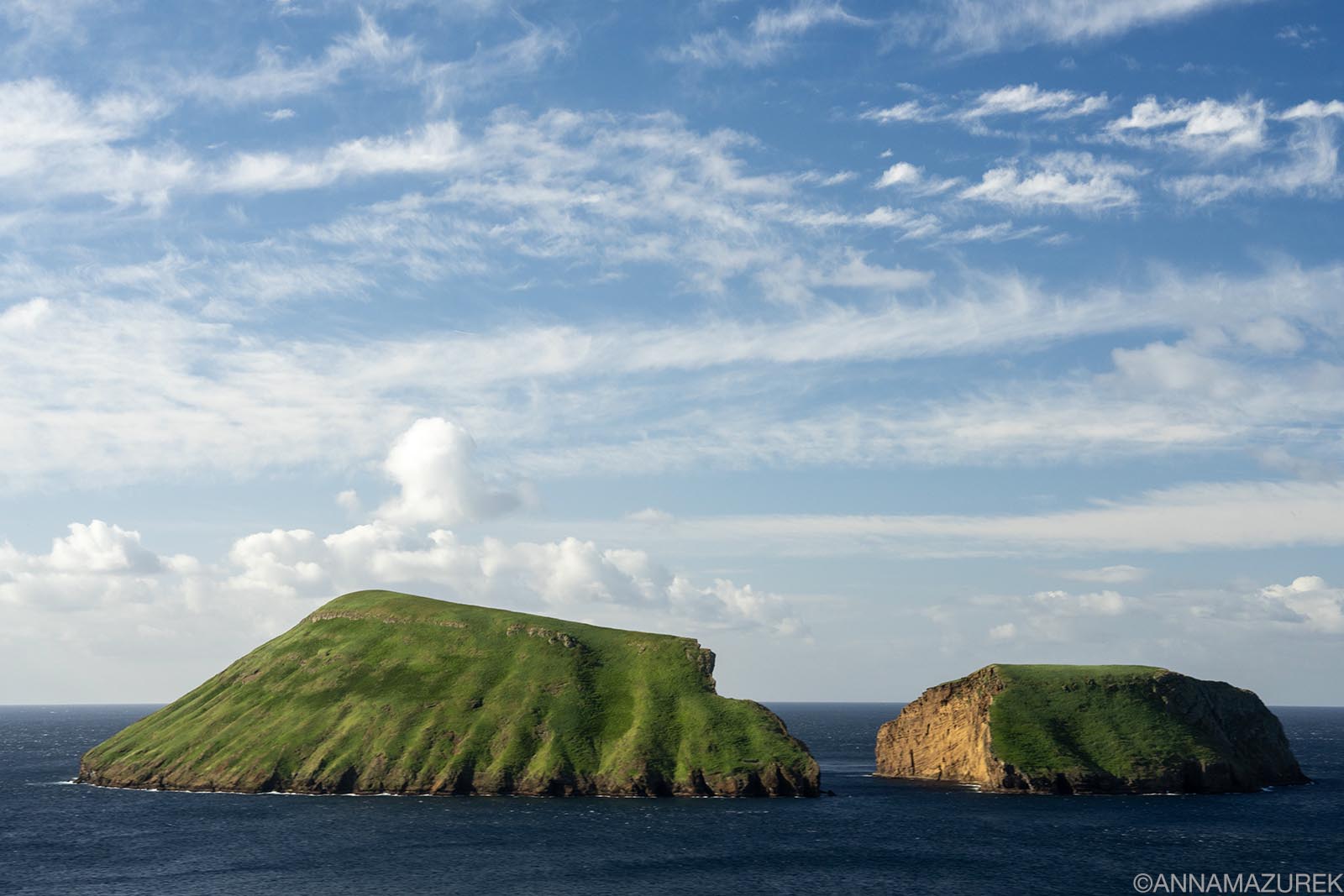 The Cabras Islets, two uninhabited islands formed by a collapsed volcano off the coast of Terceira, are a protected wildlife zone due to nesting seabirds. Visiting is not allowed, but boat trips explore the coastline.
What’s the best eSIM for the Azores?
The best eSIM is one that works with the NOS, Vodafone and/or MEO networks. Don’t buy an Azorean-specific eSIM card. Instead, buy a cheaper Portugal one since they use the same networks. People forget that the Azores is part of Portugal.
I’ve tested Saily’s Portugal eSIM on the NOS network in April on all the islands, except Graciosa, and had excellent 5G coverage. For 10% off Saily plans, use code ANNA10.
I used Airalo’s Portugal eSIM in Graciosa in 2024 and 2025, and it worked perfectly. In general, Airalo also has great coverage in the archipelago, but I haven’t tested it in Flores and Corvo. Use AIRALOESIM10 for 10% off your plan.
Do you need travel medical insurance for the Azores?
Travel medical insurance is a must for any trip abroad. Be sure to choose a plan with trip delay protection for the Azores because weather can wreck travel plans. This really saved me on my recent trip to Flores and Corvo when our flight was canceled, and we were stuck in Terceira overnight. My SafetyWing Nomad Insurance covered $150 USD of expenses, including a hotel and meals. Filing a claim took just a few minutes, and payment arrived a few days later.
17 Best Travel Apps to Download Before your Next Trip (2026 Guide)
From tracking expenses to booking flights, here are the 17 best travel apps I use as a full-time traveler to ensure my adventures are seamless.
In 2002, I took my first trip overseas to study abroad in England. Smartphones didn’t exist. Texting wasn’t even a thing yet. While the nostalgic part of me misses the days of paper maps and film cameras, smartphones do make travel and life a lot easier.
I recently wrapped up a seven-month trip abroad to three different continents, and these apps simplified my travels and life. They include currency converters and making your own postcards to planning the perfect outdoor photoshoot and filing travel insurance claims. Most have free versions across phone platforms and many have web versions. Add downloading these apps to your digital packing list.
Affiliate links are used in this post. If you make a purchase, I earn a small commission at no cost to you, which goes toward the cost of maintaining this blog.
In this Article
The apps are organized in the following categories:
Expense Tracking & Currency Apps
Health, Safety & Logistics Apps
Photography & Entertainment Apps
Discount Travel Booking Apps
Klook (Free)
 The Klook app allows me to skip ticket lines!
I’ve used Klook to buy discounted admission tickets and transportation online across the world. It saved me roughly $10 on entry to Gardens by the Bay in Singapore and $13 on the cable car to the big Buddha in Hong Kong. I’ve also used it for private transfers in Vietnam.
The best part of the app is the tiered Klook Rewards program, where users earn KlookCash to redeem on future purchases. Additional points can be earned by posting reviews. The free loyalty program includes member-only rates and exclusive perks. Overall, I’m a big fan because it saves me money, and I never have to stand in long queues. Book on the app or directly on the website.
Booking.com (Free)
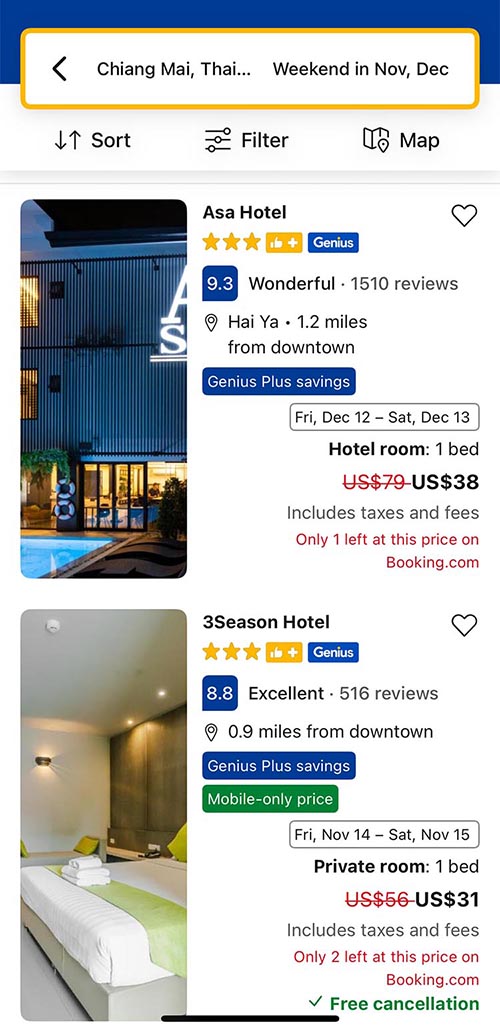
Take advantage of Booking.com’s cheaper mobile rates in the app.
The majority of the time, I find Booking.com has the lowest rates for accommodation, especially when booking on their mobile app where prices can be 15-30% cheaper than booking on their website. (I’ve written a deep dive into why mobile rates are cheaper.)
Now that I’ve reached tier three of their Genius loyalty program, I get even more discounts. When pricing accommodation, cars and even flights, it’s worth doing a quick mobile search on Booking.com’s app to compare with other platforms.
Finance Apps
Tricount (Free)
 I used the Tricount app in May to track expenses on a nine-day trip in the Azores to Flores and Corvo.
Tricount is a free expense-splitting app that makes it easy to track travel expenses. I tested this recently on a week-long trip in the Azores with a friend, and it was seamless. The user-friendly interface includes functions to split expenses unevenly and upload receipt photos. A built-in calculator and currency converter tool do all the math for you. And, the best part is you can start using it instantly without creating an account. (To sync data across multiple devices, you will need to create an account.)
The app is owned by the Amsterdam-based bank bunq B.V. and is currently ad-free, which is why I stopped using Splitwise and exclusively use Tricount now.
Dollarbird (Paid)
 I’ve used Dollarbird for years to track my travel spending. I’m currently using it for my two-month Africa trip.
Dollarbird is an expense tracking app that I use to track my spending on my travels. (It’s $4.99/month or $39.99/year.) It can be used for your regular budgeting. I make custom categories and manually add my expenses. It provides a running balance summary and allows you to export the data to a spreadsheet. (I only use it to track expenses, not income.) I used this app to create the charts in my post about the cost of my two-month trip in Southern Africa.
XE Currency Converter (Free)
 The free XE Currency Converter even works offline with the last updated rate.
XE is my favorite currency app. It allows you to add up to 10 currencies and switch easily been them. The best part is that it even works offline using the last updated rate. I use this all the time to check the cost of things to make sure I’m not overspending.
TIP: If you have the option to pay in different currencies, check the rate for both to see which is cheaper. It’s almost always cheaper to pay in the local currency than in USD, which I dig into deeper in my travel banking post.
iPhone Calculator App Currency and Unit Conversion (Free)

The iPhone calculator app has a feature that allows you to convert currency and units.
When Apple introduced iOS 18 in September 2024, it included a conversion function in the calculator that allows you to convert categories ranging from currencies to units (speed, time and weight). To access the feature, click on the calculator symbol to the left of the 0 button, then turn on Convert. Use the arrow to choose the unit or currencies to convert from.
Genius Scan (Free)
 Genius Scan helps sort my receipts for taxes and work travel. I export the files to my Mac as a backup.
This PDF-scanner app is super helpful. It allows you to photograph anything – receipts, maps, brochures—and make a PDF file from the documents. It’s the best for tracking expenses for business travel. You can take photos through the app or import them from the camera roll on your phone. I find it useful for both tracking receipts when I travel and sending them to Dropbox. I also use it to photograph brochures to reduce my paper usage. The PDFs can be easily sent via email, AirDrop and messaging apps.
1Password (Paid)
 1Password helps manage passwords, bank accounts and loyalty programs. It’s secure and allows you to copy and paste numbers for online shopping.
1Password is my favorite app of all time, even when I’m not traveling. The app securely stores and organizes all your passwords in one place. It’s easily searchable for what you need. I keep EVERYTHING in it – bank details, frequently flyer accounts and email passwords. It syncs across devices easily and is very secure. You use one password to open the app. (TIP: Use a password that you’ve never used elsewhere.) I use it to copy and paste my credit card number when shopping online.
While the app isn’t free, it’s inexpensive – $2.99/month or $4.99 for a family of 5. There’s a free 14-day trial. (Full disclosure: I got this app for free through an old job, so I don’t pay for it.) While Apple has introduced the free Passwords app, I find 1Password to have a better interface and organization system when it comes to credit cards and membership numbers, etc.
Communication Apps
Airalo (Free)
Airalo eSIMs make it easy and affordable to stay connected while traveling.
eSIM cards are an affordable way to stay connected abroad. The Airalo app makes it easy to purchase, install and monitor your balance while traveling across over 200 countries and regions. Airalo was the world’s first eSIM store and often has the best partner networks abroad.
Use promo code NEWTOAIRALO15 for 15% off your first purchase. Existing users can save 10% with AIRALOESIM10.
Google Voice (Free)
Google Voice is an easy way to call U.S.-numbers for free while abroad.
As someone who travels most of the year, two-step verification is the bane of my existence. Google Voice has changed this—I’ve started using it as my phone number for two-step verification. (If you have trouble with codes coming through on the app, log in on your computer.) Google Voice allows you to have a second phone number to use for calls, texts and voicemail. To set up, you need an existing Google account and a phone number. U.S. and Canadian users can choose their phone numbers. Google Voice is also available in select European countries.
You can also call U.S. numbers for free so it’s easy for me to call family members or even airline customer service, etc. (Google Voice has been my replacement for the now-defunct Skype. RIP.)
Google Translate (Free)
 Google Translate offers both text and photo translations.
Google Translate has been a lifesaver. I simply type a phrase and show it to my taxi driver or anyone I need to communicate with. It also lets you save phrases to use later. There’s a camera option so you can translate labels, which is helpful if you’re trying to find lotion that doesn’t have whitening cream in it in Asia. (It’s nearly impossible in Vietnam.) My favorite app in Spanish speaking countries is SpanishDICT, it allows you to translate phrases and also provides conjugations.
WhatsApp (Free)
The chances are high that you are already using WhatsApp. If not, then you need to download this text and voice message app NOW. The app is owned by Meta and works across all phone platforms and locations. It’s a great way to connect with friends and even business when you are traveling. Outside of the U.S., it’s the primary means of personal and business communications, from booking dinner reservations to taxis. You’ll need a phone number to register.
Postagram (Free;$1.60-$2/postcard)
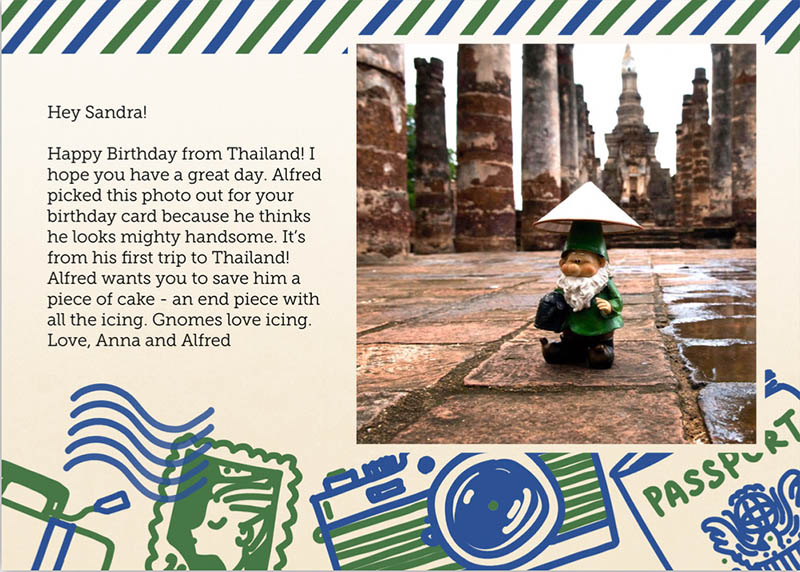 This is a postcard I sent my Aunt with one of my own photos of my globetrotting gnome, Alfred. I’m a big fan of the Postagram app and how you can customize everything including delivery dates so I never miss a birthday!
Let’s be honest—everyone appreciates real mail! I’ve spent countless hours on trips writing postcards to friends and family, and even more time waiting in endless post office lines just to buy stamps! (I spent thirty minutes in Greece recently waiting in line to buy postcard stamps, which were 2 Euros each!)
I’ve used the Postagram app for years to send printed postcards using my photos. The app allows you to customize the background design and colors. The most important feature is that it allows you to schedule a delivery date, so I never miss a birthday or holiday.
While I still send real postcards when I can, Postagram has been the next best option. International locations cost $3/card, while U.S. addresses start at $2. The price decreases if you buy in bulk. The printing quality is excellent. (Full disclosure: I did have an issue once when a postcard did not arrive, and they resent it for free.)
Health, Safety & Logistics Apps
Maps.me (Free)
I used Maps.me to track all the places we stopped on my Mongolia trip. It’s a great, customizable offline map tool.
The offline GPS app Maps.me is a must-have for all hikers and anyone traveling to areas without phone service. Simply download a map of where you are going, and the app will help you navigate turn-by-turn efficiently without phone service. It allows you to create and edit routes, which many hikers share online. Read the app user guide before using it in remote locations. The app was initially completely free, but now, they’ve added in-app purchases and the ability to make travel bookings. The free version allows 10 downloaded maps at a time.
I loved using this for my Mongolia trip, which was 90% off-road, to label all the locations where we stopped. I also used it for my Namibia road trip over the winter.
SafetyWing Travel Medical Insurance
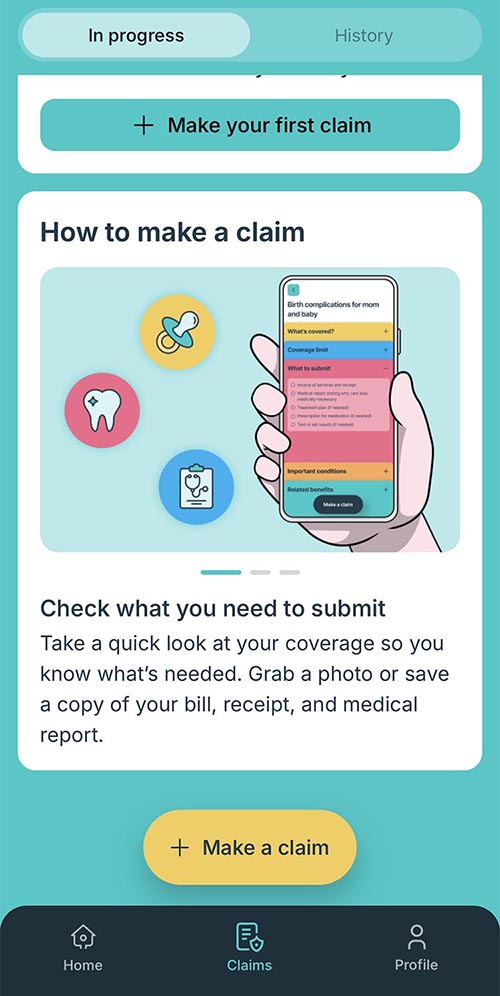
SafteyWing offers affordable travel medical insurance for 180+ countries.
SafetyWing is currently my go-to company for flexible travel medical insurance. They offer two plans: Essential and Complete. (I always use the Essential plan.) The new claims process can be done in the app in just five minutes. For more details, check out my SafetyWing review.
NordVPN (Paid)
 NordVPN makes it easy to safely browse the internet from any corner of the globe.
I started using NordVPN about four years ago to protect my data and identity online while traveling both in the U.S. and abroad. It just makes it safer to browse the internet, check up my banking and even to use streaming services, like Disney+, which sometimes are location dependent. I usually buy a two-year subscription that works on both my Mac and iPhone.
AirVisual (Free)
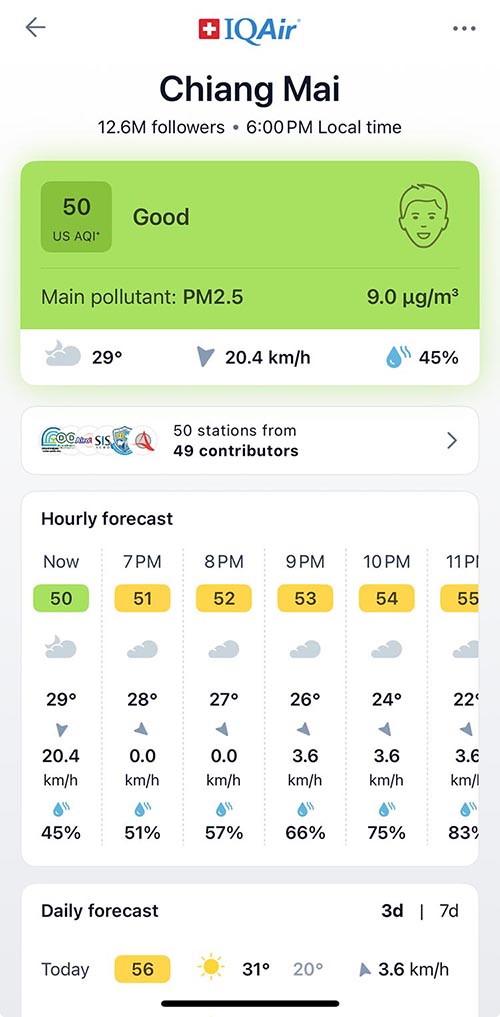 AirVisual makes it easy to track the air quality anywhere you are traveling.
If you’re traveling anywhere in Asia, then I recommend the free AirVisual app to check the air quality. It uses sources from government agencies to tell you the current air quality. It’s really helpful in places with pollution (India) or burning seasons like Chiang Mai, where you might need to wear masks! It works worldwide.
Photography & Entertainment Apps
TPE Photo Ephemeris (one-time fee of $9.99)
 TPE is my go-to app for planning outdoor photo shoots based on the sun’s location.
This photography app is life-changing for photographers because it allows you to plan outdoor shoots in natural light. TPE shows where the light will fall on any part of the globe both day and night. The AR feature lets you visualize a shoot by overlaying the features over your camera app in a location. The app has a one-time $9.99 fee and additional in-app purchases.
Hoopla (Free)
 I read a lot more books thanks to the Hoopla app and my public library membership.
Hoopla is an online platform that allows you to read eBooks and listen to audiobooks for free with your public library membership across North America. It also works on web browsers. I use it a lot for travel guides and audiobooks when I travel. There’s a monthly limit for the number of books you can check out that varies based on your library membership. I get four per month from the library in Austin. This is also great to use when you aren’t traveling.
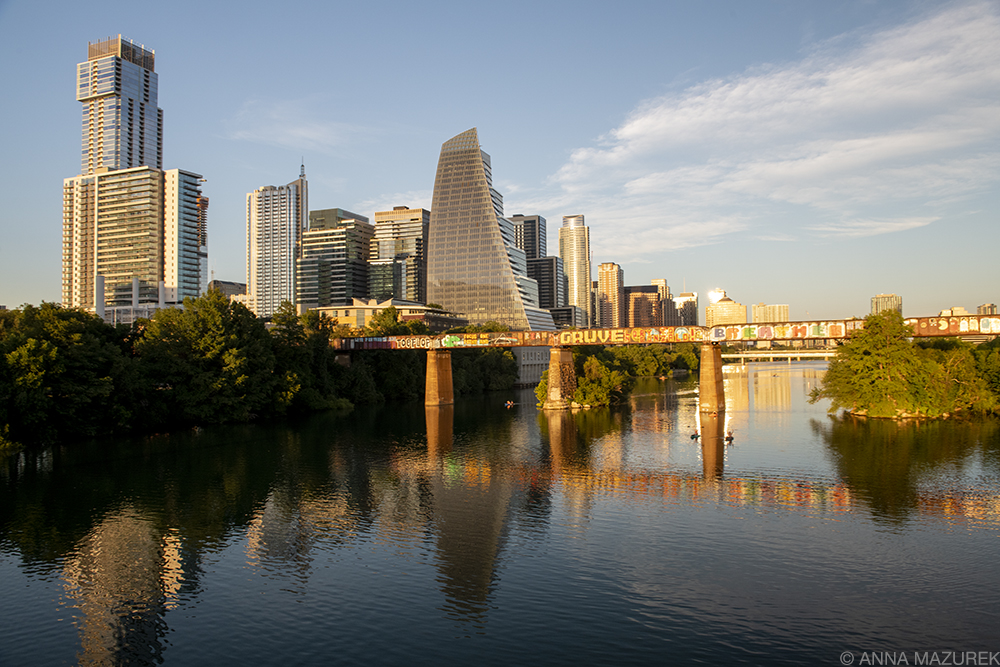
14 Best Things to Do in Austin, Texas, From a Local Travel Writer
 The 11-acre Waterloo Park near the Capitol Building is one of Austin’s newest greenspaces and part of a larger on-going project extending to Lady Bird Lake.
Post Updated in May 2026.
Austin, the Texas state capital, is famous for many things, from music to barbecue and spring-fed swimming holes. Most of all, the city is known for its laid-back “Keep Austin Weird” vibe that makes it a great place to visit but hard to leave.
The capital city has been my home base since December 2013. It is a mixture of all the things I love about the South (biscuits, grits, the word “y’all,” and barbecue), merged with the things I loved about California (fitness-focused outdoor culture and the ability to recycle everything easily) sprinkled with a little LA-style traffic and no state income tax.
As a travel writer, it’s literally my job to write and photograph many of the coolest spots in my current hometown and the great state of Texas. If you’re heading to Austin for SXSW, ACL or a football game, here’s my list of all the best things to do in Austin, Texas categorized by topic for easy scrolling! (I’ve been to every place on the list!) Of course, I’ve also written about the where to eat in Austin and the best hotels organized by neighborhood!
In this Post
1. Paddleboarding on Lady Bird Lake
2. Swim at Barton Springs Pool
3. Tour the Texas State Capitol
4. Hike the Barton Creek Greenbelt
5. Play a Round at Peter Pan Mini Golf
8. Attend an Austin City Limits Taping
9. Stroll Through Austin’s Parks
10. Visit Austin’s Central Library
12. Take Advantage of Free Museum Days
1. Paddleboarding on Lady Bird Lake
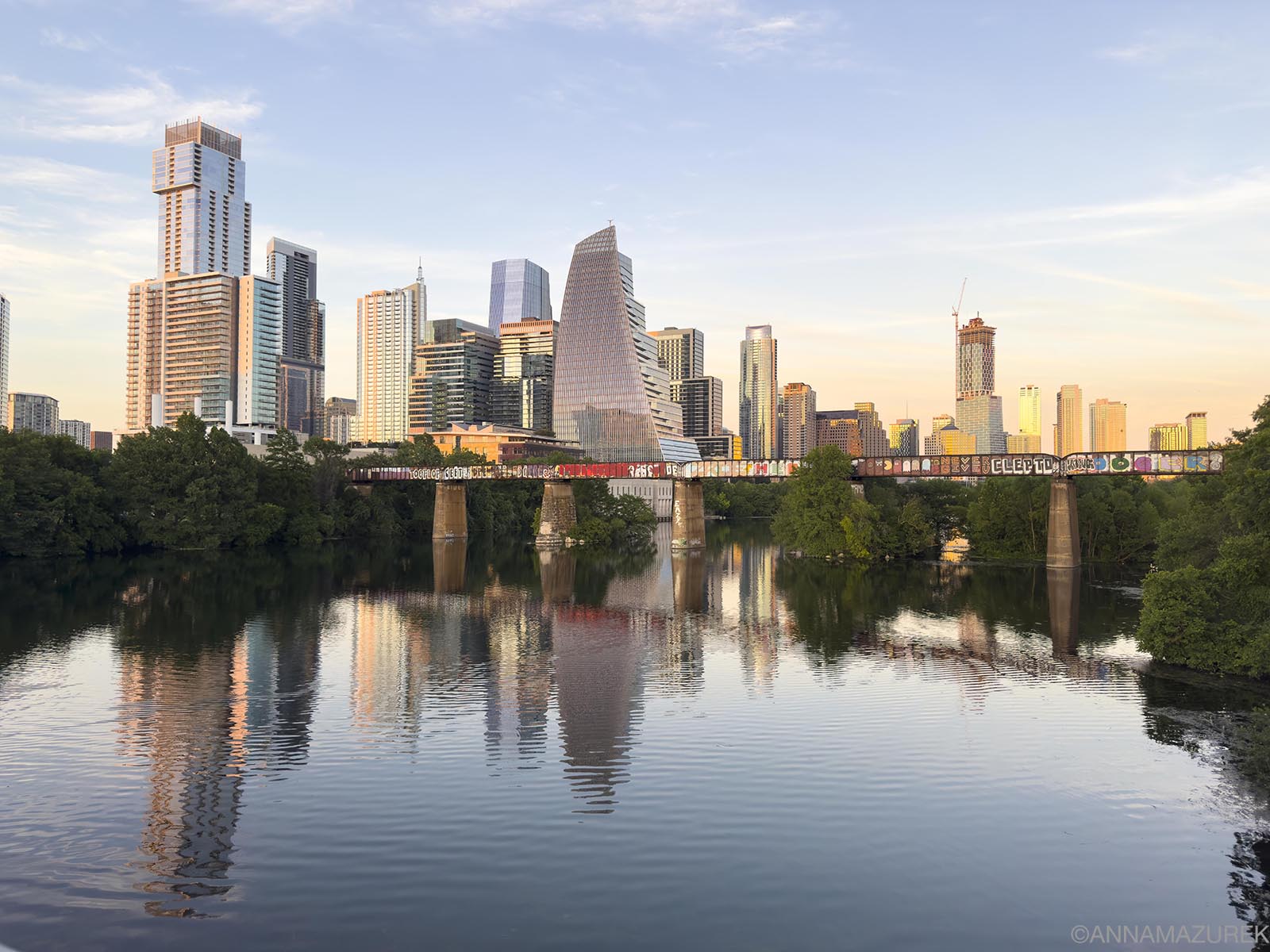 The ever-changing Austin skyline photographed from the Lamar pedestrian bridge
Location: Zilker / Barton Springs | Google Maps (boat rental)
Hours: Public access generally 5 a.m.–10 p.m
Lady Bird Lake is the heart of the city and one of the best places to enjoy the city skyline. There are several boat rental places on the lake, so choose the one closest to you. I like Zilker Park Boat Rentals, which is located adjacent to Barton Springs Pool. They offer buy-one-get-one coupons on weekdays! You can also rent kayaks and canoes. The 10-mile Ann and Roy Butler Hike and Bike Trail around the lake is great for running, walking and biking. (I run a five-mile section every week.)
Stay Connected with Holafly eSIMs
Skip expensive roaming fees and get online the moment you land with Holafly’s unlimited data plans. The Always On benefit includes a 1GB/month global backup data boost, so you’re never stuck without service hiking on the Greenbelt or bar-hopping on South Congress.
Save on Your Plan: Use code TRAVELLIKEANNA for 5% off any Holafly eSIM or 10% off a 12-month plan.
2. Swim at Barton Springs Pool
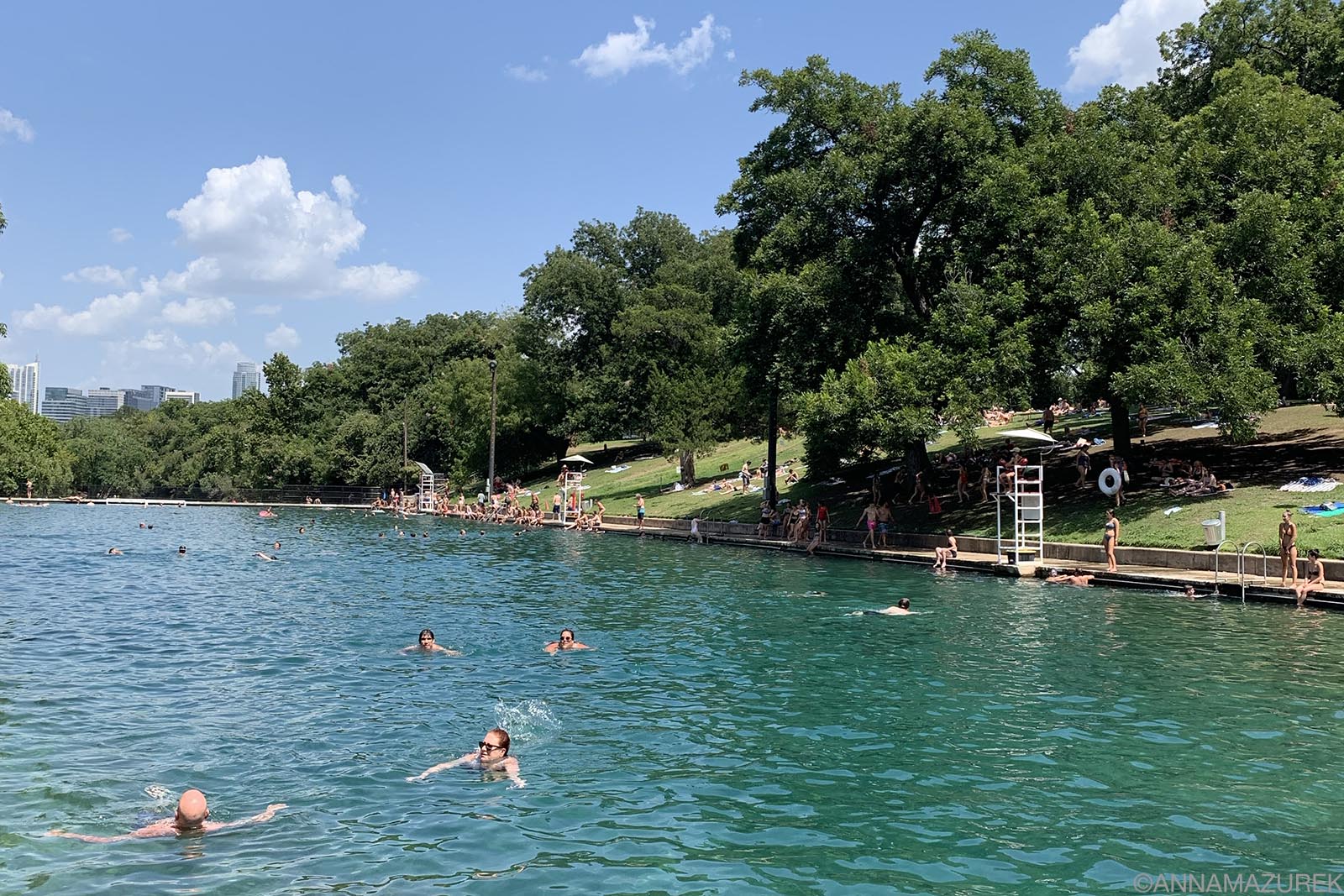 Barton Springs Pool is open year-round from 5 a.m. to 10 p.m. except Thursdays when it’s open only in the morning and evening.
Location: Zilker/Barton Springs | Google Maps
Hours: Usually 5 a.m.–10 p.m.; closed for cleaning part of Thursday.
Barton Springs Pool is 68-70 degrees year-round and a great way to cool off on sizzling summer days. The spring-fed pool is a local favorite tucked in Zilker Park and open year-round. Another option for a dip is the 100-year-old Deep Eddy Pool, the oldest swimming pool in Texas.
3. Tour the Texas State Capitol
 The interior dome of the Texas State Capitol Building
Location: Downtown | Google Maps
Hours: Usually Mon–Fri 7 a.m.–8 p.m.; Sat–Sun 9 a.m.–8 p.m. (tour times vary).
The Texas State Capitol building is an icon of the Austin skyline. The stunning four-block complex is taller than the U.S. Capitol in Washington, D.C. Free guided and self-guided tours are available daily. Don’t miss the interior dome with an eight-foot-wide star and the view from 15th Street of the glass-roofed extension.
4. Hike the Barton Creek Greenbelt
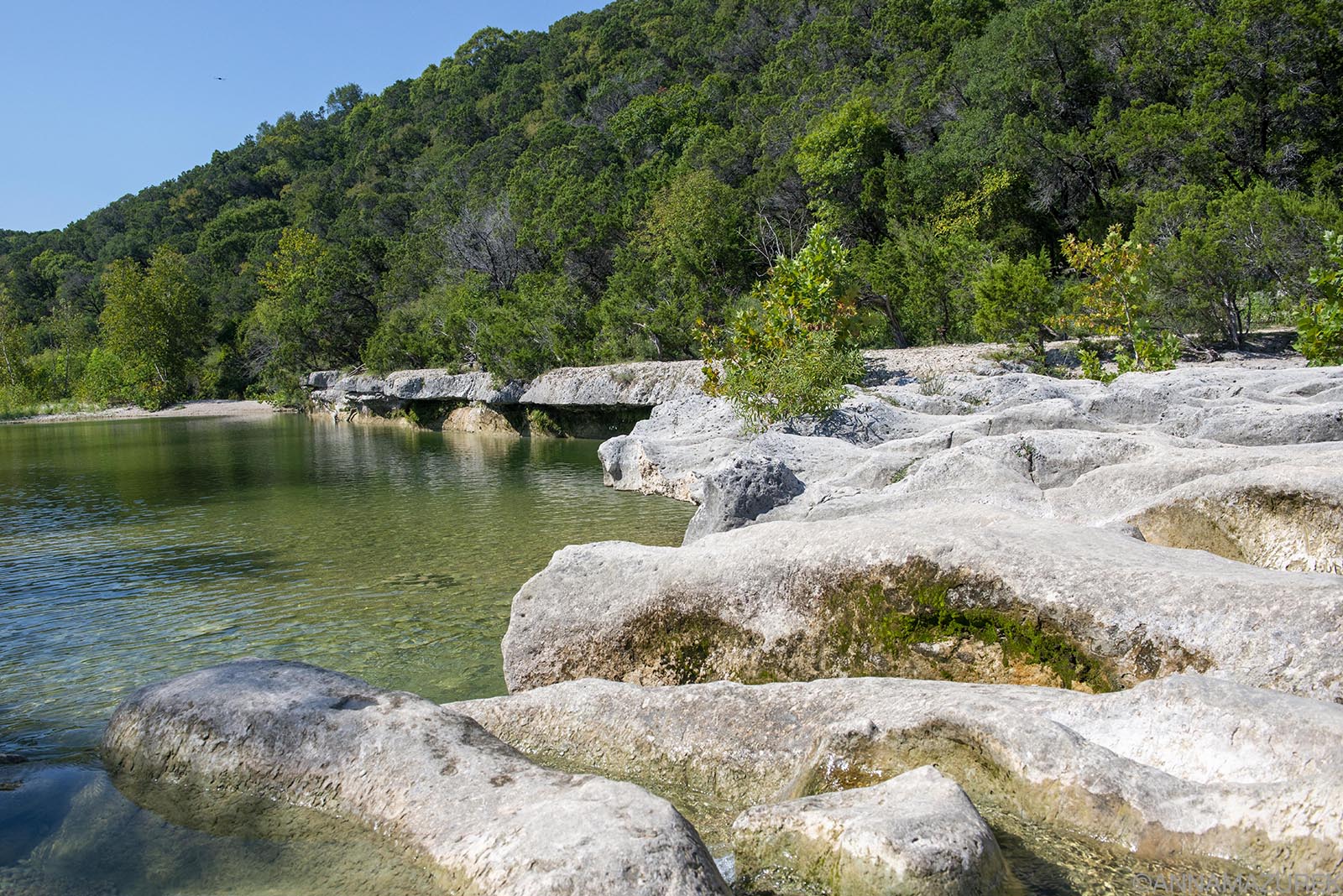 The Barton Creek Greenbelt is one of the best places to go for a hike or a swim.
Location: South Austin / Barton Creek | Google Maps (Twin Falls access point)
Hours: Generally 5 a.m.–10 p.m. (city park hours).
The Barton Creek Greenbelt is a hiking and biking trail that covers 12.86 miles with multiple access points. It’s one of the most popular spots for taking a dip in the summer months. (Twin Falls is one of my favorite spots for a swim.) Hiking the entire trail one way takes roughly three hours and can be broken into sections.
5. Play a Round at Peter Pan Mini Golf
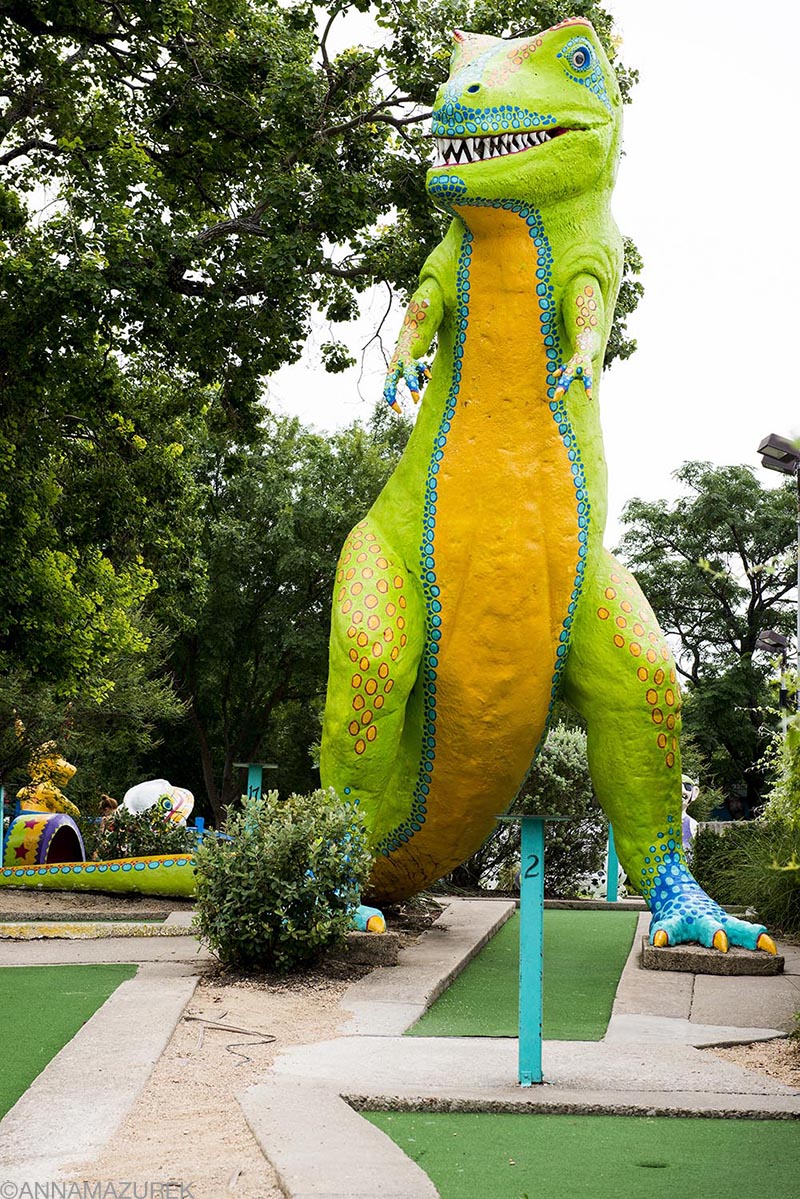 Peter Pan Mini Golf is an Austin icon that’s managed to survive despite an uncertain future due to lease uncertainty.
Location: South Lamar / Zilker | Google Maps
Hours: Usually Sun–Thu 9 a.m.–11 p.m.; Fri–Sat 9 a.m.–midnight (seasonal).
You can’t miss the giant green T.rex statue at Peter Pan Mini-Golf overlooking the corner of Barton Springs and South Lamar. This colorful putt-putt spot opened in 1948 and has two courses with colorful statues of Austin landmarks and Peter Pan characters. The courses are challenging but fun. And the best part about the course is that it’s BYOB – no glass containers.
6. Play Chicken Shit Bingo
Location: North Austin (Burnet Road) | Google Maps
Hours: Sunday 4p.m. to 8 p.m.
Sundays in Austin are for Chicken Shit Bingo. The Little Longhorn Saloon, a tiny hole-in-the-wall honky-tonk off Burnet Road, has been hosting the event for over 40 years. To play bingo, you buy a ticket and hope the chicken literally poops on your ticket number. There’s always live music and cold beer.
7. Watch the Bats on Congress Avenue
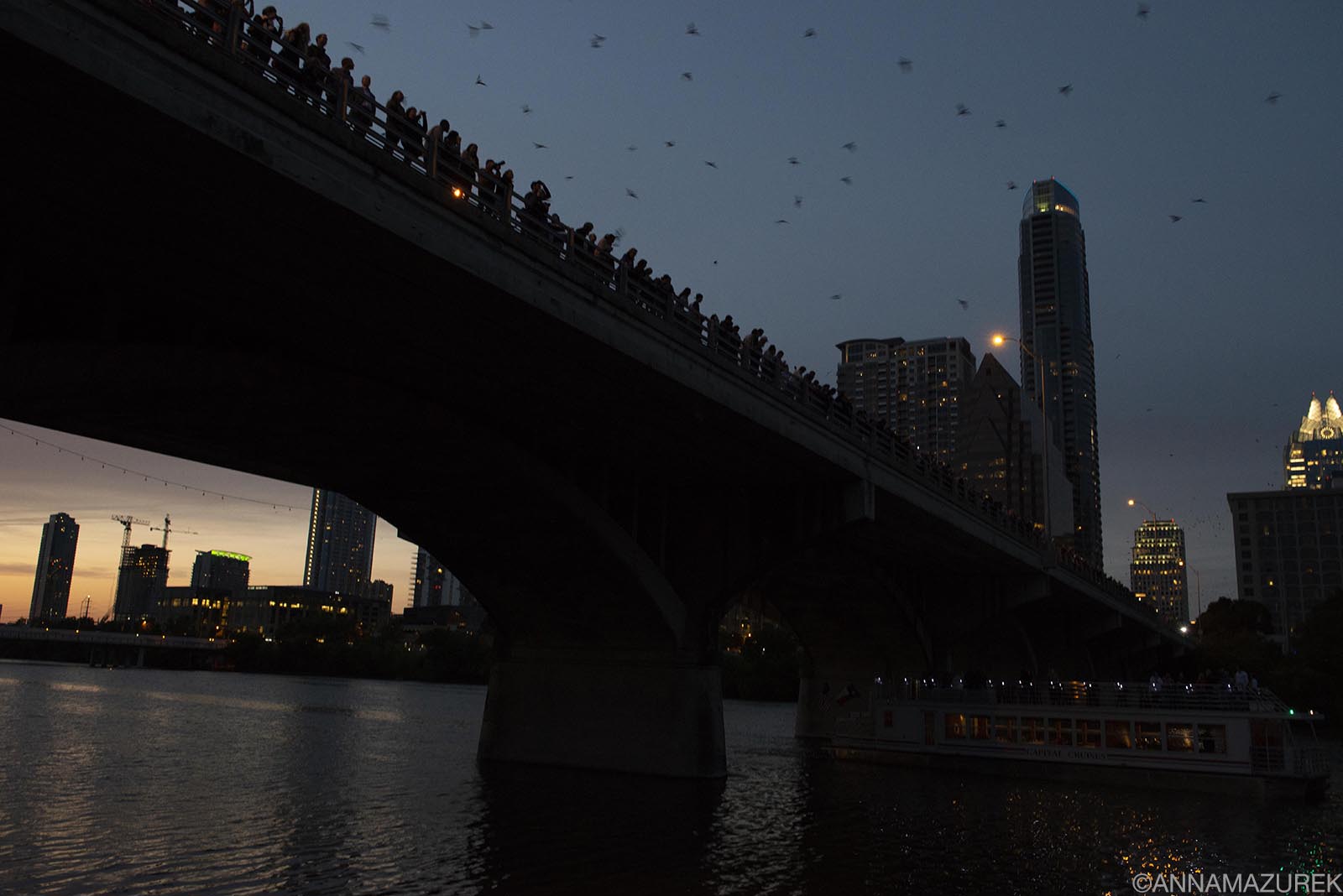 Crowds gather every night along the Congress Avenue Bridge to watch the bats spiral into the sky.
Location: Downtown | Google Maps
Hours: Bats emerge at sunset March–November.
The world’s largest urban bat colony lives under Congress Avenue Bridge. From mid-March to November, the bats spiral into the sky every night for a spectacular show. Check here to find the best time to see the bats nightly. For the best photos, watch the bats from the Statesman Bat Observation Center adjacent to the Congress Avenue Bridge.
8. Attend an Austin City Limits Taping
Location: Downtown | Google Maps
Want to be in the audience for a taping of the Austin City Limits TV show? All tickets are distributed through a free online lottery. If you don’t win, you can also wait in line to see if there are extra tickets available on the day of the show. The lottery opens usually a week before tapings, and winners are announced roughly two days before. For details about upcoming tapings, visit https://acltv.com/upcoming-tapings.
9. Stroll Through Austin’s Parks
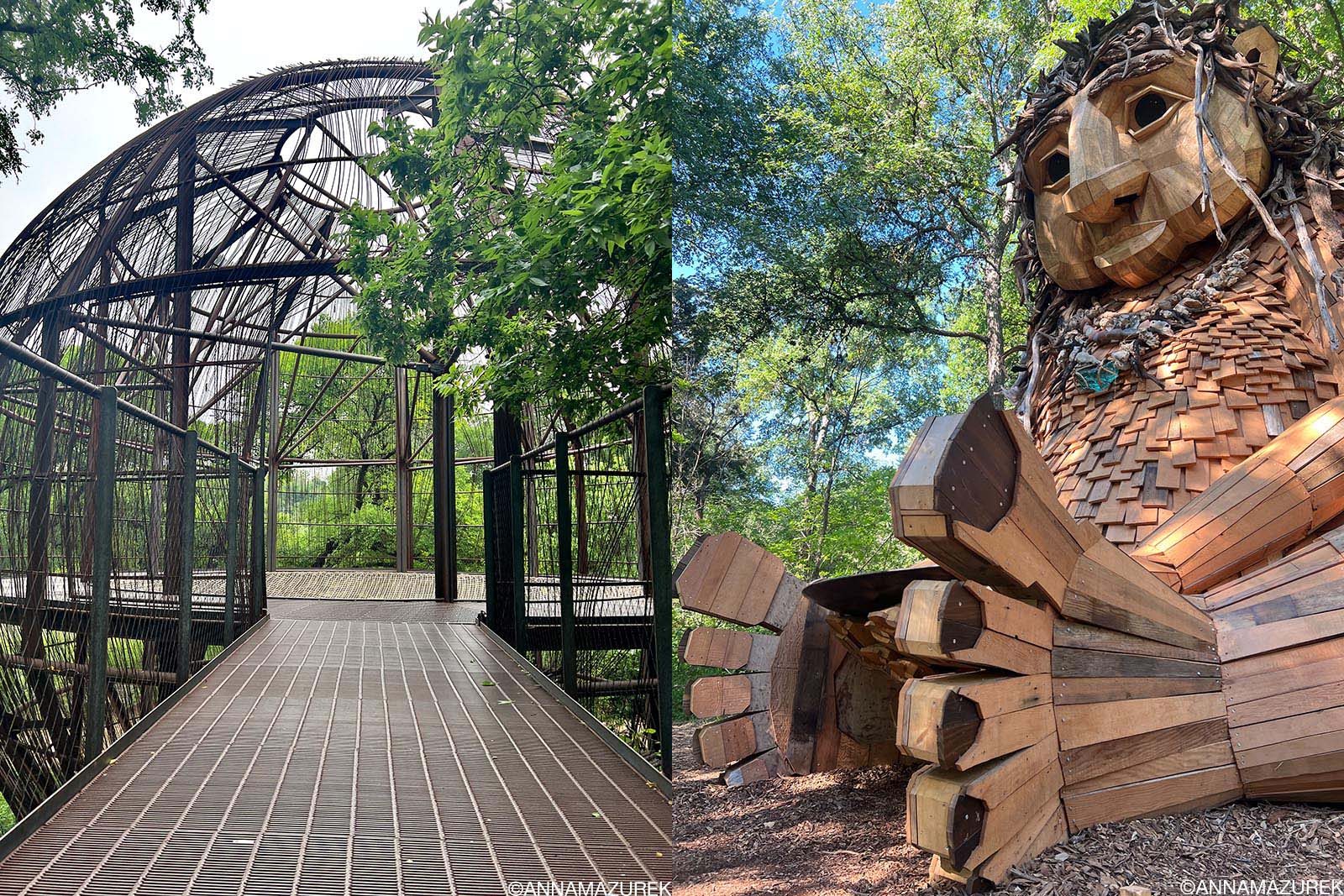 Pease Park’s new suspended treehouse (left) is part of the space’s ongoing renovation projects.and troll statue (right), Malin, by Danish artist Thomas Dambo, was one of the park’s main sights until it burned down in May 2026.
Hours: General city park hours 5 a.m. – 10 p.m.
The City of Austin is home to 512 parks, according to the Trust for Public Land. The 351-acre Zilker Park is the most famous and the hub for large events and festivals. It’s also home to Barton Springs and a great spot for paddleboarding. While it’s worth exploring, don’t miss out on some of the smaller but equally amazing outdoor spaces.
The new downtown ADA-accessible Waterloo Park has unparalleled views of the skyline and the Capitol Building. The 11-acre park, home to a 5,000-seat Moody Amphitheater, is part of a larger Waterloo Greenway Project connecting 15th Street to Lady Bird Lake.
Pease Park, an 84-acre green space along the banks of Shoal Creek, is famous for its photogenic treehouse, 40-foot circular observation pod suspended in the air. The park was home to a giant wooden troll sculpture by Danish artist Thomas Dambo that sadly burned down in May 2026.
Other favorites include Mayfield Park and Preserve, a 23-acre nature area with a historic cottage and two gardens filled with peacocks. It’s walking distance from The Contemporary Austin’s Betty and Edward Marcus Sculpture Park at Laguna Gloria, which is a stunning outdoor space. Nearby, Mount Bonnell, a ridge-line peak overlooking the Colorado River, is great for sunset.
10. Visit Austin’s Central Library
 Austin’s Central Library building and grounds showcase a variety of temporary and permanent artwork, including Christian Moelle’s CAW, a red 37-foot-tall kinetic sculpture.
Location: Downtown (Seaholm) | Google Maps
Hours: Mon–Thu 9 a.m.–8 p.m.; Fri 9 a.m.–6 p.m.; Sat 10 a.m.–6 p.m.; Sun 12–6 p.m.
Austin’s new downtown Central Library is one of the coolest buildings in town! The state-of-the-art facility feels like a swanky boutique hotel combined with an upscale mall with sweeping skyline views. Highlights include the rooftop butterfly garden, second-floor art gallery with rotating exhibits and a technology petting zoo featuring the latest gadgets. There’s WIFI, free computers to check out, and “shared learning” rooms that offer video conferencing capabilities for meetings and workshops.
11. Listen to Live Music
 A night view of the Paramount Theater, a historic movie theater listed on the National Register of Historic Places.
Austin lives up to its reputation as the Live Music Capital. Start a visit to Austin at the “grandaddy” of live music venues, The Continental Club is one of the oldest in town, dating back to 1955. The Broken Spoke is another legend—a proper honky tonk that offers two-step lessons.
Mohawk has been one of my favorites since my first trip to Austin in 2007. The multi-level bar has both an indoor and outdoor stage. The Paramount Theater, a 1915 movie theater, is one of my favorite places to photograph live shows. (The Paramount is closing for an 11-month renovation starting June 2026.)
Other options include Antone’s (old school blues downtown), Hole in the Wall (campus dive bar), Donn’s Depot (dive bar in old train depot), The Parish (sweet Sixth Street spot that relocated a few blocks to East Austin), Historic Scoot Inn (Eastside outdoor venue recently bought by C3), and Elephant Room (jazz and cocktails).
12. Take Advantage of Free Museum Days
 You can’t miss the giant star outside the Bullock Museum.
Bullock Texas State History Museum
Location: Capitol | Google Maps
Hours: Bullock Texas Stat Daily 10 a.m.–5 p.m.; free first Sundays.
The Bullock Museum focuses on the history of Texas and offers free admission on the first Sunday of every month. Each floor represents a different time period in state’s history, from early European exploration to the Texas Revolution and modern culture including oil and music. If it’s your first visit to Texas, this is a great place to start your trip.
Blanton Museum of Art
Location: UT Campus | Google Maps
Hours: Tue–Sat 10 a.m.–5 p.m.; Sun 1–5 p.m.; closed Mon; free Tuesdays.
The Blanton Museum of Art, located on the UT campus, offers free admission on Tuesdays. The museum hosts a series of visiting and rotating art exhibitions sourced from its vast 21,000-piece collection. These museums are a five minute walk and can easily be visited together.
13. Tour Austin’s Art Gallery Scene
 Austin is filled with cutting-edge galleries and large public art pieces like the 10-floor high, Tau Ceti mural by Josef Kristofoletti on the corner of East Second Street and Brazos Street.
Austin’s art scene is not to be missed, from street art to top-notch galleries. Start your art tour at Canopy Austin, a former East Austin Goodwill warehouse that’s been transformed into 89 galleries, studios and offices, including ICOSA, an artist-run cooperative gallery.
My downtown favorites include McLennon Pen Co., a contemporary arts space on West Fifth Street named after founder Jill McLennon’s grandfather’s Chicago luxury pen shop, and West Chelsea Contemporary, specializing in museum-quality exhibitions. The Creek Show is one of my favorite annual outdoor public art shows—it’s located on Waller Creek and happens every fall, usually in November.
14. Hope Outdoor Gallery
 The Hope Outdoor Gallery is a place for adults ands kids to both view and create art.
Location: Airport area | Google Maps
Hours: Wednesday to Sunday 10 a.m. to 6 p.m.
Hope Outdoor Gallery is a free space for artists to create and was one of my favorite things when I first moved to Austin in 2013. The original park closed for years and was relocated to a larger eight-acre space near the airport that opened in late November 2025. The outdoor art park campus includes outdoor mural walls, a 6,000-square-foot event venue and a park space. On my first visit to the new space on Friday afternoon, the place was buzzing with adults and families creating colorful artwork with spray paint .