
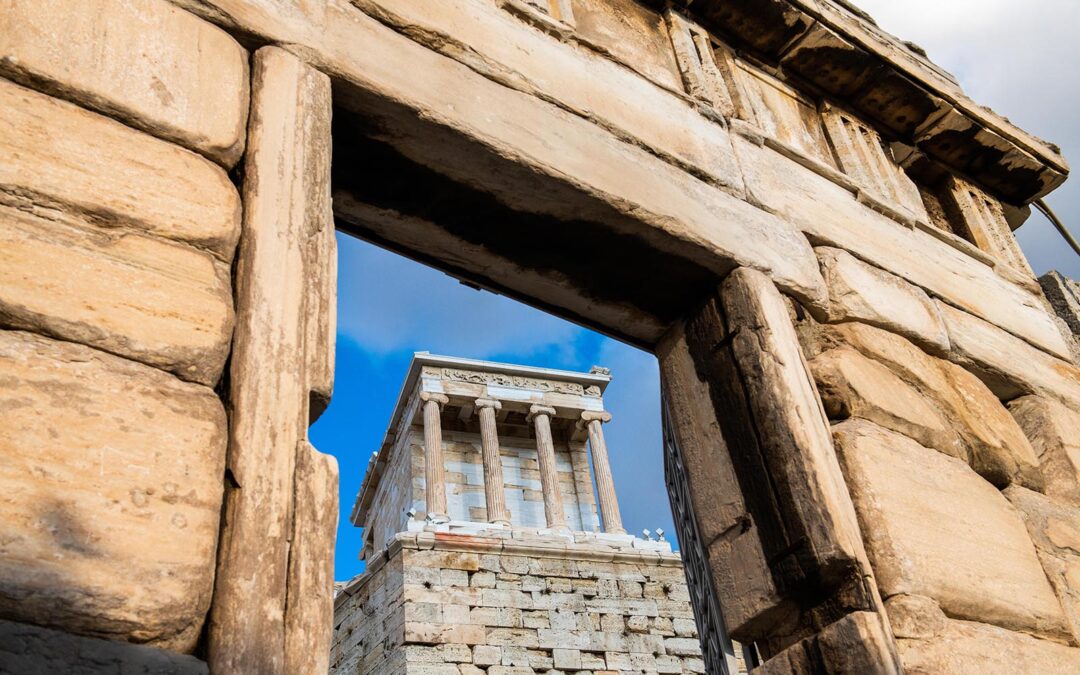
Why American Airlines Elite Status No Longer Makes Sense for Most Travelers
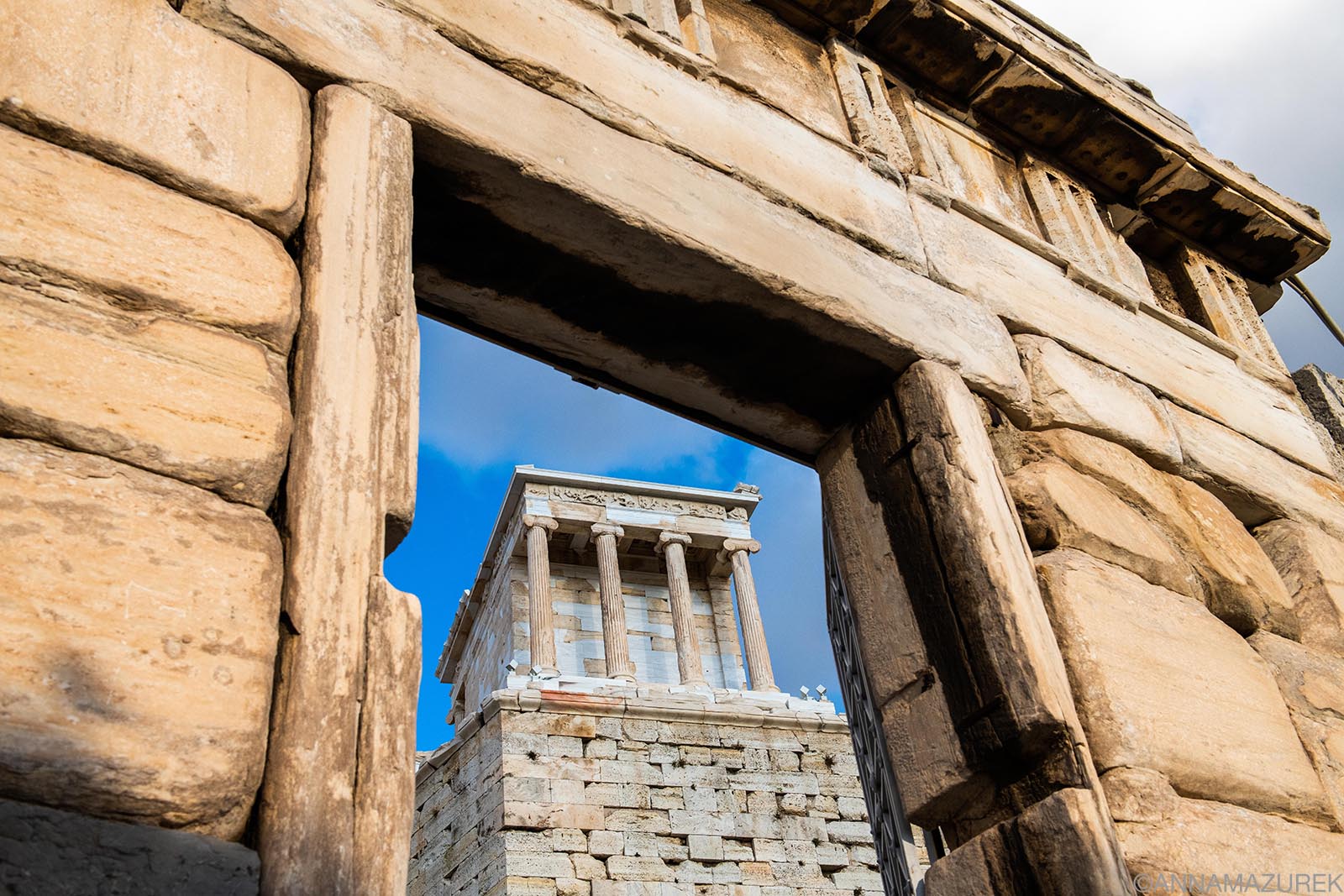 Athens, Greece is one of my summer travel destinations and my last chance to use American Airlines mileage awards before they disappear.
Last year, I wrote about how I achieved my first airline elite status, American Airlines Platinum status, and how I hacked my way up to Platinum Pro status this year.
American Airlines recently updated how mileage upgrades work making it more costly to upgrade and removed the mileage upgrade awards, which were the top benefit of Platinum Pro status for me and many others. Mileage upgrade awards allowed customers to upgrade from economy to business on international routes for $350 plus 25,000 miles based on availability and prioritized by status level. Often, these upgrades were 24 hours before travel or at the last minute.
This is a similar trend among airlines currently. United Airlines announced a similar change recently, according to The Points Guy. While everyone has different goals and methods to achieve airline status, here are a few things to consider with the new American Airlines changes.
How the new American Airlines Instant Upgrades Work
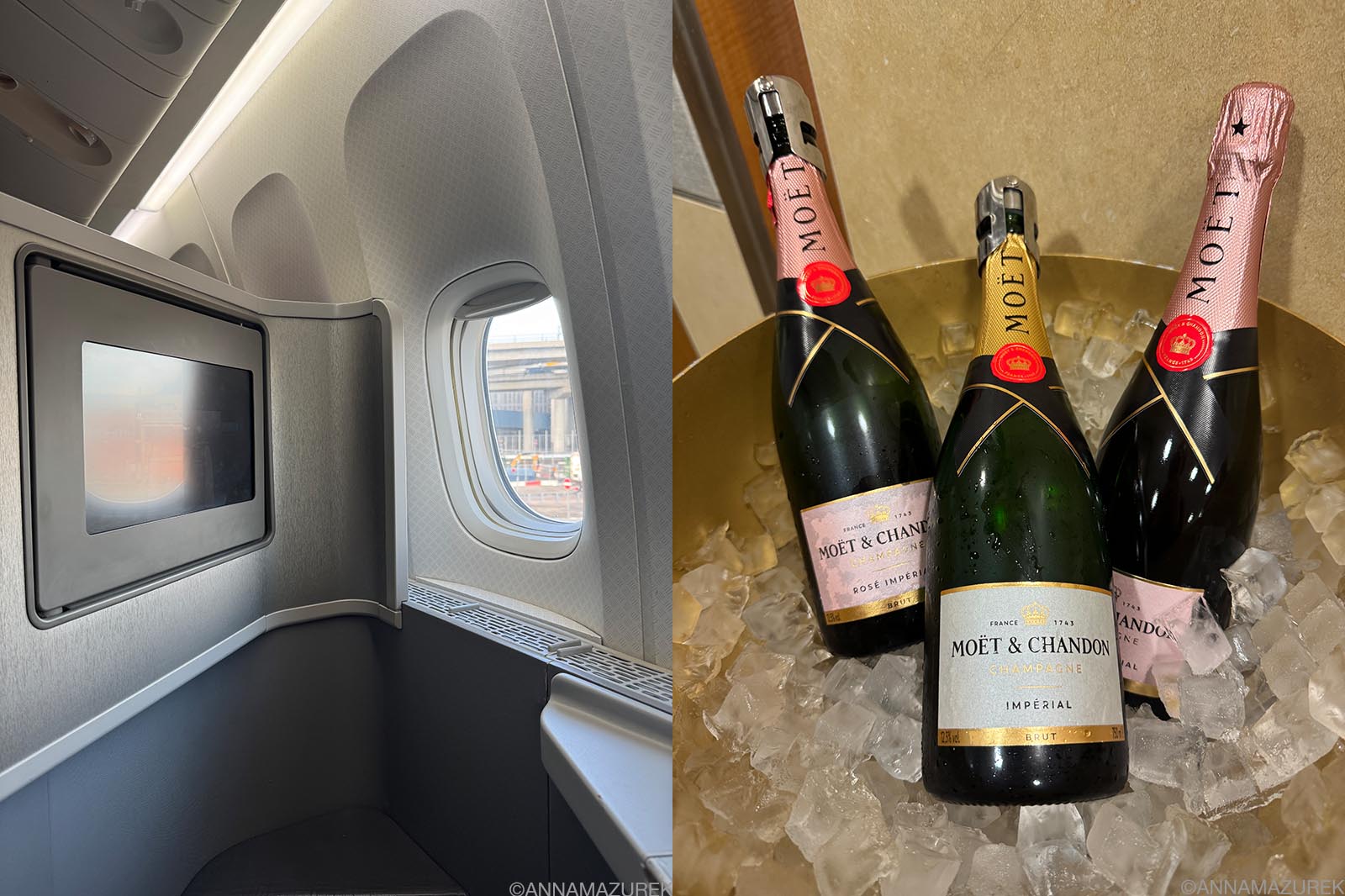 One of the main benefits of having elite status on American Airlines was the ability to upgrade to business class on long-haul flights, which is now more expensive due to the new upgrade policy.
After booking a flight, you can request upgrades on the website or app to pay in cash or with miles. No cash copayment is required if booking with miles.
While this might seem like a perk to upgrade early, the upgrade options aren’t always a good deal. In early August, I’m flying from Charlotte, NC to Athens, Greece with a layover in Philly for a work trip. (I added the layover on purpose to check out the new American Airlines Admirals Club and to also go back to the Chase Sapphire Reserve Lounge, which is one of the best lounges I’ve ever visited.) (Update – I didn’t get the upgrade (top of list but no seats left) but the new Flagship Lounge is small but fantastic.)
The total cost of the one-way flight was $827, which includes $250 in taxes roughly. When I booked this flight, I called and put myself on the waitlist for a mileage upgrade. Somehow this was removed when the changes happened. I had to call again to put myself back on the list so now it doesn’t show me the instant upgrade options online anymore.
Before I put myself back on the list, it gave me the following options for an instant upgrade:
Upgrade the Charlotte to Philly flight (1.75 hours) for $131 or roughly 29,000 miles.
For the international leg from Philly to Athens, Greece (9.5 hours), it offered an upgrade to business class for 411,000 miles and $3,110, which is a terrible deal compared to the mileage award. The full price for business class for this flight is $5,943 or 320,500 miles plus a $5.60 fee. This means it’s cheaper to buy a business class ticket flat out with miles than it is to upgrade with miles!
Once I put my name back on the mileage upgrade waitlist, the instant upgrade option disappeared. The option to use mileage upgrades ends on August 12, 2025.
Does the new instant upgrade option affect complimentary upgrades on domestic flights?
One of the benefits of having status with American Airlines is complimentary upgrades on domestic flights, which are also awarded up to 72 hours before a flight. In my experience, it happens the day of the flight. These will not be affected by the change.
Are Systemwide Upgrades Affected by American Airlines Instant Upgrades?
No, systemwide upgrades are not affected. Systemwide upgrades are one of the Loyalty Point Reward choices for people who reach 175,000 loyalty points or higher within a qualification period. This allows you to upgrade to the next class of service on a flight you’ve already booked.
How do you know if a mileage upgrade is a good deal?
The Points Guy publishes monthly validations about what points are worth for major airlines, credit cards and hotels. In the June 2025 post, American Airlines miles as worth 1.5 cents per mile, which makes the 411,000-mile offer for my Philly to Athens flight a terrible deal. It would equal $6,165, which is higher than the cost of buying the flight full price. This is helpful for judging whether it’s a good deal. Ultimately, it’s a personal decision based on your goals, comfort level and finances. It’s also likely the upgrade offers will change frequently based on demand, etc. I have no way to verify that since I don’t have access to those options anymore for my flight.
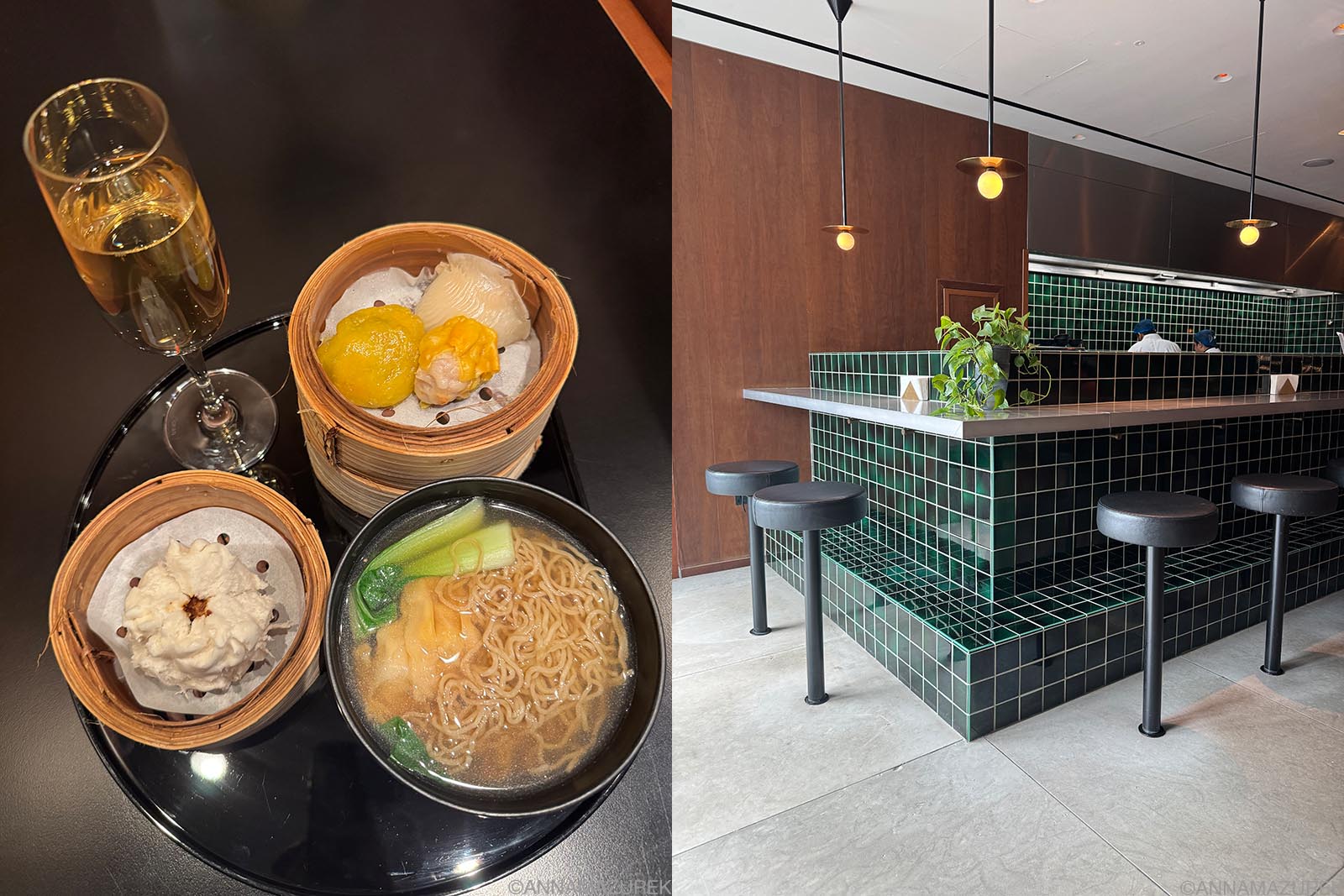 The Cathay Pacific lounge in London Heathrow has a noodle bar and is the best oneworld lounge in the airport. It is accessible to American Airlines Platinum and higher status members traveling on oneworld airlines.
Is American Airlines Elite Status still worth the effort?
With the removal of mileage upgrades, I don’t think American Airlines Platinum Pro status is worth the effort while Platinum is still worth it for me. It comes down to your priorities. Let’s dig into this below.
Benefits of American Airlines Platinum Status
Main Cabin Extra: After booking, you have access to extra-leg room seats (these are up to a $100 value).
60% Status Mileage Bonus: For every dollar spent on flights, you earn a 60% bonus on flights that helps you earn status faster.
Two Free Checked Bags + Priority Handling.
Priority Lanes for Check-in Security and Boarding: This is huge for me because it means I don’t have to check my carry-on bags.
Oneworld Sapphire Status: This gives you lounge access when flying oneworld airlines.
Currently, the only added benefit of Platinum Pro is that you are Oneworld Emerald, which gets you one boarding group higher and access to slightly fancier lounges. In addition, you get an 80 percent mile bonus on every dollar spent on flights and three free checked bags with priority handling. If you can reach the 175,000-point mark, then a systemwide upgrade is one of the reward options available.
Even though I travel six to eight months a year, I don’t see the value of keeping Platinum Pro status. It took some creativity for me to earn this status this year, which I shared with pie charts in my previous post. And, I was still nowhere near 175,000-point mark. (It takes 125,000 to hit Platinum Pro and I peaked at 130,000.) As of now, Platinum status is the most valuable for the free Main Cabin Extra seats, priority boarding and lounge access.
If you are flying business class regularly with paid fares or have extremely high spending on credit cards, then it would be much easier to reach this status. For me or even the average person, I don’t see how this is possible. While American Airlines spins the changes to act like they are in your favor, it’s mainly a benefit for them based on what I see currently.
What to Pack for the Camino de Santiago: Advice from a Woman Who’s Walked It Twice

In the latest Travel Tuesday Interview, I chat with experienced hiker and retired educator Chris Rufflo who trekked the Camino de Santiago for the second time last fall and has plans for a third trip. Rufflo is an expert at packing light and my go-to source for minimalistic packing tips. She shares her hiking experience on both the French and Portuguese routes along with her detailed packing list for the Camino de Santiago.
Affiliate links are used in this post. If you make a purchase, I earn a small commission at no cost to you, which goes toward the cost of maintaining this blog.
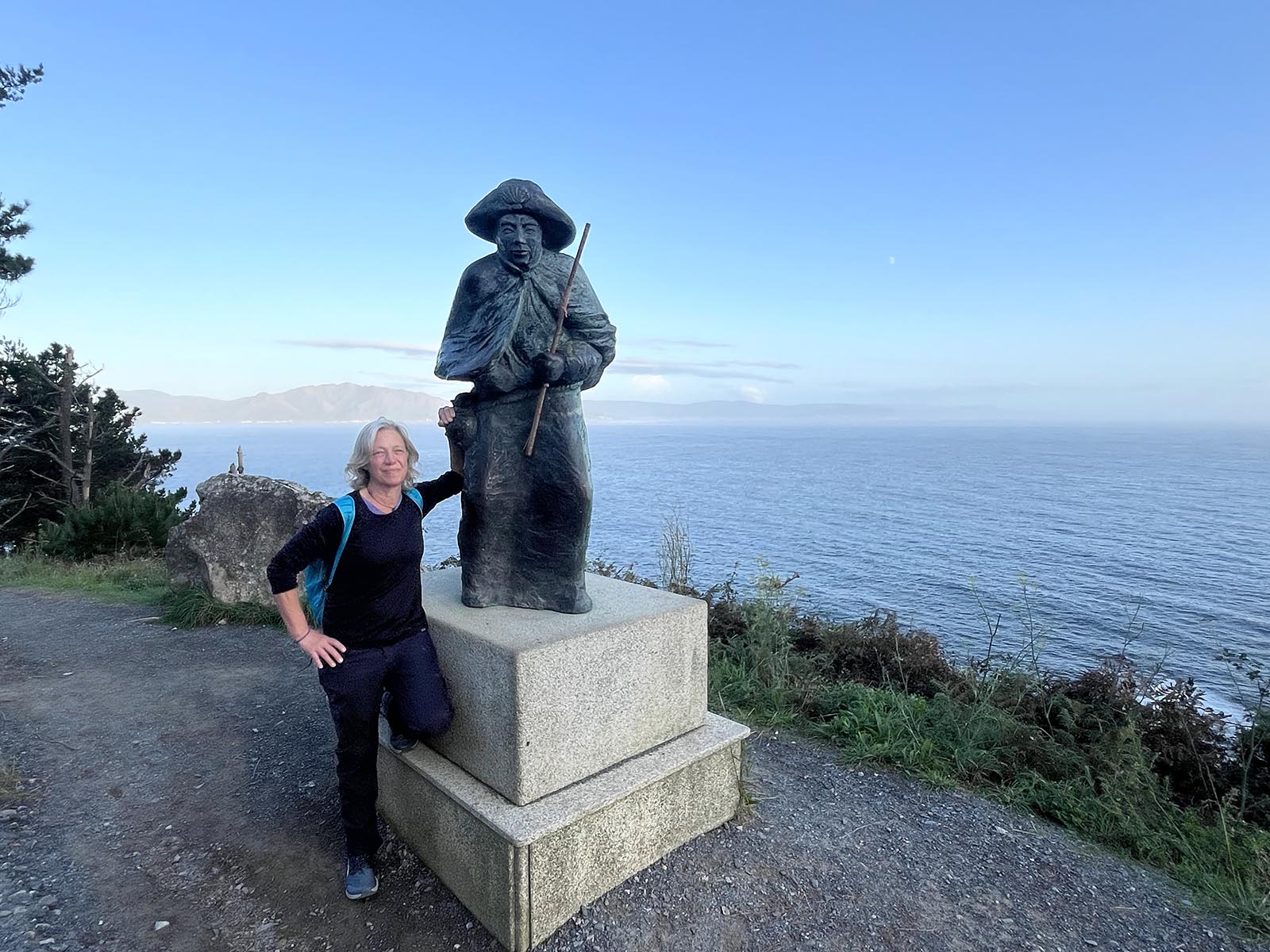 Texan Chris Rufflo at Finisterre, which is on the Camino de Santiago Portuguese and French Route. She has hiked both routes, nearly a decade apart. Photo by Chris Rufflo.
Name: Chris Rufflo
Age: 61
Home Base: Austin, Texas
Country Count: 30
What made you decide to do the Camino de Santiago twice?
That’s a tough one. I mean what compels a person to walk from one side of a country to the other?! I walked the French route in September 2018. I was in a huge transitional time in my life: my sister had recently died from esophageal cancer, which really knocked me off my feet. But there is something about the experience of losing someone close to you that shifts everything…death has a way of clarifying life. I had many tremendous life changes that year and felt the pull of the Camino as a way of clearing my head. Roughly seven years later, I retired [from a career in education] and again feeling the need to reset and clear my head, headed again to the Camino, this time the Portuguese [Sendera Literal Route in September 2024.]
How did you train for the Camino de Santiago? How far in advance should people train?
That depends on how active you are in your day-to-day life and what Camino you are planning to hike. The Portuguese is much easier to walk as there is virtually no altitude gain. The French route, however, does require strength and stamina. You should be able to walk 10 miles without it killing you, and you should be able to do that with altitude gain and loss! There will be some steep climbing days [on the French route].
When is the best time to hike the Camino?
You can hike the Camino all year, but if you are to avoid crowds, it’s best to go in the early spring or late fall. (April or Oct.) Summer is beautiful but will be more crowded with many other hikers.
How many miles were you hiking daily?
On the French route, I think I averaged about 15 miles a day. On the Portuguese route, I averaged around 18 miles a day. Typically, on the French route, I began walking at daybreak or a little before and walked until midday roughly 3 p.m. Many people begin later in the day and walk until later in the day. This is true, especially if the Portuguese route.
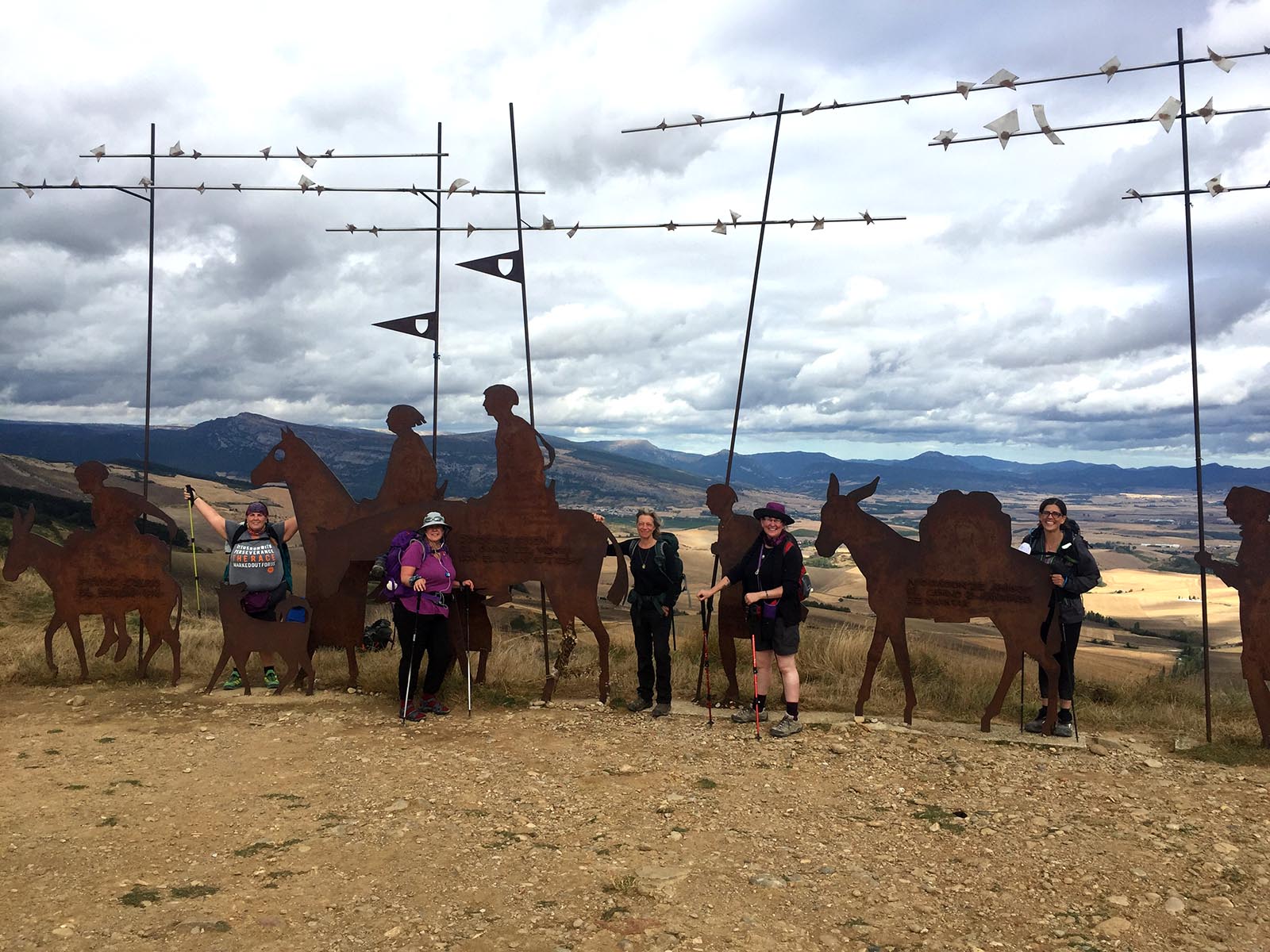 Rufflo, center, poses with friends she met on the trail at Monumento al Camino de Santiago in the El Perdon Mountain range, the site of a former pilgrim hospital. All who make it to this place are considered blessed for the remainder of the journey. Photo by Chris Rufflo.
Did you hike the Camino de Santiago alone? Is it easy to meet people?
I started off on the French route with a close friend, but after a few days of trying to match each other’s pace, we decided to separate and meet at the end, which was really amazing. The Portuguese I walked on my own. It is very easy to meet people on the Camino and make deep bonds.
What is the cost of food and accommodation for the Camino de Santiago?
The cost of doing the Camino will depend on what your needs are. You can easily do it for anywhere between $30-$50 a day depending on your comfort needs. The Camino municipals are as low as six or seven dollars a night whereas albergues can run as much as $25 or $30 a night. [Municipals are large government-run accommodation with kitchens, while albergues are hostels set up for people walking the Camino usually with a shared evening meal.]
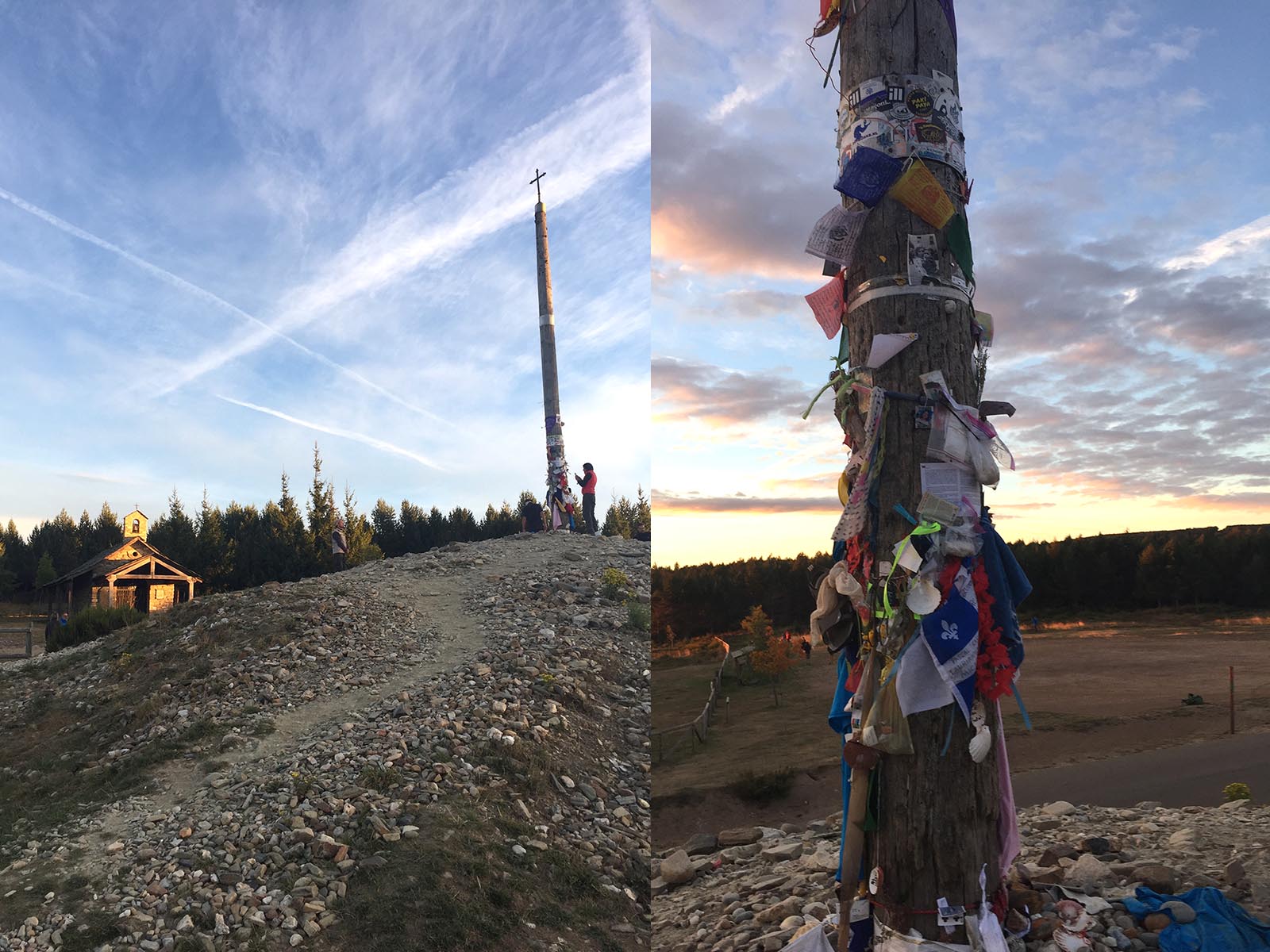 Cruz Ferro, the highest place French route of the Camino, has special meaning to Rufflo. “This is one of the most symbolic places along the Camino,” she says. “There is a custom of carrying a stone symbolizing something you want to put down or let go of. I placed a stone there in honor of my sister who had died the year prior.”
How much did your day pack weigh?
Your pack should weigh 10% of your ideal body weight, not including food and water for the day. I used an Osprey Stratus – it weighs three pounds and 4.5 ounces. It’s heavy for a pack, but I had a difficult time finding something that would fit both my torso length (which is long) and my waist. It’s a really great pack.
Can you give us a rundown on what to pack for the Camino de Santiago?
In many ways, the Camino was a metaphor for life. Learn not to carry what you don’t need. Be mindful of what you absolutely need and what you can leave behind. It will make your Camino much more enjoyable.
For myself, I brought four t-shirts very lightweight, four pairs of underwear, three pairs of very lightweight socks (Darn Tough), three pairs of heavier socks (Smartwool)—all wool. One long-sleeve Patagonia Capilene shirt, one pair of Patagonia water-resistant pants, one pair of lightweight cotton pants, lightweight hat, sunglasses, sunscreen, and toiletries. (Check out the detailed packing list at the end of the post!)
Some great hacks: Use a shampoo bar—it’s lighter than bringing regular shampoo. Remember, you can buy replacement for things such as toothpaste along the way, so bring a very small tube of toothpaste. You can buy a small tin of zinc sunscreen for your face. For your water bottle, use plastic.
If you were doing the French route, there will be days when you want to wear a light pair of socks with a heavier pair of socks over them to protect your feet. You will also want to change your socks out midday. You can buy gloves along the way if it’s cold.
How much water were you carrying every day on the Camino?
Typically, I carried about a liter to a liter and a half of water depending on how much water is available [on the route]. You can check the night before to see what water is available along the way. Finding water along the Portuguese route was more difficult and I ended up carrying closer to two liters every day
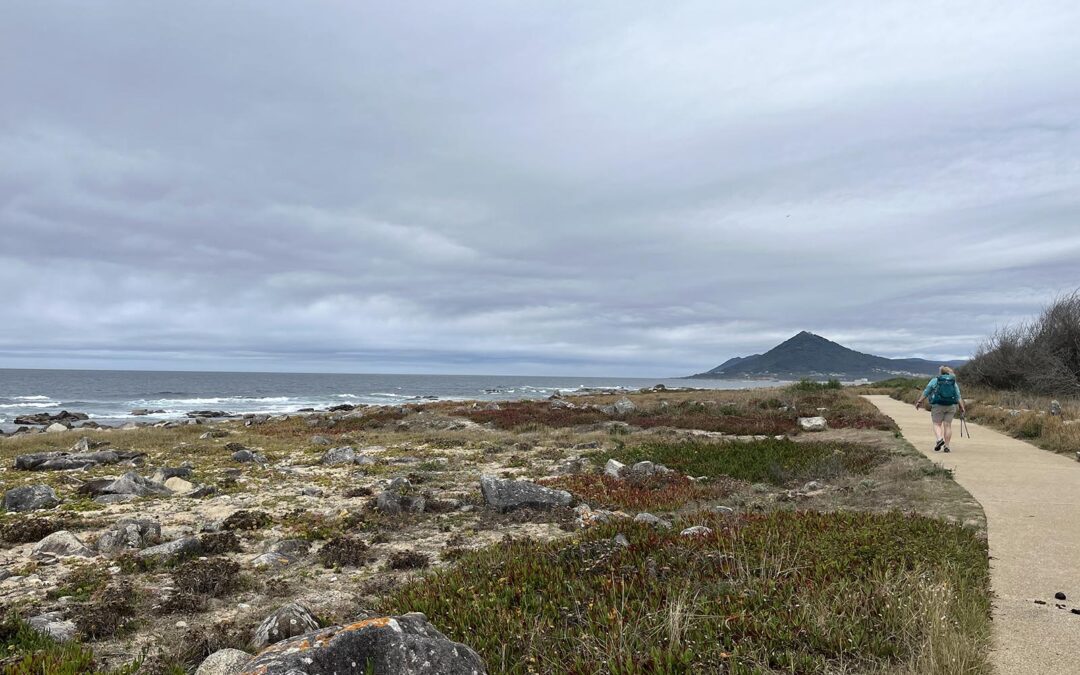
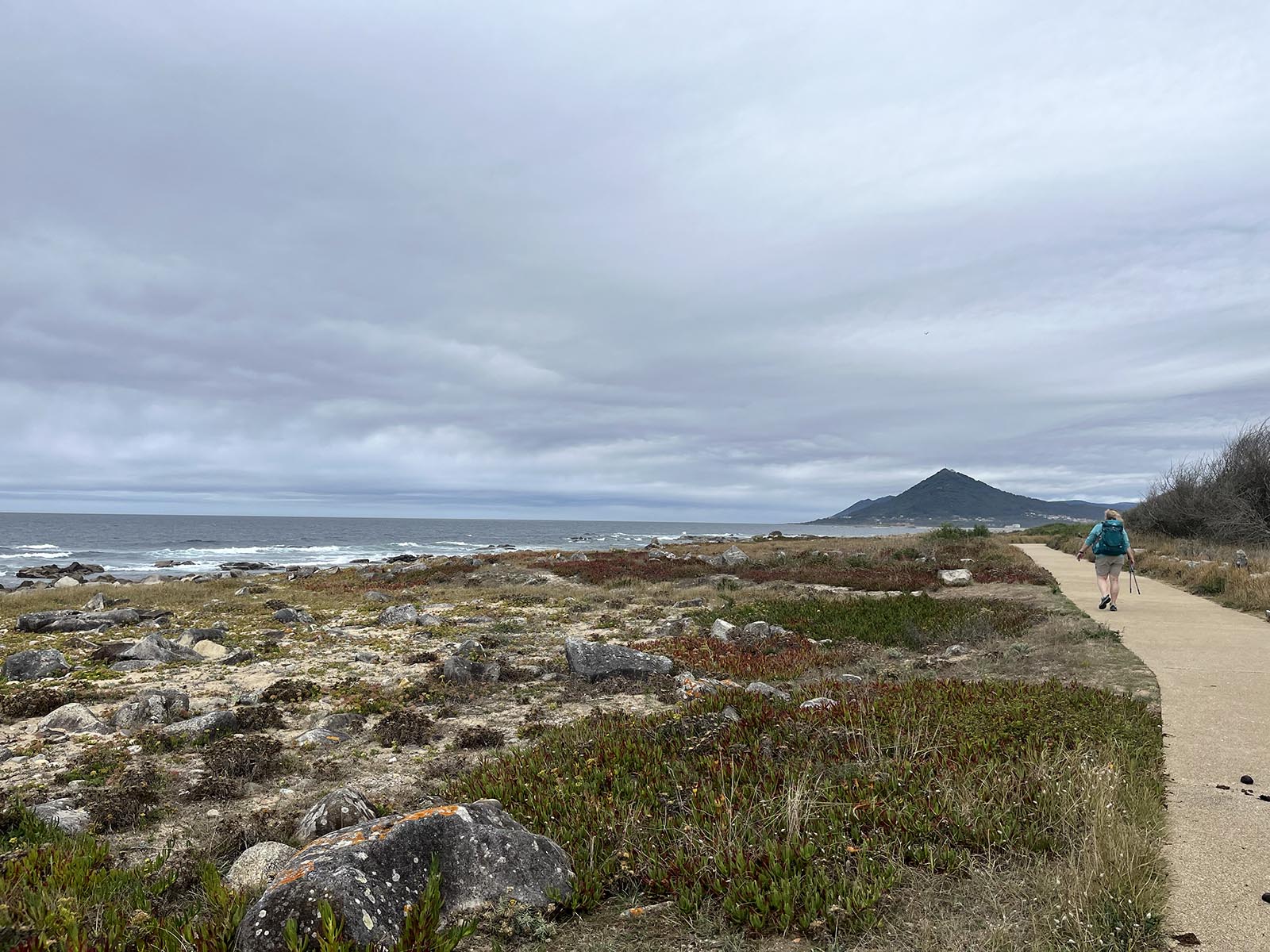 A scenic view of Moledo on the Portuguese route of the Camino de Santiago. Photo by Chris Rufflo.
What advice would you have for someone hiking the Camino?
Remember that the Camino is a personal journey, and everyone’s Camino will be different. Give yourself grace. Some people may find themselves walking five miles a day while others may find themselves walking 20 miles a day. Again, this is your journey!
What’s your next adventure?
Either going up to Hudson Bay, Canada to see the polar bears and Northern Lights or heading to Nepal for some trekking and cultural experiences.
Camino de Santiago Packing List
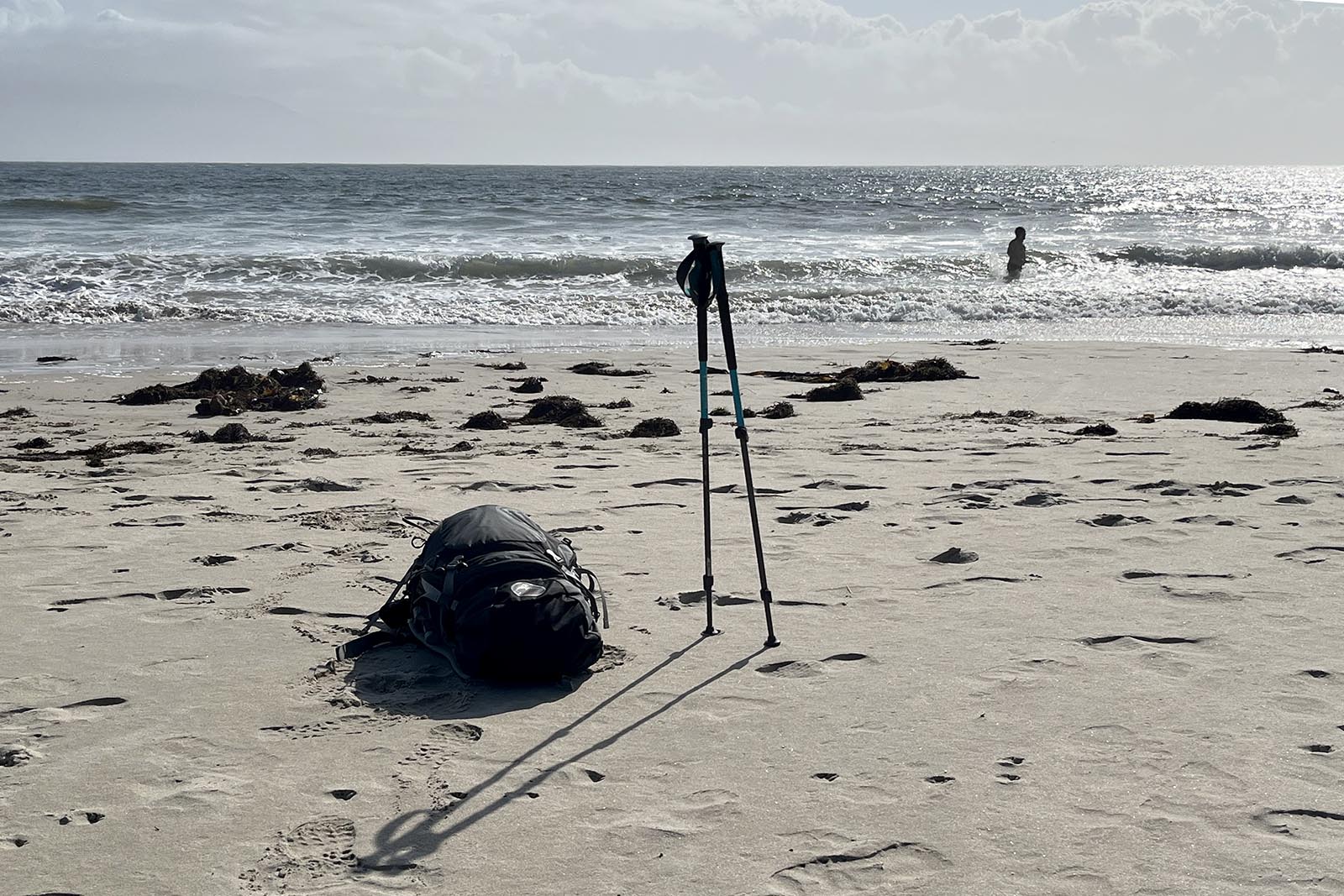 Chris’ Osprey backpack and hiking poles at Finisterre, which is on the Portuguese and French Route. Photo by Chris Rufflo.
Socks:
7 pairs (All should be wool!)
3 pairs ultralight weight Smartwool
3 pairs of Darn Tough heavier-weight socks.
One pair of ankle socks to wear at night ultra lightweight. Light Hiker Quarter by Darn Tough.
Underwear: 3 pairs
Tops: 4 lightweight t-shirts, One long-sleeve Patagonia Capilene base layer
Bottoms:
One pair of Patagonia water-repellent pants
One pair of lightweight Mountain Hardware pants.
One pair of shorts.
Chris Notes: I hiked in Patagonia [pants] the first time and Kuhl the second time. I have a pair of Mountain Hardwear for a backup but am also looking for something lighter!!!
Toiletries: Toothbrush, small toothpaste, shampoo bar (cut in half), Argon lotion bar (cut in half) for my face, lightweight towel (14X20 inches). [Chris cuts her shampoo and lotion bar in half and stores it in a plastic pill bag. She recommends Dr. Bronner’s.]
Water: Two plastic half-liter bottles. [Please note that water is more frequent on the French route than Portuguese.]
Shoes: Waterproof hiking boots (high ankle) for the French route. For the Portuguese route, I used trail runners. I did not bring a spare pair of shoes, but many people do.
Outerwear: Ultra lightweight raincoat, Patagonia puffer, lightweight hat, sunglasses.
Electronics: iPhone & charger
Hiking Poles: Get a pair of lightweight ones that can fold down.
Sleeping bag: Silk sleep sack. (Silk is both lightweight and can add warmth.)
Dry bags: Three ultra-lightweight dry bags: One to keep my clean clothes in, one to put my dirty clothes in and one very small one for my passport and other important objects that need to stay dry. Rain poncho for my pack.
I Used a Saily eSIM for 1 Month in Southeast Asia—Here’s How It Went
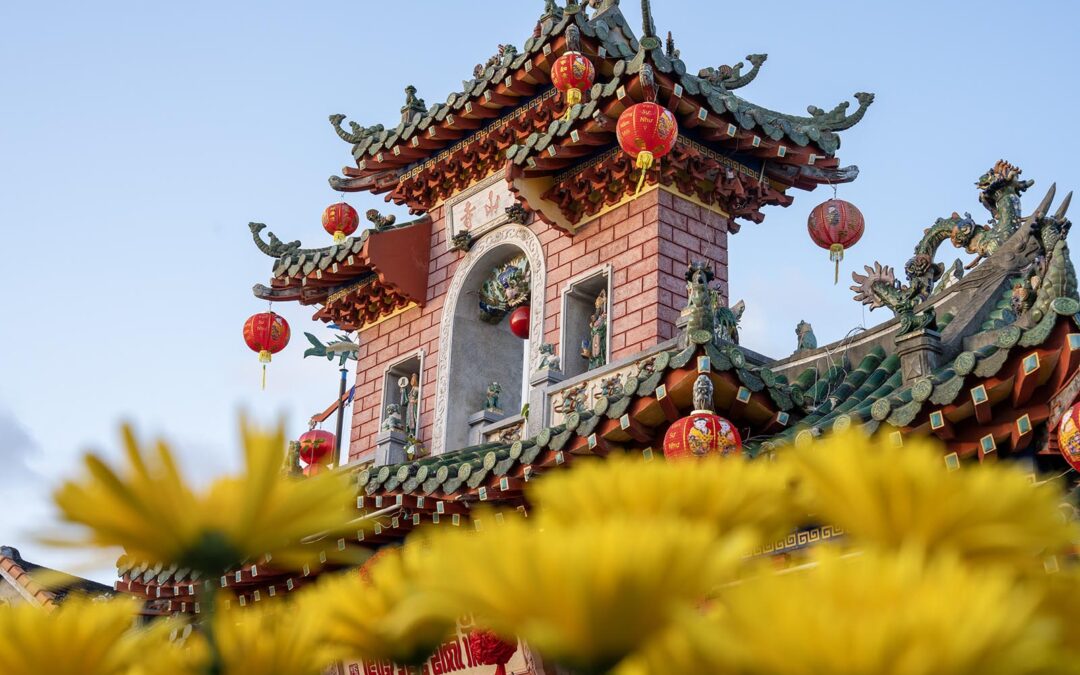
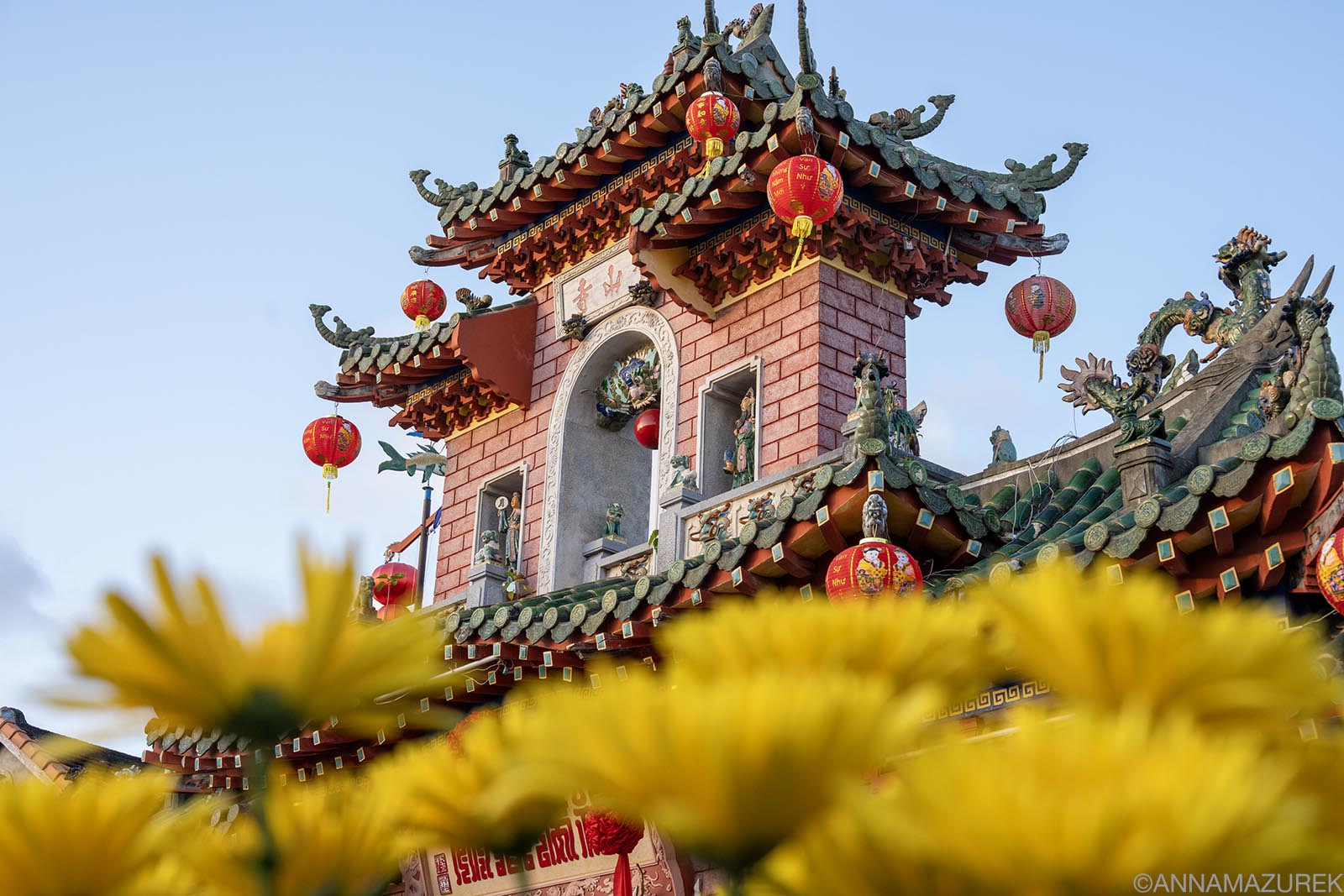 The colorful temples in Hoi An, Vietnam were one of my stops on my recent Vietnam trip testing the Saily eSIM card.
While I was hesitant to use eSIMs initially, they’ve been a lifeline for me since I travel nonstop for work. While I’ve written about the pros and cons of eSIM cards, I’ve recently tested out Saily eSIM, which is owned by the team behind NordVPN, on a six-week trip through Southeast Asia with stops in Thailand, Cambodia, Laos and Vietnam in January and February.
Affiliate Disclosure: Please note that this is a sponsored post with affiliate links. All opinions are my own. If you make a purchase, I earn a small commission at no cost to you, which goes toward blog maintenance costs. I only recommend products and companies I use.
First of all, what’s an eSIM?
An eSIM card is a digital SIM card that works the same as a physical SIM card minus the hassle of trying to insert anything into your phone. Most newer phones only accept eSIM cards and allow you to switch easily between multiple eSIM cards.
What type of eSIMs does Saily sell?
Saily sells country and regional eSIM cards to over 200 destinations with data plans ranging from 1GB to 50GB over a period of one week to 30 days. Plans have a 30-day activation window, and if not activated during that period, they will automatically activate 30 days after purchase.
Regional eSIMs are the most convenient if you are country-hopping while country-specific eSIM cards are often cheaper. If you choose a regional eSIM card, make sure all the locations you are traveling are covered. (You’ll see where I made that mistake below.) Since they are owned by the NordVPN team, they’ve integrated a lot of free security features, which I talk about below. (Use Saily promo code ANNA10 for 10% off your purchase.)
Saily eSIM Review for Southeast Asia
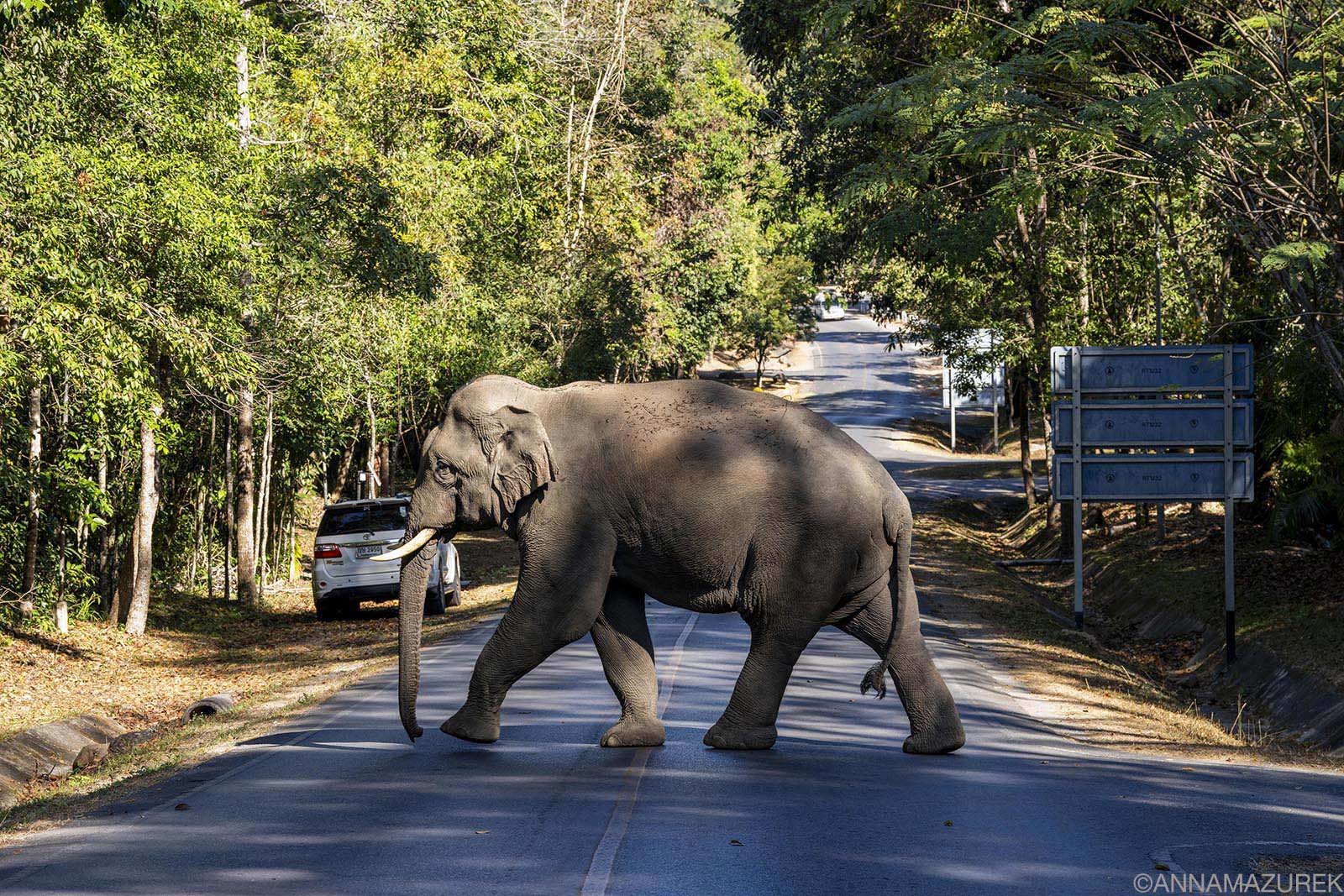 I started my trip in Thailand’s Khao Yai National Park, known for wild elephants.
I used a regional Asia eSIM (10 GB for 30 days for $35.99), a Cambodia-only eSIM (3GB for 30 days for $8.99), and a Vietnam eSIM (5 GB for 30 days for $10.99) during a six-week trip through Thailand, Laos, Vietnam and Cambodia. (Use promo code ANNA10 for 10% off all purchases. Yes, I totally use my own affiliate discount codes.)
It was very easy to install. The best thing about Saily is that you install the eSIM once, and it automatically reloads with any new plans you buy. (I’ve found it cumbersome to be constantly installing eSIMs every time I buy a new plan with other eSIM providers and having to delete old ones.) Saily does give you the option to install multiple eSIMs if you prefer.
Thailand
I installed this eSIM on a visit to Khao Yai National Park, roughly a 2.5-hour drive northeast of Bangkok. Saily uses the True network, which is one of the top two providers in Thailand. I only had LTE service initially since I was in a remote area, but it worked fine. I was even able to hotspot on LTE with no issues. In Bangkok, it was on 4G and worked perfectly.
Laos
Next, I flew to Luang Prabang, Laos, but I knew in advance that Saily doesn’t cover Laos. In fact, I’ve only seen one eSIM company cover Laos, and it was very expensive ($9.50 for 1 GB!). It was cheaper to buy a local eSIM on arrival.
Vietnam
I used this on two trips to Vietnam. On the first trip in mid-January, I flew into Hanoi and had issues getting the eSIM to connect. It finally connected to 3G service on Vietnamobile, which is not a fast network. It was a bit of a nightmare getting my Grab (Southeast Asia’s version of Uber) due to the slow network, and I had to go back into the airport to get WIFI to order the car. (I saw on Reddit and a few other forums about people complaining about this same issue at Hanoi’s airport with both Saily and other eSIM companies. This could be an issue with that airport specifically.)
I contacted Saily support immediately when I got to my hotel to resolve the issue, and their support team was fantastic. They had me go through several troubleshooting steps including ensuring roaming was turned on (it was). To fix the issue, they had me turn off automatic selection for the carrier network in the eSIM’s settings and select Mobifone, which gave me LTE service and resolved the issue. (When you do this, it gives a list of cell networks, but you need to know which ones your eSIM partners with to ensure you get service.) Please note that it’s not uncommon for eSIMs to switch between different networks.
Initially, I was expecting at least 4G or 5G coverage. (Even if an eSIM company partners with a network with 5G coverage, it usually only supports up to 4G in my experience.) With the LTE service, I was still able to stream YouTube videos on the ride from Hanoi to Ninh Binh with no issues. I had LTE with full bars in Hoi An, Ho Chi Minh City and along the Mekong Delta.
On my second trip to Vietnam, I flew into Ho Chi Minh City at the end of February and stayed in the city. Saily’s support told me they’d fixed the issue at the end of January, so I thought I’d test it again. (They gave me a code for a free 5 GB for 30 days plan due to the issues I’d experienced earlier.) I used a Vietnam-specific eSIM card, which connected to Mobifone LTE with no issues at the Ho Chi Minh airport when I arrived. I was able to call my Grab at the airport with no issues getting to my hotel. It worked in the city with no problems, and the connection was seemed pretty fast. I was able to use social media apps with no issues, etc.
Cambodia
When I entered Cambodia by ship on the Mekong River, my phone wasn’t initially connecting so I reached out to their support team. Turns out the regional Asia eSIM card I had doesn’t support Cambodia, which was my fault for not checking that. Haha!
I bought a Cambodia-specific eSIM card (3GB for 30 days for $8.99), which uses the SMART network, which works best in big cities like Phnom Penh and Siem Reap. In more rural areas like Kampong Cham, I had EDGE service whereas a second eSIM I’d bought on the Metfone network had 4G. Then, in other rural places, I’d have service on the Saily eSIM (SMART network) and no service on Metfone. Cell service in Cambodia is very location dependent.
Locals tell me that the Metfone and CellCard networks are best in rural areas in Cambodia. If you’re going somewhere outside the major tourist areas, then reach out to your accommodation to see what network is best for that area. For example, the remote island of Koh Rong Sanloem only gets Metfone service barely, so I bought a Metfone SIM card just for my three-day visit to the island.
Use Saily promo code ANNA10 for 10% off your purchase!
Saily eSIM Card Review Summary
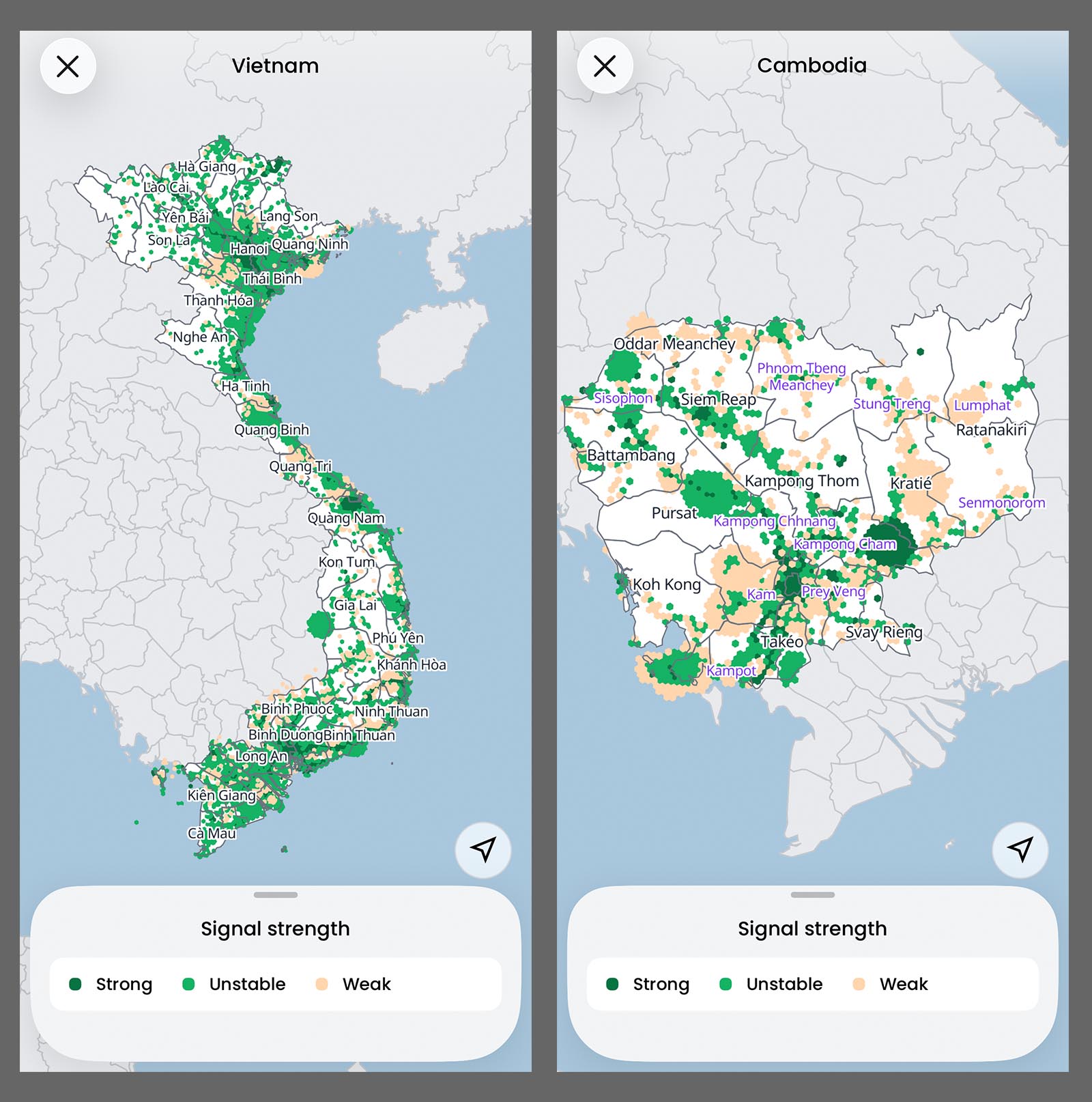 In the Saily app, you can see coverage maps for all country-specific plans, which is a great planning tool. These screenshots are Vietnam (left) and Cambodia (right).
Overall, eSIM cards are only as good as the cell networks they partner with. I was impressed by the ease of the eSIM installation for Saily and their fast customer support, which was better than the support with other companies I’d used. I’d recommend it easily for Thailand and Cambodia (major cities). As for Vietnam, I initially wouldn’t have recommended it after my fiasco at the Hanoi airport, but I had a much more pleasant experience on my second visit to Ho Chi Minh. (If you’re heading to Hanoi, be aware that you’ll likely have trouble connecting to any cell network around that airport.) I’d highly recommend buying the plan and installing it before you leave for your trip, so it works on arrival.
While Saily has a virtual location option, I used my NordVPN in conjunction with my Saily eSIM to download shows on Paramount + and Disney + since I was switching back and forth from WIFI to cellular data for downloading. (Both streaming services require you to be in the U.S. for anything to download, which is why I always use a VPN when I travel.) NordVPN and Saily’s eSIM worked seamlessly together.
Before I boarded my flight, I was triple testing my downloads using the VPN to be safe, which I also recommend doing. The eSIM worked perfectly for this. If you purchase a Saily eSIM, use code ANNA10 for 10% off your purchase.
Saily eSIM FAQ
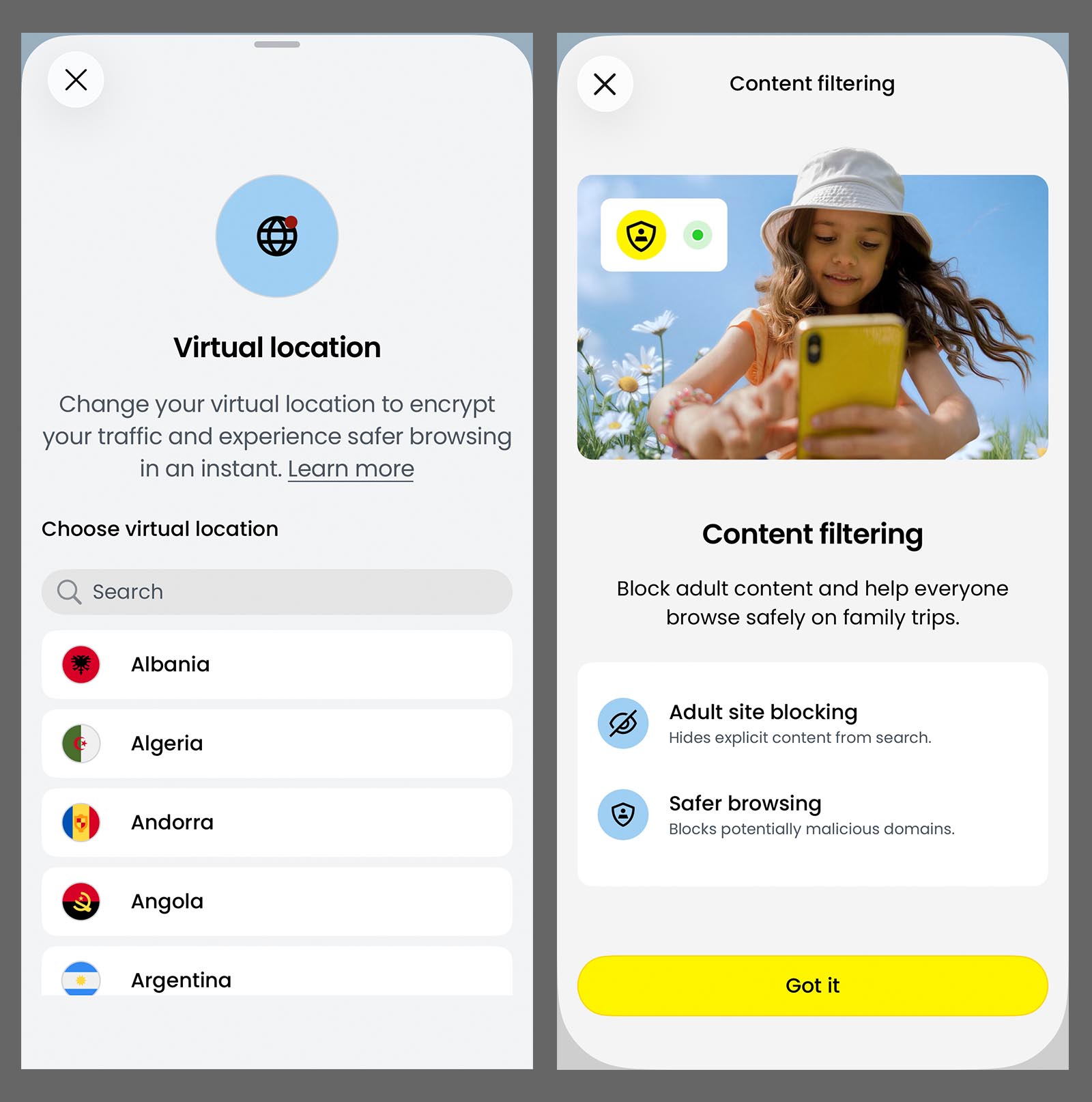 Saily eSIMs include several security features, including virtual location (left) and content filtering (right).
Are Saily eSIM cards safe and secure?
Saily is owned by Nord Security, the company behind NordVPN, so security is one of their top concerns. Saily includes the following security features in the top section of their app:
Virtual Location: Saily lets you choose your virtual location from 82 options and browse with more privacy by routing your connection through a remote server. (This is really important for streaming services and downloading movies to watch on planes.)
Ad blocker: To reduce screen clutter and save data, Saily can block intrusive ads. (Keep in mind that many websites rely on ad revenue to keep content free. If you’re browsing content from smaller creators (like me!), consider leaving ads on to help support them.)
Web Protection: Through DNS filtering, Saily reduces trackers and malicious websites before they reach your phone.
Does a Saily eSIM give you a phone number?
No, a Saily eSIM does not give you a phone number. It currently only supports mobile data, but this is a feature they are looking to add per their website. For more about having a number when you travel, check out my post on traveling and two-step verification.
Does Saily eSIM work in the U.S.?
Yes, Saily has six different plans for the United States ranging from 1 GB to 50 GB lasting from one week to 30 days. Prices range from $3.99 to $49.99. Use code ANNA10 for 10% off your purchase.
How to Install Saily eSIM on your iPhone
The setup for Saily is easy. Simply download the Saily eSIM app, choose your plan and it will activate automatically.
If you’d like to set it up manually, go to “Settings,” tap “Cellular”, Tap “Add eSIM,” click on “Use QR code” and follow the instructions. For more details, check out Saily’s Help website.
Troubleshooting Issues with a Saily eSIM card
If you are having issues with your eSIM cards connection to cellular service, try the following. These worked well for me when I had issues.
1. Turn Airplane Mode on and off.
2. Make sure the correct eSIM card is turned on and set as your default line.
3. Make sure data roaming is turned on.
4. If you know the network your eSIM is partnered with, turn off “Automatic Selection” and manually choose the network.
5. Toggle between 5G, LTE and the other network speed selections.
6. Turn Airplane Mode on and off again to test everything is working properly.
For more details, check out Saily’s Help website.
11 Things to Do in Hanoi That Are Actually Worth Your Time
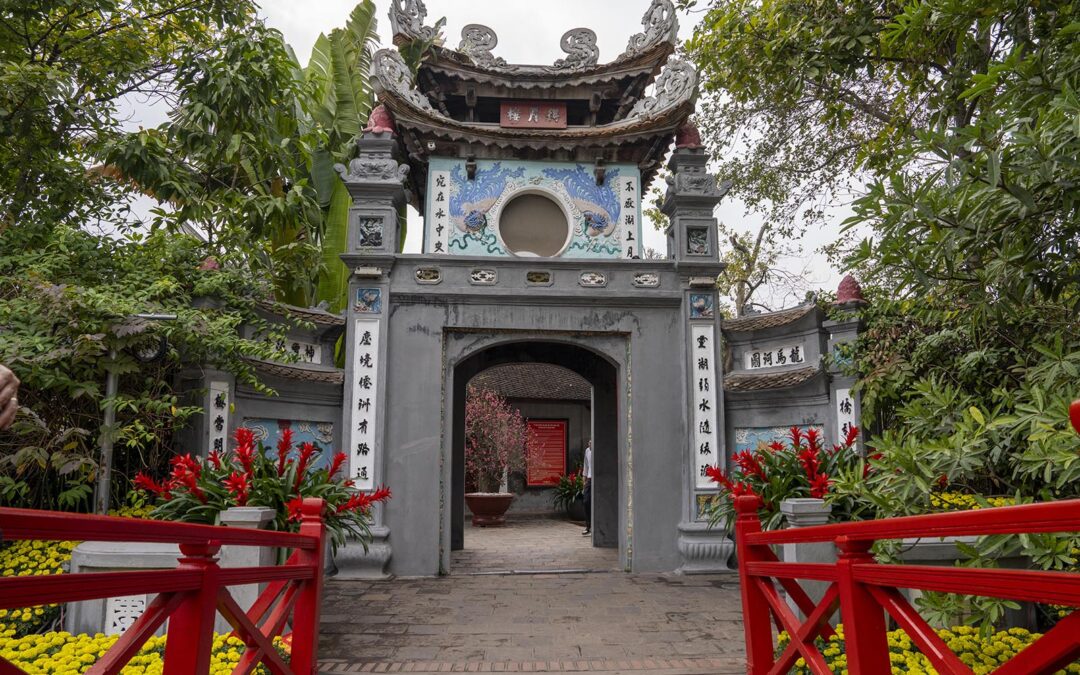
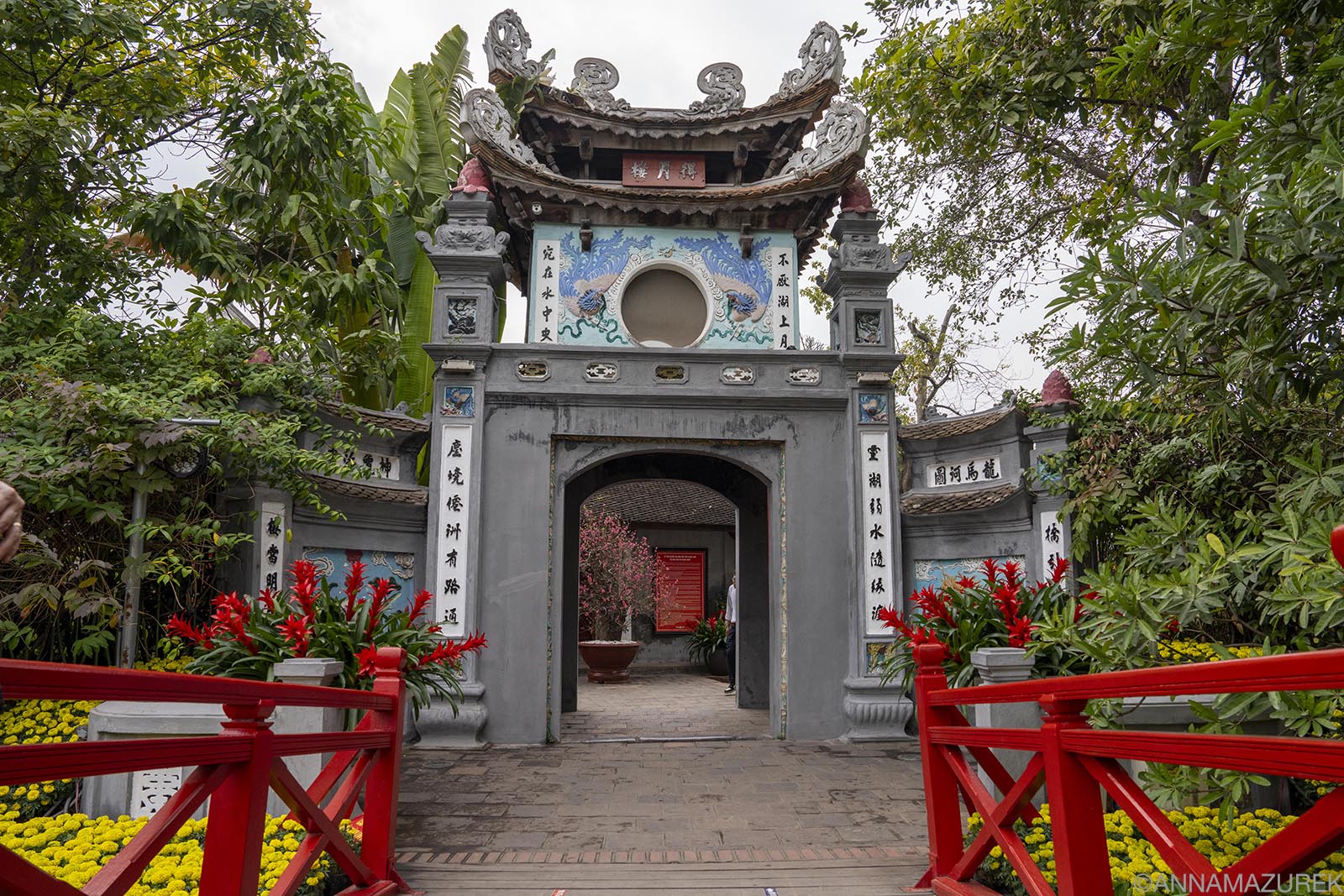 Located on an island on Hoan Kiem Lake, Ngoc Son Temple is easily accessible by a red bridge.
Vietnam’s two largest cities are polar opposites—Ho Chi Minh City is a sleek, modern city of skyscrapers while the charming capital of Hanoi is filled with ancient history. Hanoi is the best for watching motorbikes defy gravity with their loads ranging from refrigerators to a family of five with a dog. It’s home to the country’s largest airport and the gateway to Ha Long and Lan Ha Bay and Ninh Binh.
These recommendations are based on my experience living and working for travel companies in Southeast Asia for the past decade. (I visit Vietnam at least once a year for work.)
Here are the best things to do in Hanoi along with the best time to visit and where to stay!
You can easily do all these things on your own, but if you’re short on time consider a city tour.
Affiliate links are used in this post. If you make a purchase, I earn a small commission at no cost to you, which goes toward the cost of maintaining this blog.
Plan Your Trip
Currency: Vietnamese Dong (VND)
When to Go: Temperatures cool down in November and December.
Travel Insurance: Protect yourself with SafetyWing travel medical insurance to cover accidents and travel delays.
Mobile eSIM Card: For the fastest cellular network in Vietnam, use Airalo for 5G connectivity.
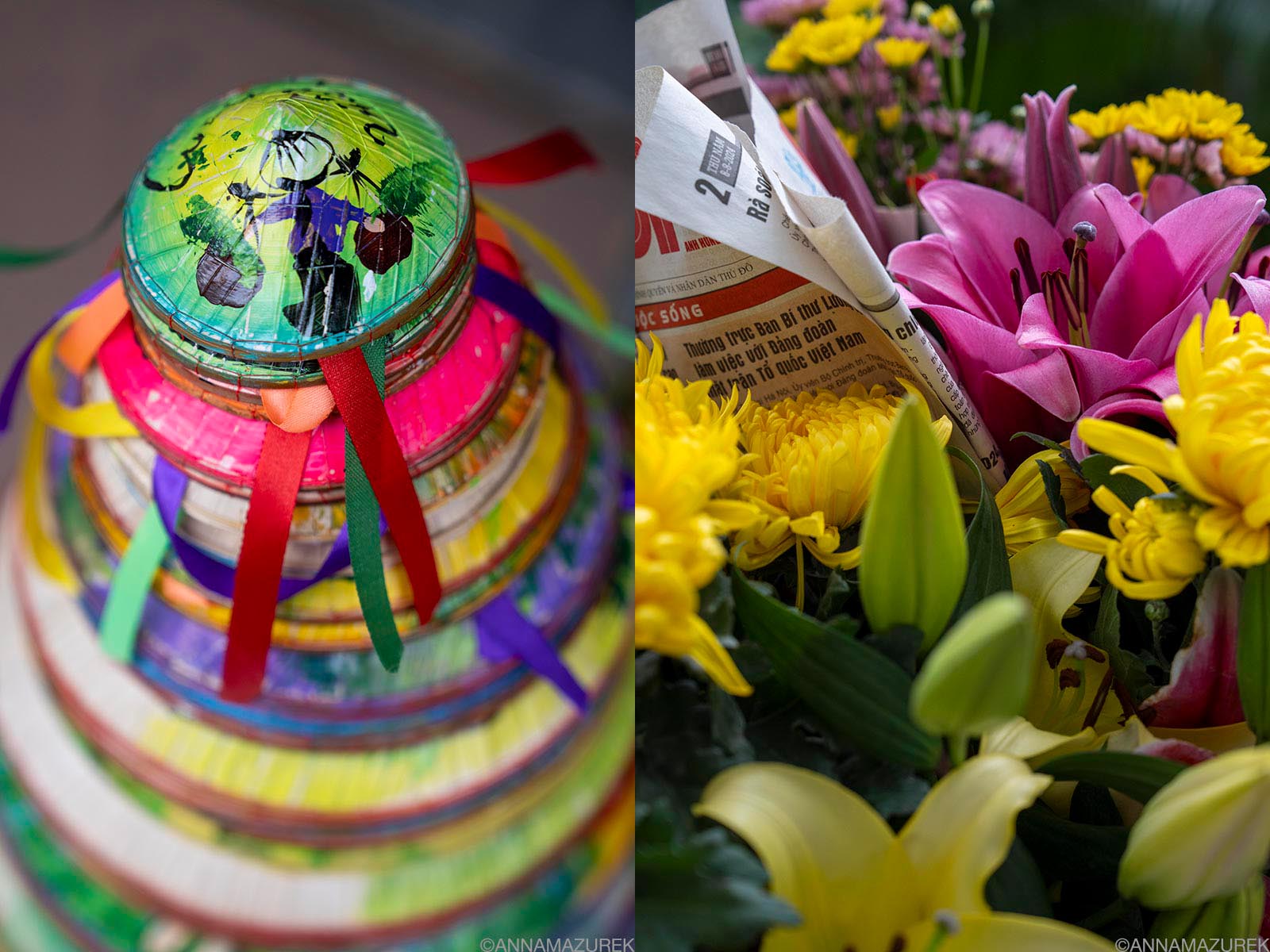 Conical hats and fresh flowers are a few of the many items for sale in the historic Old Quarter, the heart of the city’s shopping district.
Explore the Old Quarter
Hanoi’s Old Quarter lies North and slightly west of Hoàn Kiếm Lake and consists of 36 streets.It’s a great place for strolling and watching motorbikes with their outrageous loads. The streets are organized by the items they sell from shoes to silver jewelry. Here are a few of the most famous shopping streets:
Hang Dau – Shoe Street
Hang Ma – Lantern Street
Hang Bac – Silver Street
Hang Vai – Bamboo Street
Hang Duong – Sugar Street
Lan Ong – Traditional Medicine Street
Hang Gai – Silk Street
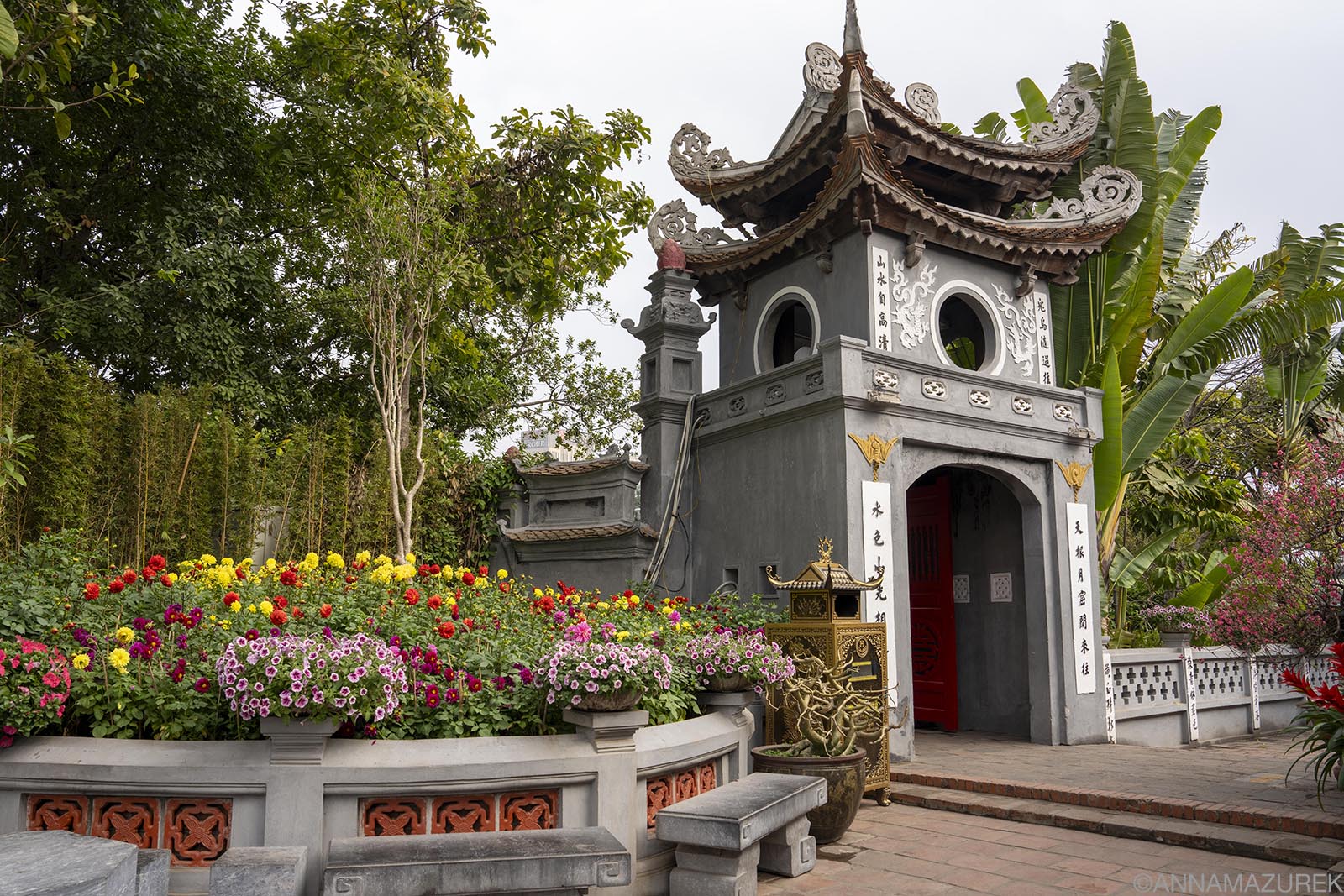 Ngoc Son Temple is one a popular spot to visit and crowded on holidays.
Hoàn Kiếm Lake
No trip to Hanoi is complete without a stroll around Hoàn Kiếm Lake. On weekend evenings, traffic is banned by the lake making it easy to explore. You’ll find a good mix of locals and travelers. Be sure to cross the red bridge to visit the photogenic Ngoc Son Temple.
Cyclo Ride
To get an overview of the city, hop on a three-wheeled cyclo, which resemble a backwards tricycle, for an orientation tour. While it might seem touristy, it’s a fun way to support a traditional and eco-friendly transportation method in a city with a huge pollution problem. Rides start around 400,000 VND ($4 USD).
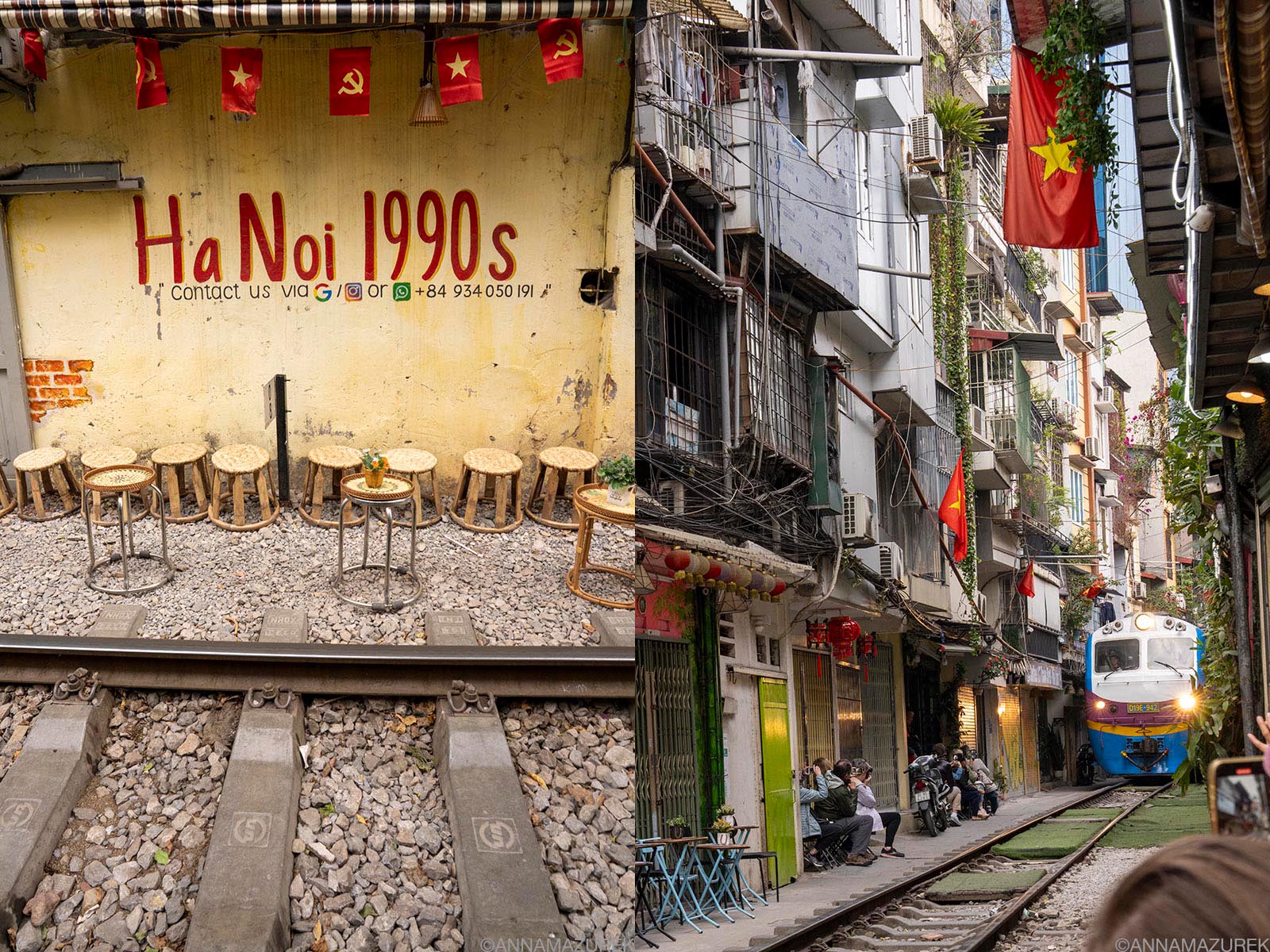 For an adrenaline rush, go have a coffee on Hanoi’s famous train street.
Visit Hanoi’s Train Street
There are two different streets where you can sip a coffee while a train whishes by just inches away from your table. The best one is a bit south of the Old Quarter and directly west of Thong Nhat Park. While it’s lined with cafes, I visited Hanoi 1990s, which I made a reservation with on WhatsApp in advance. (Plenty of people seemed to just be walking up, but I wanted to be safe.) The cafe told me to call them when I arrived, but it was easy to enter without calling because street Ngõ 222 Đ. Lê Duẩn crosses the tracks right by the cafe.
The trains get so close that the cafe lays down all the tables, makes you put your drinks on the ground and turn your body against the wall. It’s a bit scary but fun. Drinks cost around 60,000 VND. (There’s a minimum charge of 40,000 VND to sit if you don’t order a drink.)
Check the Hanoi 1990s Instagram for the train schedule. The trains departing from Hanoi station are always on time, so opt for those departures.
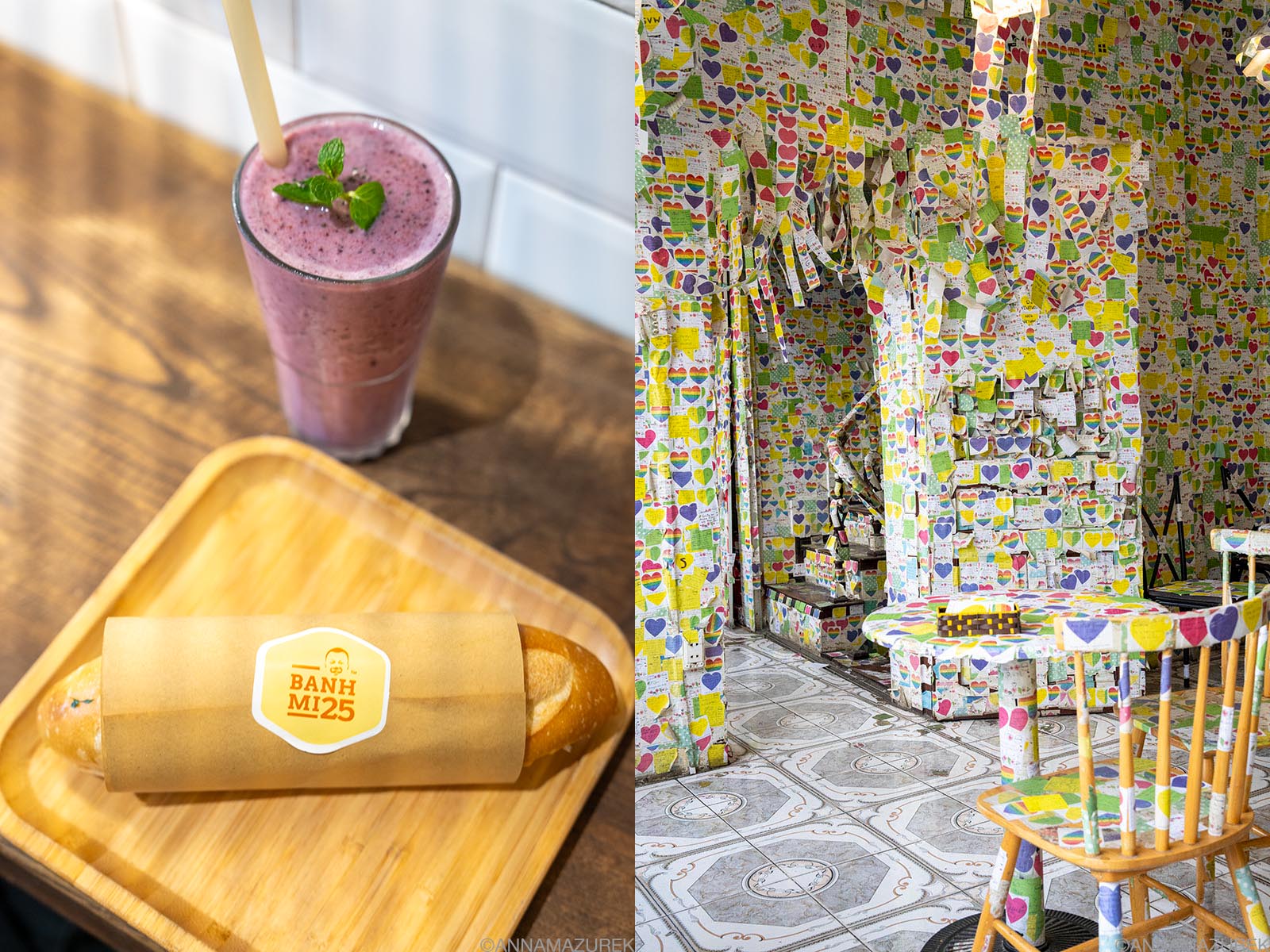 Left: A banh mi and smoothie from Banh Mi 25; Right: The eclectic decor of The Note Café.
Relax at one of Hanoi’s Cafes & Eat a Banh Mi
Vietnam does cafes well. The Note Cafe is covered floor-to-ceiling in notes and stickers and worth a stop. Even though it’s an Instagram hotspot, their smoothies are delicious, and it’s a great view of the lake. Climb to the higher floors for solitude. Don’t miss JOMA, my favorite café chain in Southeast Asia, for homemade bagels and delicious pumpkin soup!
While there’s no shortage of bánh mi restaurants, one of the most famous is Banh Mi 25. Due to its popularity, it now covers three storefronts on the same street—it’s a great place for a budget-friendly and tasty meal. I had a tasty sandwich AND a strawberry banana smoothie for $3 USD.
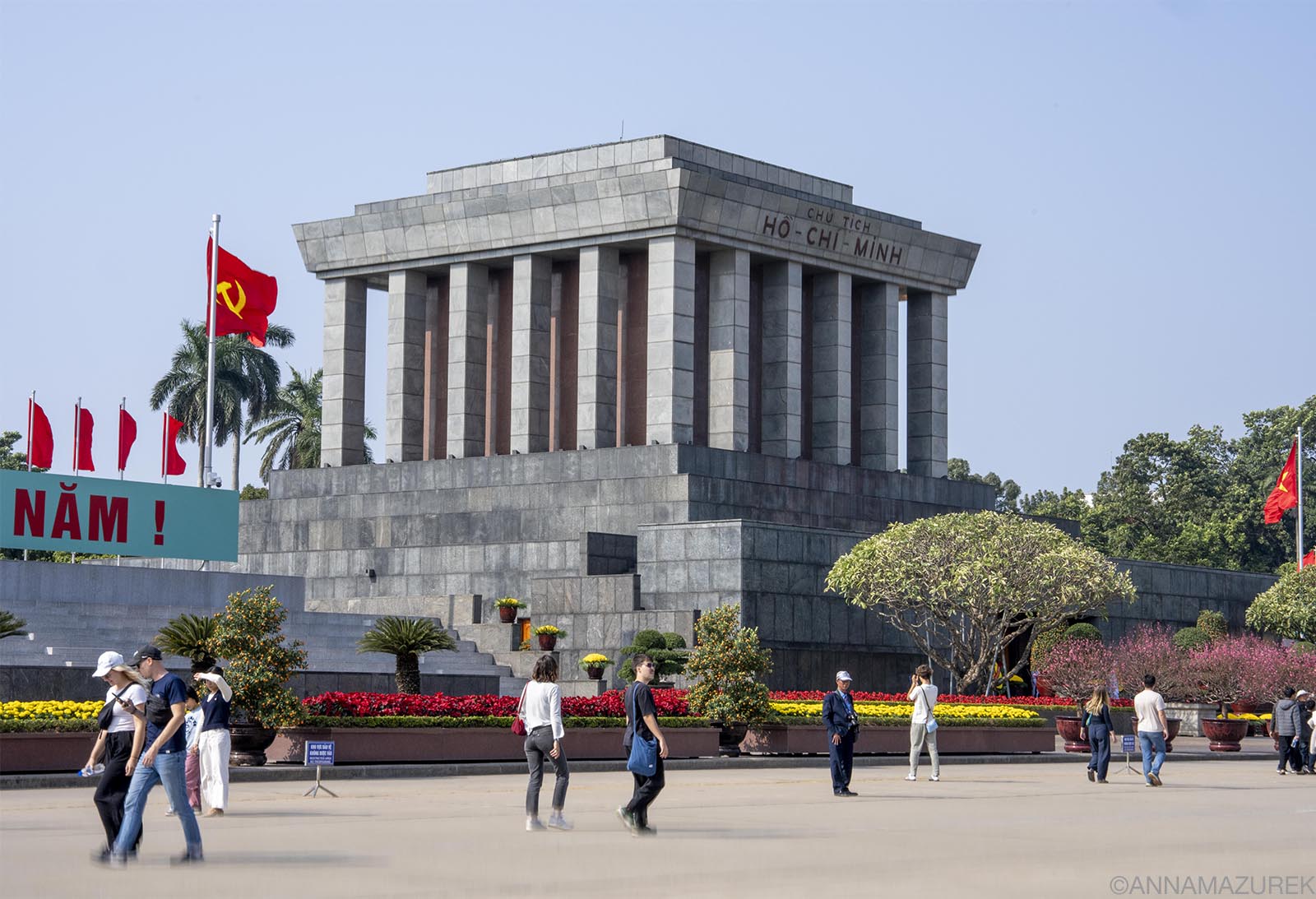 Ho Chi Minh Mausoleum is a marble moment is the resting place of the famed leader and is known for the changing of the guard ceremony.
Ho Chi Minh Mausoleum and Grounds
Behind the Ho Chi Minh Museum lies a large green space featuring a wide variety of the city’s attractions related to the former ruler including the Ho Chi Minh Mausoleum where you can walk by his embodied body on display. (The building exterior is photogenic and lit up at night.) Other attractions include Ho Chi Minh’s Stilt House and One Pillar Pagoda, a wooden building built on top of a single concrete pillar meant to resemble a lotus flower. It was built in 1054 later destroyed by French in 1954 and later rebuilt.
Vietnam Museum of Ethnology
This museum does a deep dive into the 54 recognized ethnic groups that comprise modern-day Vietnam. One of the highlights is the outdoor architectural garden that includes a life-size republic of traditional houses that you can explore, including the awe-inspiring 19-meter-high Bahnar communal house (my favorite.)
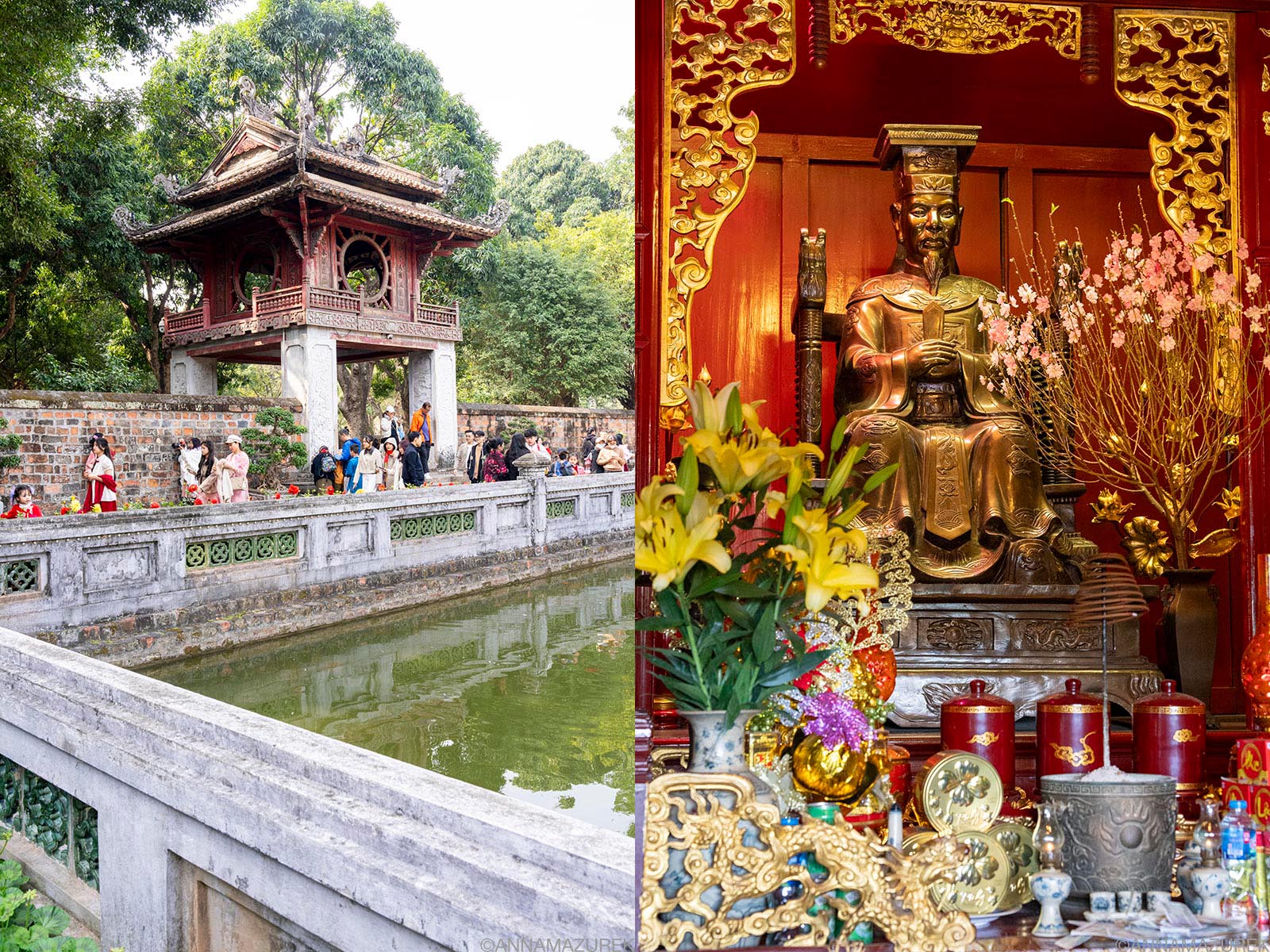 Scenic views of the interior and exterior of the Temple of Literature.
Temple of Literature
Famous for its traditional Vietnamese architecture, this historic attraction was the site of Vietnam’s first university and a Confucius temple, founded in 1070 by Emperor Ly Thanh. (You’ll recognize it as the temple on the back of the 100,000d bill.) It’s crowded on holidays, like TET, and during graduation season, when it’s often used as a photogenic backdrop.
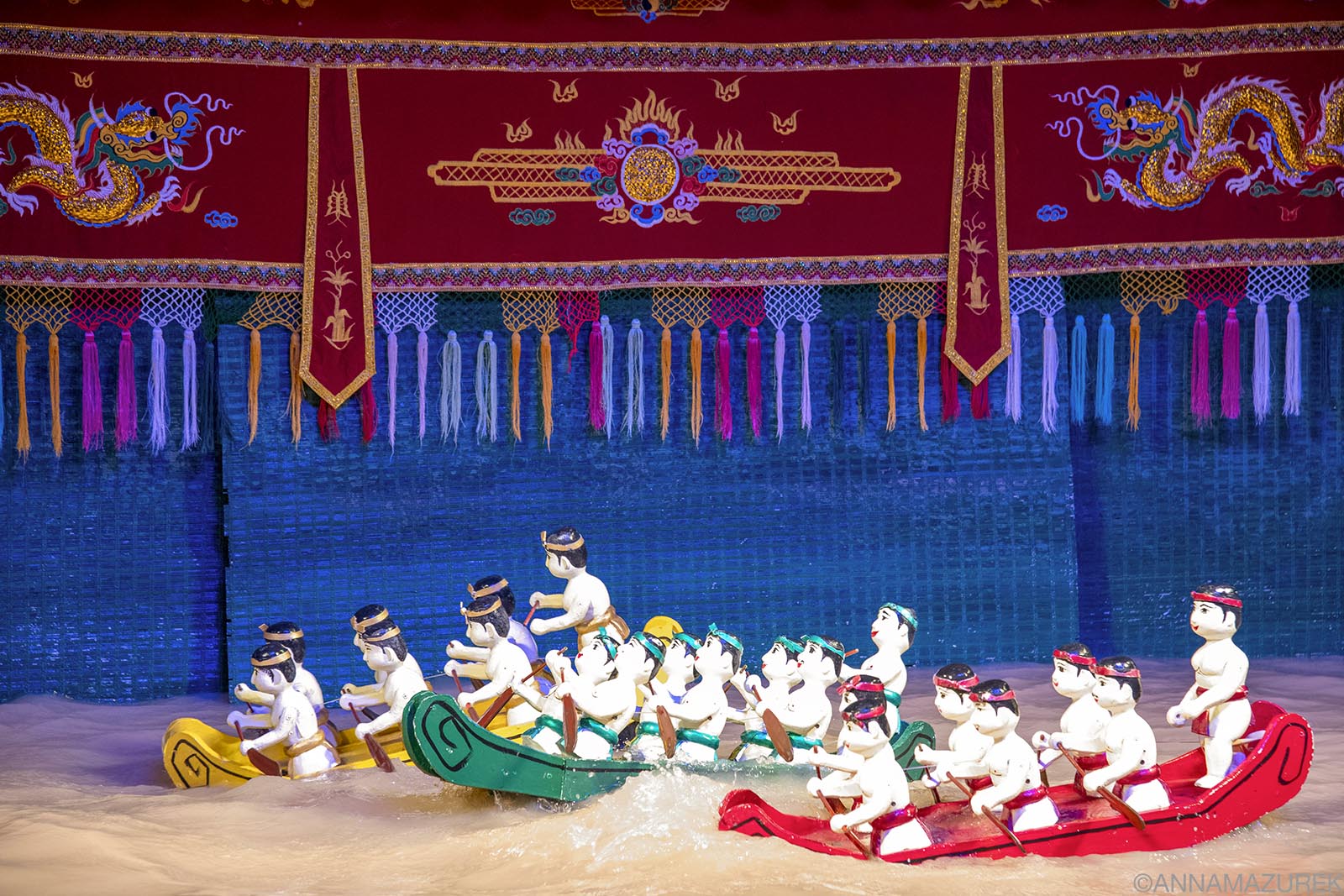 Vietnamese water puppet shows are a fun-filled attraction for all ages.
Water Puppet Show
Water puppetry is a traditional form of Vietnamese theater dating back over a century performed in a waist-deep pool accompanied by traditional folk music. While the show is entirely in Vietnamese, it’s easy to follow along with the action and laughs. (I go to one water puppet show every year for work, and it’s a really fun to experience at least once.)
The Lotus Water Puppet Theater and Thang Long Water Puppet Theater have regular performances. (You can buy tickets in person or in advance on Klook for the same price.) All water puppet shows across Vietnam are similar storylines, so no need to see shows in multiple cities.
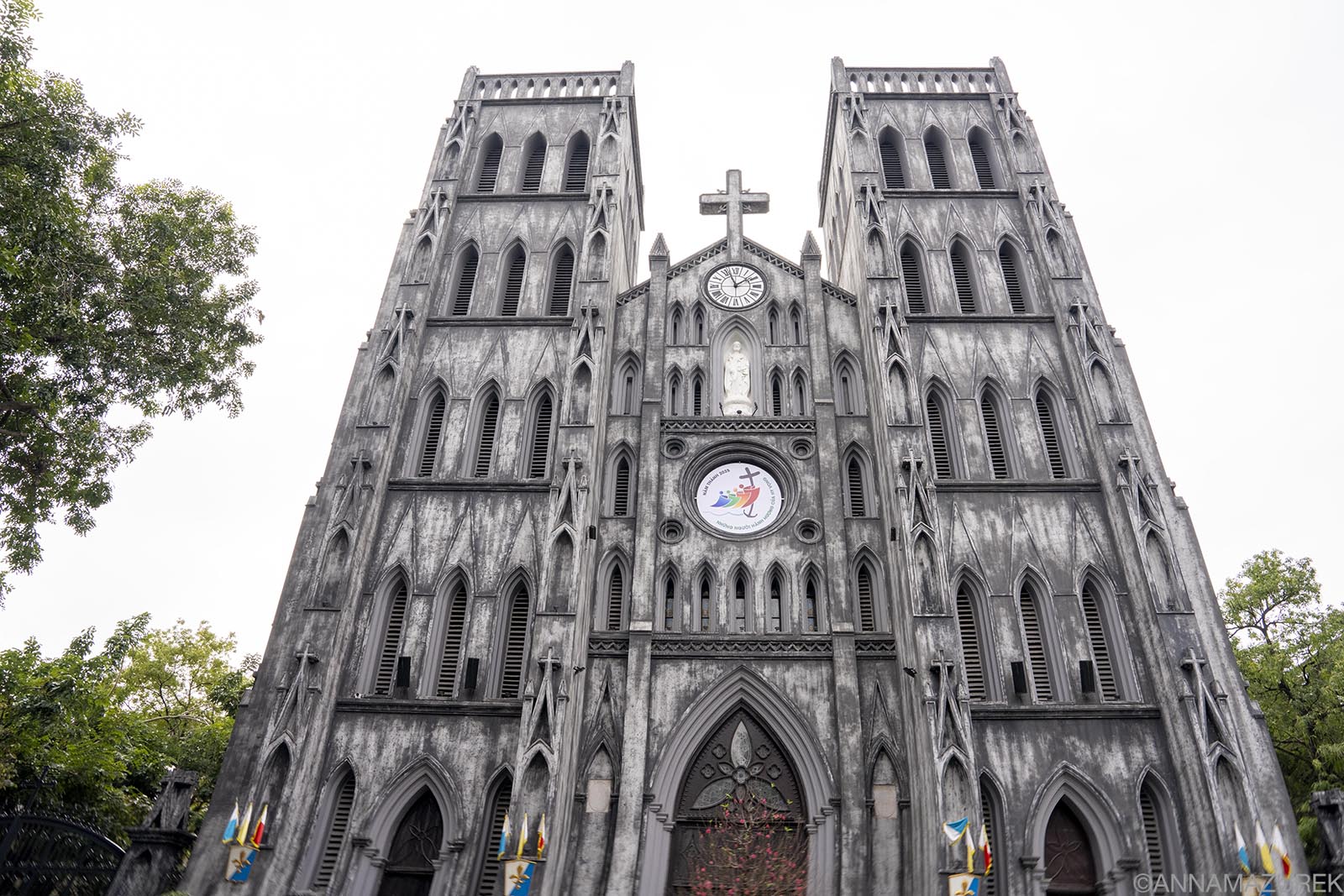 The twin bell towers of St. Joseph Cathedral in Hanoi.
St. Joseph Cathedral
Built in 1886, the neo-Gothic façade of St. Joseph Cathedral is a landmark leftover from the colonial era, known for its towering bell towers. The main entrance is only open during mass times while the side entrance is used other times. The street to the right is lined with cute cafes including the taproom for my favorite Vietnamese brewery, Pasteur Street.
Rooftop Drinks
Who doesn’t love a good sunset cocktail? On a recent trip, I googled rooftop bars and found one next to my hotel called the Terraco Sky Bar on top of the La Sinfonia del Rey Hotel & Spa overlooking the lake for happy hour. The food was also delicious. No matter where you are staying in the city, just Google rooftop bars and pick a spot with a 4.5 rating or above. That’s a trick that always works for me.
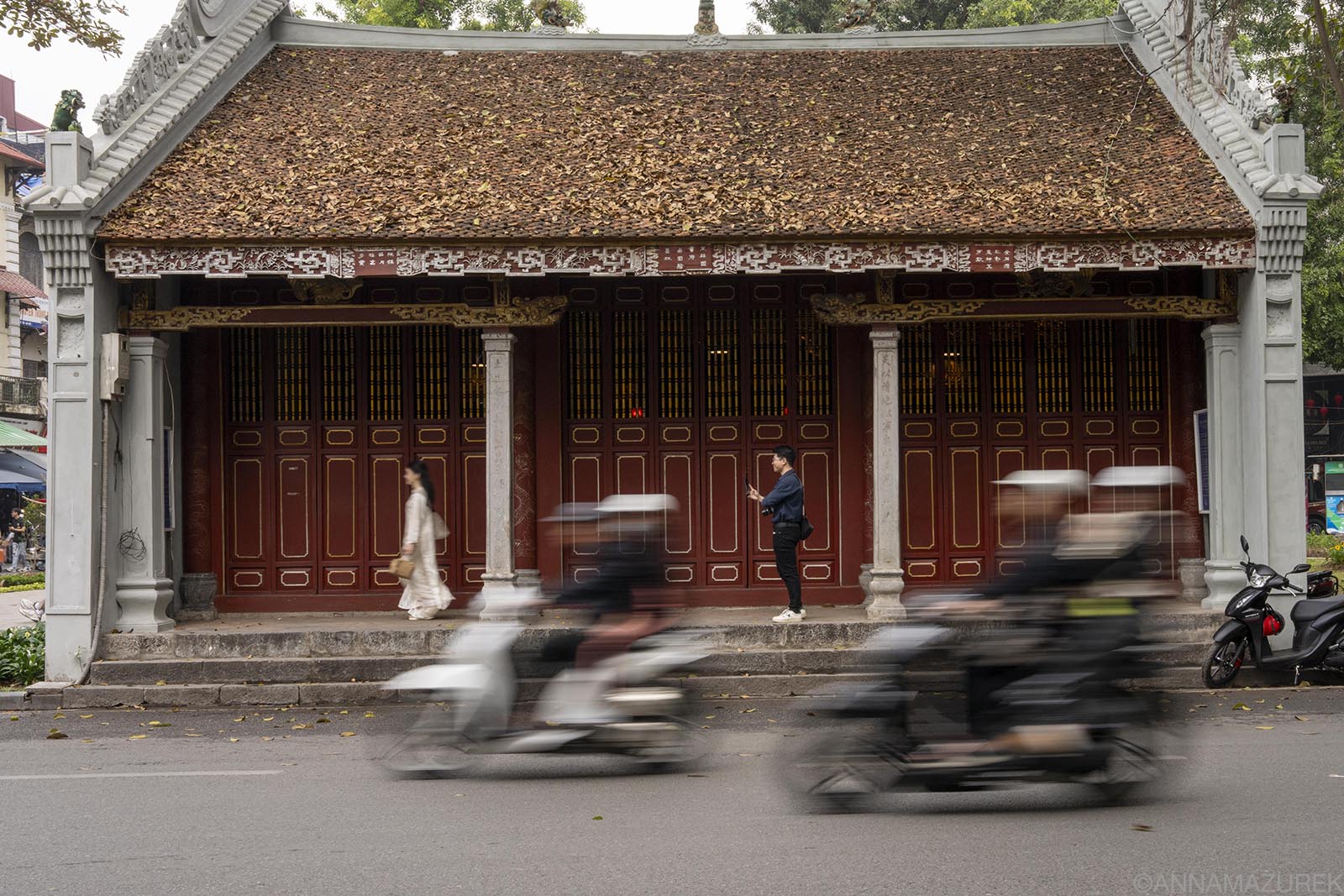 The best places to stay in Hanoi are around Hoàn Kiếm Lake and the Old Quarter.
The Best Places to Stay in Hanoi
Hotels: The highest-rated budget hotels include Hanoi Saga Hotel ($27/night) and TrangTrang Premium Hotel & Sky Bar ($37/night). The La Sinfonia del Rey Hotel & Spa ($82/night) is lovely and has that great rooftop I mentioned. I’ve also stayed at the Hanoi Authentic Boutique Hotel ($62), which has a great location.
Hostels: The Old Quarter View Hanoi Hostel has 6-12 dorm rooms with a/c starting at $18.
Splurge: If you’re looking to do a crazy splurge or cash in some credit card points, the historic 1901 Sofitel Legend Metropole is one of the nicest hotels in Vietnam. Even if you aren’t staying there, book one of their historic tours that takes you down into the wartime bunker!
The Best Time to Go to Hanoi
May through October is the rainy season, which also means the foliage will be very lush and green. Temperatures will start to cool down in November and December. January can be cold a night (50s Fahrenheit)! (Personally, I love October in Asia in between the rainy and dry seasons.)
The winter months usually mean dreary skies and high air pollution due to several factors including heavy traffic and industrial pollution from power plants. (In rural parts of Asia, farmers burn the fields in winter to prepare for planting, which creates a huge amount of air pollution.) The colder weather in Hanoi traps these pollutants closer to the ground.
During TET (Lunar New Year), the city is emptier than normal because many attractions and restaurants shutdown. It’s best to avoid this time of year because prices spike.
 Hanoi’s famous train street is lined with cafes just inches from the tracks.
Vietnam FAQ
Where’s the best place to buy a SIM card in Vietnam?
The easiest thing to do is buy a Vietnam-specific eSIM card from Airalo that will work instantly when you arrive. (Airalo partners with Viettel, the fastest network in Vietnam.) For more details, read my review of Airalo eSIM cards in Southeast Asia.
Promo Codes: New customers save 15% off with NEWTOAIRALO15 and existing users save 10% with AIRALOESIM10.
If you are traveling to multiple countries in Southeast Asia on a short trip, then consider one of their Asia Regional eSIM cards. (Both the country-specific and regional eSIMs have worked wonderfully for me and even have a mobile hotspot option that’s critical for me because I’m always working remotely.) Keep in mind it’s always cheaper to buy a country-specific eSIM than a regional one.
Do you need travel medical insurance for Vietnam?
Yes, travel medical insurance is one of the most important things to purchase for any trip abroad, especially Vietnam. It covers all the things that could go wrong from injuries to travel delays so that you don’t have to worry and can focus on traveling!
SafetyWing’s Nomad Insurance offers $0 deductible travel medical insurance coverage for over 180 countries for people aged 69 and under when traveling outside their home country. The best part is that it only costs a few dollars a day! If you get sick or injured abroad, you can visit any hospital or doctor.
Other benefits of Nomad Insurance include coverage for lost checked luggage, travel delays over 12 hours, motor accidents (if properly licensed, wearing all safety equipment and not intoxicated) and injuries from sports or leisure activities. You can even add adventure sports, electronics theft and U.S. coverage (for non-residents) to your policy.
One of the best things about SafetyWing is that you can buy policies abroad and speak to a REAL human from the 24/7 customer support team if you have questions! (I can vouch that they are excellent at assisting and will follow up with you afterward.) Pay in full or choose an auto-renewing plan that can be canceled anytime.
For more details, read my review of using SafetyWing in Southeast Asia.
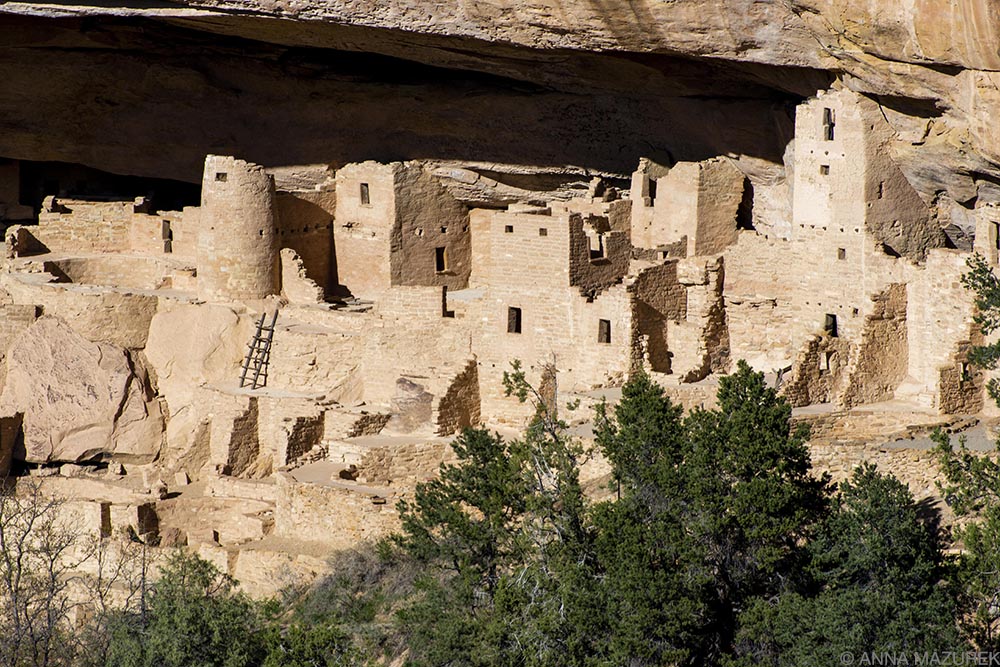
Photo Guide to Mesa Verde National Park
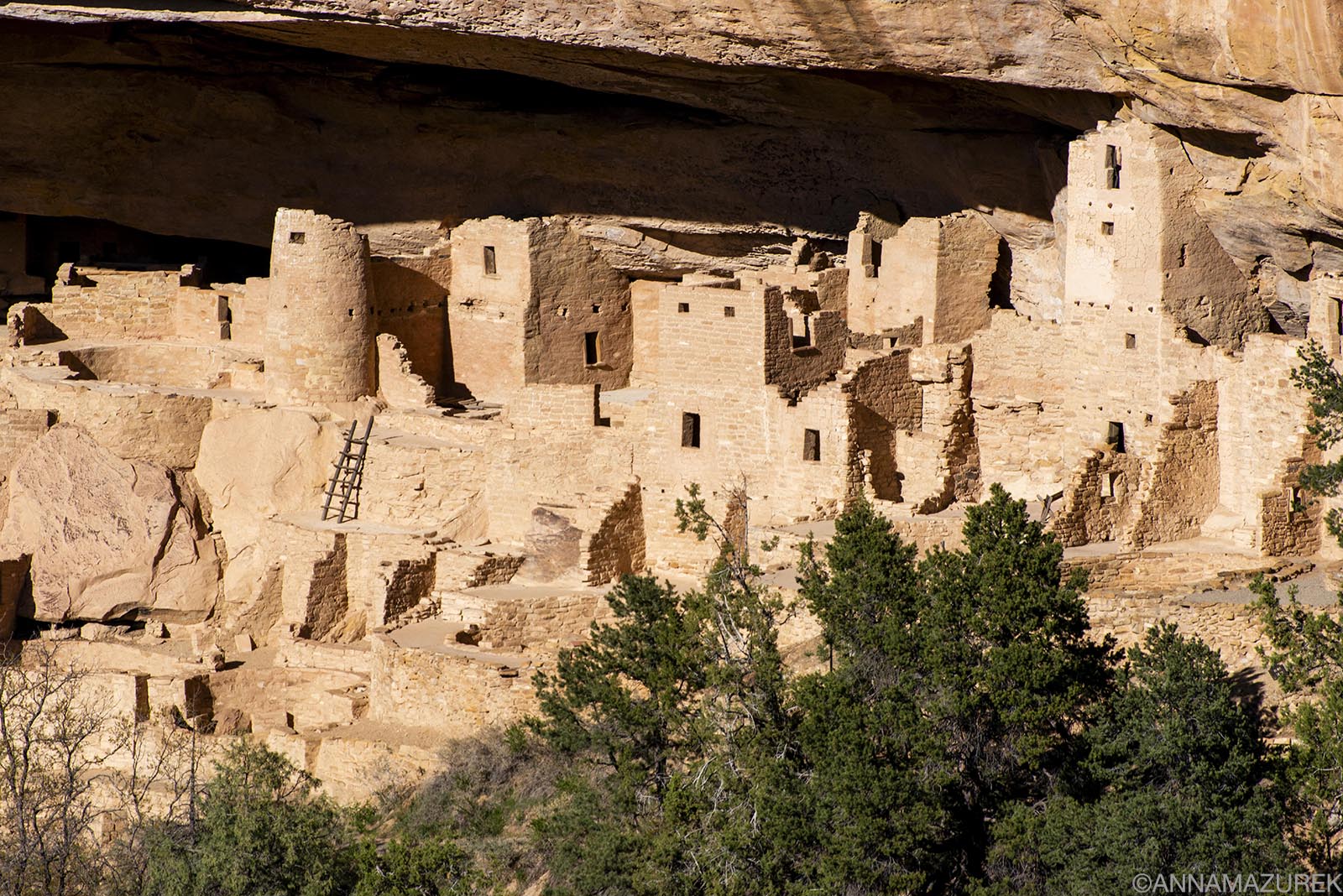 Cliff Palace cliff dwelling photographed from the Cliff Palace Viewpoint by Sun Temple on Mesa Loop. Camera Settings: f/16 @ 1/250, ISO 400, 350 mm (70-200mm lens with 2X teleconverter.)
Mesa Verde National Park is one of my favorite places in the Southwest. In 1906, it became the seventh national park in the U.S. in 1906 and is home to hundreds of ancient cliff dwellings. Now, it’s a World Heritage Site and International Dark Sky Park. In this post, I included a detailed list of the best things to see in Mesa Verde along with the best times for photography. For logistics about cost and where to stay at Mesa Verde National Park, please read the FAQ section at the end of the post.
Why is Mesa Verde Worth Visiting?
Mesa Verde National Park is home to over 600 cliff dwellings built by the ancestral Pueblo people starting in A.D. 550. The settlements evolved from half-buried pit houses to above-ground multi-room and often multi-story complexes made of stones and mud mortar, with thick wooden beams supporting roofs topped with a layer of dirt. Kivas, circular ceremonial chambers, were also key features. The walls were often covered in plaster. The settlement was abandoned by 1300 with any clear indication of why, but several theories suggest climate change or conflict. In addition to the cliff dwelling tours, be sure to stop by the Mesa Verde Museum and the Mesa Verde Visitors Center.
Where is Mesa Verde National Park?
Mesa Verde National Park is in southwestern Colorado and the closet town is Cortez, Colorado, which is where I recommend staying. It’s a 13-minute drive from Cortez to the park entrance but another 45-to-60-minute drive from the entrance to the main sites and cliff dwellings.
Guide to Mesa Verde National Park
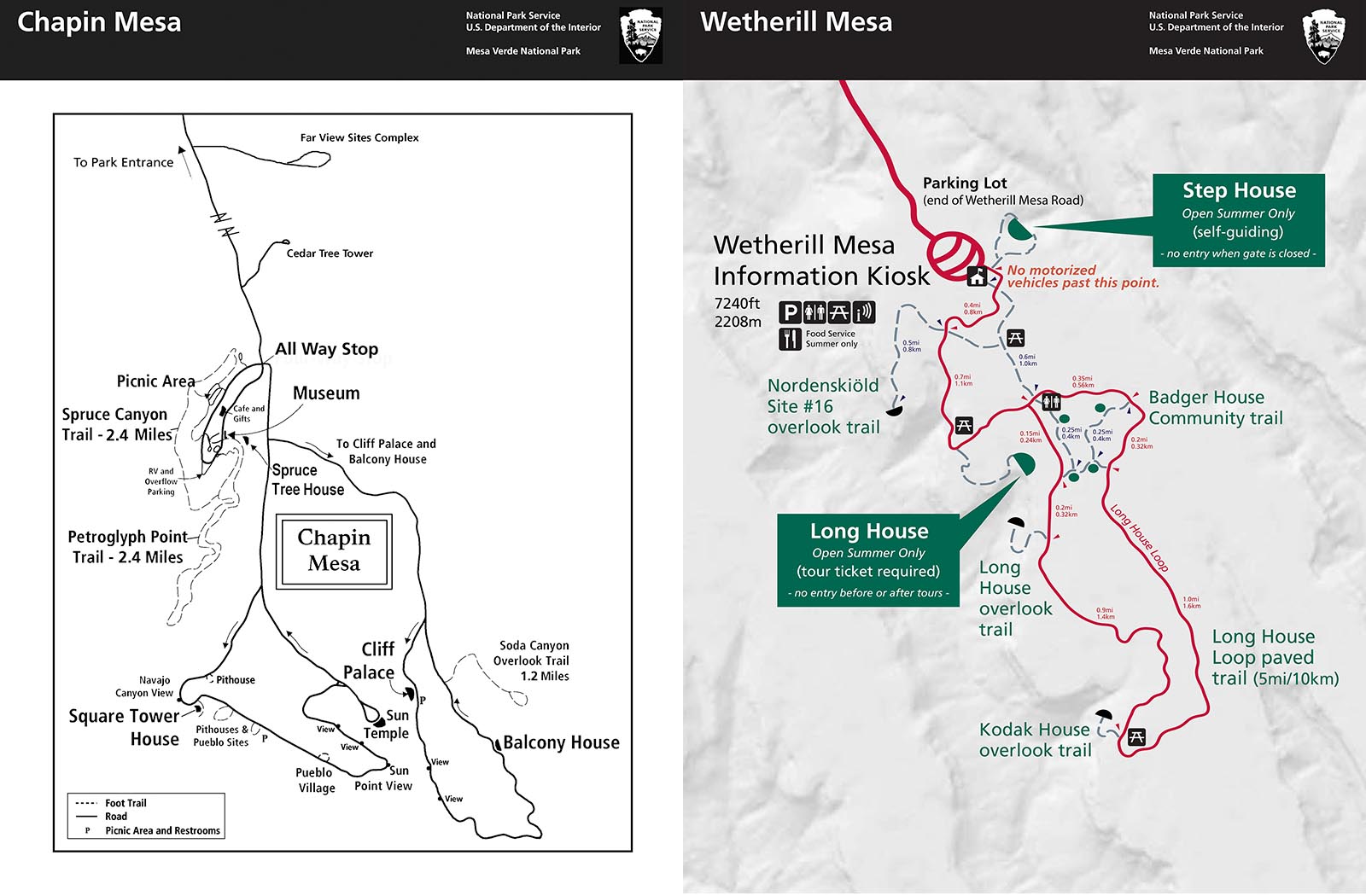 These maps from the NPS show the main areas of the park, Chapin and Wetherill Mesa, which are up to an hour drive from the park entrance.
There are two main sections of the park – Wetherill Mesa and Chapin Mesa. Chapin Mesa includes Mesa Loop, Cliff Palace Loop and Spruce Tree House. Wetherill Mesa is a good 30–60-minute drive from the other sites, which are closer together. It can take 45 to 60 minutes to drive from the park entrance to any of the locations listed. All park roads are narrow two-lane winding roads so driving between sights can take a while if there’s traffic or construction. (There was a good bit of construction when I visited, and Cliff Palace Loop was closed. It’s slated to be open summer 2025 if construction on viewing platforms is completed.) Check the park website for detailed maps and road closure notices before visiting.
Best Photo Spots in Mesa Verde National Park
I’ve organized my favorite photo spots in Mesa Verde National Park by location: Chapin Mesa versus Wetherill Mesa.
Chapin Mesa
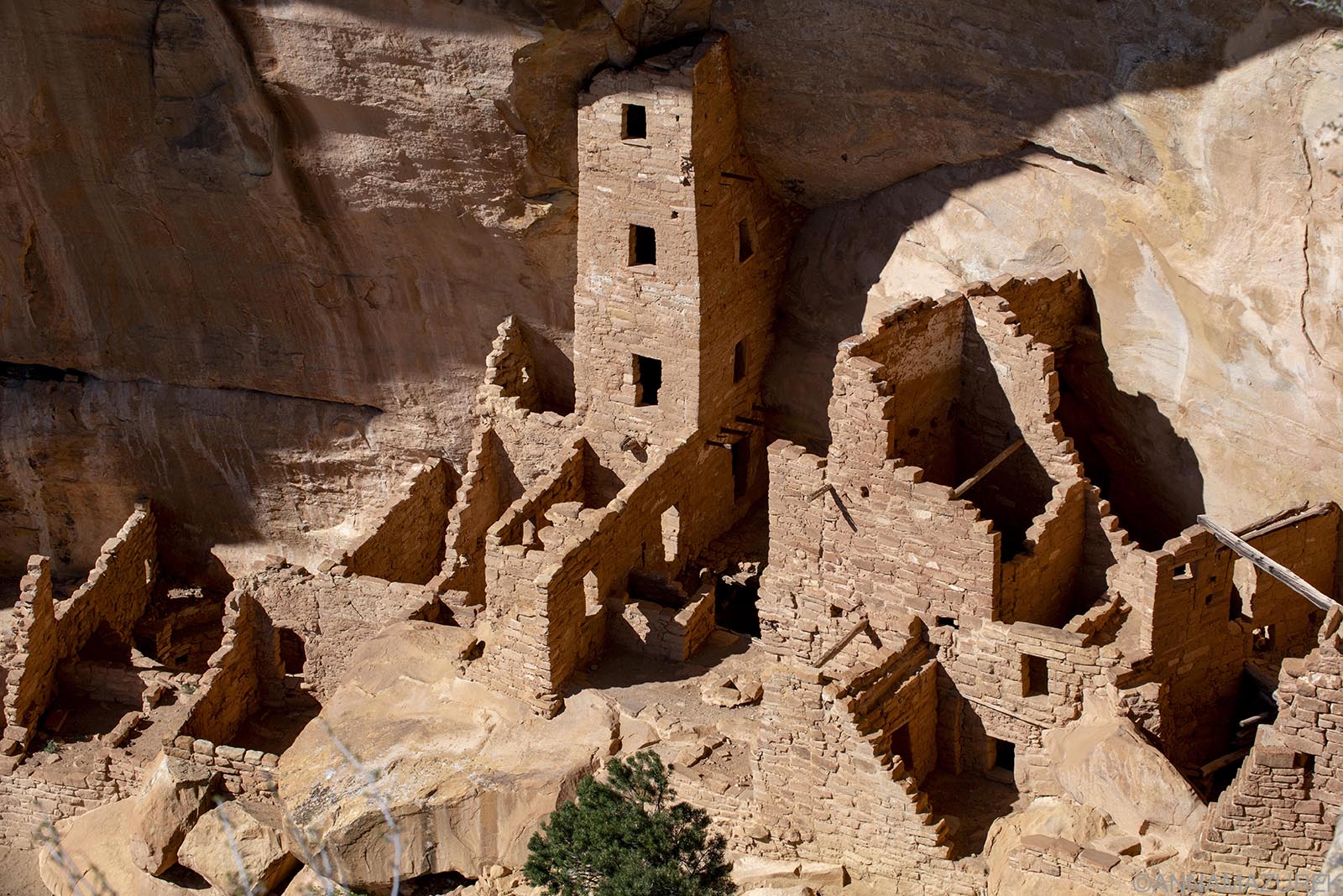 Square Tower House photographed from the viewpoint in the early afternoon. Camera Settings: f/11 @ 1/320, ISO 400, 95 mm with 70-200mm lens
Chapin Mesa is the location for Mesa Loop, Cliff Palace Loop and Spruce Tree House. It’s the most popular portion of the park and most crowded. Cliff Palace Loop is currently closed as of October 2024 per a notice on the website in early 2025.
Cliff Palace Loop
Cliff Palace cliff dwelling photographed from the Cliff Palace Viewpoint by Sun Temple on Mesa Loop. Camera Settings: f/16 @ 1/250, ISO 400, 350 mm (70-200mm lens with 2X teleconverter.)
Cliff Palace Loop is located on Chapin Mesa and was closed due to construction when I visited. (It’s slated to be open summer 2025.) When the loop is open, Cliff Palace Dwelling is only accessible by guided tours for $8/person. The loop also contains Balcony House and the Soda Canyon Trail.
Mesa Loop
 New Fire Temple and New Fire House Overlook on Mesa Loop. Camera Settings: f/8 @ 1/1600, ISO 800, 240 mm with a 70-200mm lens with 2X teleconverter. The wind was insane here, which is why my shutter speed and ISO were high.
The six-mile Mesa Loop, located on Chapin Mesa, will take a while to drive because there’s so much to see. Sunrise shots aren’t an option here because the road doesn’t open until the staff arrive (varies based on staffing so check website for details), but sunset is possible. Law enforcement will sweep the road before they close the gates at sunset so you can shoot until they come along. While it was cool to see the pit houses, they aren’t the best with photography because they are in buildings with guard rails. The viewpoints of the dwellings were the best photo spots. I recommend downloading the free Mesa Loop driving tour podcast before visiting.
Square Tower House
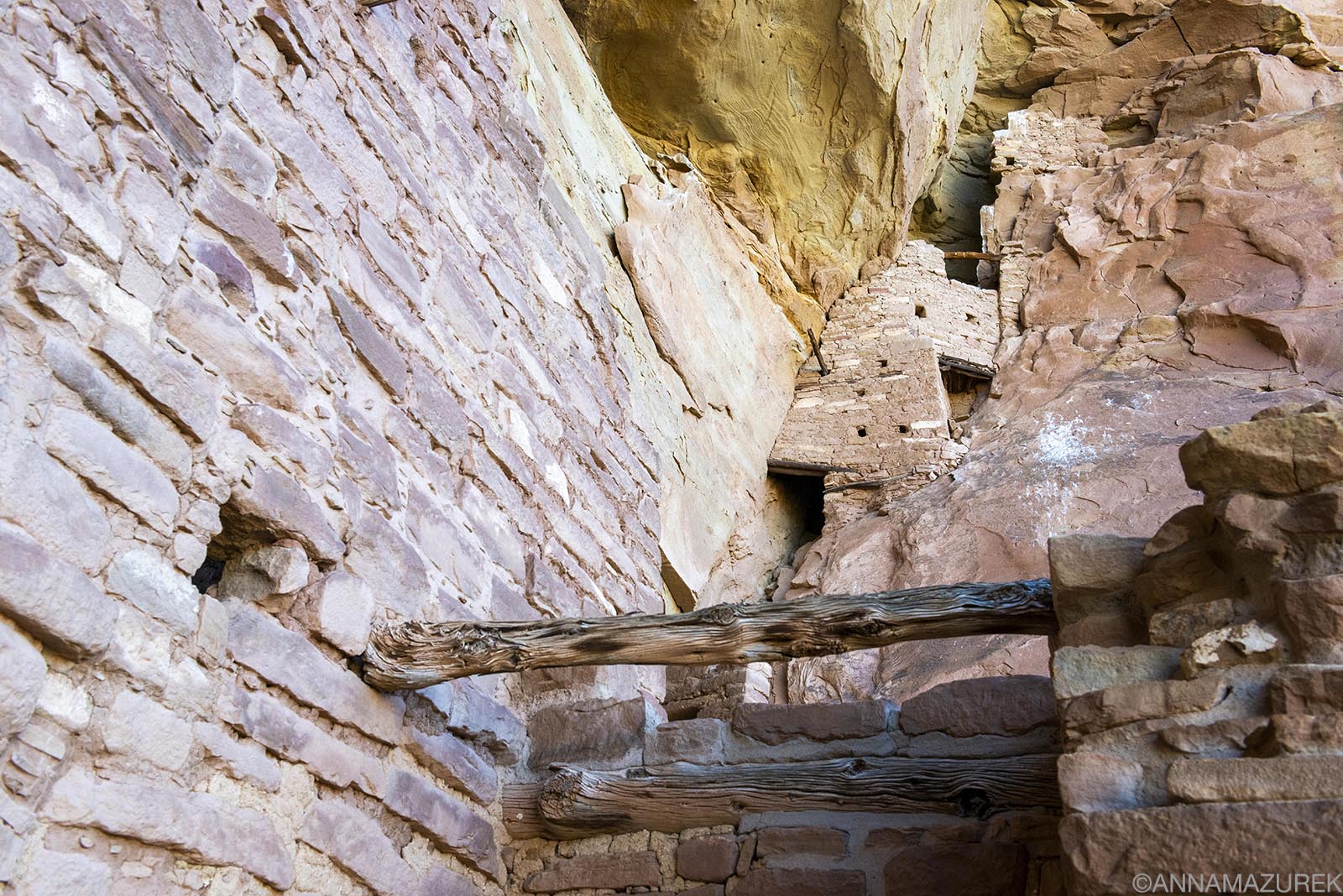 There is a crow’s nest set of buildings in in the corner of the canyon at Square Tower House that can only be seen on the tour. Camera Settings: f/9 @ 1/320, ISO 1250, 38mm with a 24-70mm lens.
The house itself is in the shade in the morning and full sun later in the afternoon. I recommend shooting in the afternoon to get the light on the house and the cliff. For tours, it’s best to go in the morning when the house is in the shade to avoid harsh shadows in the afternoon. The trail is only a mile but includes two ladders. It was my favorite of the two ranger-guided tours I did. There’s a cool Crow’s Nest building that can’t be seen from the viewpoint that we kept joking was a kid’s treehouse!
Cliff Palace Viewpoint by Sun Temple
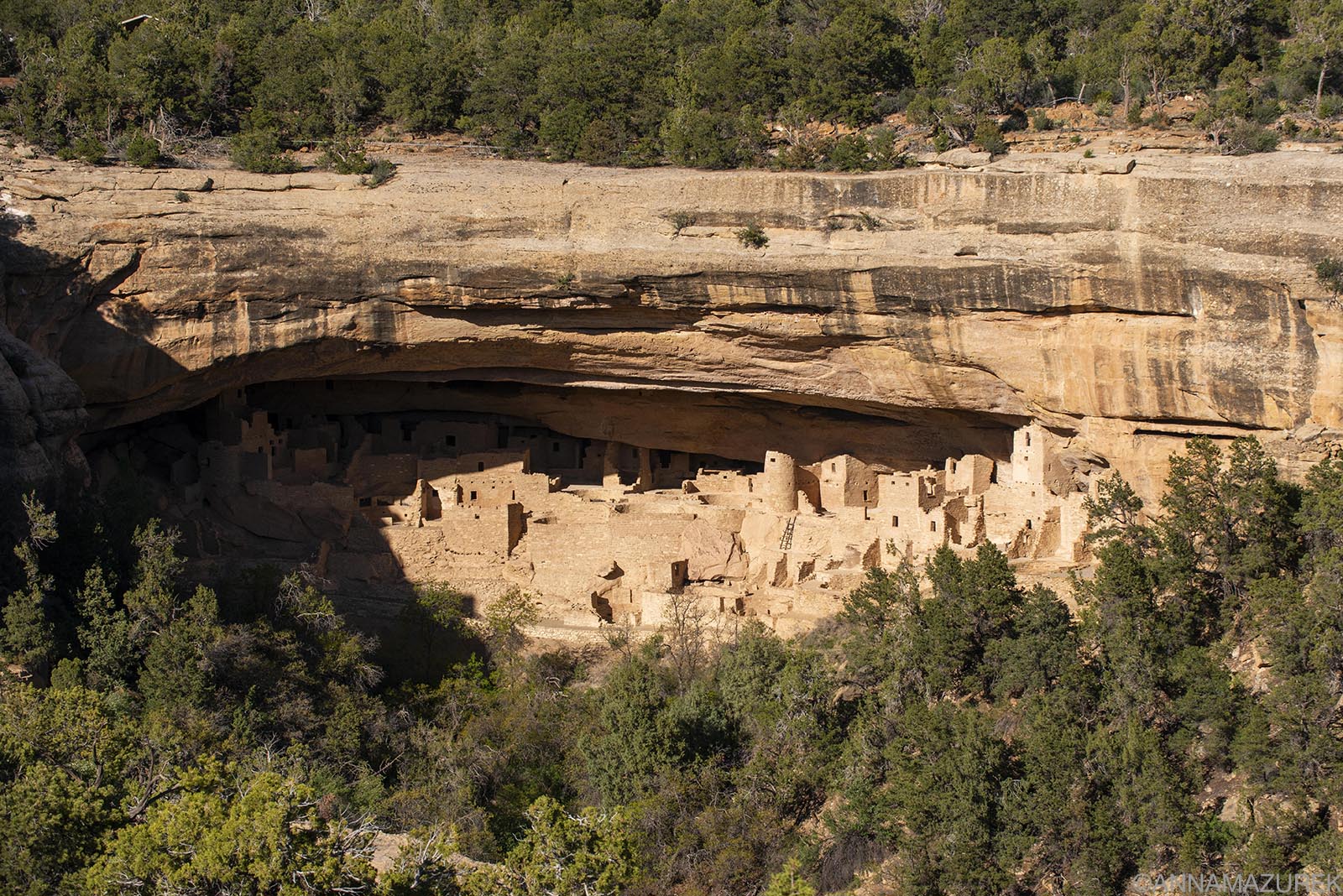 Cliff Palace cliff dwelling photographed from the Cliff Palace Viewpoint by Sun Temple on Mesa Loop. Camera Settings: f/11 @ 1/400, ISO 500, 98mm with 70-200mm lens. This was shot at roughly 4:30 p.m. in May. I’d suggest going earlier in day to avoid the dark shadow on left.
Spruce Tree House
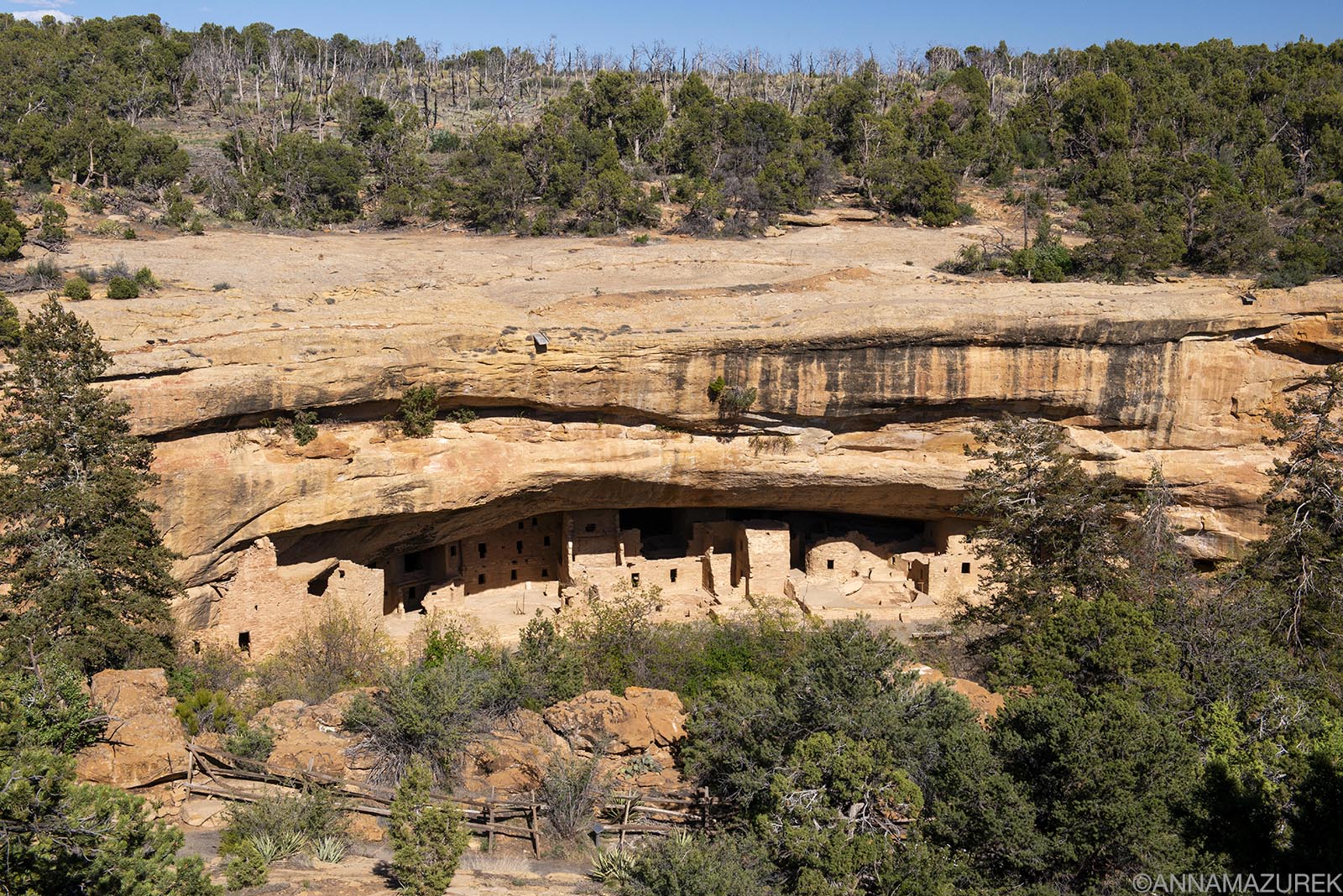 The view of Spruce Tree House from the back porch of the ranger’s office is one the best viewports in my opinion. Camera Settings: f/11 @ 1/320, ISO 400, 48mm with a 24-70mm lens.
Due to rock falls, Spruce Tree House is closed for the foreseeable future. (Previously, it was open to a self-guided tour.) There’s a lovely view of it from the back porch of the ranger’s office, which is better than the viewpoint below on the trail because it puts you above some of the trees. Unlike the other loops Spruce Tree House area is open 24/7 so you can shoot at sunrise or sunset easily, which I’d recommend. Otherwise, you’ll have to time your shoot between 3-5 p.m. to get light on the house while avoiding shadows from the cliff above or the trees in front. Around 6 p.m. the shadows from the trees in front really photobomb the image.
I’d only recommend sunrise/sunset shoots if you feel comfortable driving the two-lane winding park roads in the dark. The roads are well maintained but pretty scary driving out of the park at night, which is why I never stayed for sunset. There are some pretty steep drop-offs with no guardrails on the road! Plus, wildlife is another concern at night – there are still wild horses roaming the park. Due to this, I wasn’t happy with any of my images of Spruce Tree House.
The bathrooms at Spruce Tree House are the best ones. Mesa Loop only had portable toilets when I was there.
Wetherill Mesa
(Wetherill Mesa was closed for all of 2024 but the park office said it should hopefully be open in summer 2025 depending on staffing.)
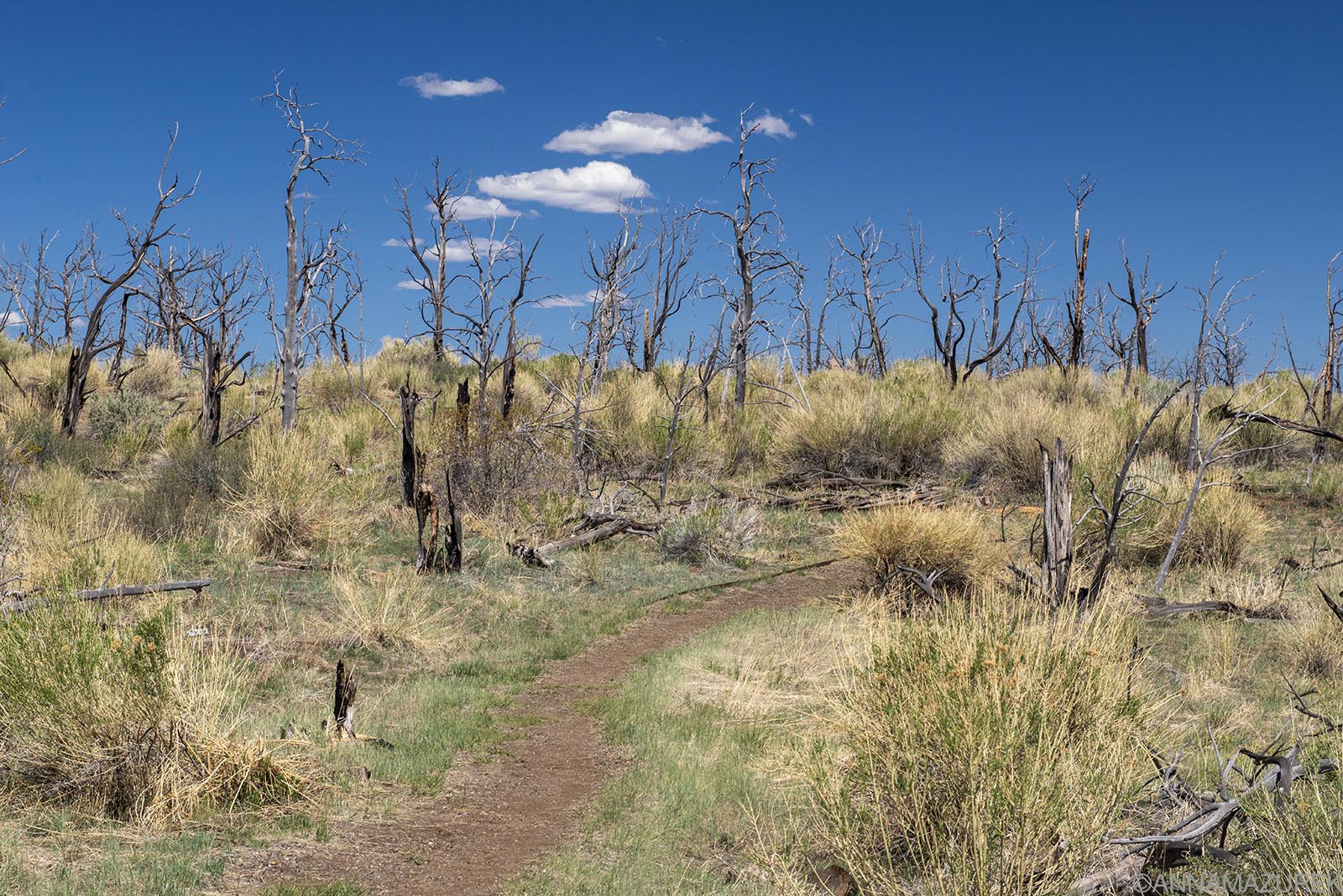 The majority of the trails at Wetherill Mesa are flat unless you are touring one of the cliff dwellings.
Once you arrive at Wetherill Mesa, you have to walk to the sites. No cars are allowed beyond the parking lot. All the trails to viewpoints are flat and easily bikeable. (This is the ONLY area in the park where bikes are allowed!) There’s no shade so go early or be prepared for the sun and wind! The area is open from May to October and is usually the quieter part of the park. Allow a least half a day to see all the sites excluding dwelling tours. There’s a ranger posted at a desk at the entrance. I’ve listed the sites you can physically visit below, but there are more sites you can see from viewpoints. It takes about 45 minutes to drive to Wetherill Mesa from Chapin Mesa and about 45-60 minutes from the park entrance!
Step House
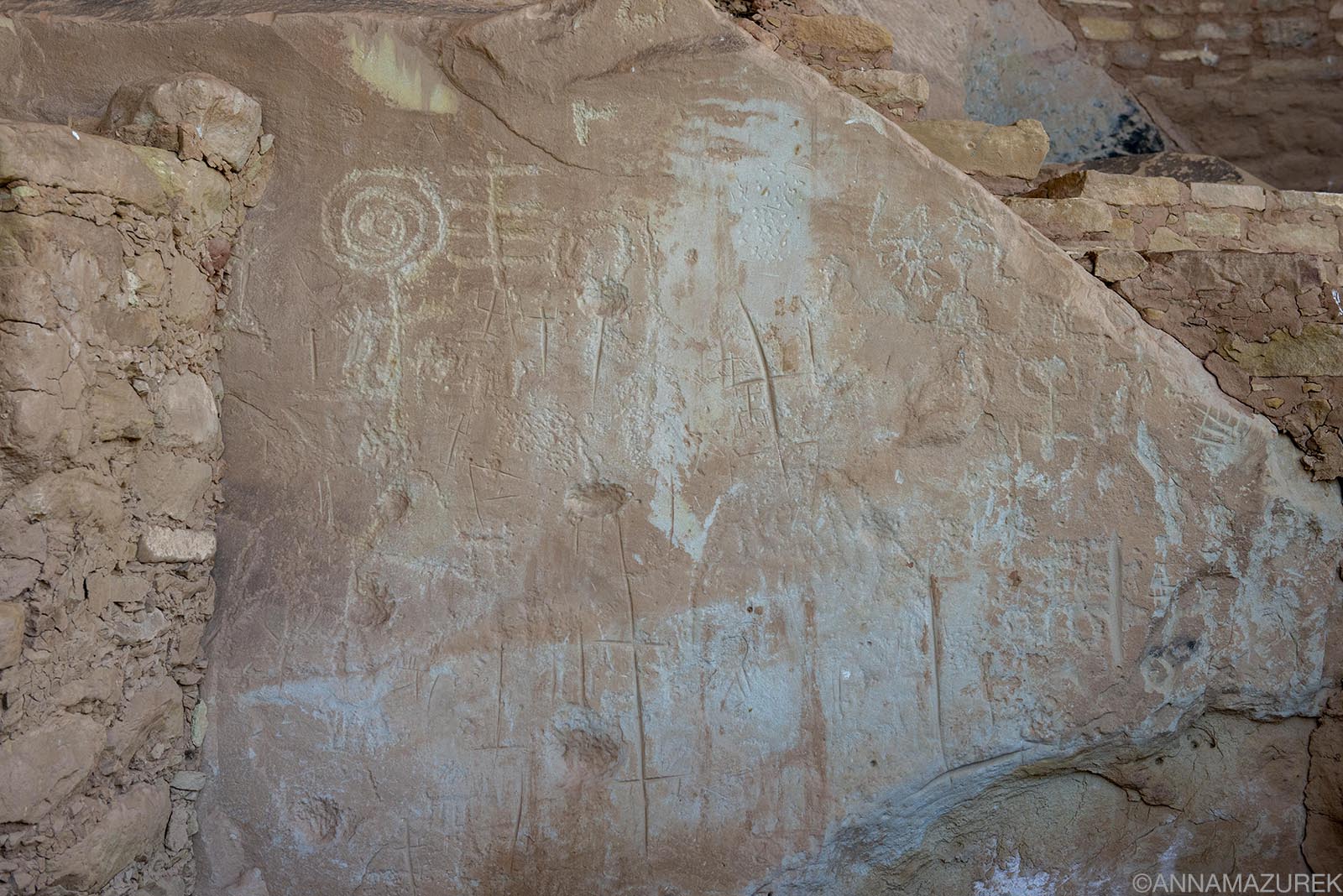 Petroglyphs inside Step House at Wetherill Mesa. This dwelling isn’t as amazing as the others but is very accessible.
A one-mile roundtrip trail starts at the kiosk and leads through the cliff dwelling that was once home to 30-40 people. It’s a unique site with a reconstructed pit house constructed around 620 and a multi-story pueblo built in 1226. It’s not as impressive as the other dwellings on the guided tours but this is the most accessible by foot, which is why they allow self-guided tours. A ranger is always on duty to answer questions at the site.
Mug House
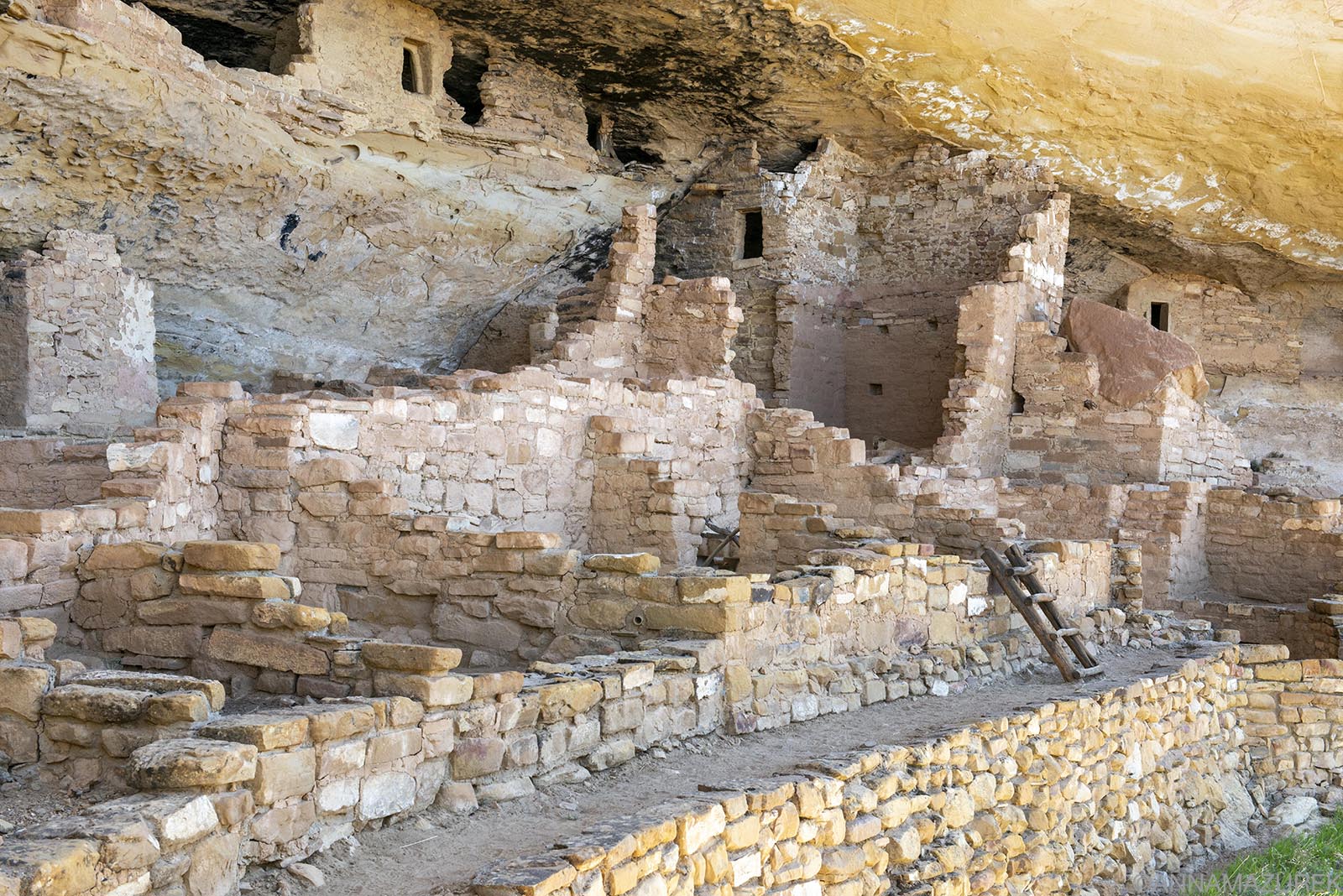 Mug House isn’t visible from any viewpoints and can only be visited on a tour. Camera Settings: f/10 @ 1/160, ISO 640, 52mm with a 24-70mm lens.
Mug House isn’t listed on any map and is only accessible by guided tour with a ranger. It’s a three-mile roundtrip hike from the kiosk and not visible from any viewpoint. While it’s labeled as a strenuous hike, I didn’t think it was bad. I did the noon tour, and the site was still in the shade since it faces west. The dwelling was named for three mugs found tied together on the site. Tours are $25/person with a maximum of 10 people.
Long House
Long House is the second-largest cliff dwelling in the park with 150 rooms and accessible only by a ranger-guided tour. ($8/person) It’s the most in-depth tour offered at the park but wasn’t available on the dates I visited.
Trails at Wetherill Mesa
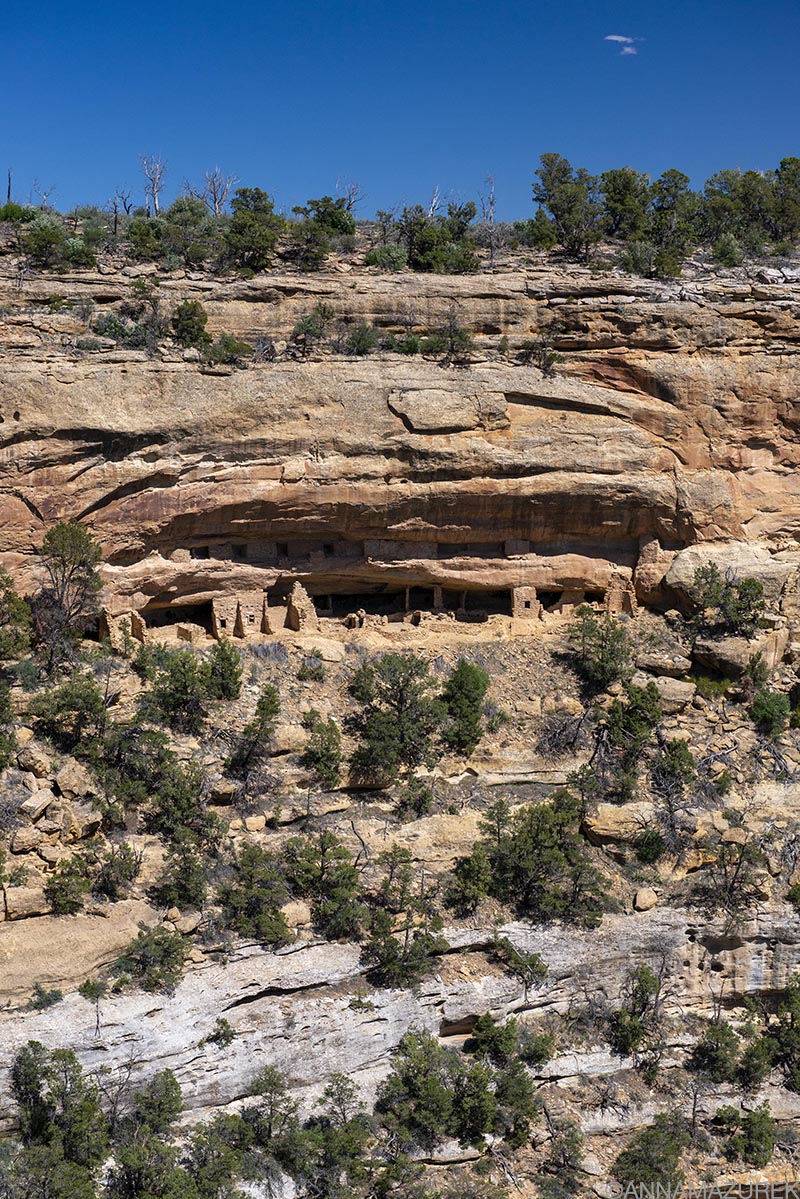 Nordenskiöld Site #16 photographed from the viewpoint. Camera Settings: f/8 @ 1/640, ISO 400, 60mm with a 24-70mm.
The main trail is the paved five-mile Long House Loop that’s great for hiking or biking. The Kodak House overlook (2.5 miles) and Long House overlook (1.5 miles) are located on the trail. Bikes have to be parked at the trailhead while you walk the .15-mile trail to the overlooks. The Badger House Community Trail (2.25 miles RT) weaves through four mesa-top sites and crosses the Long House Loop trail. The Nordenskiöld Site #16 Trail leads to an overlook of the cliff dwelling and is two miles roundtrip. All trails are relatively flat but exposed to sun/wind. (Due to the heat and exhaustion of doing two dwelling tours and Step House back-to-back, I only did the Nordenskiöld Site #16 Trail.)
Far View Sites
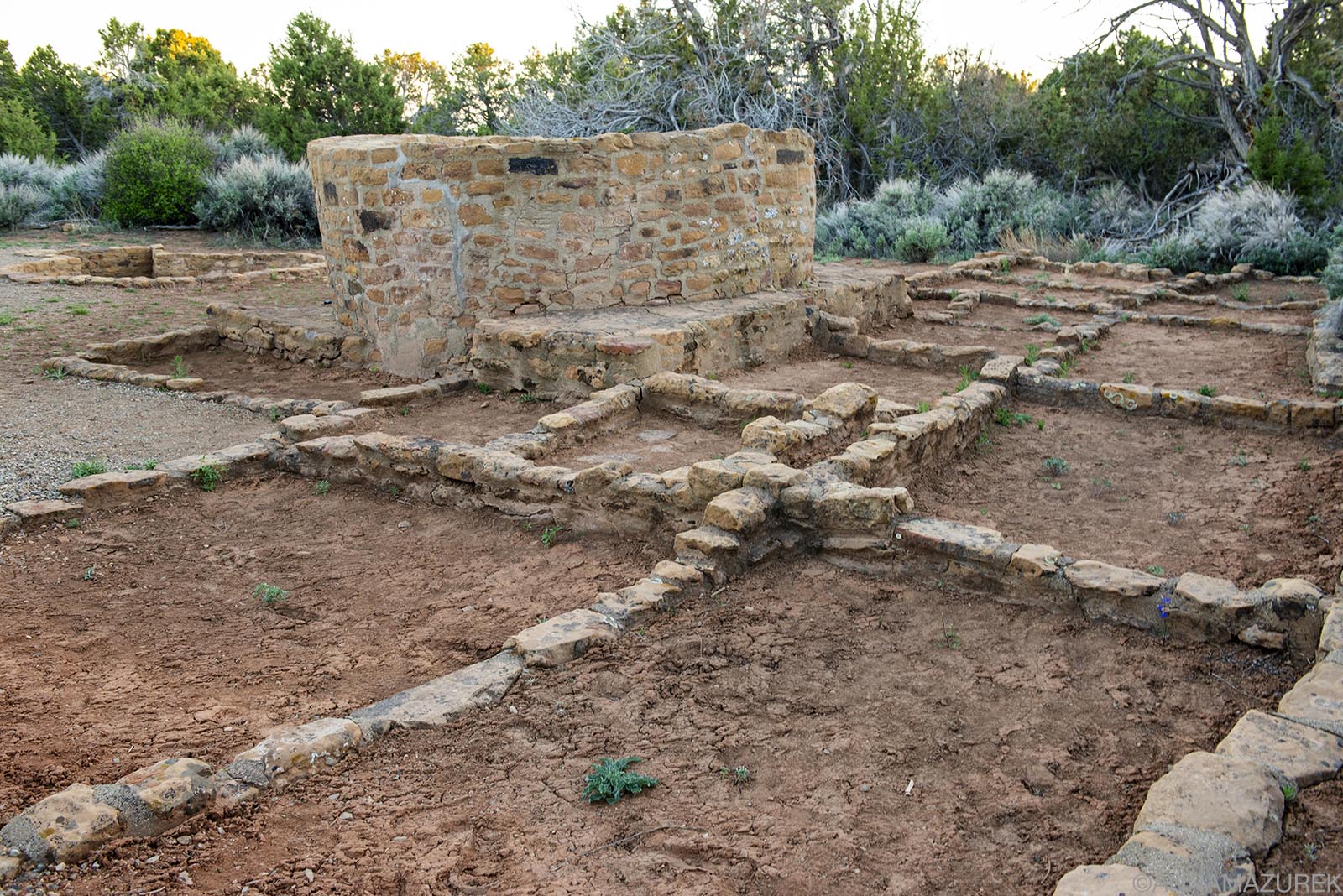 I had the Far View Sites to myself at sunset, which I recommend to avoid people in your photos. Camera Settings: f/6.8 @ 1/80, ISO 1000, 32mm with a 24-70mm.
The Far View area was a mesa-top community and one of the most densely populated regions. A .75-mile trail leads through ruins of several houses and a reservoir. I went right before sunset and really enjoyed this small walk. It’s definitely underrated and worth a visit! The site is open from 8 a.m. to sunset. It’s located on the main park road.
Hiking Trails at Mesa Verde National Park
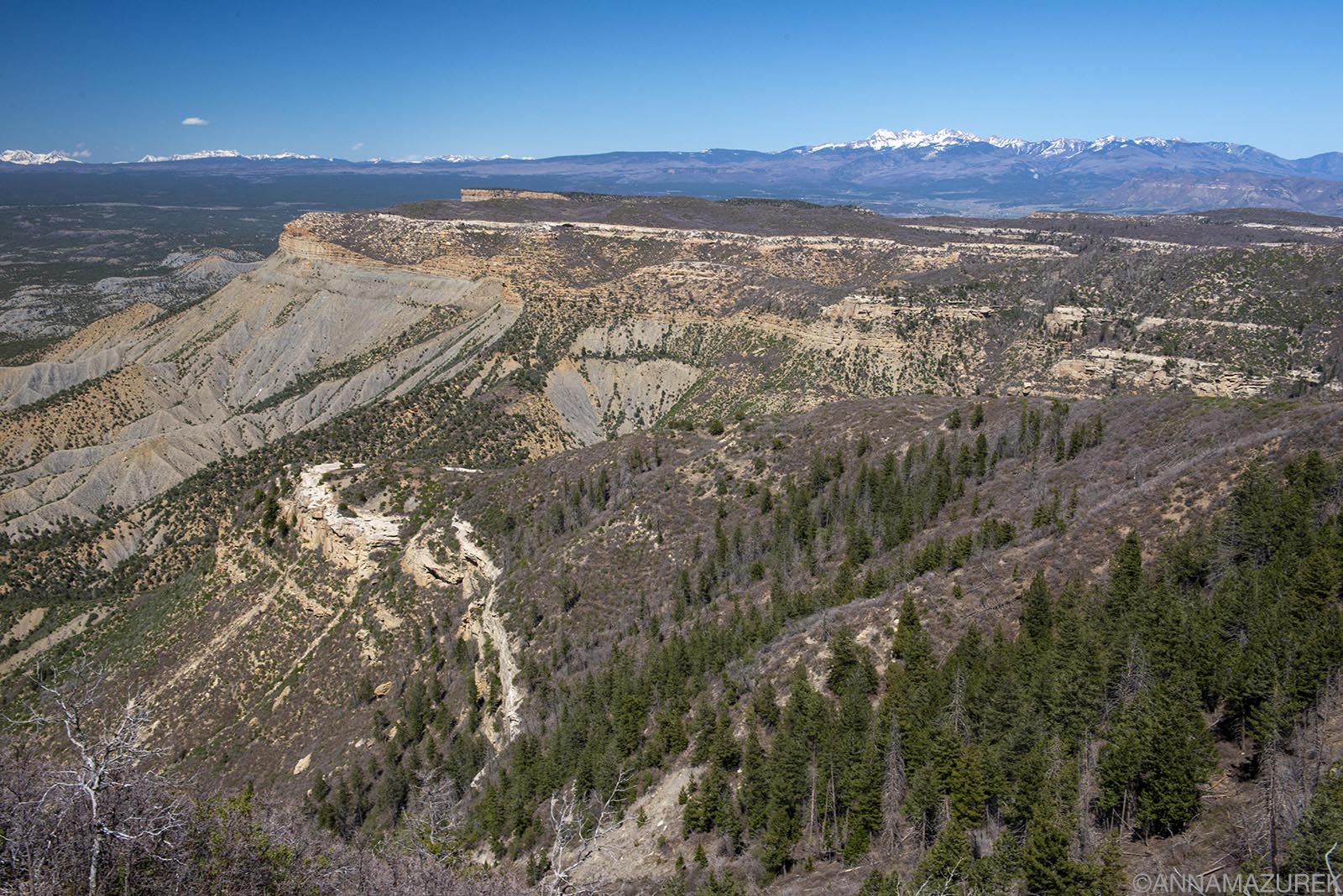 The main park road has several scenic viewpoints including this one — Park Point Viewpoint, the highest point in Mesa Verde.
There are several hiking trails throughout the park. Many of the ones I was interested in were closed partially due to Cliff Palace Loop construction, which should be open in 2025. Elevation in the park ranges from 7,000 to 8,500 feet so carrying camera gear gets even harder if you’re not used to the elevation. The sun is relentless, and there’s very little shade so start hikes early. Since I was so focused on photography and booked the dwelling tours, I didn’t get to do any other hikes due to the heat. I wanted to do Petroglyph Point but skipped it since I was going to Petroglyph National Monument in Albuquerque a few days later.
The Mesa Verde Museum Association offers free downloadable site guides for Cliff Palace, Spruce Tree House, Wetherill Mesa (Step & Long House) and Balcony House.
Photo Tips for Mesa Verde National Park
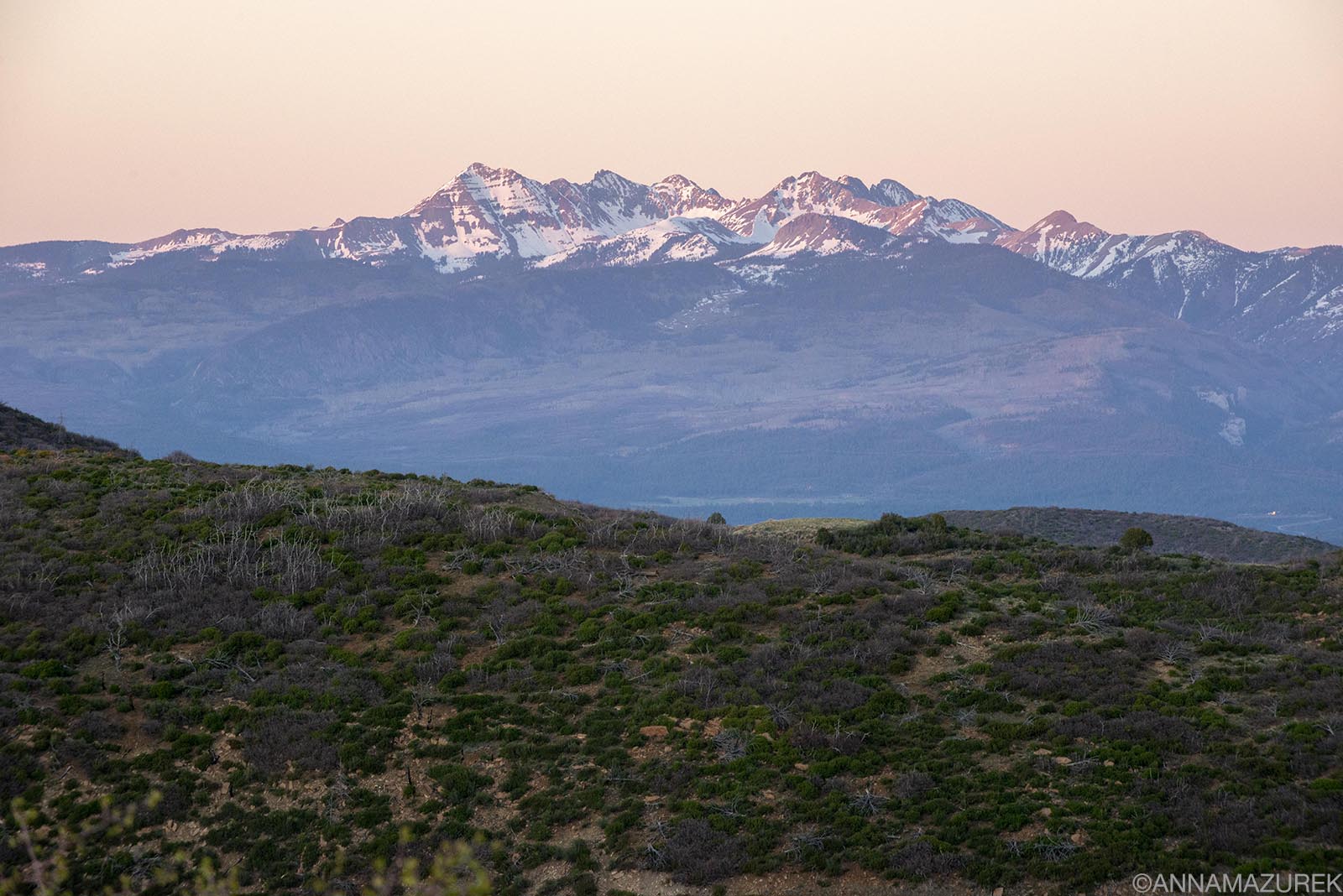 I stopped at an unmarked viewpoint to take this photo while I was leaving the park at sunset.
-
Lenses: You’ll need at least a 70-200mm zoom lens from the viewpoints for most of the cliff dwellings. I’d recommend a 400mm or a teleconverter as well. (I rented a Nikon 2X teleconverter from LensRentals.com for my trip to test it out, but I’d recommend a 1.4x teleconverter instead because that’s much sharper.)
-
Filters: A circular polarizer is a big help with the blue skies and helps reduce glare on the rocks, especially when shooting petroglyphs in the sun. A graduated neutral density filter would also be helpful with contrast but can be time consuming.
-
Take a Tripod: The wind is fierce so change lenses in your car or take two camera bodies. I’d recommend a tripod in low light or even with the teleconverter since the wind will knock you around. I used my Peak Design Travel Tripod, and it was perfect with my 70-200mm with the 2X teleconverter.
-
Photo Guide: At the entrance kiosk, they have an amateur photography guide with a chart of the most photographed areas in the park and the best times to shoot during the summer. I’ve included the chart below.
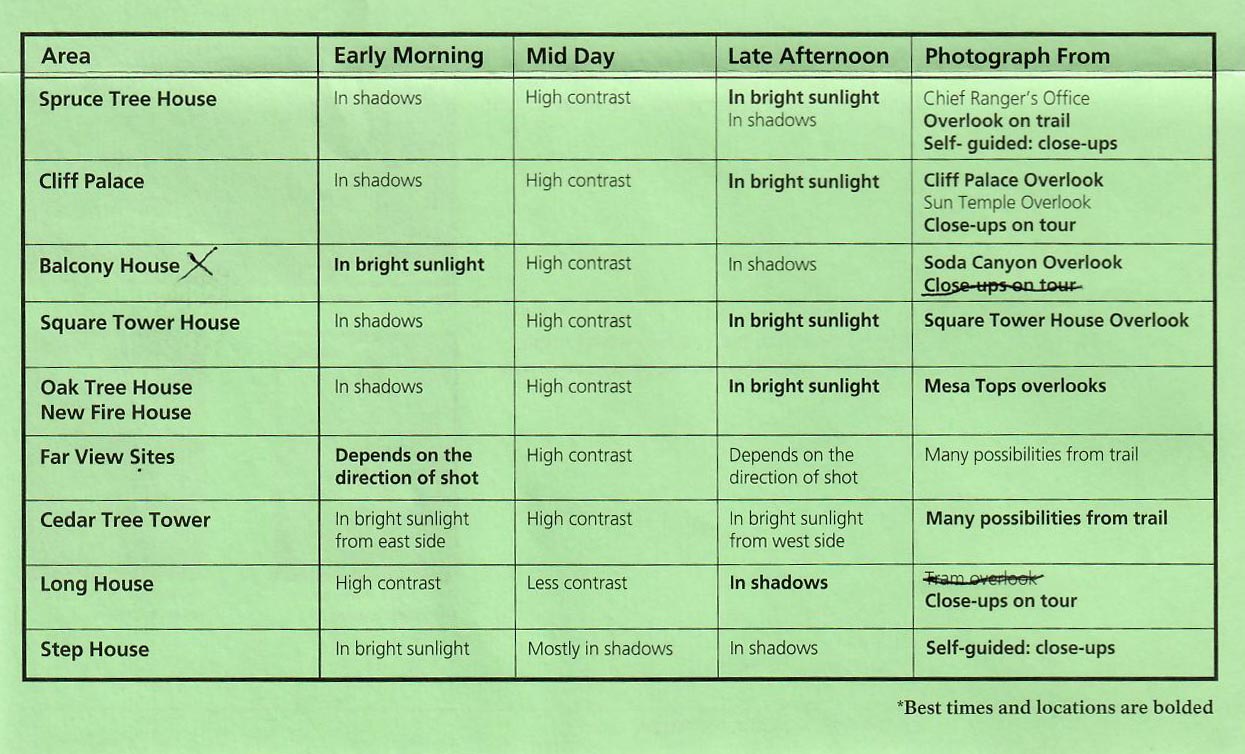 This is a scan of the National Park Service’s amateur photography guide for Mesa Verde National Park that is available at visitors center and entrance kiosks. The best times and locations for summer are bolded.
Mesa Verde National Park FAQ
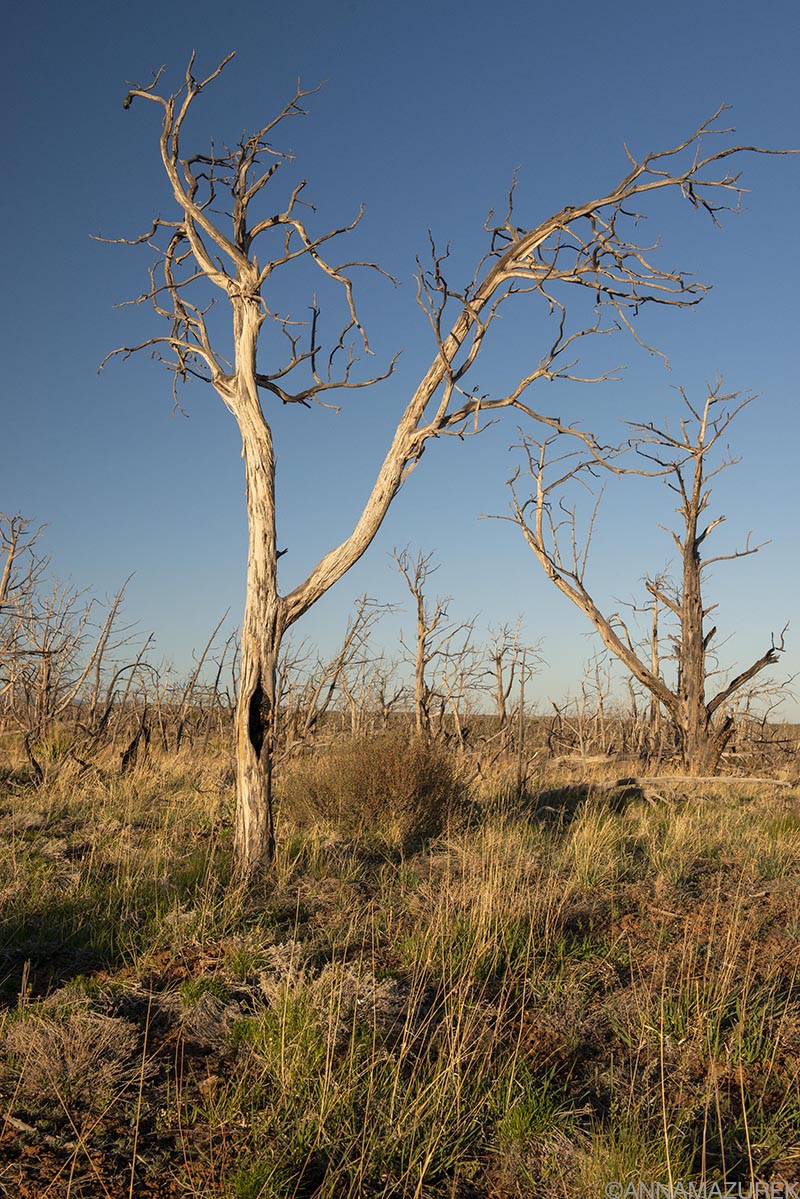 Every year there’s a series of “dry” lightning fires on the mesa tops, which are usually labeled by signs with the date of the fire. Since the park was established in 1906, 70 percent of the park has been burned by wildfires.
How much time do you need to visit Mesa Verde National Park?
Not all the sites are Mesa Verde are open at the same time each year so it honestly will probably take multiple trips to see it all. Otherwise, I’d suggest at least three to four full days and possibly more for photography. You could spend an afternoon going to the main sights on Mesa Loop but what makes this place special is going into the dwellings on a tour! It can take 45 to 60 minutes to drive from the park entrance to any of the locations listed above. All park roads are narrow two-lane winding roads so driving between sights can take a while if there’s traffic or construction. I was only here for two days (too short) because I added this on to a New Mexico road trip but plan to come back in the next year or two.
How much does it cost to visit Mesa Verde National Park?
For private vehicles, the entry fee is $30 from May 10-Oct. 22 and $20 from Oct. 23- April 30. Motorcycles are $25 from May 10-Oct. 22 and $15 from Oct. 23- April 30. The park also sells annual $55 passes. If you’re going to visit more than one national park, I’d recommend an annual pass for $80 that covers one vehicle or up to four people. If there are cancelations, they will show up on Recration.gov. I recommend setting reminders and be logged in ready to book at 8 a.m. MDT. I got every tour I wanted using this strategy. Since cell service is limited in the park, save digital tickets to your phone or take a screenshot.
Can you tour the cliff dwellings at Mesa Verde National Park?
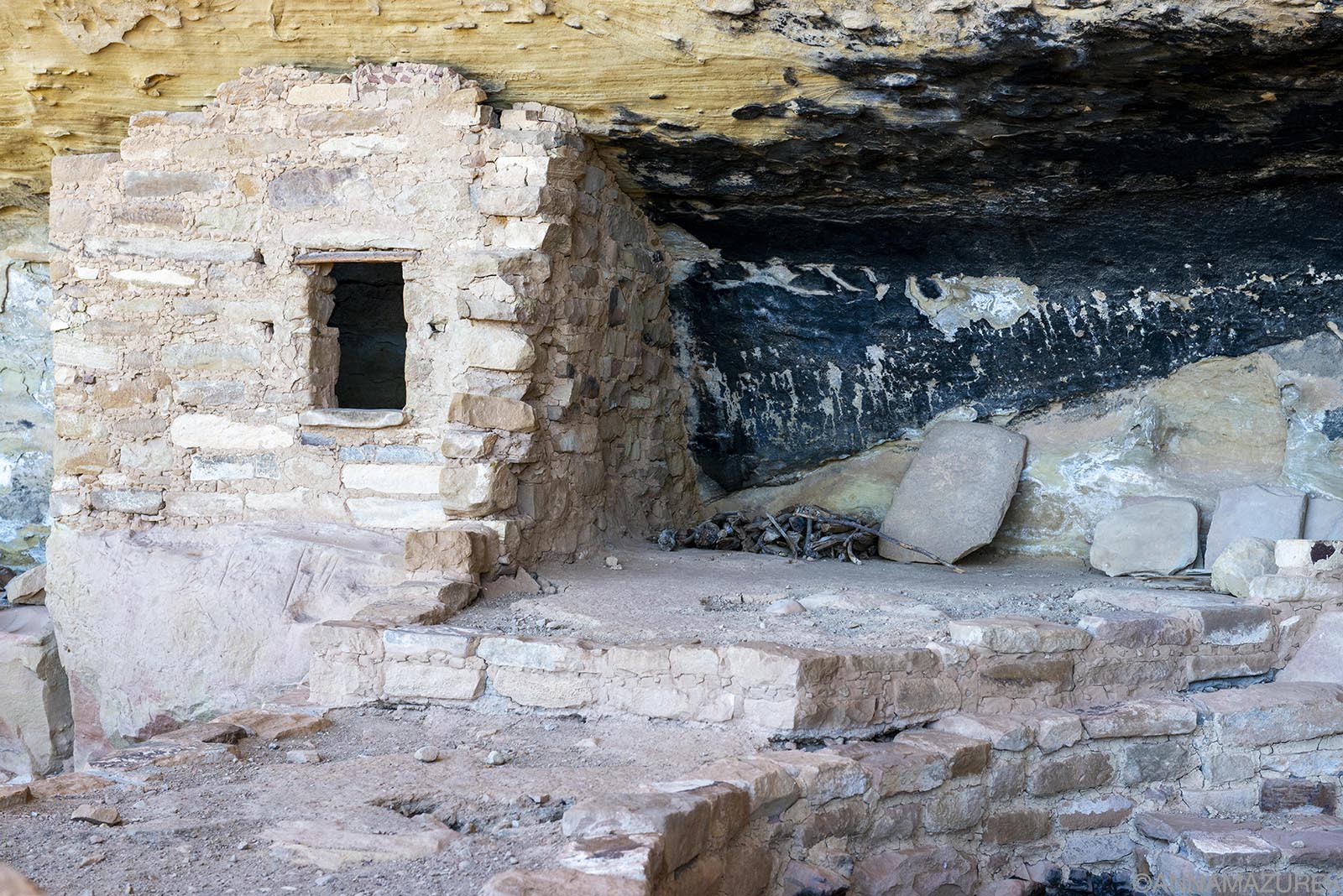 Mug House on Wetherill Mesa // The cliff dwellings are all made with rocks and mud mortar. The roofs were made of wood and covered in a layer of dirt. The black areas in the caves were the result of fires from the kitchen areas. Camera Settings: f/7.1 @ 1/250, ISO 650, 60mm with a 24-70mm lens.
Step House is the only cliff dwelling that’s publicly accessible for a free self-guided tour. A handful of other dwellings are open for either ranger-assisted or ranger-guided tours for $8-45/person, which trust me is worth it, especially for photography. The only way to get detailed shots of the dwellings is to do a tour, which books up fast and reservations open at 8 a.m. MST 14 days before the date. (I was literally on my computer when the clock it 8 a.m. to book my tours! Each tour only had 10 spots!)
The dwellings that are open for tours varies each year, so check the park website for updates. I toured Square Tower House in the morning and Mug House in the afternoon. (Both were $25 each.) I highly recommend both but loved Square Tower House the most. Read the details for the tour carefully as some require climbing ladders on the trail.
More tours are offered during the summer, which is also the busiest season so expect crowds. Other sites available for tours are Long House and Spring House, which is an eight-mile full-day tour only offered four times this summer. There are other sites available for limited dates, which vary each year. For more information on guided tours, visit the NPS website.
Is there cell service in Mesa Verde National Park?
Cell service is non-existent in most parts of the park. Download offline maps before visiting the park. Keep in mind that it’s a 45–60-minute drive from the entrance to the main sites.
What’s the best time to visit Mesa Verde National Park?
Spring (May) and fall (September and October) are the best time to visit for weather and to avoid the crowds. Most cliff-dwelling tours are open during these dates. Summer means more daylight but more crowds and often intense heat. (There’s not a lot of shade in the park.) The park is open in winter but facilities are limited and snow can make things hard to access. (I visited in mid-May and highly recommend that time of year.)
Where to stay at Mesa Verde National Park?
The most budget-friendly option is the Morefield Campgrounds (all services open May to September in addition to limited October options) in the park, which has direct access to some of the best hiking trails that are focused more on scenery than cliff dwellings. The Far View Lodge (starting at $146/night) is an excellent location in the park for photography because it’s close to attractions and located past the scariest portions of the road.
There’s a plethora of other camp and RV sites including a KOA and most hotel brands available on the way to the park or in the city Cortez, which is just a 10–15-minute drive from the park entrance. I stayed at the Hampton Inn in Cortez, which was cheaper and rated higher than the Far View Lodge. (Prices vary by season.) I brought my own food to cut costs, so I didn’t eat out at all.
This post originally appeared online in 2021; it was recently updated in February 2025 to include current information.
How to Visit Moo Deng from Bangkok Without a Car
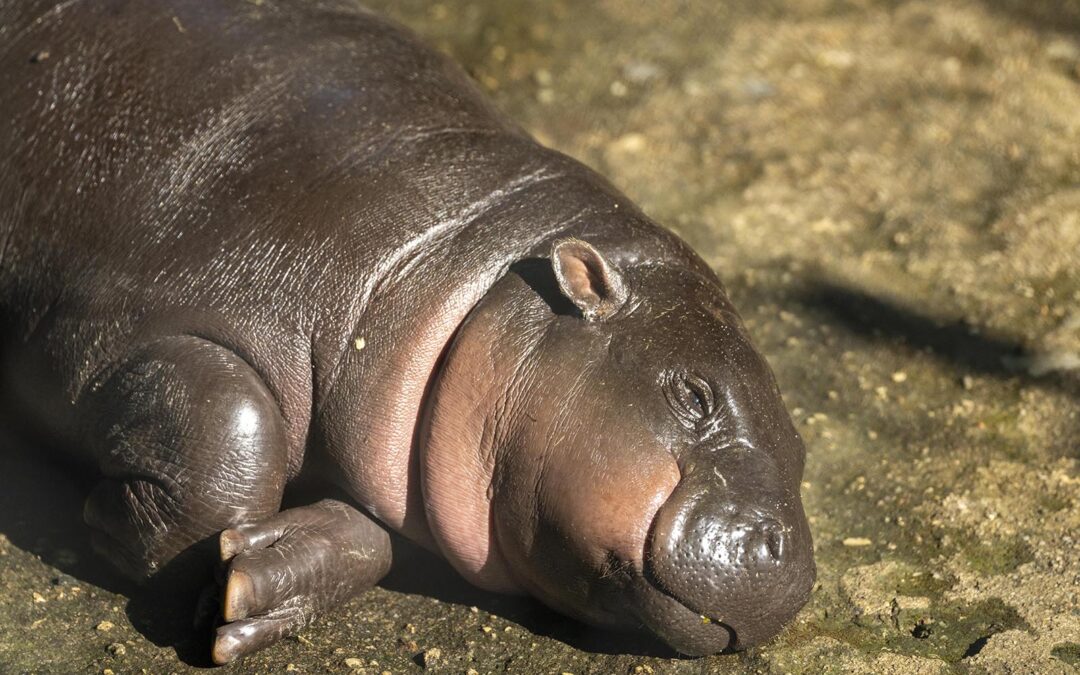
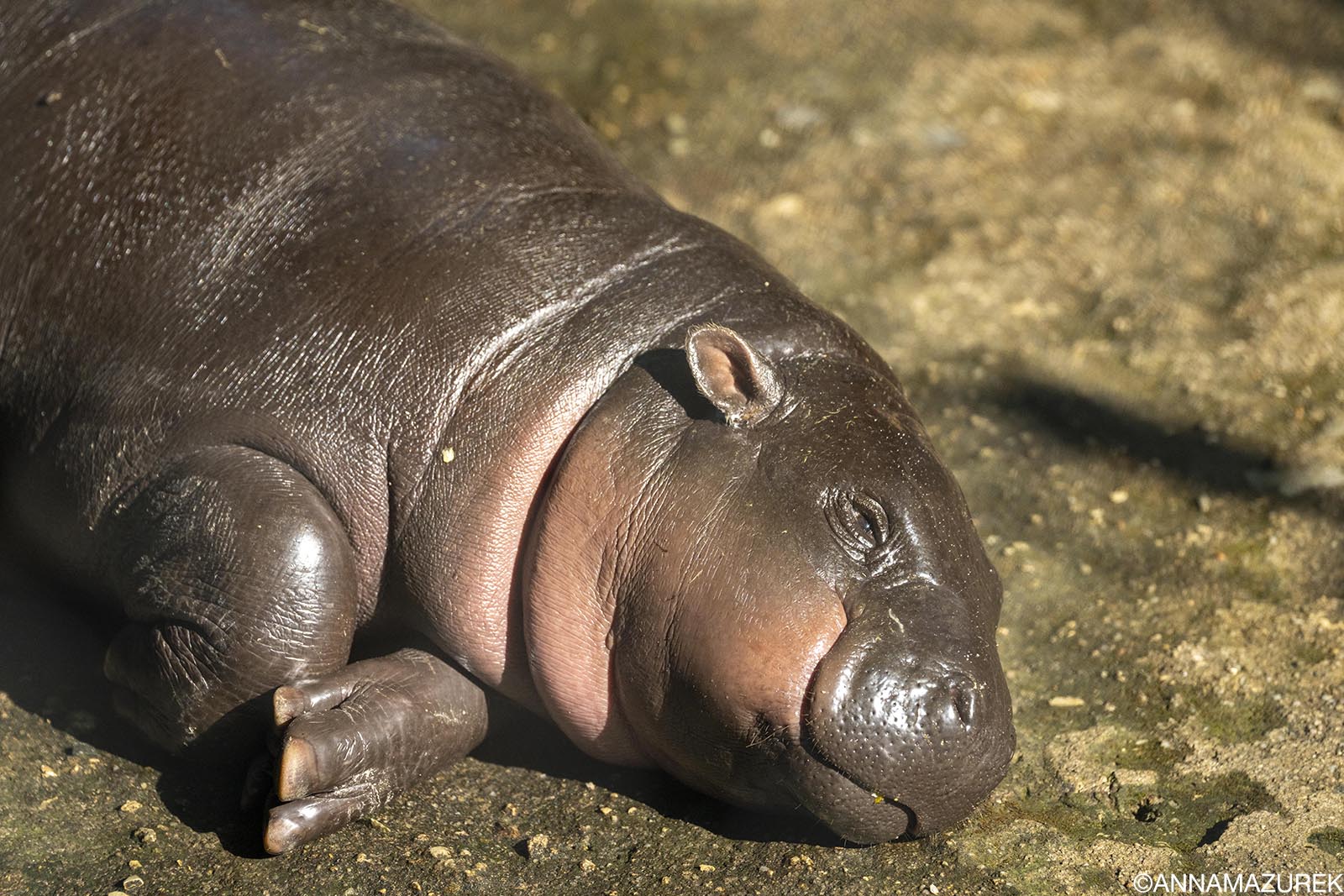 Moo Deng napping after a big breakfast and fighting off all the monkey’s trying to steal her food.
Today, I went to visit Moo Deng, a baby pigmy hippo was born on July 10, 2024 in Thailand. She’s achieved international fame on social media for her quirky antics and playful personality. She’s the best thing on the internet right now with a 24/7 live stream!
It’s no easy feat to visit Moo Deng and takes a bit of planning to get good photographs of her. Here’s how my friend and I visited Moo Deng from Bangkok without a car and timed our trip to get the best photos. (I made another blog post of my favorite photos I took of Moo Deng!)
Affiliate links are used in this post. If you make a purchase, I earn a small commission at no cost to you, which goes toward the cost of maintaining this blog.
Where does Moo Deng live?
Moo Deng lives at Khao Kheow Open Zoo in Si Racha, Chonburi, Thailand. The zoo is roughly a two-hour drive from Bangkok (114 km) and an hour’s drive from Pattaya (48 km).
How to Visit Moo Deng from Bangkok without a Car
The easiest way to visit Moo Deng from Bangkok is to drive or hire a car with a driver. We hired a car with a driver through our Airbnb for 3,000 baht ($88 USD) for the day and got a swanky van with nice reclining seats. GetYourGuide offers private transfers. Klook also offers day tours from Bangkok and Pattaya.
If you want to take public transport, you can take a shared van to Si Racha from Bangkok and then, take a Grab or taxi from there.
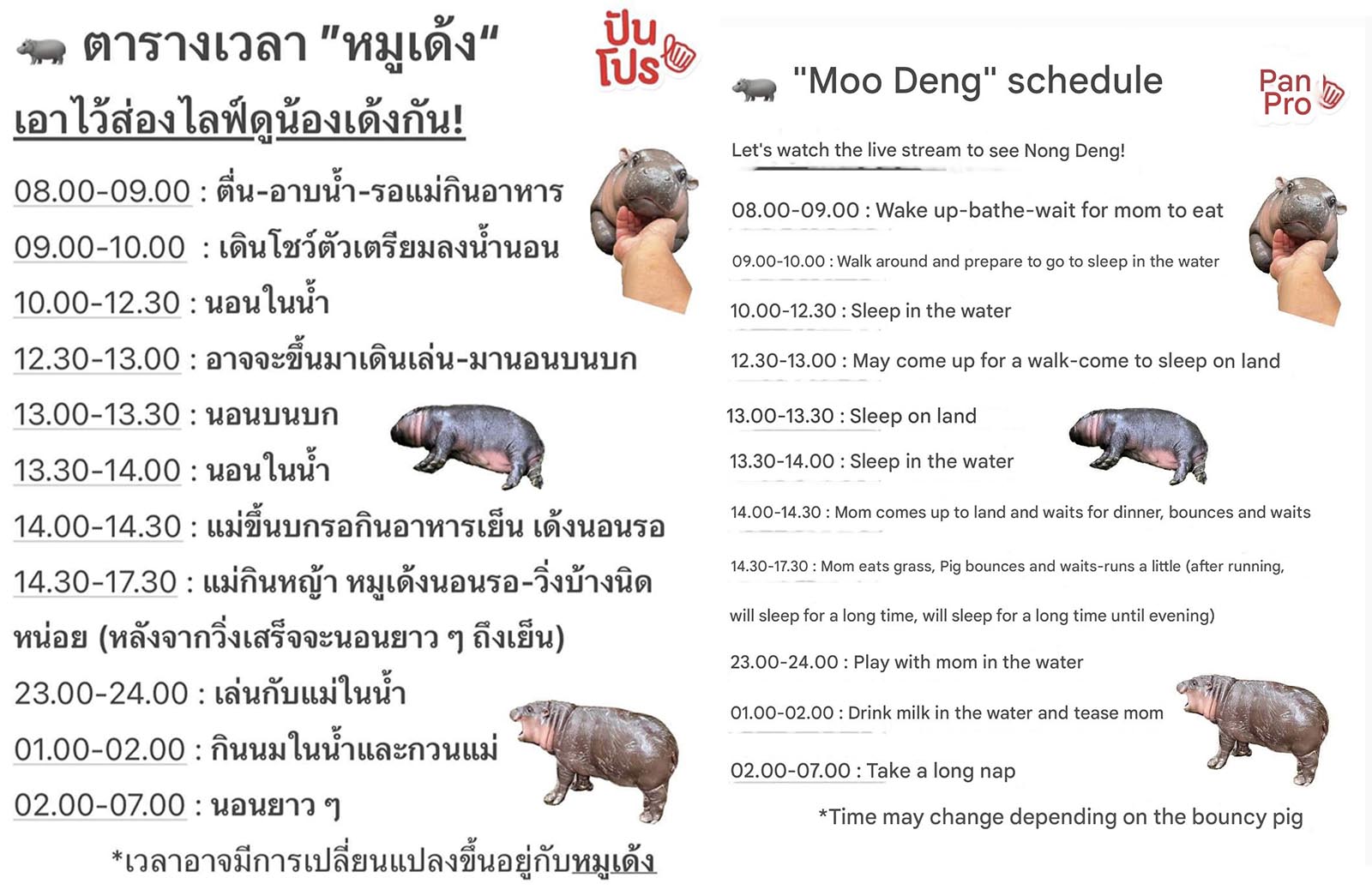
The zoo sent me Moo Deng’s schedule, which I used Google translate to tranlate to English on the right.
When is the best time to visit Moo Deng?
The zoo posts a rough schedule of Moo Deng’s day, but it’s hard to predict what she’ll feel like doing. She does sleep quite a lot. I recommend visiting at 8 a.m. right after the zoo opens when it’s less crowded. Moo Deng and her mom, Jona, wake up at this time and her mom eats so she’s active. This is also when the caretaker was cleaning their enclosure making for fun moments of those two interacting.
The caretaker was splashing water on her and taking Instagram photos. We also lucked out and got some interaction between Moo Deng and the troublesome monkeys trying to steal their food. Around 9 a.m., they went to sleep and were still sleeping at noon when we checked again. Late afternoon seems to be another active time for them.
Due to overcrowding, the zoo implemented a system where people only get five minutes to watch Moo Deng. Thankfully, it wasn’t crowded when we went on a weekday morning, so we spent about an hour with her. (The five-minute rule only seems to apply when it’s crowded because there was no enforcement when we were there.) There were only a handful of people when we arrived and roughly 30 max. A large tour group showed up at 9 a.m. making it close to 50 people.
I highly recommend visiting early on a weekday. The zoo was busy after 10 a.m. but never overly crowded by Moo Deng’s enclosure when we’d drive by in our golf cart. If you have questions about visiting, I found the zoo to be very responsive to Facebook messages.
Where to Buy Tickets for Moo Deng
Foreigners must buy tickets at a little building on the left before they reach the main entrance gate. Thais can buy tickets at the gate.
Prices: For foreigners, it’s 350 baht ($10.32 USD) for adults and 120 baht ($3.54) for kids. Parking passes are 40 baht ($1.18 USD) for a motorcycle and 80 ($2.36 USD) for a car.
You can buy tickets online through Klook for a slightly discounted rate to save time when you arrive. (We didn’t realize this was an option or we’d have done it!)
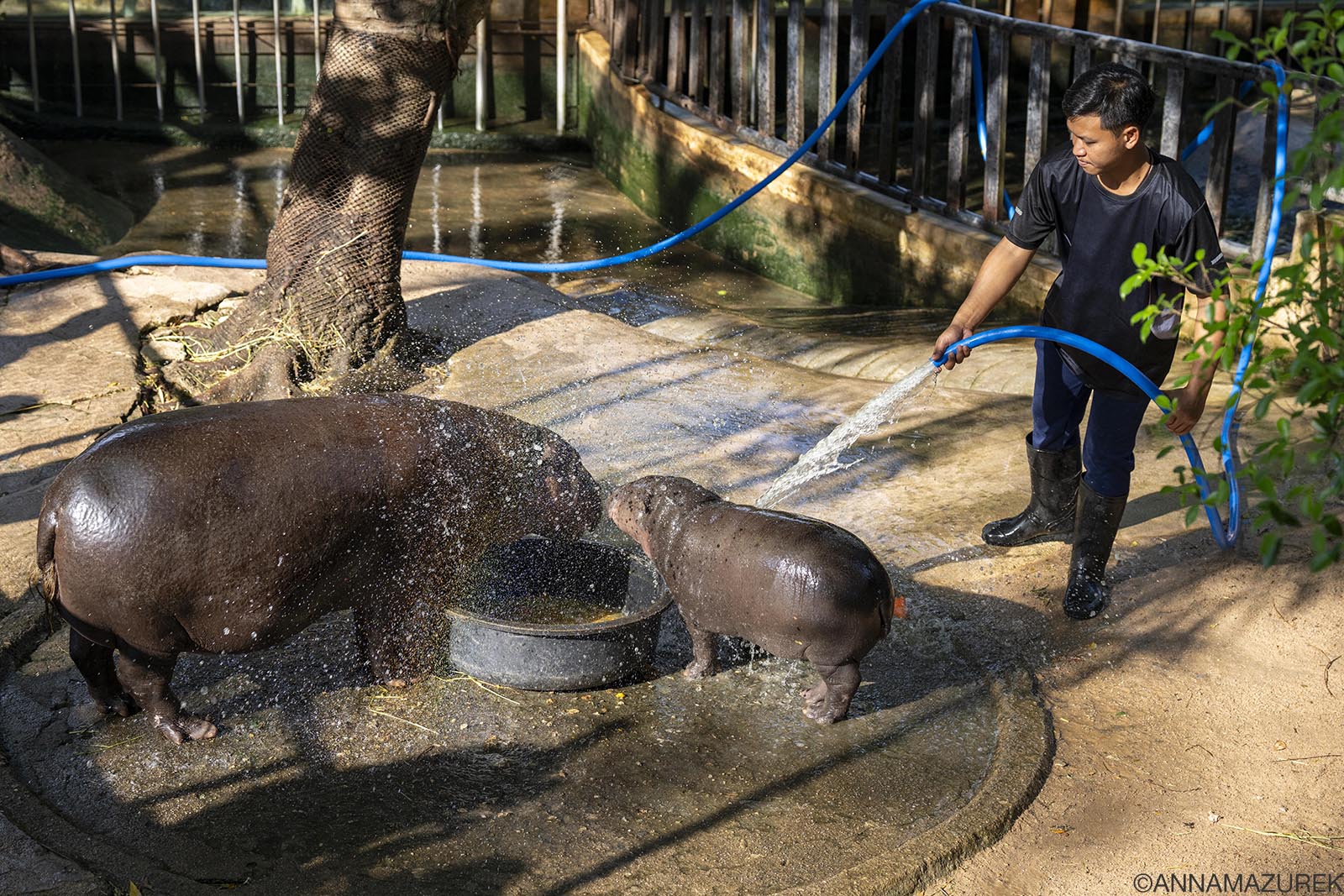 Moo Deng getting hosed down by her caretaker early on a weekeday morning. She and her mother are active and eating between 8 a.m. and 9 a.m.
Where is Moo Deng at the Zoo?
No cars are allowed in Zone 1, so you have to walk inside to the zoo. Moo Deng’s enclosure is easy to find – take a left once you walk through the entrance and follow the hippo signs with arrows. It’s roughly a 10-minute walk. You’ll walk across a boardwalk by other hippos until you reach their enclosure. There’s always Moo Deng music playing so it’s hard to miss!
The best photo angles of Moo Deng are from the elevated far end of the enclosure. Unless you are tall, the bottom end has a glass wall and fence wire that gets in the way of photos. In the morning, it’s best to shoot from the top due to the angle of the sun.
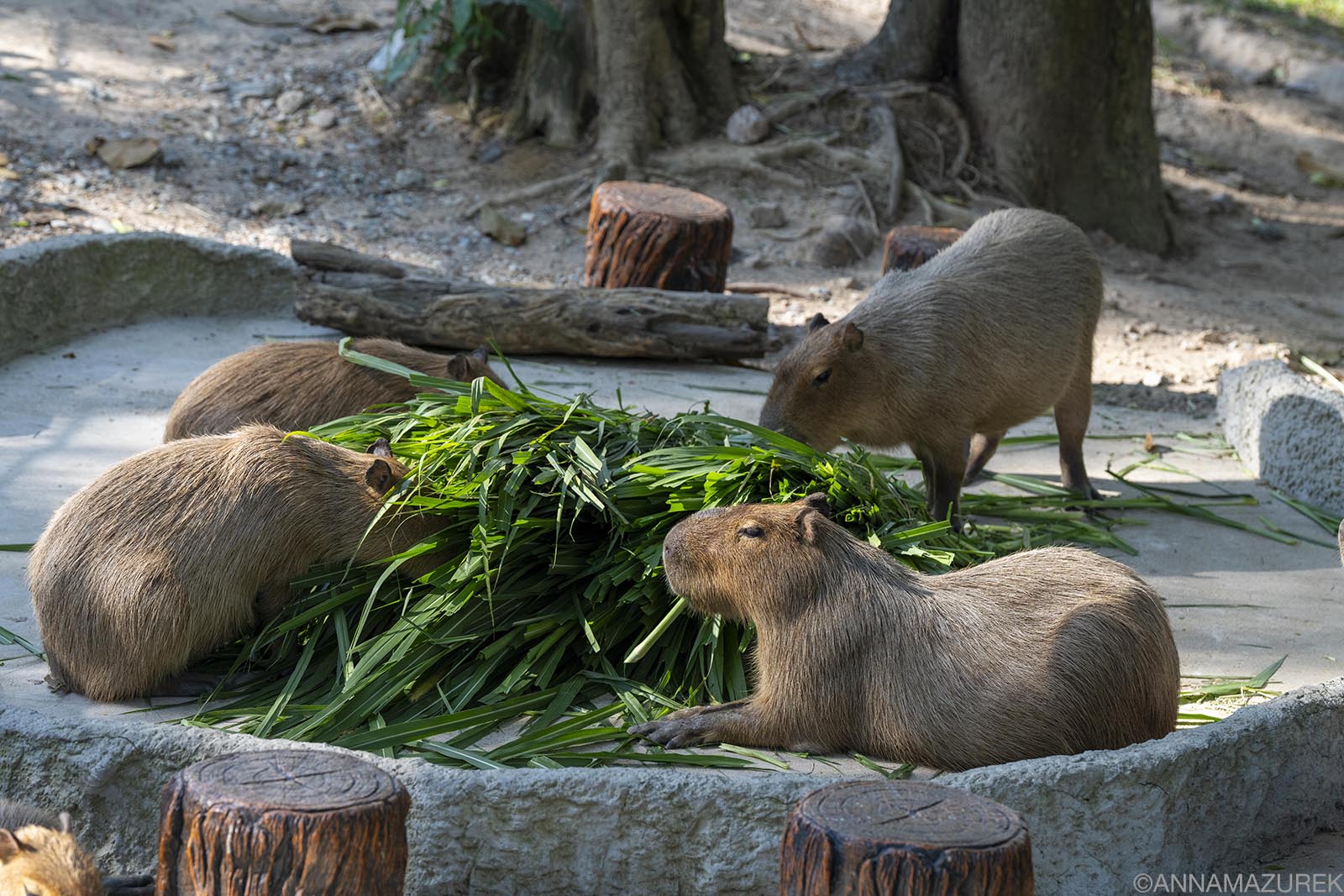 On weekends and holidays, the public can feed Capybara’s at Khao Kheow Open Zoo.
What else is there to do at the zoo?
The zoo is divided into two zones and is too big to walk on foot—it’s 2,000 acres. We rented a golf cart for 500 baht ($14.75 USD) for two hours. We basically spent the rest of the time driving around, which was so fun!
Cars are allowed in Zone 2 for a fee. If you don’t feel comfortable driving a golf cart, there is a tram that makes the main stops.
Zone 1 is the busiest area with the main attractions, while Zone 2 is more rural and feels a bit like being in Jurassic Park because you drive by some dilapidated exhibits and enclosures that are no longer used. There are no crowds in this section.
I’m not much of a zoo fan but did enjoy this experience. (I literally flew to Bangkok from Chiang Mai for Moo Deng! My friend and I brought matching t-shirts to wear.)
The other main attractions are the penguin parade where they march out to be fed and an elephant swimming show along with opportunities to feed elephants and giraffes. We didn’t do any of these.
Where can I buy Moo Deng merchandise?
You can’t buy Moo Deng shirts at the zoo sadly. There are plenty of Moo Deng stuffed animals but that’s about it. The zoo trademarked and patented Moo Deng and is supposed to sell licensed t-shirts. I’ve yet to figure out where they are sold but it’s not listed on their website. We bought bootleg ones online and from an artist in Chiang Mai. It’s honestly really hard to buy Moo Deng merchandise anywhere in Thailand!
Where to Go in Southeast Asia
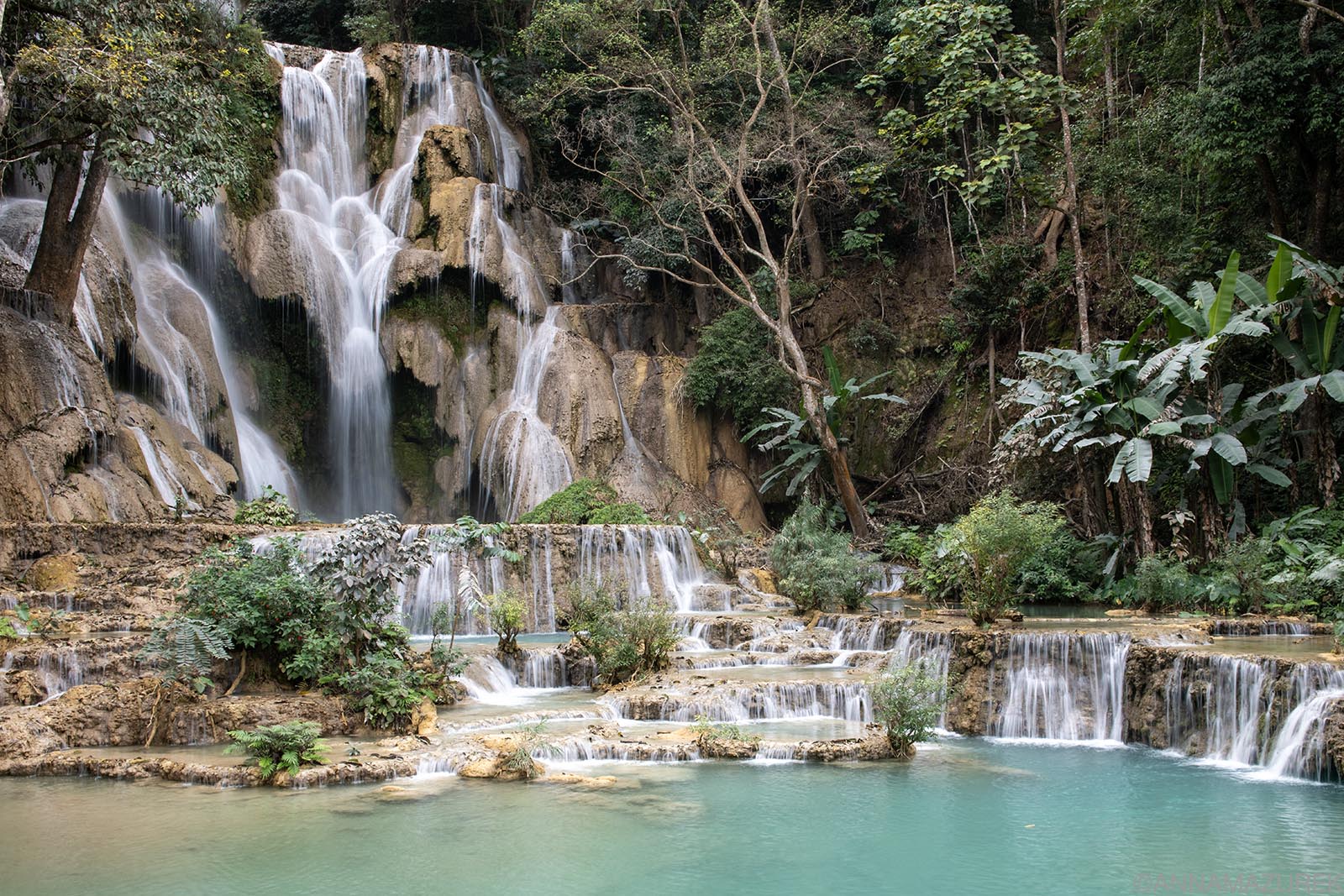 Tat Kuang Si Waterfall is a good day trip from Luang Prabang, Laos!
Southeast Asia is the perfect travel destination – it’s cheap, safe and beautiful. Plus, it’s always flip-flop weather!
There’s no place I love more than Asia. I’ve spent years managing photo trips for a travel company in Southeast Asia and live in Chiang Mai every winter. From jungle treks to ancient ruins, keep reading for my favorite places to visit and things to do in Southeast Asia.
Affiliate links are used in this post. If you make a purchase, I earn a small commission at no cost to you, which goes toward the cost of maintaining this blog.
Plan Your Trip
Travel Insurance: Protect yourself with SafetyWing travel medical insurance to cover accidents and travel delays.
Mobile eSIM Card: Get seamless connectivity worldwide with Airalo minus the hassle of physical SIM card. (Save 10% with code AIRALOESIM10!)
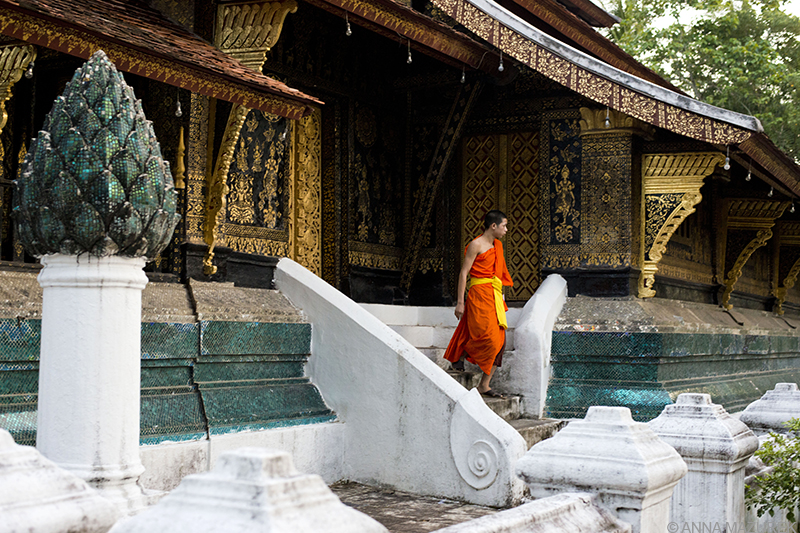
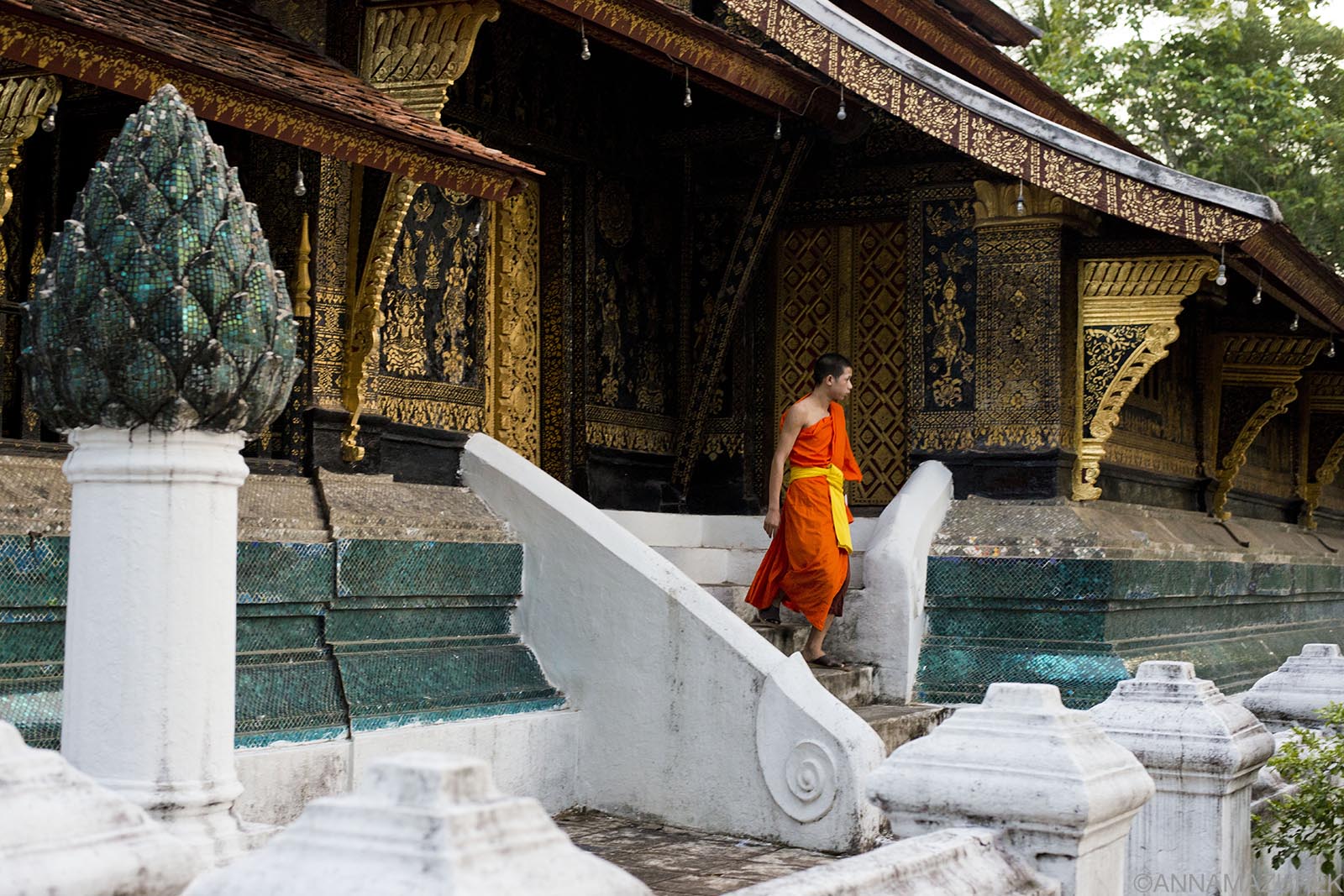 Built in 1560, Wat Xieng Thong in Luang Prabang is one of the most important Buddhist temples in Laos.
Luang Prabang, Laos
Luang Prabang is one of my favorite cities in the world and a traveler’s dream. The entire city is a UNESCO World Heritage site surrounded by lush mountains and sliced in half by the mighty Mekong River. The former French colony opened for tourism in 1989 making it one of Southeast Asia’s best-kept secrets.
The former royal capital is known for well-preserved golden temples and the daily morning procession of monks who walk the streets collecting alms from locals. The town center is lined with delicious French restaurants, cafes and bakeries like JOMA, Popolo, Bamboo Garden, Family Bakery Restaurant and Le Banneton Café & French Bakery.
Don’t miss the local street market one block over – fresh crepes, fish and local stir-fries are available every morning for cheap. Be sure to hike the impressive Tat Kuang Si Waterfall and take a boat trip down the Mekong to visit the Buddha-filled Pak Ou Caves. (Price tours with local agencies and Klook to find the best options.)
IMPORTANT TIP: If you go to the monk alms ceremony, be respectful of the monks! Take photos from a distance and not directly in their faces. Dress conservatively, and do not stand higher than the monks. (You’ll notice most locals are seated.) Avoid giving the monks food because there’s been a huge issue with on-site street vendors selling foreigners old food that makes the monks sick. Let only the locals give food.
Where to Stay in Luang Prabang
I like Meunna Boutique Hotel ($70 USD/night) because it’s a quiet location with a pool that’s walkable to any spot in the city. It’s hard to find a room with a good desk for working so that’s also why I love this post.
Cheaper options include the rooms at Maison Barn Laos for $39/night or the $8/night dorms at La Casa Hostel.
For a fancier waterfront spot, I like the Belle Rive Boutique Hotel ($117/night). Its riverside restaurant is my favorite sunset spot.
How to get to Luang Prabang
The easiest way is to fly—I recommend either Bangkok Airways or Vietnam Airways. There’s a new high-speed train that makes the journey from the capital of Vientiane in less than 2.5 hours. Tickets sell out fast days in advance, so ask your accommodation for help. Check out my Instagram story about my experience! You can take boats downstream from the upper Mekong but a new dam built above Luang Prabang means you’ll be take by van for the last few kilometers. The roads are windy so avoid buses if you can.
When to go to Luang Prabang
I prefer the rainy season which lasts roughly from April to October, which usually means brief showers daily. It’s much lusher. March is the hottest month. November to January are the coolest months and most crowded. The bamboo bridges are up this time of year, which is fun. I either go in August or January.
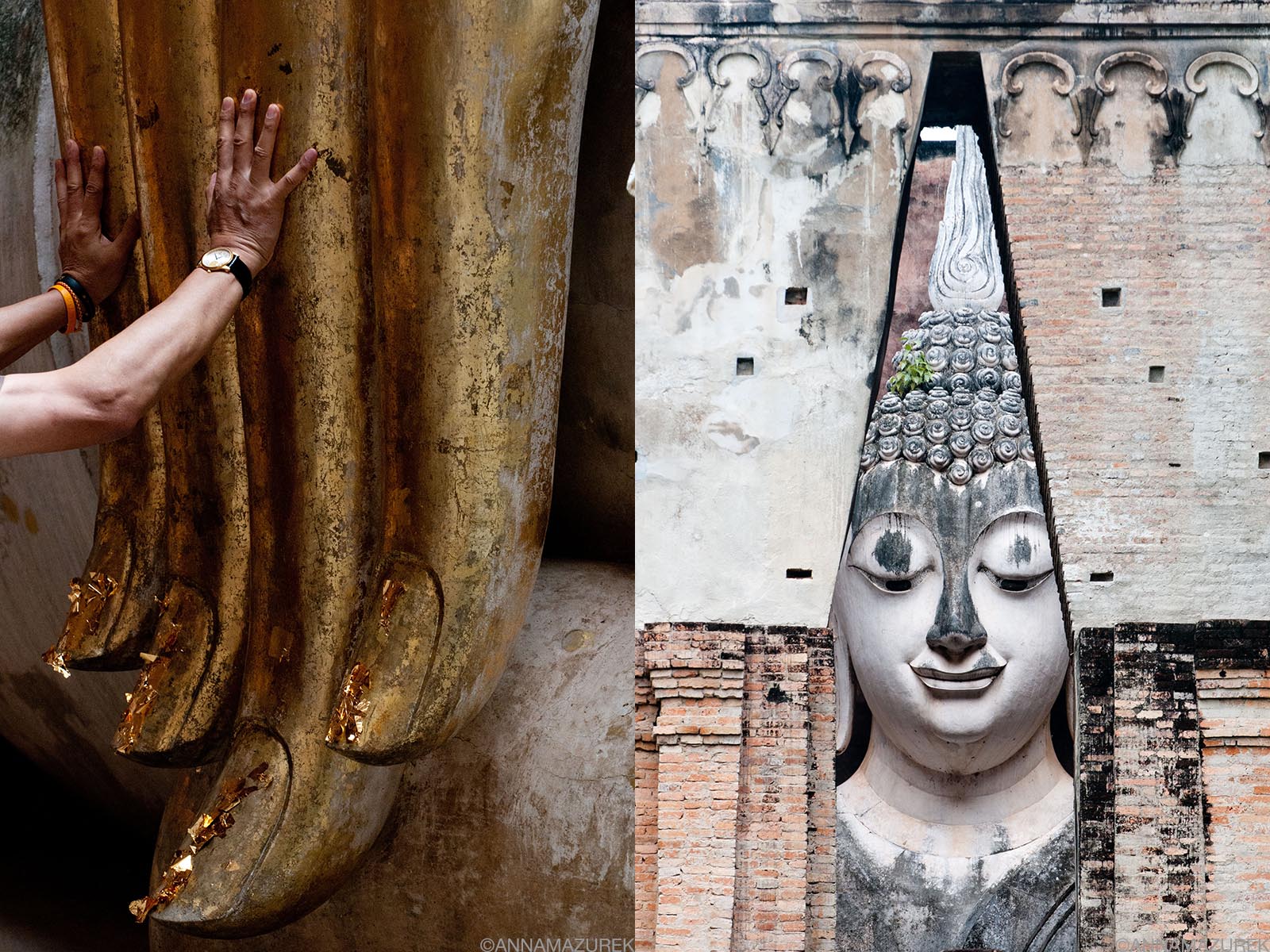 Two angles of the giant Buddha statue at Wat Si Chum in Sukhothai Historical Park.
Sukhothai Historical Park, Thailand
My favorite place in Thailand is Sukhothai Historical Park, the site of the 13th- and 14th-century capital of Siam. Within the old city walls of the UNESCO World Heritage site, there are 21 sets of gorgeous ruins and another 70 in a five-kilometer radius, which are best visited by bike or motorbike. (I always rent a bike by the park entrance for less than $1 USD.)
The size of the park makes it easy to escape the crowds. The ruins are more centralized and much less crowded than Ayutthaya, whose sites are spread across the town and surrounded by pushy street vendors.
My favorite ruins are Wat Si Chum featuring a famous giant Buddha statue above; Wat Mahathat, the largest ruin and former royal palace, and the Khmer style temple, Wat Si Sawai, that is reminiscent of Angkor Wat.
For a very local experience, visit the nearby site of Si Satchanalai, which is part of the same UNESCO designation. (Sukhothai was the political head of the first kingdom of Thailand while Si Satchanalai was the spiritual headquarters.) For details on how to visit, check out my Instagram highlight on Si Satchanalai.
Where to Stay in Sukhothai
On my last visit, I stayed at TR Guesthouse ($14 USD/night for a private room) and really liked it. Free breakfast is included.
How to get to Sukhothai
The park is a few hours north of Bangkok and the perfect stop enroute to Chiang Mai. Catch a bus from Bangkok’s northern bus station, Mo Chit. The closet train station is Phitsanulok, an hour away. The park is 12 km from the new town of Sukhothai and easily accessible by tuk tuk or a songthaew (pickup truck style bus). The entrance fee for foreigners is 100 Baht ($2.80 USD) for each zone or 350 Baht ($10 USD) for all five zones.
When to go to Sukhothai
Avoid March and April when it’s steaming hot. The dry season, from November to February, has best weather while June to October is monsoon season. I prefer the rainy season when the trees are a vibrant green and the puddles make for great photos.
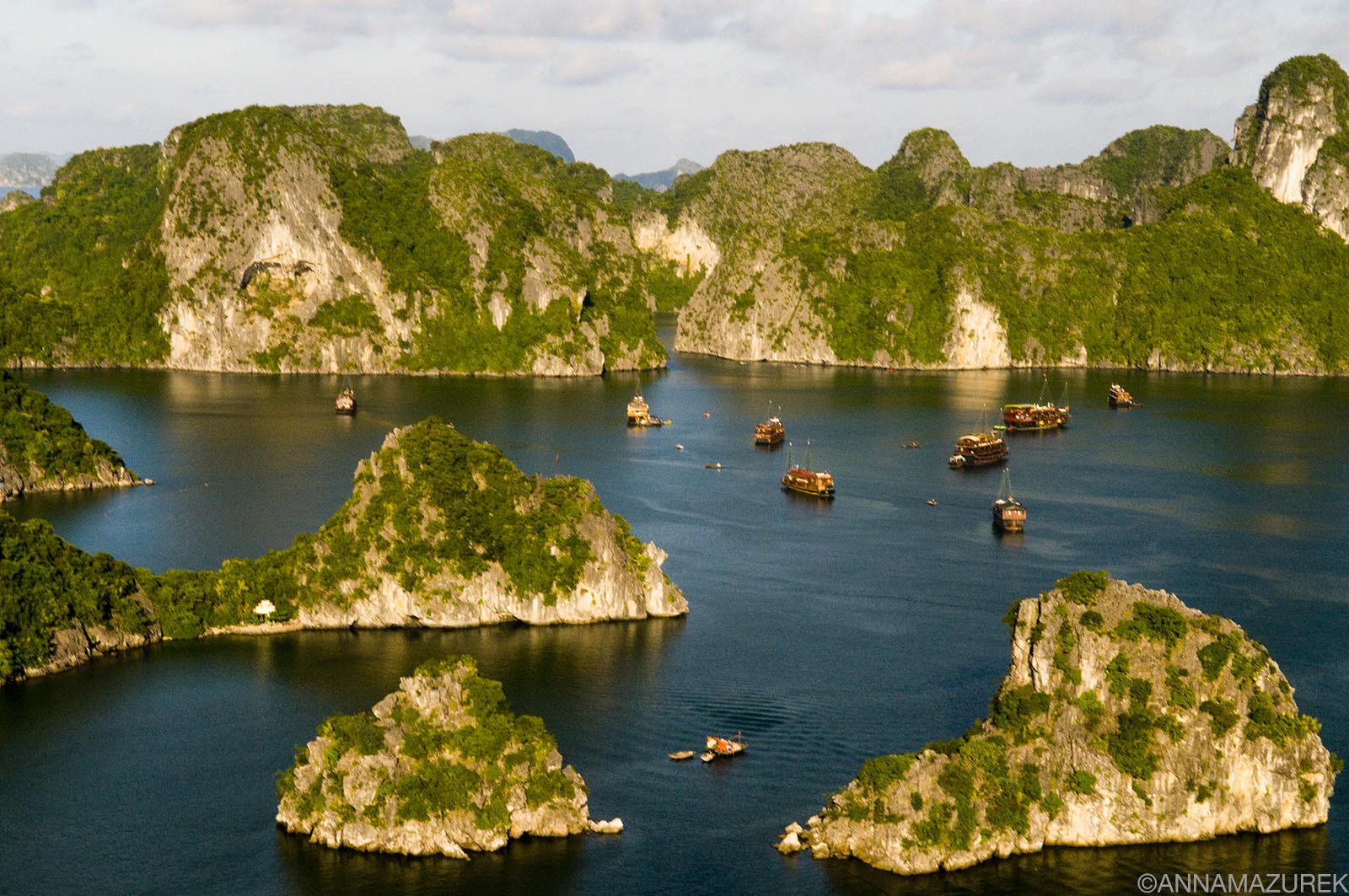 A bird’s eye view of Ha Long Bay, Vietnam.
Ha Long Bay, Vietnam
Ha Long Bay is one of those places like Machu Picchu that you must visit once in your life. The scenery is postcard-perfect: limestone pillars and tiny islands scattered through the Gulf of Tonkin’s emerald waters. It is the number one attraction in Vietnam.
The best way to experience the bay is to do a multiple-day cruise on a houseboat to explore the islands, swim and eat year weight in fresh seafood! There are short boat trips and overnight cruises for every budget. I recommend spending a night or two on a houseboat!
How to Get to Ha Long Bay, Vietnam
Boats depart from the less-appealing port town of Halong City. It’s four hours north of Hanoi by car or bus. Klook offers budget-friendly transfers and tours.
When to go to Ha Long Bay
Avoid February to April when it’s cool and drizzly. Peak season is June to mid-August, which also corresponds with tropical storm season. November is best for blue skies and calm seas. (I’ve been in July and January.)
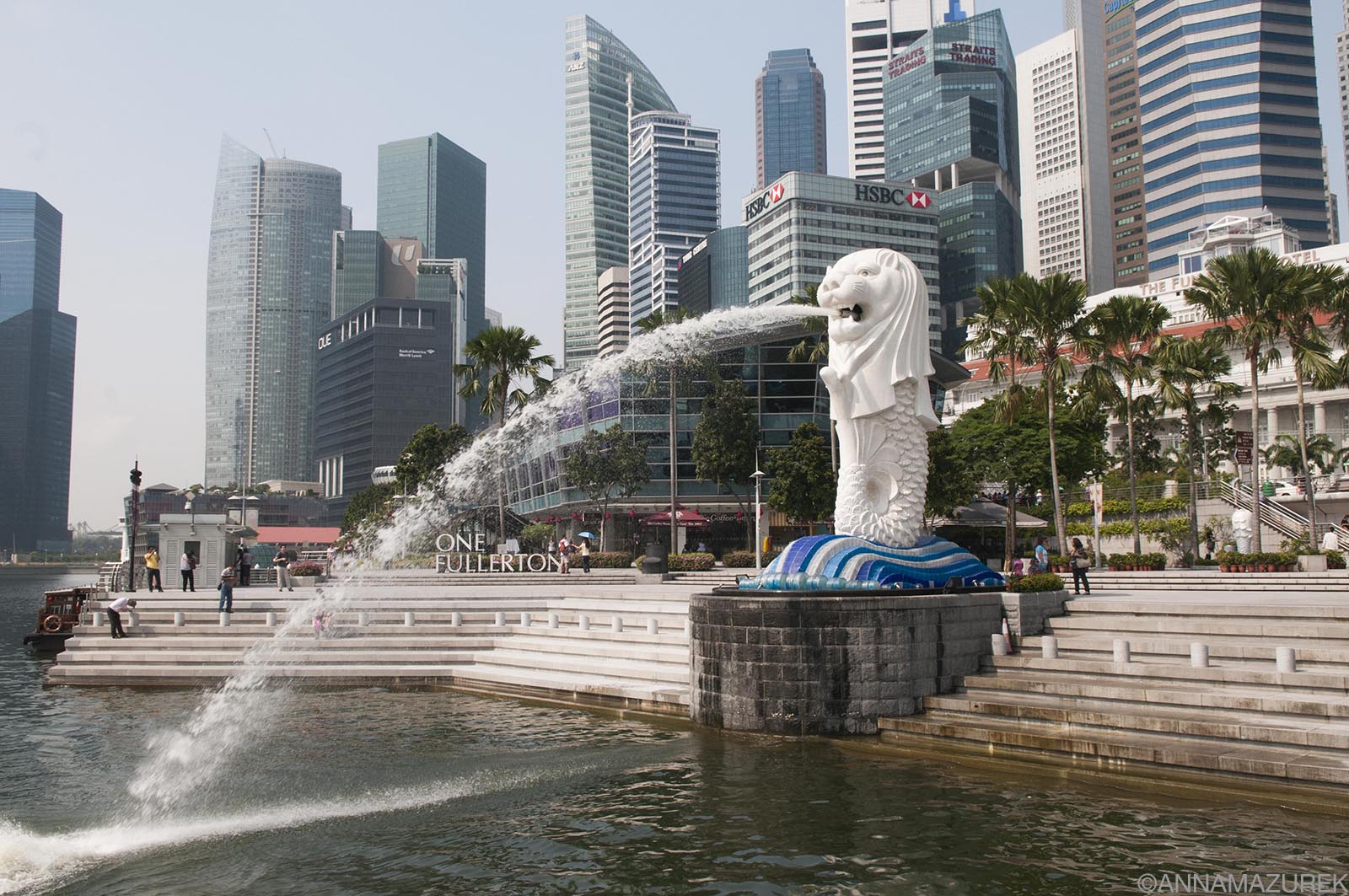 Singapore’s famous Merlion, a half-lion and half-fish statue guards Marina Bay.
Singapore
Singapore is the New York City of Southeast Asia, filled with sleek skyscrapers, world-class museums and culinary delights.
The only way to fully understand Singapore’s kaleidoscope of cultures (Chinese, Malay, Indian and Western) is to explore the museums, including The National Museum of Singapore and the Peranakan Museum. Other highlights include the famous Supertree Grove of vertical gardens at the Gardens by the Bay and the view from the rooftop bar of Marina Bay Sands Resort.
Despite its sleek and sophisticated exterior, the heart of the city is the countless food stalls that serve up tasty treats like traditional kaya (coconut jam) toast and Hainanese chicken rice.
For more, read my detailed Singapore guide!
Where to Stay in Singapore
I really love the location of 30 Bencoolen because it’s only a 20–30-minute walk to Chinatown or downtown.
If you’re looking to splurge or cash in points for a luxury stay, then the most iconic hotels are Raffles Singapore, Fullerton Bay Hotel and Marina Bay Sands.
How to get to Singapore
You can fly to Singapore from just about anywhere. Changi Airport is the nicest airport in the world. (Trust me, you WANT a layover in Singapore.) It’s easily accessible by bus from Peninsular Malaysia and by ferry from parts of Indonesia.
When to go to Singapore
Monsoon season lasts from November to January. June to September is when the rain clears off and temperatures spike a bit. Overall, it’s usually 81-87 °F year-round.
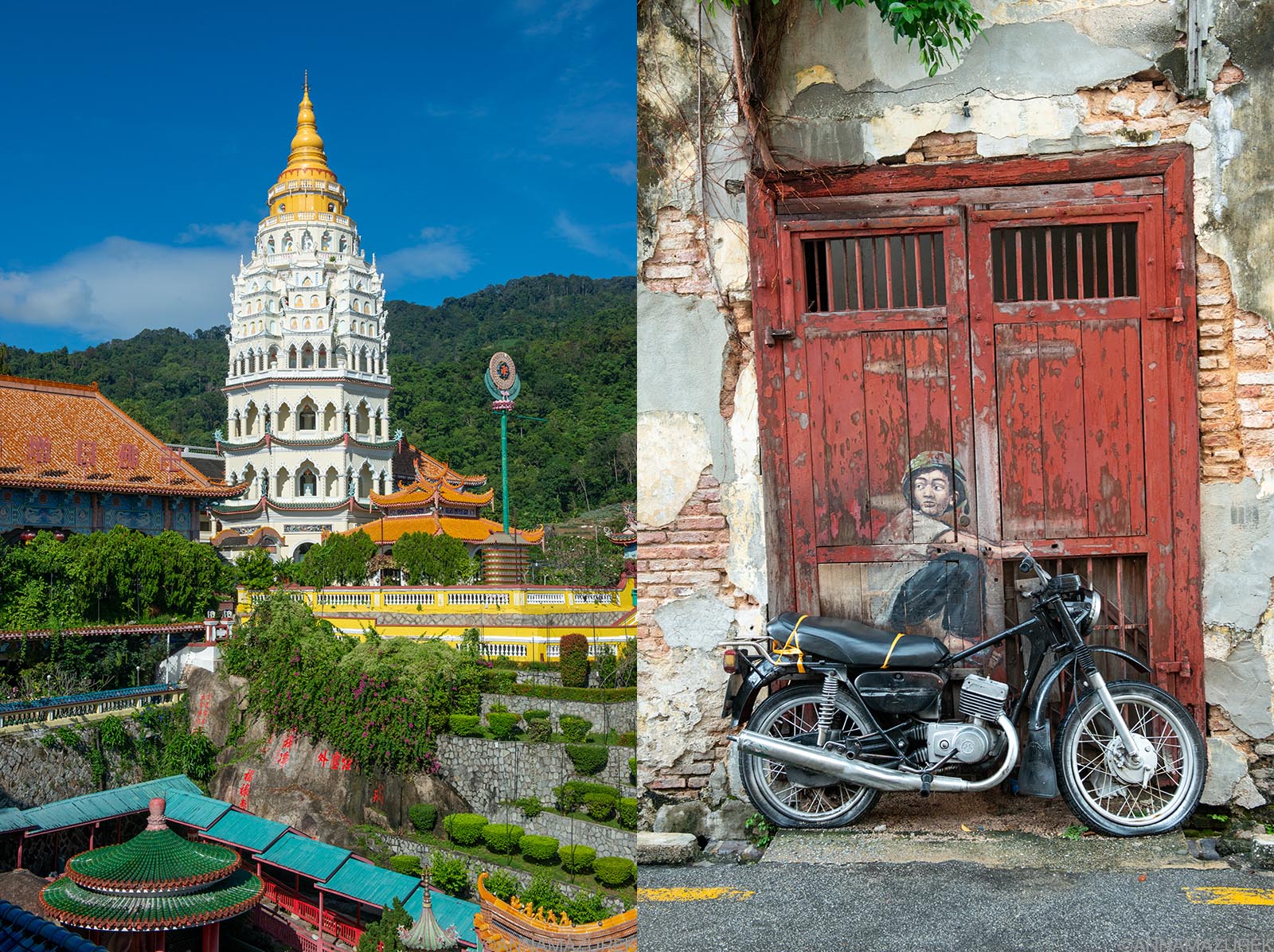 Left: The colorful Buddhist temple of Kek Lok Si; Right: George Town’s famous street art.
George Town, Malaysia
Like Singapore, George Town (the capital of the island state of Penang) is a mixture of three cultures and various types of architecture, ranging from Chinese shophouses to British colonial buildings.
It’s also the street art capital of Southeast Asia. Pick up a map from your hotel or the tourism association to guide you through the labyrinth of 3D artwork and murals like the one decorating the shop where Penang native and famous shoemaker Jimmy Choo first apprenticed.
Be sure to eat the crispy chicken with plum sauce for dinner at Tek Sen! Other highlights include the house museums including the famous Blue Mansion.
How to get to George Town, Malaysia
It’s easily accessible by plane from across Southeast Asia. There is a train service from Kuala Lumpur (KL) and buses from all over Malaysia. (I took the bus from KL many times, which was comfy and nice.)
When to go to George Town, Malaysia
The weather doesn’t fluctuate much here. Holidays like Chinese New Year will be crowded. November and December are when temperatures drop a little.
 Thomas’s leaf monkeys (left) and Sumatran orangutan (right) in Gunung Leuser National Park on Sumatra, Indonesia.
Gunung Leuser National Park, Sumatra, Indonesia
The Indonesian Island of Sumatra parallels peninsular Malaysia and Singapore and is known for the diversity of its tropical forests. One of the highlights is Gunung Leuser National Park, a UNESCO biosphere reserve that’s home to the critically endangered Sumatran orangutans and endemic Thomas’s leaf monkey. The main hub for visiting the park is the town of Bukit Lawang where orangutan treks can be arranged with guides. (I have been to all seven continents, and this is arguably one of the coolest experiences of my life.)
When to go to Sumatra
Fruit is more plentiful in the rainy season (November to March) making it easier to see the orangutans. I visited in August with no rain and great orangutan sightings.
How to get to Sumatra
Medan is the closest major city with an airport. From there, you can bus or drive. Transfers can also be arranged via Klook.
Where to stay in Bukit Lawang
I stayed at Rindu Alam Hotel, which had convenient access to the jungle trails to Gunung Leuser National Park. It’s a no-frills hotel with large, air-conditioned rooms. The location and food were fantastic!
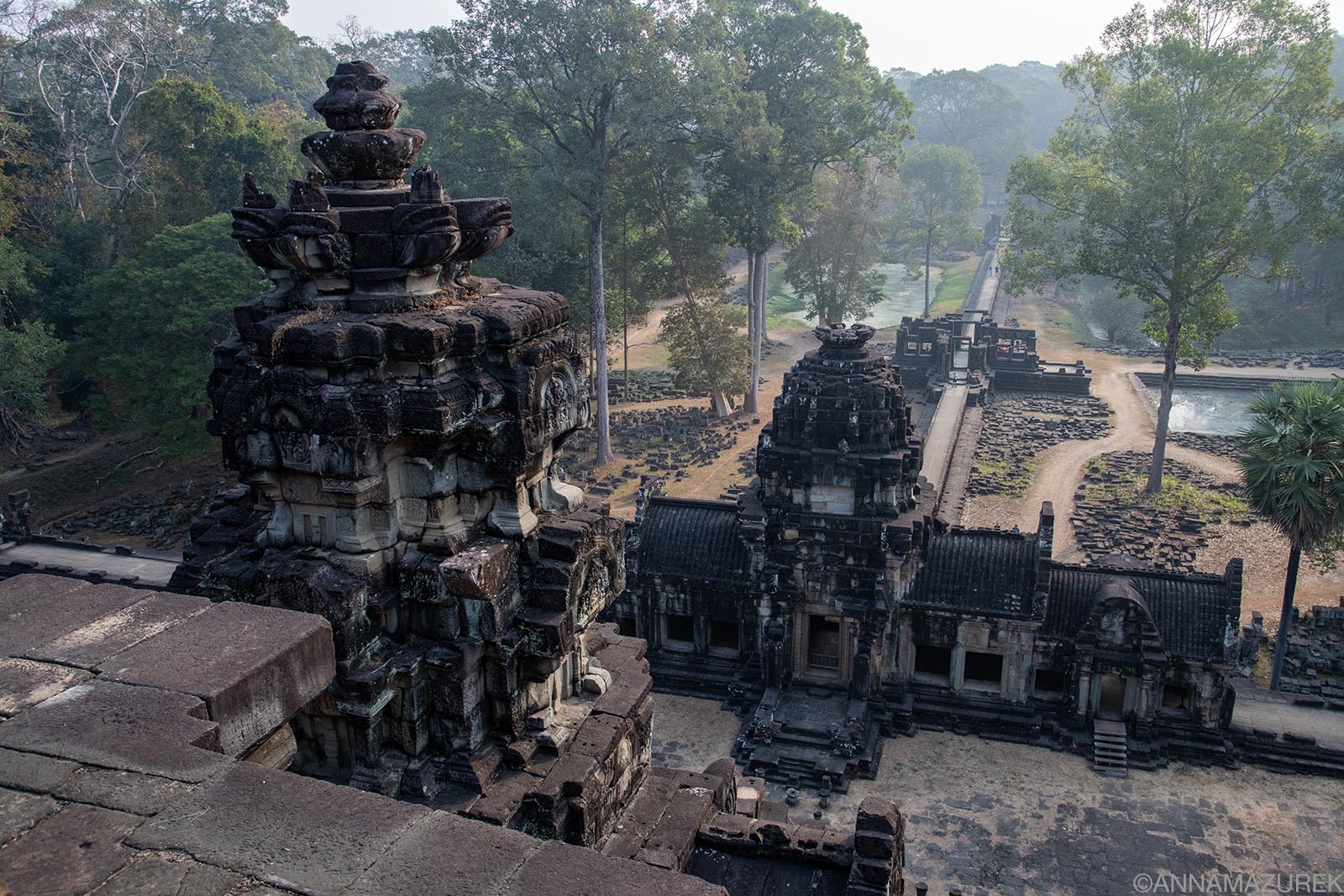 A sunrise view from the top of Baphuon temple in Angkor Thom in Cambodia.
Angkor Wat, Cambodia
Angkor Wat, the largest religious structure in the world, is Cambodia’s claim to fame—it adorns everything from the currency to the national flag. While the most famous temples in the Angkor Archeological Site are Angkor Wat, Ta Prohm (Tomb Raider temple) and Bayon, there are dozens of other temples built by the same god-kings nearby that are worth exploring.
I visit Angkor every year for work and my personal favorites are Preah Kahn, Baphuon and Pre Rup. (Banteay Kdei is a less-crowded alternative to Ta Prohm.) To make the most of your visit, consider buying at three- or five-day pass.
Venture further for fewer crowds at the Roluos temple group (short tuk-tuk ride east of Siem Reap) or drive northeast to the tiered-pyramid of Koh Ker and the unrestored jungle temple of Beng Mealea. To fully escape the crowds, check out the story I wrote for National Geographic for other remote temple complexes.
The charming tourist town of Siem Reap is the gateway to the Angkor temples. It’s a fun town with great food options like Wild, Sambo Khmer & Thai Restaurant, New Leaf Eatery, Mamma Shop Italian and Fellini. The best craft beer spot in town is Embargo Craft Beer.
Gelato Lab has the best ice cream.
How to get to Siem Reap
Siem Reap is accessible by plane from most major cities in Southeast Asia. (I always fly from Bangkok, Singapore or Ho Chi Minh.) It’s a six-hour drive or bus ride from Phnom Penh.
When to go to Angkor Wat
The rainy season is from May to October. (I personally prefer the end of the rainy season when everything is lush and green.) The weather is cooler (but still hot) from November to February, but all the rice fields and trees are brown.
Where to stay in Siem Reap
The Hari Residence Hotel ($55-60 USD/night) is one of my favorites—rooftop pool and free breakfast.
For more budget-friendly options, consider the highly-rated The Urban ($22 USD/night) or Boutique Indochine d’Angkor ($22 USD/night on Booking.com). Hostels, like Lub d Cambodia Siem Reap and Bokre Angkor Hostel range from $4-14 USD a night.
If you’re looking to splurge on a fancy resort, then I recommend Raffles Grand Hotel d’Angkor or Sofitel Angkor Phokeethra Resort. (This is where I stay for work.)
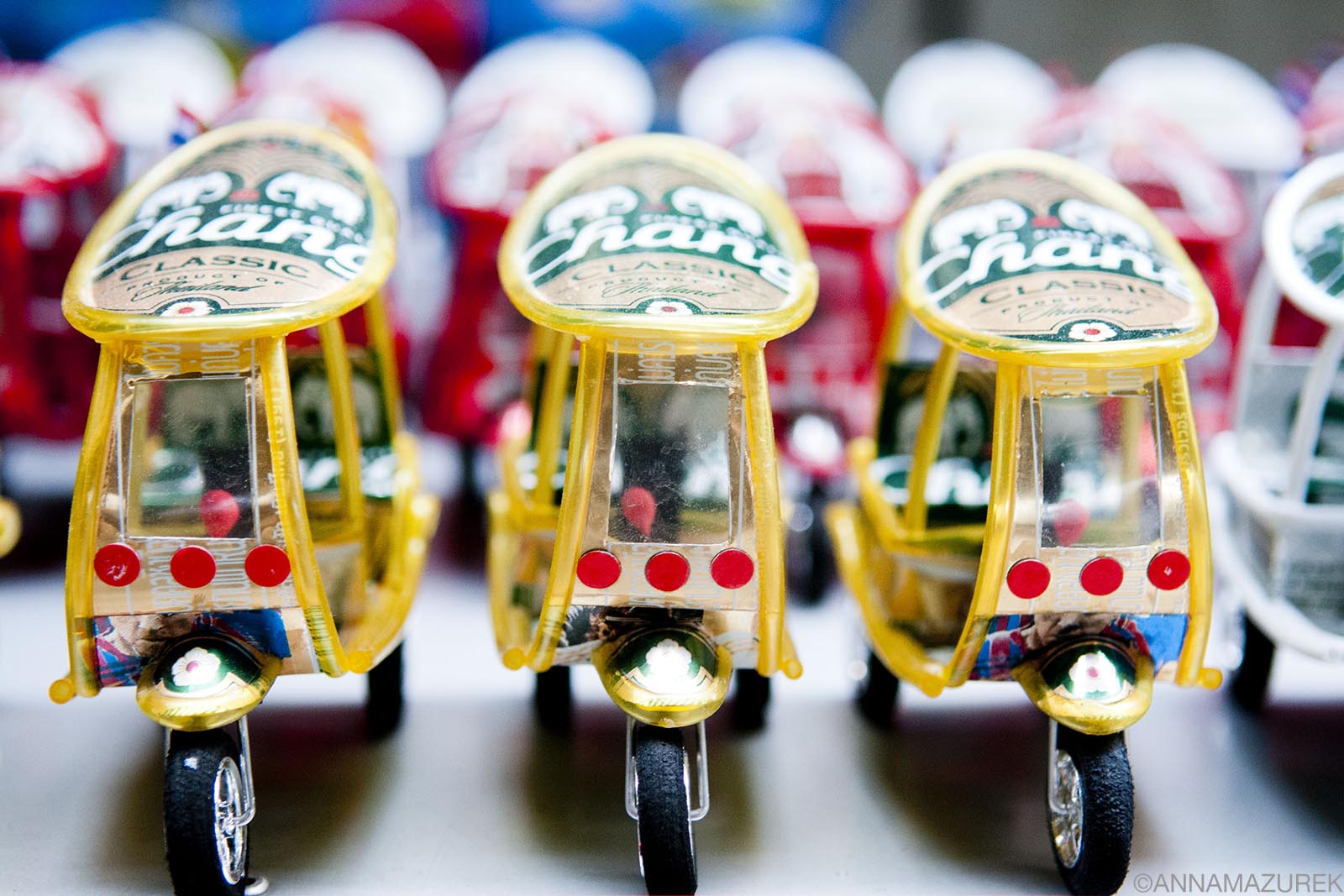
Miniature tuk tuks at a market in Bangkok.
Southeast Asia FAQ
Do you need travel medical insurance for Southeast Asia?
Yes, travel medical insurance is one of the most important things to purchase for any trip abroad, especially Southeast Asia. It covers all the things that could go wrong from injuries to travel delays so that you don’t have to worry and can focus on traveling!
I use SafetyWing’s Nomad Insurance, which offers $0 deductible travel medical insurance coverage for over 180 countries for people aged 69 and under when traveling outside their home country. The best part is that it only costs a few dollars a day! If you get sick or injured abroad, you can visit any hospital or doctor. Other benefits of Nomad Insurance include coverage for lost checked luggage, travel delays over 12 hours, motor accidents (if properly licensed, wearing all safety equipment and not intoxicated) and injuries from sports or leisure activities. You can even add adventure sports, electronics theft and U.S. coverage (for non-residents) to your policy.
If you’re abroad for 90 days, you can get 30 days of home-country coverage. (For the U.S. residents, it’s 15 days.) Plus, every single part of the process from purchasing a policy to filing a claim is easy, which is why SafetyWing has been the best travel medical insurance policy for me.
For more details about my experience using SafetyWing in Southeast Asia, read my SafetyWing Review.
Where’s the best place to buy a SIM card for Southeast Asia?
If you are traveling to multiple countries in Southeast Asia on a short trip, then consider one of their Asia Regional eSIM cards. (Both the country-specific and regional eSIMs have worked wonderfully for me and even have a mobile hotspot option that’s critical for me because I’m always working remotely.) Keep in mind it’s always cheaper to buy a country-specific eSIM than a regional one.
Be sure to join the free Airalo Loyalty Program to earn 5% cash back for every purchase, which can be redeemed on future purchases. For more about eSIM cards, read my Airalo Review and guide to pros and cons of eSIM cards.
10 Best Things to Do in Bangkok—Here’s What’s Worth the Time
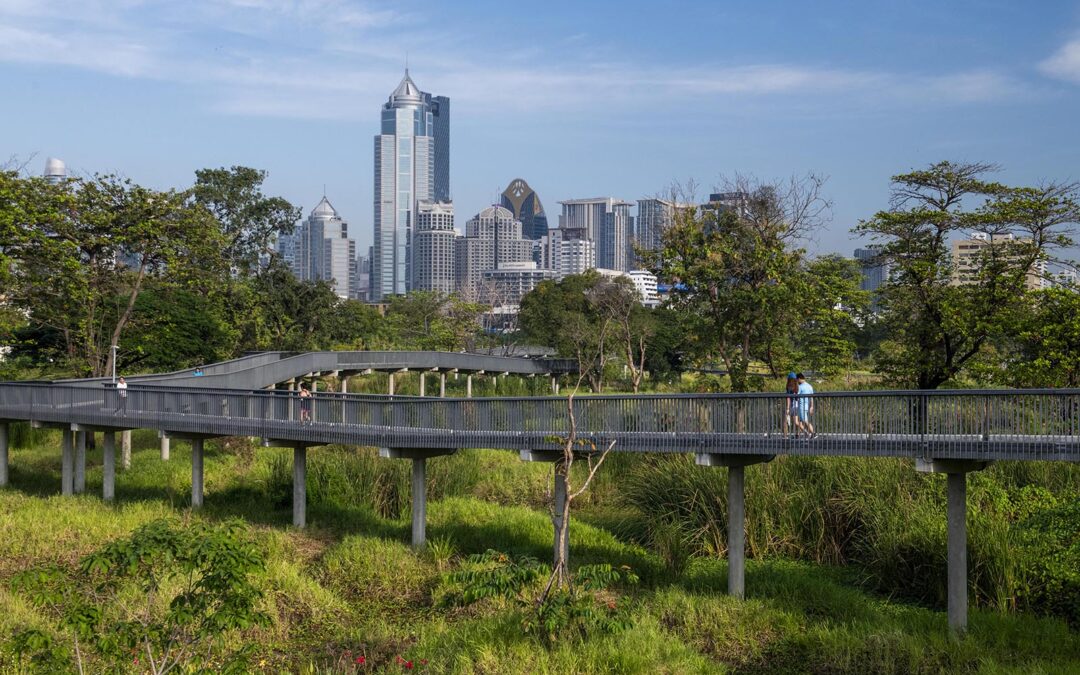
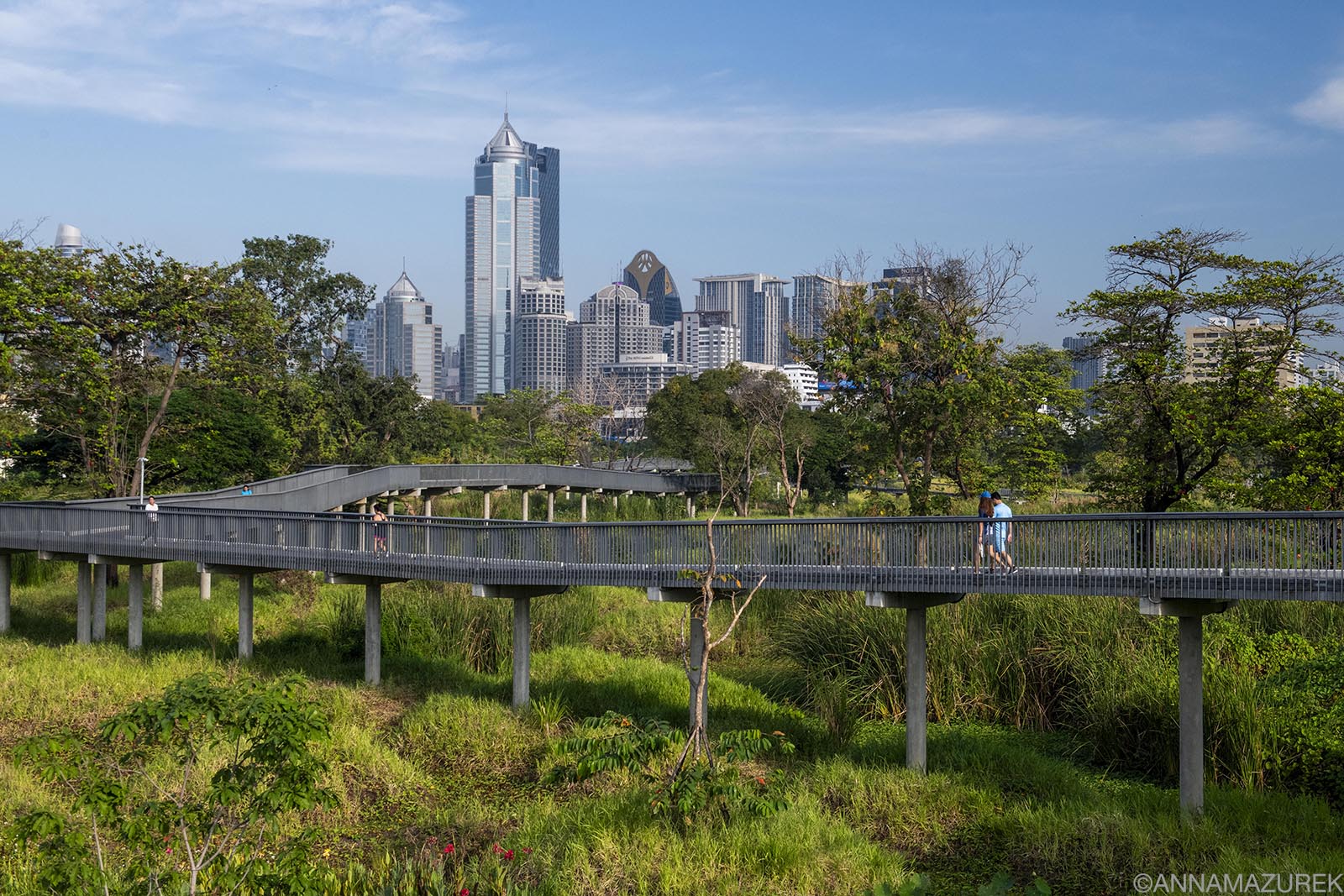 A former industrial site in the heart of Bangkok was transformed into the 102-acre Benjakitti Park in 2022.
There’s no denying that Bangkok buzzes with energy—the bustling modern city located on the banks of the Chao Phraya River is filled with towering skyscrapers, ancient temples and vibrant street life. The Thai capital, home to 11 million people, boasts a sleek, air-conditioned public transit system making it easy to zip between neighborhoods at an affordable rate while avoiding the city’s notorious traffic. The hardest part of visiting Bangkok is deciding what to do.
From temple hopping to perusing the stalls at the Chatuchak Weekend Market, this guide covers the best things to do in Bangkok, including where to stay and eat. (If you want to visit Moo Deng (famous baby hippo) from Bangkok, check out my guide.)
Affiliate links are used in this post. If you make a purchase, I earn a small commission at no cost to you, which goes toward the cost of maintaining this blog.
Plan Your Trip
Currency: Thai Baht (THB)
When to Go: November to February for cooler temperatures.
Travel Insurance: Protect yourself with SafetyWing travel medical insurance to cover accidents and travel delays.
Mobile eSIM Card: Get seamless connectivity worldwide with Airalo minus the hassle of physical SIM card. (Save 10% with code AIRALOESIM10!)
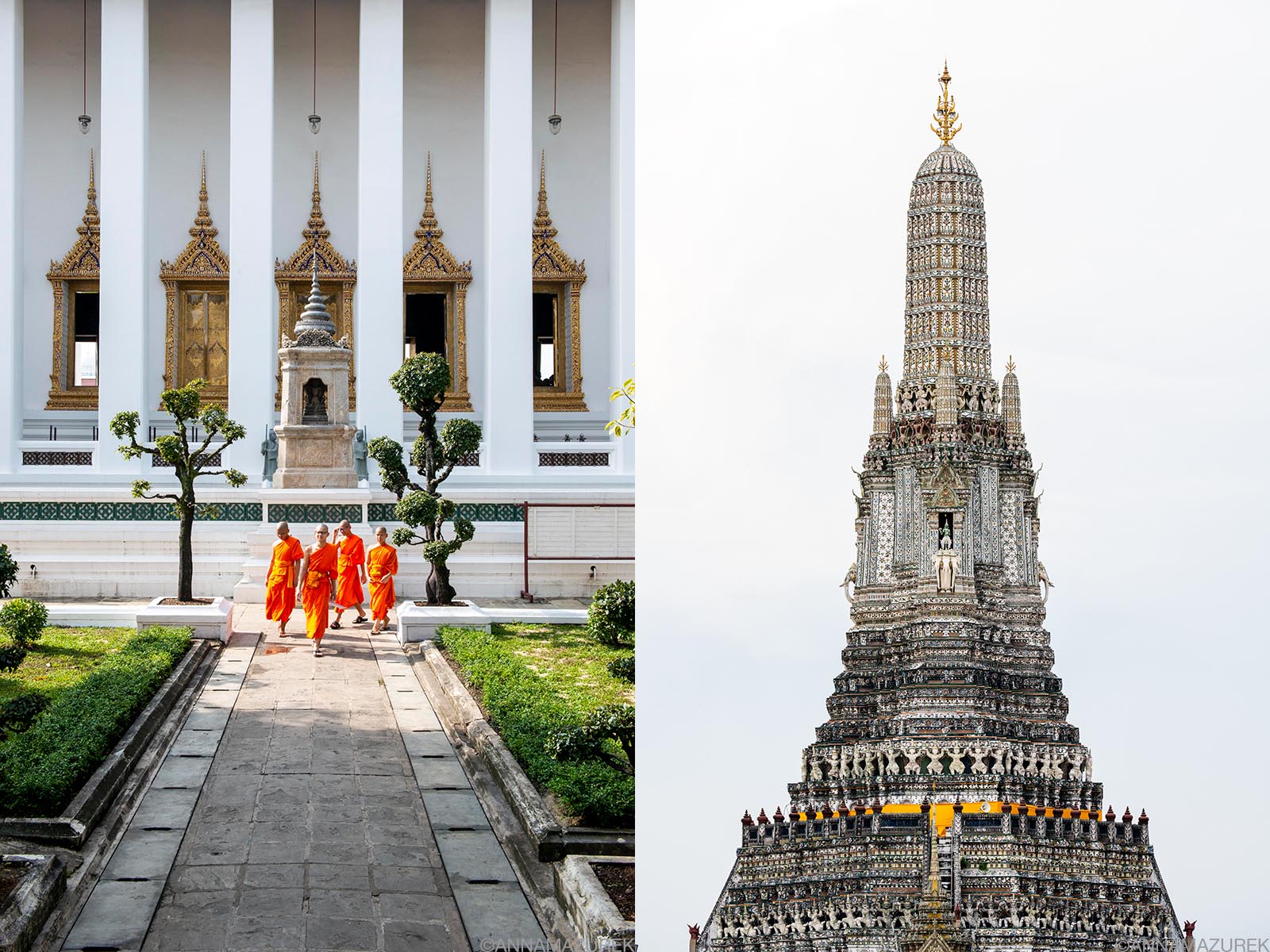 Left: Monks at Wat Suthat, one of Bangkok’s most stunning temples; Right: The 82-meter-high Wat Arun photographed from across the Chao Phraya River.
The Best Things to Do in Bangkok
The Grand Palace, the former royal residence, is a must for your first trip. One of the highlights is the stunning golden 1782 temple complex of Wat Phra Kaew, home to the Emerald Buddha, the most revered image in Thailand that dates to the 13th and 14th centuries. (Admission: 500B/$14 USD) Consider booking online through Klook to skip the lines. Cover your knees and wear long sleeves or you’ll be forced to rent clothing.
Wat Pho is near The Grand Palace and home to the largest reclining Buddha in the city. (Admission: 100B/ $2.80 USD)
Wat Arun. Take a boat across the river from the Grand Palace to visit the 82-meter-high Khmer-style tower of this grand Buddhist temple complex located on the Chao Phraya River. You can no longer climb to the top sadly. On your right after the ticket booth, you’ll see two giant guardian statues by a temple—Phaya Yak Wat Chaeng, which has a courtyard surrounded by Buddha statues that are lovely to photograph. (Be warned the temple is now overflowing with people dressing up in traditional clothing to take photos. Arrive early to beat the madness!) The best photo spot of the temple is across the river, which you can get to easily on a water taxi for five baht that leaves right by the temple’s entrance.
Traveling in Southeast Asia
Read my guides to Thailand, Chiang Mai, Vietnam and Singapore!
 In Thailand, there is a different Buddha for each day of the week. Saturday is the naga Buddha in this image. These protective amulets are often worn as necklaces.
The Amulet Market is another great spot to hit if you’re by The Grand Palace. The market is a series of covered stalls selling amulets, protective talismans and Buddha statues. These trinkets are highly sought after by monks, taxi drivers and people in dangerous professions. I have bought several from here that I made into necklaces.
Jim Thompson House: This is the best thing in Bangkok. The house/art museum is the former home of American silk trader and antique collector Jim Thompson. The complex consists of six Thai-style houses moved from other parts of Thailand to the current location, which is within walking distance from the MBK center and the BTS Skytrain National Stadium stop. His art collection includes Buddha sculptures dating back to the 8th century along with paintings and porcelain. The art is what makes this place stunning. Photography is not allowed inside the houses. (Admission: 200B/$6 USD)
Wat Suthat holds one of the highest ranks of royal temples in the country. The photogenic courtyard is lined with Buddha statues, which is why it’s one of my favorite temples to photograph in Thailand! (Admission: 100B/$3 USD)
 Lotus flowers at Chinatown’s bustling 24-hour flower market, Pak Khlong Talat.
Pak Khlong Talat (Bangkok’s Flower Market): One of my favorite photo spots in Bangkok is the flower market in Chinatown, which doubles as the city’s largest vegetable market during the day. It was once a street market but now resides in a giant warehouse lined with stalls overflowing with orchids, carnations and women stealthy making temple offerings and good luck charms. It’s open 24 hours, but I prefer to go at sunrise to photograph the fresh flowers, which are delivered late at night. Klook offers guided tours if you’d rather not go solo
Wat Saket And The Golden Mount is a golden chedi located on the only hill in Bangkok. It’s worth climbing the 320 stairs to the top and spending some time exploring the sprawling complex. (Admission 50 Baht/$1.50 USD)
Giant Buddha at Wat Paknam Phasi Charoen: This 230-foot-tall Buddha was completed in 2021 on the outskirts of Bangkok. It’s a 15–20-minute walk from the BTS (Wutthakat station) and MRT stations (Bang Phai or Tha Phra stations). (Be warned –it’s covered in scaffolding as of November 2024.) There’s a great view from the Tha Phra MRT platform but often that end of the platform is closed.
Erawan Museum: A 14-story statue of Erawan, a mythical three-headed elephant known as Airavata, is one of the main attractions, known for its colorful interior staircase. The museum was the brainchild of antique collector Lek Viriyapant, who built the structure to house his collection but sadly passed away before it opened in 2003. It’s a bit of a trek to get here on the BTS (Chang Erawan Station (E17) exit 2), but I enjoyed my visit because I love Buddhist art. The grounds are lush and great for photos as well. I recommend visiting in the morning to avoid the crowds. Tickets are normally 400 Baht, but I bought mine almost half price on Klook.
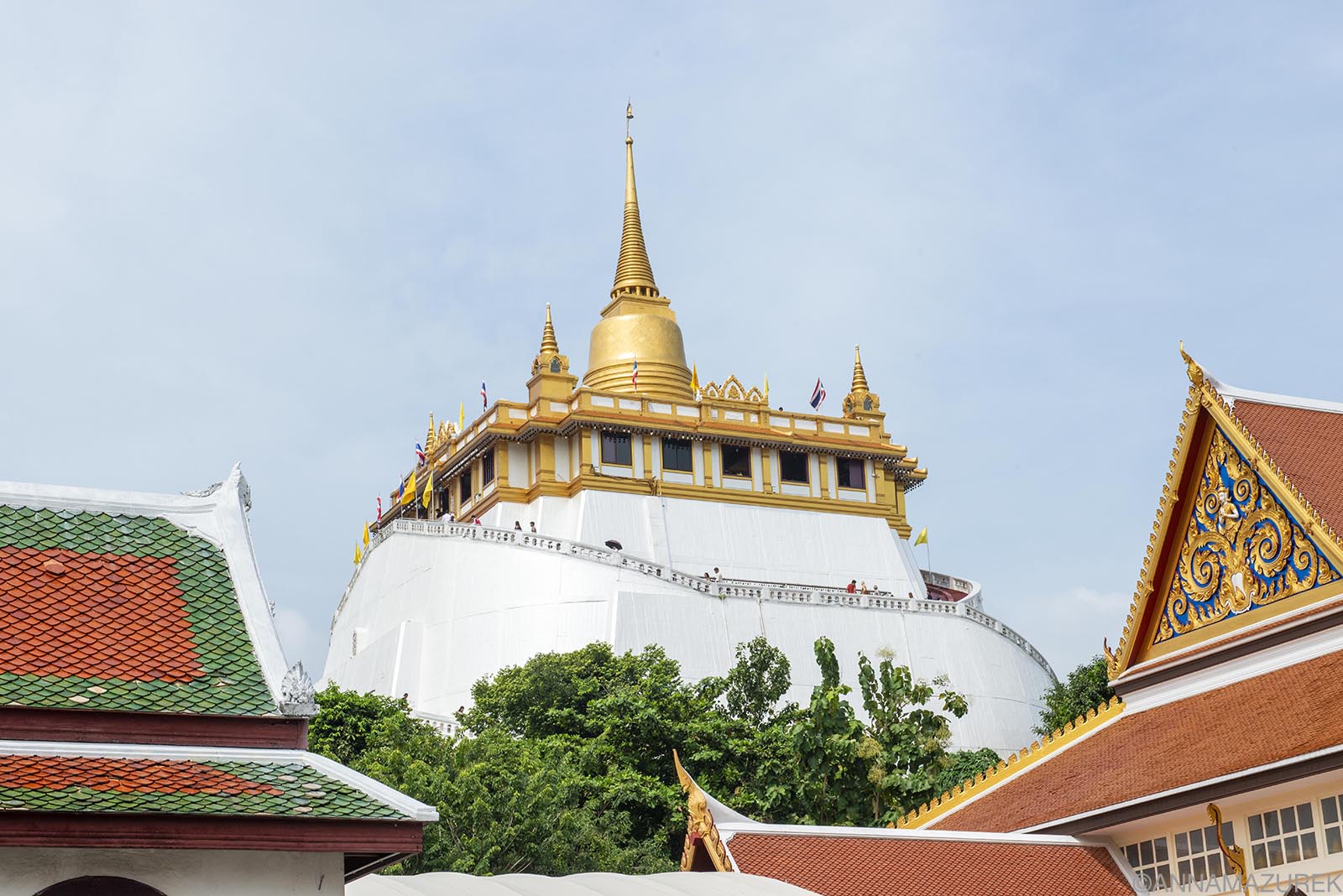 The Golden Mount Chedi is located on Bangkok’s only hill.
Where to Stay in Bangkok
Always choose accommodation near one of the train lines to make it easy to get around. I like to stay near the Siam area because it’s central but have also enjoyed staying near Lumphini Park.
Hotels: The Holiday Inn Express Siam ($88 USD/night) by the National Stadium BTS is my go-to when I need to work because it’s a great location with clean rooms, free breakfast and a gym. If you want to splurge, I recommend VIE Hotel Bangkok ($188 USD/night).
Hostel: I stayed at Bed Block One Hostel ($16 USD/night) for years and loved how close it was to Siam, Ratchathewi BTS station and the airport train
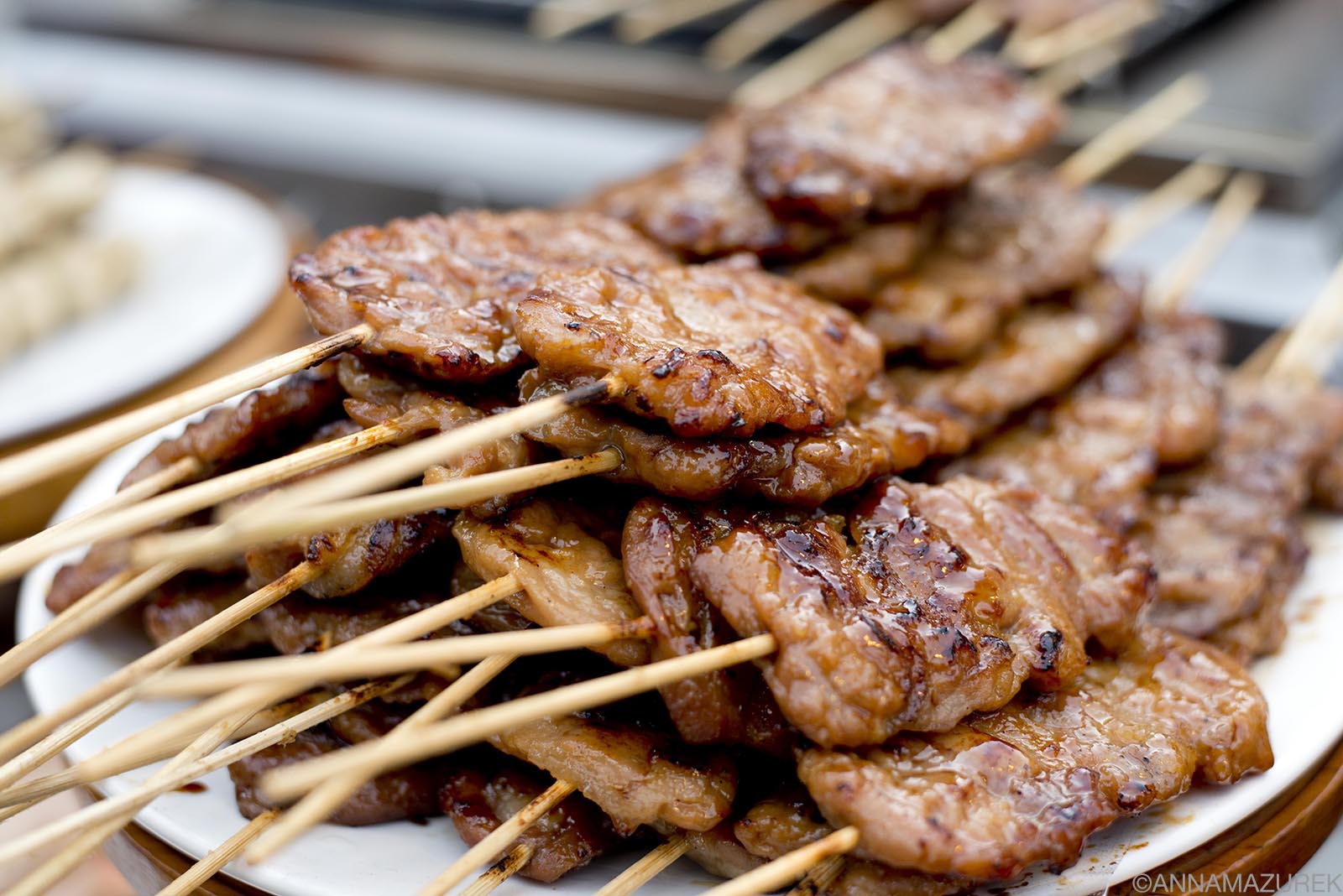 Moo ping, grilled pork skewers with a sweet marinade, at Chatuchak Weekend Market.
The Best Places to Eat and Shop in Bangkok
Chatuchak Weekend Market is Thailand’s largest market and my favorite place to shop. The sprawling complex is separated into 26 sections ranging from local artists to trendy boutiques to potted plants. The entire market is open on Saturdays and Sundays from 9 a.m. to 6 p.m. and is close to both the BTS Skytrain (Chatuchak Park stop) and MRT (Kamphaeng Phet stop). Early birds beware—the shops are never all fully open until at least 10 a.m.
Mall Food Courts
No one does malls as well as Thailand. The food court at MBK, a sprawling multi-level maze-like shopping mall in Siam, is the best. The food court is called Food Legends and is hidden on the sixth floor behind all the chain restaurants and vendor stalls. It consists of a series of side-by-side food stalls serving everything from curry to papaya salad with most meals costing less than 100 baht ($3 USD). (Don’t get it confused with the restaurants on the fifth floor, which is more obvious from the escalators than this hidden spot.)
To buy food, you have to put money on a meal card, which you use to pay for your food. Turn in your card before leaving to get a refund of any unused money. You’ll see the card booth as you enter.
Both the Terminal 21 and Siam Paragon shopping malls also have food courts. The food court is located on the top floor of Terminal 21 and the bottom floor of the Paragon behind all the normal restaurants. Both use a similar meal card system.
Thong Lo Neighborhood
If you are a foodie, then this is your neighborhood. Khao Jao is great for no-frills, authentic Thai food with high spice levels. Sit and Wonder is a hidden spot with a great atmosphere and delicious Thai food! Roast is a good treat if you’re craving Western food.
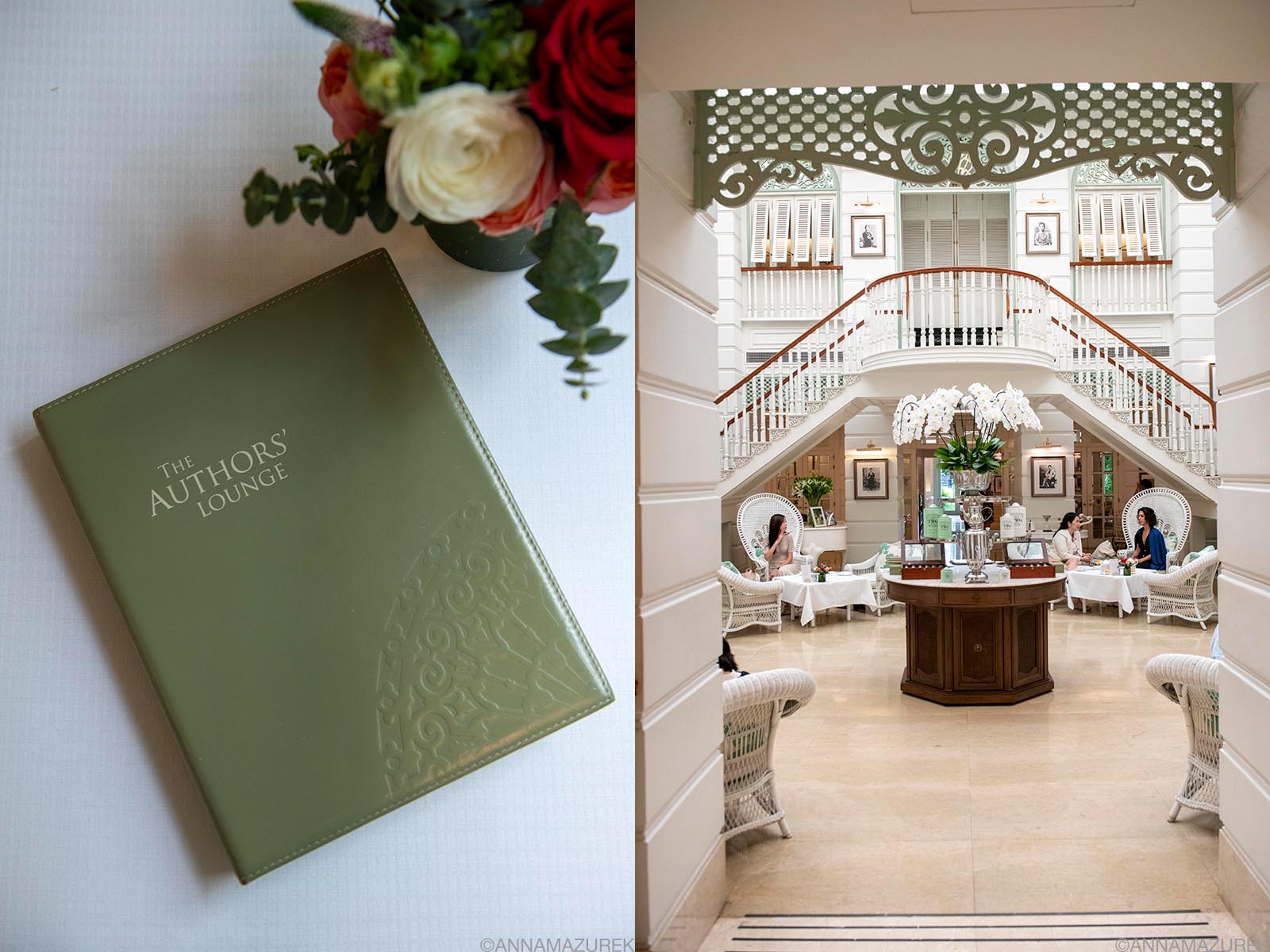 Looking to splurge? Treat yourself to the seasonal high tea at the Arthur’s Lounge at the Mandarin Oriental Hotel in Chinatown.
High Tea at the Arthur’s Lounge
Located on the banks of the Chao Phraya River, the historic Oriental Hotel was a haunt for famous writers such as Graham Greene and W. Somerset Maughan during the early 19th century. Now, the five-star hotel, the Mandarin Oriental Hotel, is part of the Mandarin Group and offers seasonal high teas daily in the light-filled atrium of the Arthur’s Lounge lined with wicker chairs. I thought it was a fun experience to get dressed up and treat myself. Cost was roughly $50 USD. Reservations recommended.
Craft Beer in Bangkok
While there are a bunch of glitzy pricey rooftop bars in Bangkok, I’m a big fan of the craft beer spot called Brewski, located on the top floor of the Radisson Blu Plaza Hotel near the Phrom Phong BTS stop. It’s a chill vibe with Thai and foreign beers on tap and tasty pub food. Don’t miss their BOGO deal for happy hour from 5 p.m. to 6 p.m. daily.
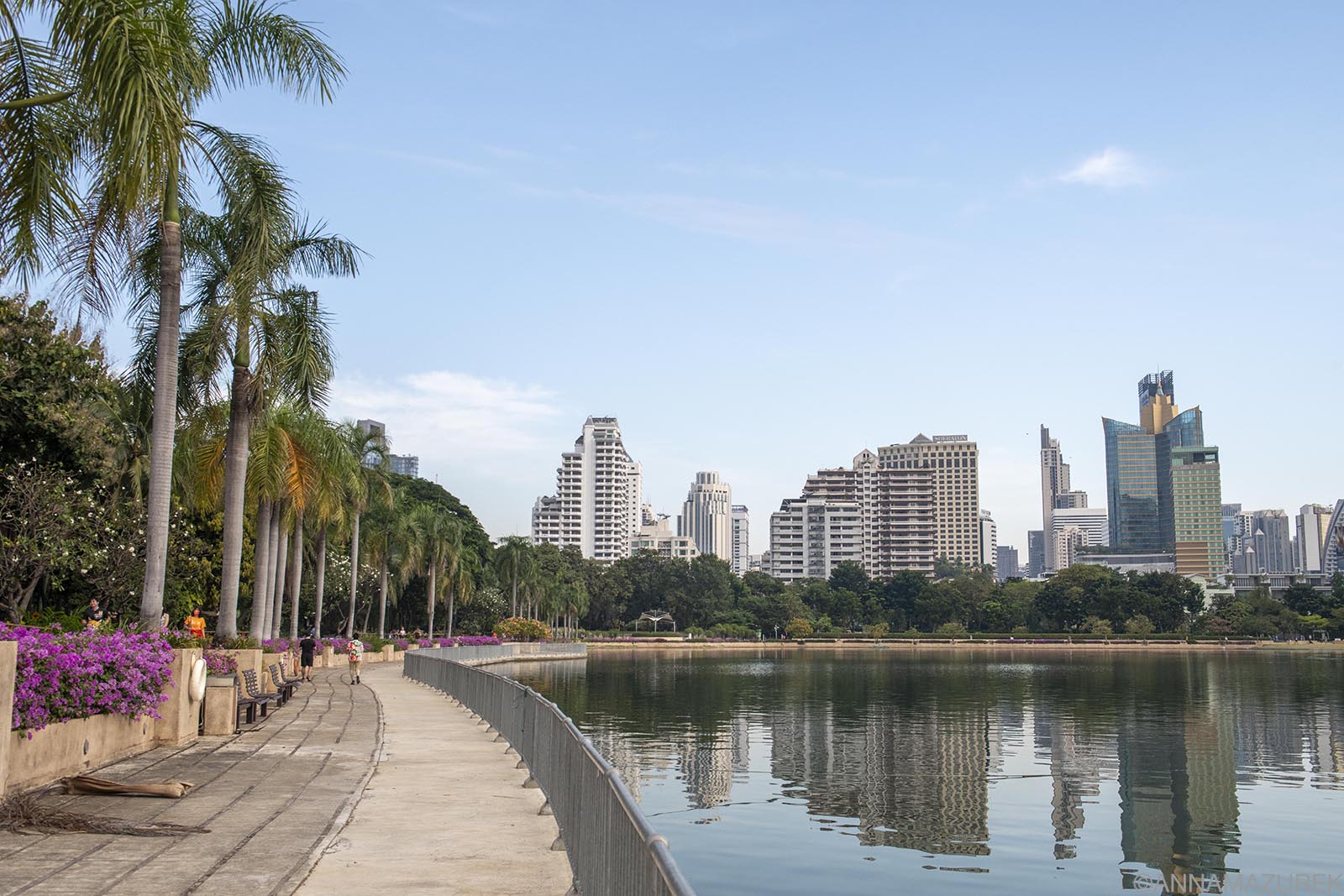 Benjakitti Park’s four lakes can hold a million cubic liters of stormwater. The lakes and wetlands naturally filter polluted water and act as a sponge during monsoon season.
The Best Parks in Bangkok
Lumpini Park is Bangkok’s oldest and largest green space covering 58 hectares. Rent a paddleboat for a loop around the artificial lake or go for a run along the trails between the well-manicured lawns. There’s usually always a Tai Chi class, too.
Another favorite is Benjakitti Park, a 102-acre park built on the site of a defunct tobacco factory with the former buildings now doubling as sports facilities. The natural space is mostly wetlands, frequented by birds, bats and monitor lizards, intersected by a series of elevated walkways. The park acts as a green lung for the city and works like a sponge during monsoon season rains. A flower-lined walking track circumnavigating a pond across the street from a series of skyscrapers is a great space for running or walking.
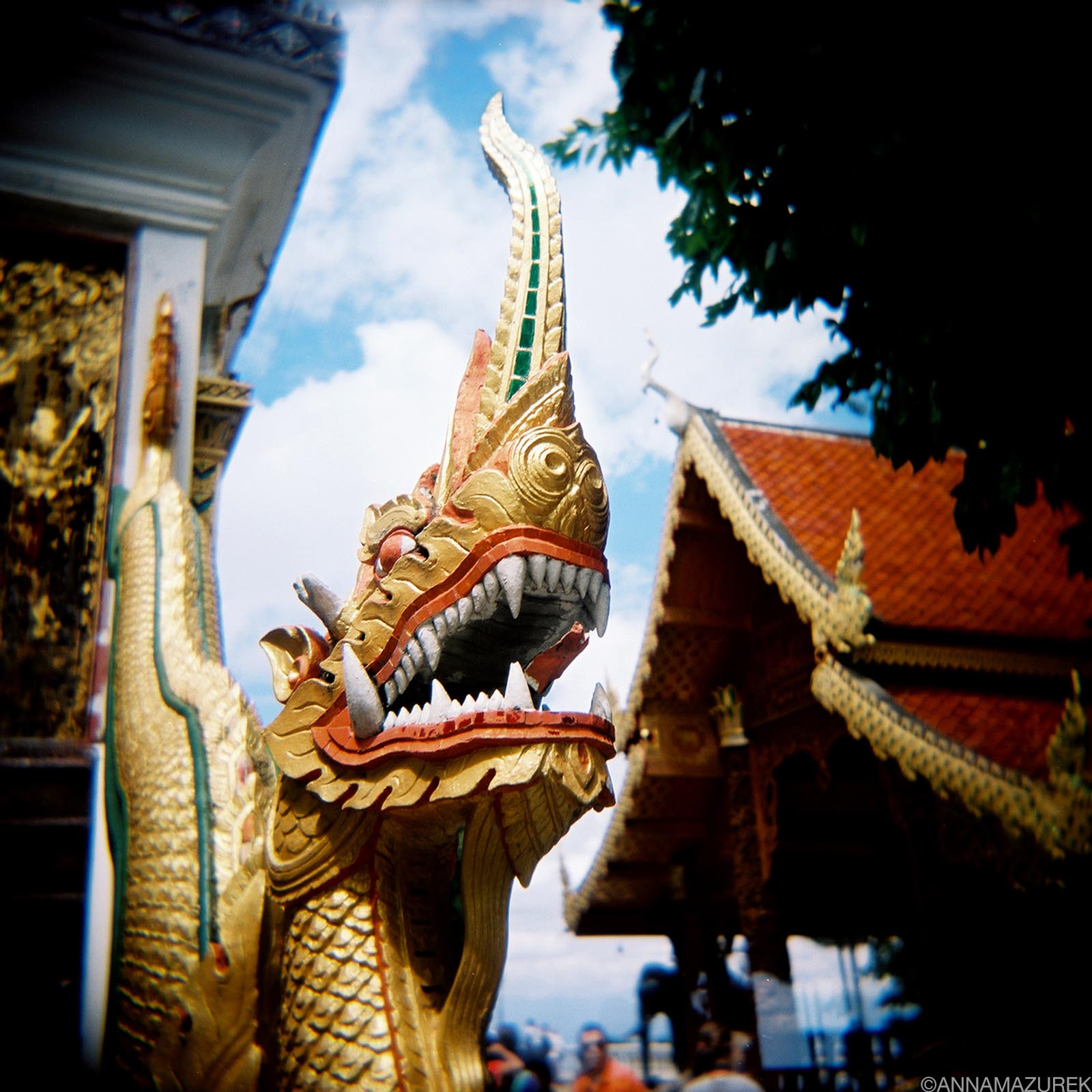 A naga, a mythical serpent, adorns the stairway of a temple inside The Grand Palace
Bangkok FAQ
Where’s the best place to buy a SIM card in Bangkok?
Do NOT buy a SIM card at the airport because they are ten times the price of an eSIM or local SIM. The easiest thing to do is buy a Thailand-specific eSIM card from Airalo that will work instantly when you arrive. If you are traveling to multiple countries in Southeast Asia on a short trip, then consider one of their Asia Regional eSIM cards. (Both the country-specific and regional eSIMs have worked wonderfully for me and even have a mobile hotspot option that’s critical for me because I’m always working remotely.)
Keep in mind it’s always cheaper to buy a country-specific eSIM than a regional one. Be sure to join the free Airalo Loyalty Program to earn 5% cash back for every purchase, which can be redeemed on future purchases. For more about eSIM cards, check out this post about the pros and cons of eSIM cards!
If you are staying for a month or more in Thailand, go by an AIS store and buy a local SIM or eSIM card for the cheapest deal. (AIS is Thailand’s largest mobile network operator.)
Do you need travel medical insurance for Thailand?
Yes, travel medical insurance is one of the most important things to purchase for any trip abroad, especially Thailand. It covers all the things that could go wrong from injuries to travel delays so that you don’t have to worry and can focus on traveling!
I use SafetyWing’s Nomad Insurance, which offers $0 deductible travel medical insurance coverage for over 180 countries for people aged 69 and under when traveling outside their home country. The best part is that it only costs a few dollars a day! If you get sick or injured abroad, you can visit any hospital or doctor.
Other benefits of Nomad Insurance include coverage for lost checked luggage, travel delays over 12 hours, motor accidents (if properly licensed, wearing all safety equipment and not intoxicated) and injuries from sports or leisure activities. You can even add adventure sports, electronics theft and U.S. coverage (for non-residents) to your policy.
If you’re abroad for 90 days, you can get 30 days of home-country coverage. (For the U.S. residents, it’s 15 days.) For more details about my experience using SafetyWing in Southeast Asia, read my SafetyWing Review.
Bangkok Transport Tips
Subway and Skytrain
The cheapest and fastest way into the city from either airport is to take a train. Don Mueang International Airport is connected to the city by a 17-minute train from Krungthep Apiwat Station.
From Suvarnabhumi Airport, take the Airport Link Train, which connects seamlessly to the BTS Skytrain. Some BTS stations are located near MRT stations. Elevators are at stations but not on all sides of the road. There’s always an escalator going up but sometimes, you might have to carry luggage down a set of stairs.
There are multi-trip passes available for both the BTS Skytrain and MRT subway individually. The MRT now lets you tap credit cards FINALLY but not the BTS.
Taxis are ALWAYS cheaper than auto rickshaws/tuk tuks. Taxi drivers rarely want to go by the meter anymore so expect to haggle. It usually takes me three taxis to get one to take me where I want to go at the meter rate. (Sundays are their day off so expect to pay exorbitant prices.) There are motorcycle taxis on most street corners that will take you nearby for a small fee. You’ll see the drivers wearing orange vests hanging around big intersections.
Grab, the rideshare app, does work in Bangkok, but I’ve really struggled to ever get one to pick me up in the Siam area without canceling because of traffic.
Where is the best English-speaking salon for a haircut in Bangkok?
I’ve been going to Shingo at Sensui Salon in the Sukhumvit area for over a decade. The owner, Shingo, is Japanese and speaks perfect English—he even lived in London for a while. I message him on the Facebook page to make my appointments.
Where is the best massage in Bangkok?
I love Nature Thai Massage on Soi 5 in the Siam area. There is a 20% discount for all appointments before 5 p.m. I usually do an oil massage that comes in a private room.
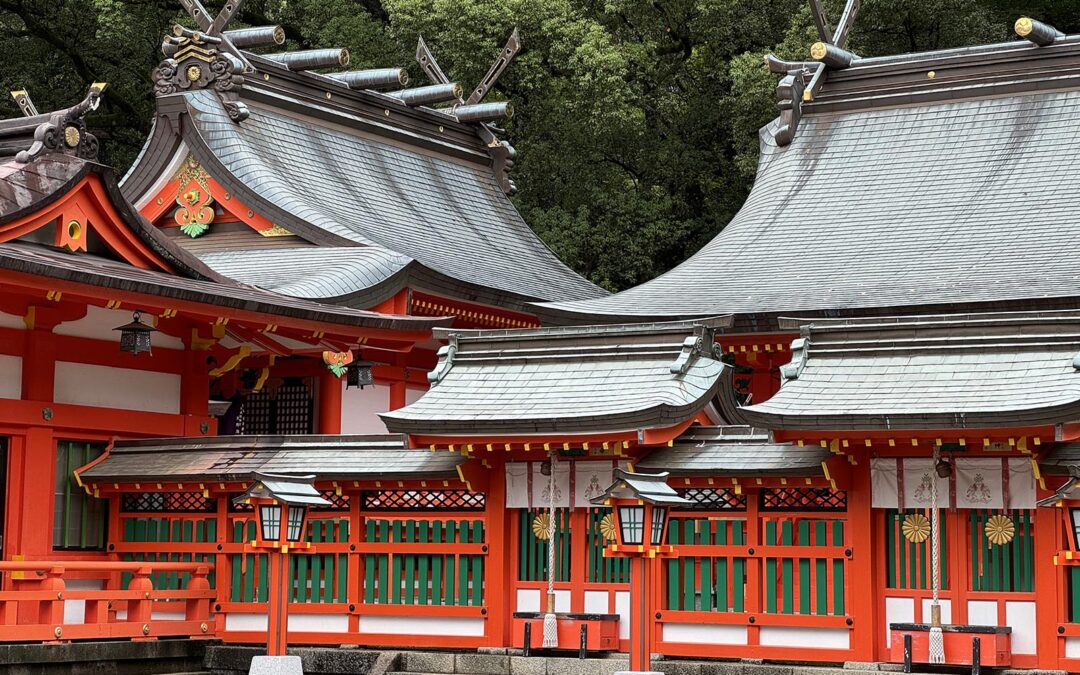
How to Snag the Best Hotel Deals with Mobile Discounts
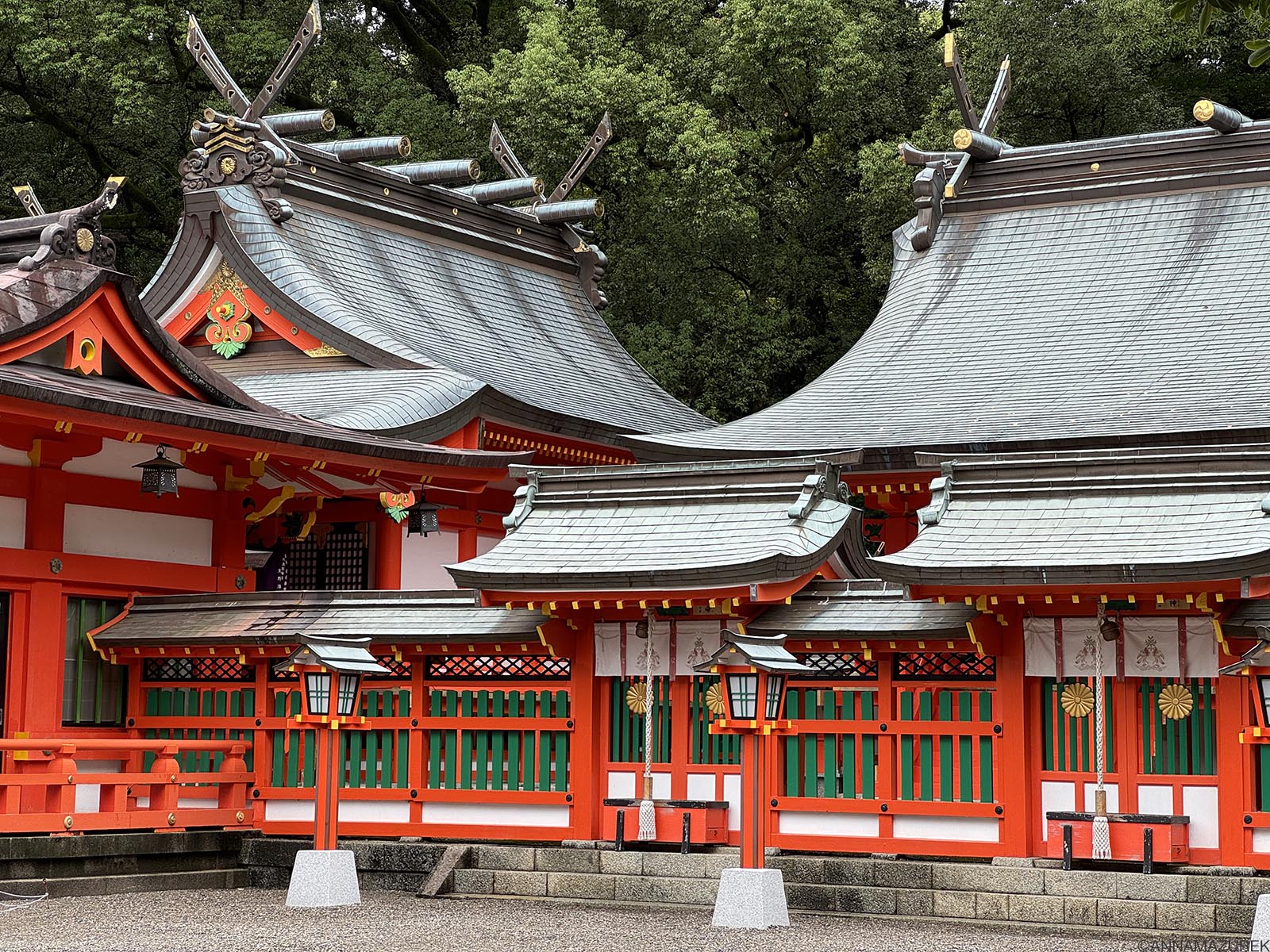 The Kumano Hayatama Taisha in Shingu, Japan is one of the three grand shrines I visited on my Kumano Kodo trek.
Accommodation and flights are often one of the biggest travel expenses. On my recent six-week trip to Japan (a combination of work and personal travel), I learned some new money-saving tricks that I wanted to share about how to find the best hotel deals.
(AFFILIATE DISCLOSURE: Please note that some affiliate links are used in this post. If you make a purchase, I earn a small commission at no cost to you, which goes toward blog maintenance costs. I only recommend products and companies I truly love and use.)
Hotel Booking Tips: The Best Mobile Hotel Deals
Booking hotels on mobile apps like Expedia saved me 15-30% on hotels with its mobile pricing. For example, I booked a room at the Smile Hotel in Okayama, Japan on Expedia’s desktop for a Saturday night stay about two weeks in advance for $96. Five days before my stay, I happened to look up the same hotel and date on the Expedia mobile app, and it was nearly 30% cheaper—$69.05! I booked it instantly and canceled the more expensive one. (Now, I’m a bit obsessed with finding the best deal so I often price check rates for refundable bookings when I’m stuck in a grocery store line or waiting for my luggage in an airport baggage claim.)
Fast forward a few days later, I got stranded in Japan because a typhoon delayed and then canceled my Taiwan trip. Since I enjoyed my stay at the Smile Hotel in Okayama, I stayed loyal to the brand. (Smile Hotels have simple, spotless rooms in convenient locations, which I highly recommend if you’re traveling to Japan anytime soon.) I strictly only looked up hotel mobile rates on Expedia, which saved me at least 15% each time and were even cheaper than my previous booking! I booked rooms for $36-50/night after taxes in both Okayama and two Osaka locations by Shin-Osaka and Tennoji train stations. The rates were even cheaper than booking directly through the hotel’s website, which is normally the best place to book. And, I even stayed over the weekend for these cheap rates!
Important note: The U.S. dollar is strong against the Japanese yen currently so it’s much more affordable for Americans to travel now. I was spending around $80-100/night in bigger cities or remote locations before I discovered this hack!
The best part of this trick is that you still earn rewards for booking these mobile deals! The One Key rewards I earned from Expedia for my bookings were easily applied to my next booking, which was great because I was booking new hotels every two days waiting to see what this typhoon would do!
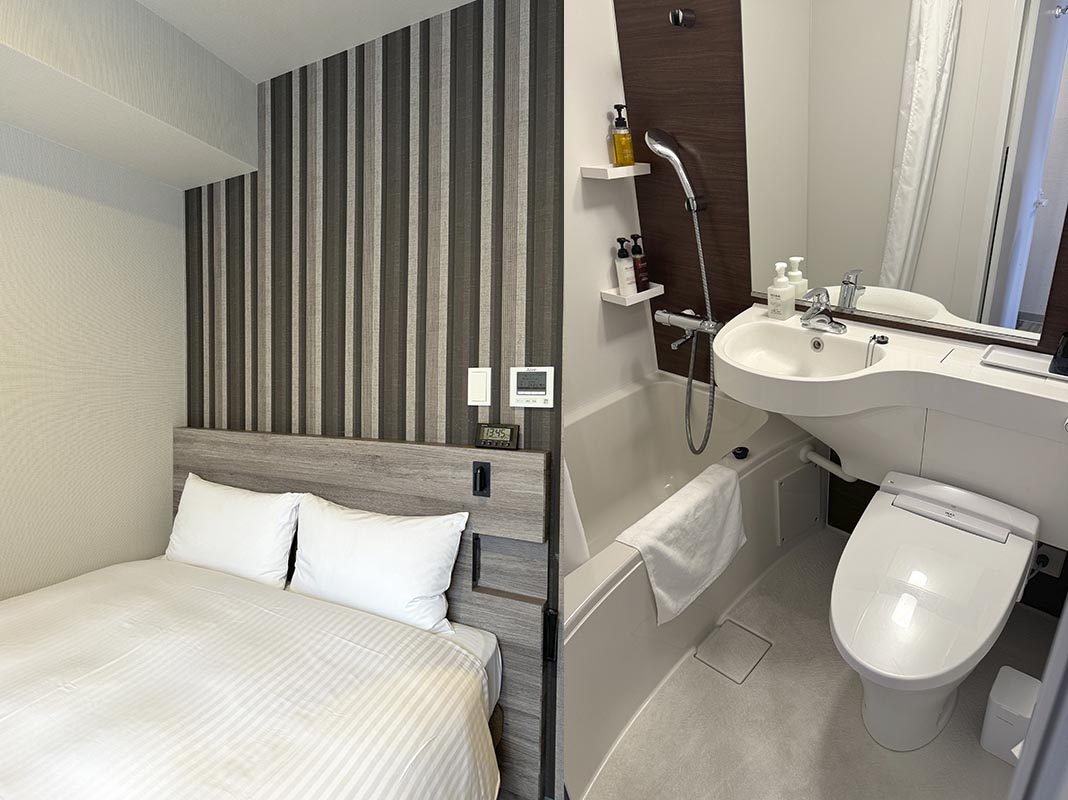 I booked rooms at three Smile Hotel locations in Japan for $36-$50 a night on my trip in September. The hotel brand has clean rooms in convenient locations withing walking distance of major train stations.
How much cheaper are mobile hotel rates?
On average, it is 10-30 percent cheaper than desktop prices. Booking.com requires participating hotels to offer at least a 10% discount.
Why are mobile hotel rates cheaper?
There’s a higher cost to get desktop users to book—paying for ads and keywords—whereas mobile users are easier to convert to a sale. Booking.com says 50% of its traffic is from mobile. (The same article says that two-thirds of those bookings are made by millennials who leave more reviews than other groups.) Some hotels even offer lower rates strictly to mobile users based on these high usage statistics.
It’s always worth double-checking desktop rates, but I’d advise doing it without logging into the website. I had one instance where it seemed like the mobile app changed to reflect the desktop price after I logged in online.
If the “mobile” rate is a good deal and there’s free cancellation, I often just book it on the spot. Then, check the desktop site later to verify. Keep in mind that just because the app claims it’s a “mobile only” deal doesn’t mean that it actually is a better rate. Do your homework.
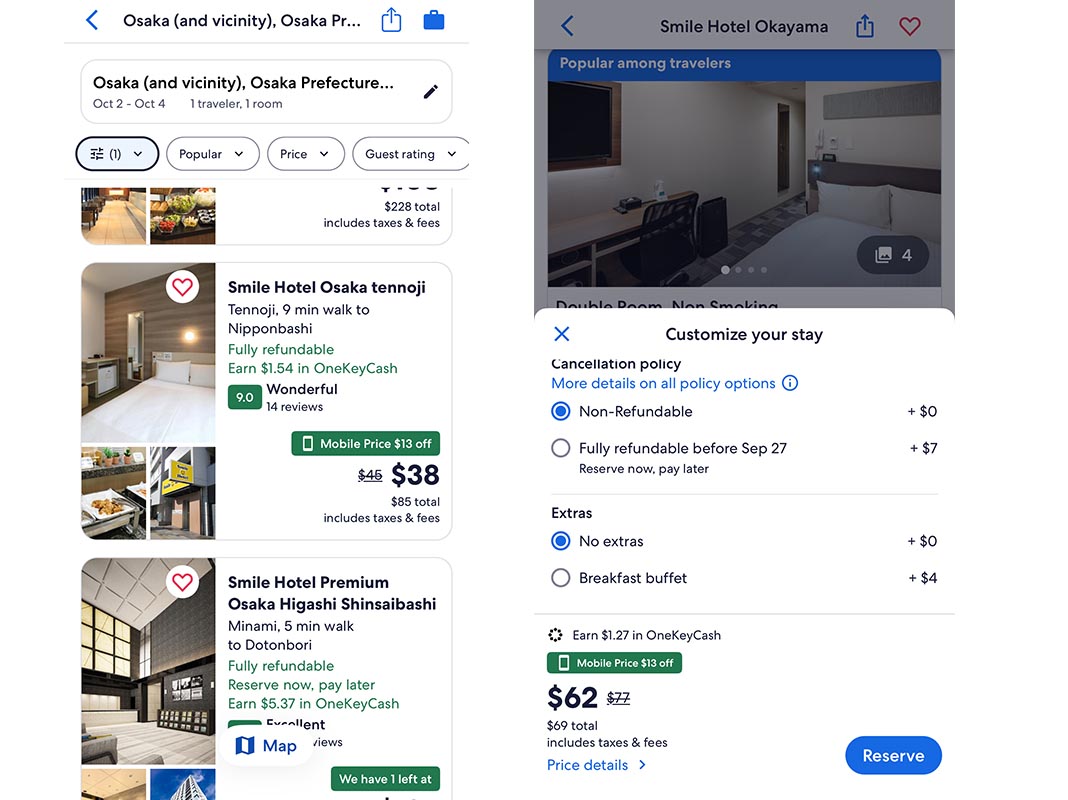
The Expedia’s mobile rates show up as a green icon when using the app.
What is the best travel app for hotels?
Honestly, I check a variety of apps along with the hotel’s website to compare. My go-to apps are Expedia, Booking.com and Hotels.com. I used Booking.com for my Kumano Kodo hotels and Expedia for all the big cities but did find a cheaper deal on Hotels.com for my hotel (Iroha Grand Hotel) in Nara, Japan. (In Tokyo, I loved this hotel!) I don’t really have any loyalty between the brands. I simply book the cheapest option with the most flexible refund policy.
Loyalty programs and rewards are also important and can help save you more money. Since I’ve finally achieved Booking.com’s highest tier (Genius Level 3), I automatically get 20% off many bookings and even scored a simple room for $26 in Shingu, Japan!
Looking for more Japan travel tips?
Check out my Instagram highlights for a detailed story on budget trips for Japan travel and my hike along the Kumano Kodo, the sacred UNESCO-designated pilgrimage trek.
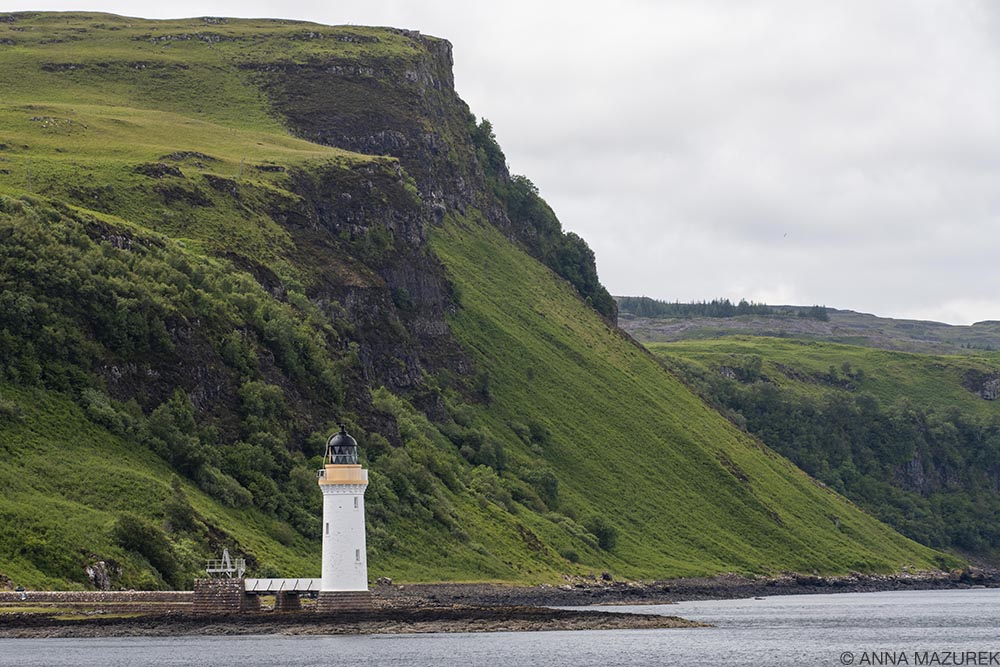
#ClaimYourAdventure with Flexible Travel Medical Insurance
Tobermory Lighthouse on the Isle of Mull, Scotland.
I live a very unconventional life—I travel most of the year for either work or fun. I am part vagabond, nomad and business traveler. Often, I’m gone for months and never quite know exactly when I’ll be flying back to the U.S. My life is a series of one-way flights, which makes it difficult to find flexible travel insurance since I never really know when my trip will end exactly. I’m a huge fan of SafetyWing’s flexible policies and monthly travel insurance options. They recently launched their new Nomad Insurance 2.0 with a lightning-fast claims process and new add-ons. Keep reading for the benefits of flexible travel insurance and #ClaimYourAdventure with SafetyWing!
Why do you need travel insurance?
Travel insurance covers all the worst-case scenarios—the flight delay that left you stranded in Istanbul for the night or the bout of food poisoning that hits a few hours before your flight home from Mongolia. Both are true stories from my travel adventures and not fun memories. I ALWAYS buy travel insurance for every trip, which only costs a few dollars a day no matter what brand you purchase.
Who is SafetyWing?
SafetyWing is a fully remote Norwegian startup based in California. It is run by nomads and expats providing insurance for budget travelers and nomads since 2018. (You don’t have to be a nomad or a budget traveler to use their insurance. It’s available to everyone under age 69.)
Why is flexible travel insurance important?
Travel requires a lot of planning, which can be exhausting. Thankfully, SafetyWing’s insurance policies help make things easier. Not all travel insurance companies cover one-way flights. If I don’t have a return flight booked, I always buy a recurring plan. SafetyWing offers reoccurring plans that renew monthly and can be stopped at any time. Then, the minute I get back in the U.S., I cancel the plan, and they provide a pro-rated refund. (Please note they currently offer U.S. coverage on plans for non-U.S. residents only. The reason I wait until I return to the U.S. to cancel is to ensure all my travel is completed with no delays.) SafetyWing’s customer service is 24/7, and you ALWAYS get a real human. It just takes a couple of minutes to cancel, and the refund shows up quickly.
If I know my set travel dates, I often just buy a policy for the entire time and pay upfront in full. I’m currently in Europe for three months mostly for work with a bit of personal travel. Since my travel dates are set, I paid in advance for the entire plan. If there’s even a chance I might extend my travel, then I’ll opt for a monthly travel insurance plan, which is what I’m doing for the fall. (In August, I’m heading to Asia for five months. I know I’ll be back in late February or March but will not book my return flight before I leave.)
Forget to buy travel insurance before you depart for your trip? One of the other great perks of SafetyWing policies is that you can buy it while you are traveling. Since I work for a travel company that covers me when I’m working. When I have a few days in between contracts, I’ll wait to buy policies until the eleventh hour. They offer same-day start dates. You can even buy policies if you’re already abroad and don’t know exactly where you are traveling.
SafetyWing Travel Insurance Options
SafetyWing offers two different times of travel insurance with global coverage. Their Nomad Insurance is travel medical insurance for people outside their home country. They recently added policy add-ons for extra coverage options include adventure sports coverage, electronics theft, and U.S. coverage (for non-U.S. citizens or residents). (U.S. residents do get 15 days of home country coverage for every 90 days of travel abroad as part of the policy without this add-on.)
One of the best benefits of SafetyWing is that they have 24/7 customer support with a REAL human! (I can vouch that they are excellent at assisting and will follow up with you afterward!) Check out the full details here!
What does SafetyWing Nomad Insurance 2.0 cover?
While it’s important to always read the full insurance policy, these are covered by SafetyWing. Each policy has a $250,000 USD max limit and a $100,000 USD max limit for US residents over 65.
- Emergency Accident & Sickness Expenses.
- Emergency Evacuation & Repatriation. (Evacuation to a better-equipped hospital when needed is included with a $100,000 USD lifetime max.)
- Trip Cancelation, Delay or Interruption. (Benefits kick in usually for delays after 12 hours. $100/day for two days)
- Baggage Delay & Damage. ($500/item with a $3,000 policy maximum)
- Injuries from leisure sports and activities.
- Motor Accidents. You must be properly licensed, not intoxicated and wearing safety equipment to be covered.($250,000 US max limit)
- Continued coverage in your home country after 90 days abroad. (30 days for non-U.S. residents and 15 for U.S. residents.)
- For more details, read the full policy on their website.
What’s not covered?
SafetyWing doesn’t cover pre-existing conditions, cancer treatment, lost or stolen personal belongings, trips that were canceled before you left and high-risk or professional sports activities.
Purchasing Process with SafetyWing
It just takes minutes to fill out the form online including your age, home address and countries you’ll be visiting. Their chat box makes it easy to ask questions and talk to a real human 24/7 within minutes. Their customer service can easily answer any questions quickly. They are also great about following up when needed. You can pay monthly or in full for policies. You can even set policies to auto-renew. When you cancel a policy you’ve paid for, they will give you a pro-rated refund.
How do you file a claim with SafetyWing’s Nomad Insurance 2.0?
Filing a travel medical insurance claim may feel overwhelming but it doesn’t have to be thanks to SafetyWing’s new Nomad Insurance claims. Fill out the simple new form in as little as five minutes and get reimbursed within 2.8 days!
- Type of Claim: Choose medical or non-medical claims (stolen electronics, travel delays, natural disaster evacuation)
- Medical Information: For medical claims, enter the location, date of service and total cost for the claim. The next two questions ask about preexisting conditions and if you’re covered by any other form of insurance.
- Personal Information: Enter your contact information and passport number
- Reimbursement: Add your bank account details and how you’d like to be paid for the claim.
- Upload Documents: This is one of the most important sections so be sure to have all of your documentation together before you leave the doctor’s office. A copy of your medical report (doctor’s notes about your symptoms, diagnosis and treatment.) Invoices and receipts to show the breakdown of the cost of the bill are also required. I recommend using the free Genius Scan app to make a PDF that can be exported easily.
- Review and Submit: Check over the information you have entered to ensure it is correct, especially your bank account information. This ensures the claim can be paid ASAP! You can always check your claim status anytime on the website.
If you have any questions about claims or buying a policy, SafetyWing’s 24/7 support can connect you with a REAL human instantly!
*Please note that some affiliate links are used in this post. If you make a purchase, I earn a small commission at no cost to you, which goes toward the cost of maintaining this blog. If you would like to support this blog and are ready to make a purchase, these links are one way to show your support. I only recommend products and companies I truly love and use. Please email me with any questions.